

Table of contents:
Installing an electric vehicle charging station is more than just plugging a wire into a socket. ChargePoint, as one of the largest providers of electric vehicle charging infrastructure in the US, has developed an entire ecosystem of tools for installers. If you’re a licensed electrician or planning to become a certified ChargePoint installer, this guide will walk you through the process.
According to ChargePoint’s official website, the company offers a specialised training and certification programme for installers, as well as a mobile application that greatly simplifies the installation of the most popular station models.

What is the ChargePoint Installer App
The ChargePoint Installer App is a mobile tool designed specifically for certified installers and qualified electricians. The app allows you to quickly and safely install ChargePoint charging stations at residential and commercial properties.
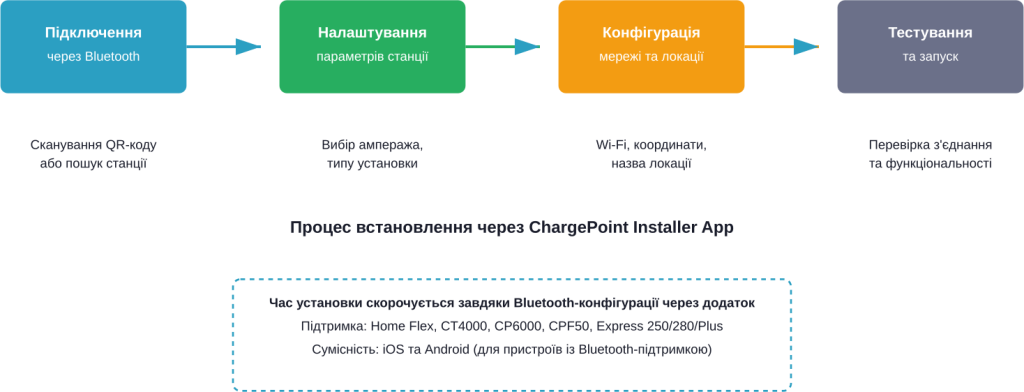
The ChargePoint Installer App works with a list of supported ChargePoint stations (depending on model and region). The app connects to Bluetooth-enabled stations, allowing you to configure all settings directly from your smartphone or tablet.
Main features of the application
The ChargePoint installer app provides personalised instructions for each station model. You get step-by-step guidance that is tailored to the specific type of installation, whether it’s a residential or commercial location.
The app lets you configure the type of installation, electrical settings, and select from advanced network connectivity options. For commercial stations, the app allows you to pinpoint the exact location, whether it’s a ChargePoint station or a network-compatible device.
ChargePoint Installer Certification Programme
In order to officially install ChargePoint stations and gain access to all technical documentation, you need to complete a training programme. According to the official ChargePoint website, the company offers the Installation Training Certification Programme for anyone who wants to become a certified installer.
The programme includes access to ChargePoint University, a free learning platform where you can find installation guides, facility design guides and other technical documentation.
How to register for the programme
Registration for the certification programme is available through the official ChargePoint website.
After you create a free ChargePoint University account, you will have access to:
- Installation guides for all station models
- Site design guides for charging facilities
- Technical documentation and specifications
- Training videos and webinars
- Product Reference Documents
This is not just a theoretical course. The programme focuses on the practical skills required to actually work with electrical systems, local safety regulations and the specifics of each plant model.
Installing ChargePoint Home Flex (CPH50)
ChargePoint Home Flex is one of the most popular residential charging stations. The CPH50 model is designed to be installed both indoors and outdoors, making it a versatile solution for electric vehicle owners.
According to the official ChargePoint Home Flex installation guide, the station can be installed by any licensed electrician. It is compatible with NEMA 6-50 or 14-50 plugs and comes with a 23-foot (approximately 7 metres) charging cable.
Technical parameters of the installation
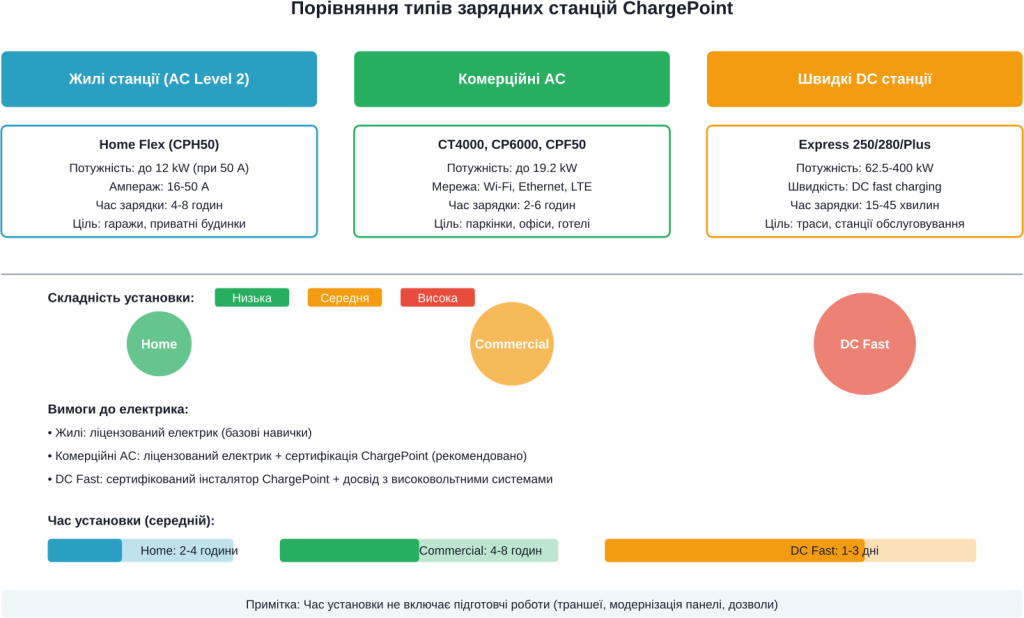
The Home Flex (CPH50) supports an ampere range of 16 to 50 amps, depending on the driver’s needs and the capabilities of the home’s electrical system. Owners should check with their electrician for the desired amperage and plug type before installation.
| Parameters. | Specification | Details |
|---|---|---|
| Amperage range | 16-50 A | Configurable during installation |
| Types of arbs | NEMA 6-50, 14-50 | The choice depends on the home electrical system |
| Cable length | 23 ft (7 m) | Sufficient for most parking spaces |
| Accommodation. | Inside/outside | Protection from weather conditions |
| Connection | Wi-Fi, Bluetooth | For charging monitoring and scheduling |
According to the Alternative Fuels Data Centre (AFDC), the cost of a residential Level 2 charger can range from $380 to $690 for equipment (according to a report by the Rocky Mountain Institute). This does not include the cost of installation, which depends on the complexity of the electrical work.
Steps to install Home Flex
The installation process begins with an assessment of the home’s electrical system. The electrician must ensure that the electrical panel has sufficient power to support the charger at the selected amperage level.
Next, the optimal location for the station is determined. Factors such as distance to a parking space, driver accessibility, weather protection (for outdoor installation) and cable length are taken into account.
After installing the physical device, the electrician adjusts the parameters via the app or the interface of the station itself. Here, the desired amperage is set, Wi-Fi is connected, and the functionality is tested.
Commercial ChargePoint stations
The installation of commercial ChargePoint charging stations is significantly more complex than residential models. This includes popular models such as the CP6000, CPF50 (commercial version), and the Express 280 and Express Plus DC fast chargers.
Commercial facilities require careful planning. According to ChargePoint’s official website, the company provides resources for designing charging facilities, including specifications for architects and engineers.
Designing a charging facility
ChargePoint offers out-of-the-box tools to quickly integrate electrical equipment (EVSE) into projects. This saves time in the planning phase and ensures compliance with building codes and ADA standards.
Power management is an important aspect. ChargePoint uses smart charging technologies to minimise initial infrastructure costs, reduce peak demand charges and optimise the distribution of energy across multiple stations.
Compliance with regulations and standards
ChargePoint has the largest network of public charging stations installed across the United States. This means that the company’s products meet and exceed current building codes and ADA (Americans with Disabilities Act) standards.
It is important for installers to understand local electrical codes. According to the Alternative Fuels Data Centre (AFDC), planning for charging infrastructure development includes determining the project scope, budget, financing mechanism and schedule based on local regulations.
Technical documentation and resources
ChargePoint provides comprehensive technical documentation for all of its products.
After registering for ChargePoint University, installers get access to:
- Installation guides for each station model
- Datasheets with technical specifications
- CAD models for integration into architectural projects
- Guidelines for the design of charging facilities
- Documentation on compatibility with other systems
- Information on End-of-Life Products
The official website offers quick links to documentation for the most popular models: Home Flex, CT4000, CP6000, CP6000 fleet, CPF50, Express 250, Express 280, Express Plus and DataHub. Information on software products and services is also available.
Installation guides for the main models
Each station model has a detailed installation guide containing step-by-step instructions, wiring diagrams, electrical specifications and safety tips. These documents are designed for licensed electricians and contain all the information you need for a safe and correct installation.
Installation guides are available in PDF format and include:
- Electrical system requirements (voltage, amperage, type of wiring)
- Dimensions and installation templates
- Connection diagrams and wiring diagrams
- Setup and testing steps
- Solving common problems
- Compliance with NEC (National Electrical Code) and local standards
Requirements for the electrical system
Installing a charging station requires a thorough assessment of the existing electrical infrastructure. This is critical for both residential and commercial properties.
Residential installations
For residential Home Flex stations, an electrician should assess the capacity of the home’s electrical panel. The station can operate at different ampere levels, but most modern installations use 32-50 amps for optimal charging speeds.
If the existing panel does not have sufficient power, it may need to be upgraded. This increases the overall cost of the installation, but ensures safe and reliable operation of the charger.
According to the AFDC, the cost of a Level 1 residential charger can range from $0 (if no additional equipment is required) to $900, while a Level 2 charger costs between $380 and $690. But remember: this is only the cost of the equipment, not the installation work.
Commercial installations
Commercial sites often require more complex planning. Powerful stations such as the CT4000 or DC fast chargers require considerable electrical power.
ChargePoint offers smart load management technologies that allow you to efficiently distribute available power across multiple stations. This is particularly useful for parking facilities with limited electrical infrastructure.
| The type of station determines the balance between charging speed and cost. Home stations are the best choice for saving money, while public stations are suitable for long journeys. Home solutions, such as those from ECOFACTOR, can be the ideal choice for savings and convenience. | Typical capacity | Connection requirements | Scheme type |
|---|---|---|---|
| Home Flex (16-32A) | 3.8-7.7 kW | 208-240V, single-phase | Dedicated 40-50A circuitry |
| Home Flex (40-50A) | 9.6-12 kW | 208-240V, single-phase | Dedicated 60A circuitry |
| CT4000/CP6000 | CT4000: Up to 7.2 kW per port (208-240V AC). CP6000: Up to 19.2 kW per port in select configurations (208-240V AC) | 208-240V, single-phase | Dedicated 100A circuitry |
| CPF50 (commercial) | Up to 12.5 kW | 208-240V, single/three-phase | Dedicated 80A circuitry |
| Express 250 | 62.5 kW | 400-1000V DC | High-voltage DC infrastructure |
| Express Plus | Up to 400 kW | 400-1000V DC | Specialised DC infrastructure |
The installation process step by step
Regardless of the type of station, the installation process follows a general structure, although the details may differ.
Step 1: Assessment of the object
The first step is a detailed assessment. The installer determines the optimal location of the station, assesses the distance from the electrical panel, checks for obstacles and takes into account the user’s needs.
For commercial facilities, the assessment includes traffic flow analysis, accessibility for people with disabilities, visibility of stations for drivers and integration with existing parking systems.
Step 2: Obtaining permits
Most jurisdictions require electrical permits for the installation of charging equipment. This is an important step to ensure compliance with local safety regulations.
The permitting process can take anywhere from a few days to several weeks depending on local authorities. Experienced ChargePoint installers are familiar with the requirements of different jurisdictions and can expedite the process.
Step 3: Electrical work
This is the most technical part of the process. The electrician runs the wiring from the panel to the station, installs the necessary circuit breakers and protective devices, and mounts the station.
For residential installations, this typically takes 2-4 hours of work. Commercial installations can take anywhere from a few hours to several days depending on the complexity of the project.
Step 4: Setup and configuration
After installing the station, the installer uses the ChargePoint Installer App to configure all the settings.
This includes:
- Connecting the station via Bluetooth
- Setting the amperage level
- Connect to Wi-Fi or Ethernet (for network models)
- Setting geolocation (for commercial stations)
- Configuring advanced network options
- Check your connection to the ChargePoint cloud platform
Step 5: Testing and verification
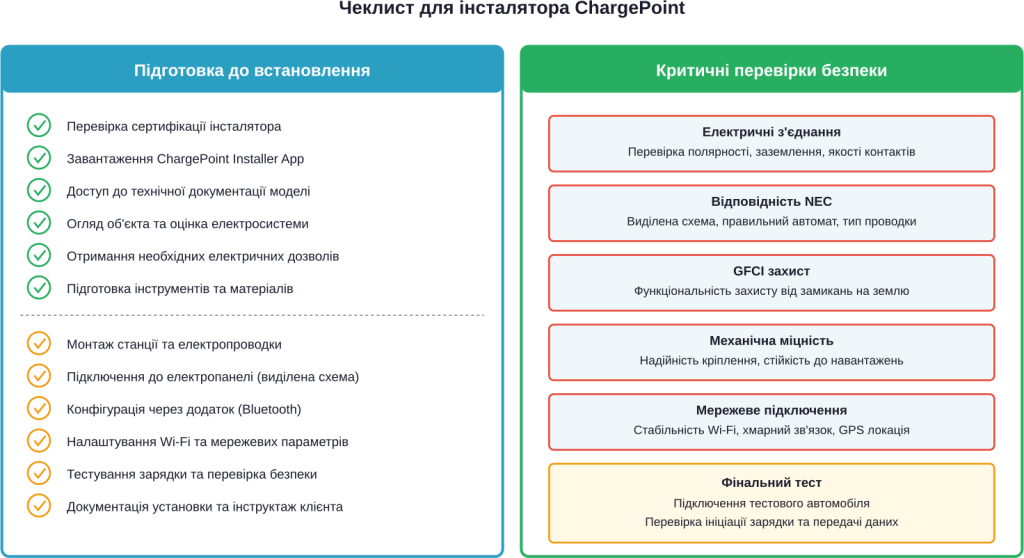
The final step is a comprehensive test. The installer checks that all connections are correct, tests charging functionality, verifies network connectivity and ensures that the station is displayed correctly in the ChargePoint system.
For commercial stations, we additionally test integration with payment systems, correct display in the ChargePoint mobile app for drivers, and the functionality of any additional features such as charging scheduling or access control.
Security and compliance
Safety is the most important aspect of charging equipment installation. ChargePoint designs its products to meet strict safety and reliability standards.
Testing and certification standards
According to DIYguru, AC chargers for electric vehicles on the US market are subject to rigorous testing to ensure compliance with standards. This includes tests for extreme climatic conditions:
- Operating temperature: -22°F to 122°F (-30°C to 50°C)
- Humidity: up to 95% without condensation
- Mechanical testing for vibration, shock and impact resistance
These tests ensure that ChargePoint stations operate reliably in a variety of environments, from hot deserts to cold winter regions.
National Electrical Code (NEC)
All installations must comply with the NEC, which sets out the minimum safety requirements for electrical systems. ChargePoint keeps its installation guides up to date with the latest versions of the NEC.
Key NEC requirements for charging equipment include the use of dedicated circuits, appropriate wiring types for the load, ground fault circuit interrupter (GFCI) protection, and proper grounding.
Additional products and software
ChargePoint is not just a manufacturer of charging stations. The company offers a comprehensive ecosystem of products and services for owners and operators of charging infrastructure.
DataHub and software solutions
DataHub is ChargePoint’s software platform for managing and monitoring charging operations. It allows commercial station owners to:
- Remotely monitor the entire fleet of charging stations
- Get detailed usage and revenue analytics
- Customise pricing and access to stations
- Monitor equipment status and receive notifications of problems
- Integrate with other building management systems
This is critical to achieving ESG (Environmental, Social, Governance) goals, as it allows organisations to track their environmental impact by reducing CO2 emissions.
Network compatibility
ChargePoint supports interoperability and network integration programmes. This means that some third-party charging stations can integrate into the ChargePoint network, providing users with access through a single platform.
Planning for future needs
Smart planning for charging infrastructure involves taking future growth into account. This is especially important for commercial facilities.
Electric vehicle readiness (EV Readiness)
According to the AFDC, EV readiness is how state and local leaders prepare for the growing number of EVs on the road by developing EV-related infrastructure, policies and services.
EV readiness is a community-based effort that requires planning, policies and support services to prepare for the arrival of electric vehicles and charging infrastructure. Local leaders can use the EV readiness guide to assess their readiness and plan.
Infrastructure scalability
When designing a charging facility, it is important to consider the possibility of expansion.
This may include:
- Installing an electrical panel with more power than currently required
- Laying additional cable channels for future stations
- Reserving a parking space for additional charging points
- Selecting network solutions that support dynamic power management
Cost and financial aspects
The cost of installing a ChargePoint charging station depends on many factors. It is important to understand all the cost components to plan your budget properly.
Components of the total cost
The total cost of the project includes several main components:
- The cost of the charging equipment itself
- Installation work (electrician)
- Permits and inspections
- Upgrade the electrical panel (if required)
- Laying additional wiring
- Construction works (trenching, concreting)
- Network equipment (for commercial systems)
According to AFDC, the cost of a residential Level 2 charger can range from $380 to $690. But that’s just the equipment. Installation work can account for a significant portion of the total cost, depending on the complexity of the project.
Tax benefits and incentives
An important detail: there are tax credits for installing charging infrastructure. AFDC offers the 30C Tax Credit Eligibility Locator tool from Argonne National Laboratory to help determine if your home, business or facility is located in a location that qualifies for tax credits.
These incentives can cover up to 30% of the cost of purchasing and installing electric vehicle charging infrastructure. This significantly reduces the overall cost of the project.
Support and maintenance
Once the station is installed, it is important to ensure that it is properly maintained for reliable operation.
ChargePoint guarantee
ChargePoint provides a limited warranty on its products. Warranty terms may vary depending on the model and type of installation (residential or commercial).
According to the ChargePoint installation guides, the warranty procedure includes contacting technical support, obtaining an RMA (Return Material Authorisation) number, and sending the defective equipment for repair or replacement.
Regular maintenance
ChargePoint stations are designed for minimal maintenance, but some checks are recommended:
- Visual inspection of cables and connectors for damage
- Cleaning the station from dirt and contaminants
- Checking the network connection
- Software updates (usually automatic)
- Performance monitoring through the management platform
Typical problems and their solutions
Even with proper installation, problems can arise. Understanding common situations helps to resolve them quickly.
Connection problems
The most common problem is the loss of a network connection. This can happen due to a weak Wi-Fi signal, changes in the network configuration, or temporary failures of the Internet provider.
The solution typically involves rebooting the station, checking the Wi-Fi settings via the installer app, or using alternative connection methods (Ethernet or LTE for supported models).
Electrical problems
If the station does not start charging, the cause may be in the electrical system. Check the circuit breakers, make sure the voltage is within specifications, and check the quality of the electrical connections.
A qualified electrician with the appropriate measuring equipment is required to diagnose electrical problems.
Problems with vehicle recognition
Sometimes the station may not recognise the connected electric vehicle. This is often due to the communication protocol between the vehicle and the station.
Try disconnecting and reconnecting the cable, rebooting the station, or updating the station software. If the problem persists, contact ChargePoint technical support.

Зарядні stations and сервіси ECOFACTOR – комплексне рішення for electric vehiclesв
In 2026, convenient and stable charging of an electric vehicle is no longer an additional advantage, but a basic need. That’s why we at ECOFACTOR are developing a comprehensive ecosystem of solutions so that drivers can confidently use electric vehicles throughout Ukraine. Our goal is to make the charging process simple, clear and accessible anywhere in the country.
Charging infrastructure from ECOFACTOR
We create and develop charging stations for different usage scenarios. Our network includes AC solutions for homes, residential complexes and offices, as well as fast DC stations for highways, shopping centres, business locations and public spaces. This allows drivers to choose a charging format that suits their needs – slow at night or fast while travelling.
Our ECOFACTOR charging infrastructure covers different regions of Ukraine and we are constantly expanding it. We take care not only of installation, but also of maintenance, stability and user support.
Mobile app for easy management
To make the charging process as easy as possible, we have developed a mobile application for
The app also offers online payment, session history, and other features that simplify the daily use of an electric vehicle. This is especially convenient for both city and long-distance journeys.
Solutions for home and business
In addition to network development, we offer equipment for private and commercial customers. In our
Also available in the catalogue are cables and adaptersThe system is compatible with various car models, as well as additional accessories for convenient and safe use.
A single ecosystem for electric vehicles
We combine charging stations, digital services and equipment into a single system. This is how we provide a comprehensive approach to make using an electric vehicle simple, straightforward and financially predictable.
We are building an infrastructure that allows you to charge your car without unnecessary steps, complicated settings or searching for third-party services. This is how we see the development of the electric transport market in Ukraine – through convenience, technology and accessibility for every driver.
The future of charging infrastructure
The electric vehicle charging industry is developing rapidly. ChargePoint is actively implementing new technologies and standards.
Smart charging and integration with the power grid
Smart charging technologies help to optimise electricity consumption, reduce the load on the grid during peak hours and integrate with renewable energy sources.
ChargePoint develops systems that can automatically adjust charging speeds based on the time of day, electricity tariffs and grid load. This not only saves money, but also helps to stabilise the grid.
Next-generation fast charging
The Express ChargePoint range includes high-capacity models for fast charging. Further increases in charging speeds are expected in the future, making the EV charging experience even more similar to a traditional petrol station.
For installers, this means that they need to be constantly trained and updated on new technologies and standards.
Conclusion
Installing ChargePoint charging stations is not just a technical challenge. It is an investment in the future of electric mobility and sustainable transport. ChargePoint provides installers with all the tools they need to succeed: a comprehensive training programme, a user-friendly mobile app, detailed technical documentation and support at all stages.
The key to a successful installation is proper preparation. Get certified, review the model-specific technical documentation, thoroughly assess the site before you begin, and use the ChargePoint Installer App to simplify the configuration process.
The electric vehicle charging industry continues to grow. According to the Alternative Fuels Data Centre, tens of thousands of charging stations are being installed across the United States. ChargePoint remains the market leader in this area with reliable equipment, an extensive network and comprehensive support for installers.
Ready to be part of this revolution? Register for ChargePoint University, complete the certification programme and join a network of professionals building the infrastructure of the future. Every station installed is a step towards a cleaner, more sustainable transport future.
FAQ: Frequently asked questions
How long does it take to install ChargePoint Home Flex?
A typical ChargePoint Home Flex installation takes 2-4 hours by a licensed electrician. This time may increase if you need to upgrade the electrical panel or run a long line of wiring from the panel to the installation site.
Do I need ChargePoint certification to install residential stations?
An electrician’s licence is sufficient for residential installations of Home Flex models. ChargePoint certification is recommended for commercial installations and provides access to extended technical support and documentation.
What is the difference between NEMA 6-50 and 14-50 plugs?
NEMA 6-50 is a 240V plug used for electric vehicle charging applications. NEMA 14-50 is a four-prong (two phase + neutral + ground) 240V plug, standard for electric stoves and RV connections. Both are suitable for ChargePoint Home Flex, depending on your existing electrical infrastructure.
Can I install a ChargePoint station on an exterior wall?
Yes, most ChargePoint models are designed for outdoor installation and are weatherproof. ChargePoint Home Flex can be installed indoors or outdoors. Make sure to follow the installation guide for installation and protection from direct weather.
How much does it cost to install a commercial ChargePoint station?
The cost of installing a commercial station varies considerably depending on the type of station and the electrical infrastructure of the facility. We recommend obtaining a detailed estimate from a certified ChargePoint installer.
How do I get access to ChargePoint University?
Registration for ChargePoint University is free and available through the official ChargePoint website. Create an account, fill out a profile, and get access to installation guides, training materials, and technical documentation. For full installer certification, you need to register for the Installation Training Certification Programme.
Does the ChargePoint Installer App support all station models?
The ChargePoint Installer App supports the most popular Bluetooth-enabled models, including the Home Flex, CT4000, CP6000, CPF50, and Express Series. Older models or stations without Bluetooth may require manual configuration through the web interface or physical station controls. Always check the compatibility of your specific model before installation.