Table of contents:
When you charge your smartphone at home, you simply plug it in and wait an hour or two. With an electric car, it’s a little more complicated – and a lot more interesting.
DC fast charging technology has changed the game for electric car owners. Instead of waiting for 8-12 hours at the home socket, you can top up the 80% battery while you’re drinking your coffee.
But how exactly does it work? And why do some electric cars take 20 minutes to charge, while others take an hour?
We remind you that you can purchase home and commercial
What is DC Charging
A DC charger (or DC charging station) is equipment that converts alternating current from the mains to direct current and transfers it directly to the battery of an electric vehicle.
This is what makes this technology special: all the hard work of converting the current takes place in the charging station, not in the car. This makes it possible to transfer much more power.
Think of it as the difference between a garden hose and a fire hydrant. Both deliver water, but one does so much faster.
How the DC Charging Station Works
According to IEEE research, fast DC charging includes several key components: a powerful converter, a cooling system, a charging controller, and a communication module.
The process looks like this:
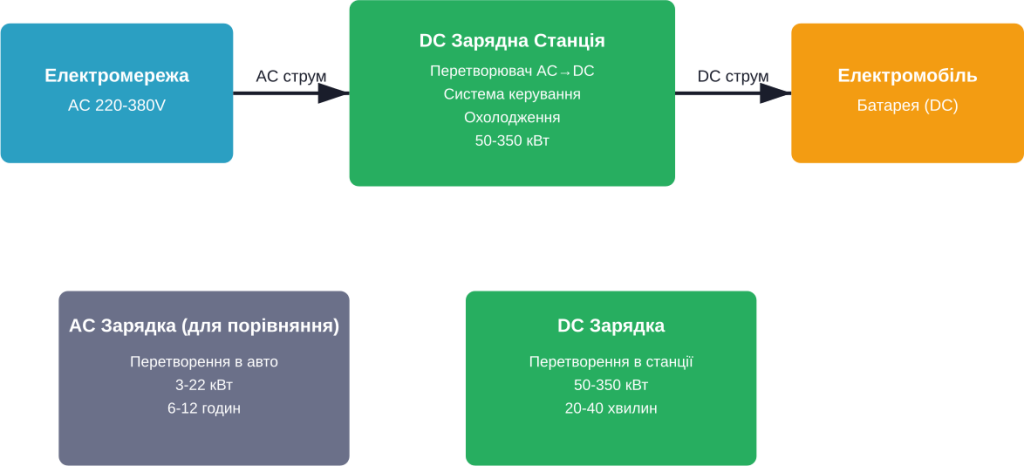
- AC power from the mains is supplied to the charging station
- A powerful rectifier converts it to direct current
- The control system communicates with the vehicle to determine the optimum parameters
- Direct current is supplied directly to the high-voltage battery
- The vehicle’s on-board charger is not used at all
That’s why DC charging stations are so large and heavy – all the current conversion equipment is inside them.
AC vs DC Charging: Key Differences
Many people confuse these two types of charging, but the difference is critical to understanding the capabilities of your electric vehicle.
| Parameters. | AC Charging | DC Charging |
|---|---|---|
| Current conversion point | In the car (on-board charger) | In the charging station |
| Power | 3-22 kW | 50-350 kW |
| Charging time (0-80%) | 6-12 hours | 20-40 minutes |
| Station size | Compact, wall-mounted | Large, floor standing |
| Cost of equipment | €500-2000 | €30,000-150,000 |
| Typical applications | At home, in car parks | On highways, petrol stations |
| Impact on the battery | Minimal | Moderate (with frequent use) |
According to BENY, DC charging accelerates the electric current directly to the battery, bypassing the vehicle’s internal conversion process.
It’s like a sprinter who accelerates quickly, giving up most of his energy in a short time.
DC Charging Standards
This is where the real confusion begins. There are several competing fast charging standards, and not all cars are compatible with all stations.
CHAdeMO
The CHAdeMO Association was established by Nissan, Mitsubishi Motors, Fuji Heavy Industries (Subaru), Toyota and Tokyo Electric Power Company (TEPCO). Japanese automakers were among the largest users of the standard.
Technical characteristics:
- Rated current: 125A, 150A, 200A
- Rated voltage: up to 600V DC
- Maximum power output: up to 200 kW (CHAdeMO 3.0 promises up to 500 kW)
- Separate connector with a unique shape
Nissan Leaf, Mitsubishi Outlander PHEV and older models of electric vehicles often use this standard.
CCS (Combined Charging System)
CCS, or Combined Charging System, is a European and American standard that combines AC and DC charging in one connector.
Real talk: CCS is winning the battle of standards. Most new electric vehicles use it.
There are two versions:
- CCS Type 1 (Combo 1) – common in the USA and Asia
- CCS Type 2 (Combo 2) – European standard
The capacity of modern CCS charging stations reaches 350 kW, which allows some models to get 200 km of range in 10 minutes.
Charging speed: What Affects the Time
You drive up to a 350 kW station, but your car is charging more slowly than the manufacturer promised. What’s wrong?
In fact, the charging speed depends on several factors, and the power of the station is only one of them.
Charging capacity of the vehicle
Each electric vehicle has a maximum energy intake rate. If two electric cars with the same battery size are charging side by side at a powerful DC station, but one can only take in 50 kW of DC and the other 250 kW, the latter will charge much faster.
Examples:
- Nissan Leaf: up to 50 kW
- Tesla Model 3: up to 250 kW
- Porsche Taycan: up to 270 kW
- Hyundai Ioniq 5: up to approximately 230-240 kW (on a 350 kW station, provided the temperature is correct and the SOC is low)
Battery charge status
This is where it gets interesting. The battery does not charge linearly.
From the 0% to the 80%, charging is at maximum speed. This is the same curve that all manufacturers talk about.
But from 80% to 100%, the rate drops dramatically. This is a battery protection mechanism that prevents overheating and degradation.
Therefore, experienced electric car owners rarely charge up to 100% at fast charging stations – it is time inefficient.
Battery temperature
A cold battery charges more slowly. This is a fact.
Modern electric vehicles have battery preheating systems. When you enter a DC charging station into the navigation, the car starts preparing the battery for a fast charge.
In frosty weather, the difference can be dramatic – from 150 kW to 50 kW at the same station.
Infrastructure and Accessibility
The network of fast DC charging stations is actively developing in Ukraine. The main suppliers are OKKO, WOG and private operators.
But there is a nuance here: not all stations are the same. Some offer only 50 kW, while new locations are installing equipment for 150-350 kW.
The cost of Fast Charging
DC charging is always more expensive than home AC charging. This is the price you pay for convenience and speed.
In general, the cost depends on:
- Operator tariffs
- Plant capacities
- Time of day (some operators have night discounts)
- Subscriber programme
Check the operators’ official websites for the latest prices, as tariffs change regularly.
Charging infrastructure from ECOFACTOR
When it comes to fast DC charging, the most important thing for a driver is stable access to a convenient infrastructure. That is why DC Charger-enabled charging stations play a key role in the daily use of an electric vehicle. They can significantly reduce recharging time, especially when travelling on the highway or in a city with an active traffic rhythm.
ECOFACTOR’s charging infrastructure is designed so that the driver does not have to think about technical details. The network covers various charging formats: from AC solutions for home and office to powerful DC locations in public places and along major routes. Thanks to this
A separate convenience is provided by a mobile application that runs on
For those who plan to install their own chargers, available online shop ECOFACTOR. Here you can choose equipment for home or business, as well as cables and adaptersthat correspond to different types of connection. This approach allows you to assemble a complete set for comfortable charging without unnecessary searches.
As a result, the entire system works as a single mechanism: charging stations, digital services and equipment complement each other. This makes fast DC charging not just a technical possibility, but an understandable and convenient process for every electric vehicle owner.
Impact on battery health
This question is of concern to many. Does fast charging harm the battery of an electric vehicle?
The short answer is yes, but less than you think.
IEEE research shows that modern battery management systems minimise the negative impact of fast charging through active cooling and dynamic current management.
Recommendations for battery life:
- Use DC charging only when travelling, not all the time
- Charge via AC at home (slow charging is better for the battery)
- Do not charge the 100% unnecessarily
- Avoid charging in extreme heat or cold
- Maintain charge between 20-80% for daily use
Modern lithium-ion batteries are designed for 1000-2000 charging cycles while retaining 80% of capacity. With mixed use of AC and DC charging, this is 8-15 years of operation.
The future of Fast Charging
Technology does not stand still. What’s in store for us in the near future?
Ultra-Fast Charging
The 500 kW stations are already in test mode. This will make it possible to charge an electric car as quickly as refuelling a petrol car.
According to IEEE Spectrum’s 2025 publication, solid-state transformers are boosting EV charging efficiency. Compact solid-state transformers simplify the charging process, reducing costs and complexity while improving grid efficiency and charging station performance.
800V architecture
Electric vehicles with 800V batteries (instead of the standard 400V) can take a higher current without overheating the cables.
Hyundai Ioniq 5, Porsche Taycan and Kia EV6 already use this technology.
Vehicle-to-Grid (V2G)
Two-way charging will allow electric vehicles to not only receive but also return energy back to the grid. This will turn your car into a mobile energy storage device.

How to Choose the Right Charging Station
When you’re planning a long journey, the choice of charging station matters.
What to check:
- Connector compatibility – whether the station supports your standard (CHAdeMO, CCS, Tesla)
- Power – 50 kW vs 150 kW vs 350 kW
- Availability – how many charging points are available and whether they are occupied
- Payment. – what methods are accepted, whether an operator card is required
- Location. – whether there is a cafe, toilet, shop nearby (charging takes time)
Use mobile apps to find stations: PlugShare, ChargePoint, ABRP (A Better Route Planner) show not only the location, but also the real status of stations and user reviews.
Common mistakes during fast charging
Even experienced electric car owners sometimes make these mistakes.
- Charging up to 100% at a DC station – This is inefficient. After the 80%, the speed drops 3-4 times, and you just stand there and wait.
- Ignoring preheating – If your vehicle has this feature, use it. Enter the charging station in the navigation 20-30 minutes before arrival.
- Selecting the nearest station instead of the fastest one
- Parking near the station without charging – This blocks the space for others. As soon as you have charged, put the car away.
Conclusion
Fast DC charging has changed the game for electric vehicles. What once seemed impossible – charging a car during a coffee break – has now become a reality.
The technology continues to evolve. 350 kW stations are becoming standard, 800V architecture is spreading, and ultra-fast 500+ kW charging is on the horizon.
The key to successful use is understanding the principles of operation. Know your vehicle’s capabilities, plan your routes with charging stations in mind, and keep in mind the balance between the convenience of fast charging and battery health.
Ready to switch to an electric car? Check the availability of DC charging stations in your area and make sure your future car supports modern fast-charging standards. The future of mobility is here.
Frequently Asked Questions (FAQ)
How long does it take to fully charge at a DC station?
Depends on the power of the station and the car. At a 150 kW station, a modern electric car will charge from 0% to 80% in 25-35 minutes. Charging from 80% to 100% will take another 20-40 minutes due to speed limits. In general, a full charge at a fast station takes 45-90 minutes.
Can I charge any electric vehicle at any DC station?
No, you need connector compatibility. CHAdeMO stations are suitable for Nissan Leaf and Japanese cars. CCS stations are suitable for European and most newer electric vehicles. Always check the connector type of your car and the station before you travel.
Does fast charging harm the battery of an electric vehicle?
With moderate use, no. Modern battery management systems protect against overheating and overcharging. However, regular fast charging can accelerate the degradation of the 5-10% battery compared to slow AC charging. It is recommended that you use DC charging only when travelling and charge slowly at home.
Why does the charging speed drop after 80%?
Це захисний механізм батареї. При високому рівні заряду ризик перегріву and деградації зростає. Контролер батареї автоматично знижує струм після 80%, щоб забезпечити безпеку and довговічність. Саме тому виробники завжди вказують час charges u0022до 80%u0022, а не до 100%.
How much does fast charging cost compared to home charging?
DC charging is 2-4 times more expensive. While home charging costs 3-5 UAH per kWh, the price at fast charging stations can reach 12-20 UAH per kWh. For a 60 kWh battery, the difference is 180-300 UAH (at home) versus 720-1200 UAH (fast charging station). Check the current tariffs on the operators’ websites.
What is 800V architecture and why is it important?
Electric vehicles with 800V batteries (instead of the standard 400V) can take a higher current without overheating the cables. This allows for faster charging – up to 350 kW instead of 150 kW. Cars such as the Hyundai Ioniq 5, Porsche Taycan and Kia EV6 use 800V architecture and can charge from 10% to 80% in 18-20 minutes.
Can I install a DC charging station at home?
Technically possible, but impractical. A DC charging station costs 30,000-150,000 euros, requires a powerful grid connection (minimum 100-200 kW) and a special permit. For home use, an AC charger with a capacity of 7-22 kW is sufficient, which costs 500-2000 euros and charges the car overnight.