





The best navigation apps for electric cars: what to choose in Ukraine and Europe
When you switch to an electric car, the route immediately starts to look different. It's no longer just "fill up and go", but "where is the next charging point, does the connector fit, how many kilometres are left, and is there anything else besides a field?". That's why route planning apps have become almost mandatory for everyone who drives an electric car. Luckily, every year [...]
Content:
When you switch to an electric car, the route immediately starts to look different. It's no longer just "fill up and drive", but "where is the next charging point, does the connector fit, how many kilometres are left, and is there anything else besides a field?". That's why route planning apps have become almost mandatory for everyone who drives an electric car.
Fortunately, there are more and more of these tools every year - and they are getting smarter. They take into account the remaining charge, pull up charging stations in real time, advise when to stop, and even tell you if the charging is working. But not all of them are equally convenient for Ukrainian drivers. That's why we've put together a selection of the most useful apps that really work both here and abroad.
We remind you that you can purchase home and commercial charging stations in our online storeand also use the public charging stations ECOFACTORcharging points located throughout Ukraine. For convenient access to charging infrastructure, we recommend using our mobile applicationwhich is available on iOS and Android.
What makes an electric vehicle route planning app really convenient?
Every EV app has its pros and cons, and it's often convenient to tailor them to specific situations. But there are a few key characteristics that distinguish truly useful routers - those that don't let you down in a critical moment and really make your journeys easier.
Precision and adaptation to real-world conditions
- Simplicity of planning: A good router doesn't complicate, but rather simplifies, the preparation for a trip. It should easily take into account traffic, road conditions, weather conditions and the capabilities of a particular electric car. All this without unnecessary clicks and technical settings.
- EV-specific navigation: The app should take into account the range and indicate where exactly you need to recharge. It is ideal if it suggests stops close to cafes, car parks or other convenient places - and does not lead to petrol stations with "no light, no charging".
- Integration of live data: Real-time updates about station occupancy, breakdowns or temporary shutdowns are critical. If a station is under repair or has a queue, you want to know before you arrive, not when you're already there.
Flexible filters
- Personalised settings: It's great to be able to choose the type of connector, power, preferred operator, or simply indicate that you need a fast charge with free space. Some apps even show you how many ports are available at the station, which is great when you don't want to stand in line.
- Consideration of preferences across networks: Some drivers only charge at certain networks or have subscription discounts. Therefore, it is important to be able to filter stations by operator, price, or type of connection.
User-friendly and intuitive interface
- Simplicity is the key: Even if there are a lot of functions, they should be presented in a way that doesn't get lost. The best apps are not overloaded - everything is logical and in its place, without unnecessary complications.
- Speed and stability: The app should not slow down or quickly drain the phone's battery. And it is important that it is equally easy to use for both beginners and those who have been driving EVs for years.
Integration with charging station operators
- Connecting to networks in real time: The most convenient apps are those that "see" charging directly. That is, they show the status of ports in real time, allow you to reserve a station or even start charging remotely.
- Payment via the application: If you can pay for charging directly from the app, it's convenient. No need to download additional apps every time or look for a QR code on a pole in the rain.
- Details about each station: Power, connector types, number of ports, whether there is a parking space, whether charging is available at night - all this should be on the charging station card. And it is desirable that this data is actually updated, and not just for show.
Calculating the cost and savings
- A rational route for the price: If the app can roughly calculate the cost of charges along the route, it's very convenient. Some services even offer cheaper alternatives without losing travel time.
- Dynamic cost calculation: We may have different rates during the day and night, and some stations have subscription fees or discounts. A good app will take this into account and give you a more accurate cost forecast.
- Analysis of energy consumption: A bonus, but useful feature is when the app shows how much energy was consumed on different routes and how it depended on the driving style, weather or terrain. It helps you to better understand your car and the real costs.
Planning with multiple stops
- A multi-point route - without the headache: It is ideal when you can create a complex route with several points and get the optimal charging calculation, even if there are several hundred kilometres between the points.
- Flexible editing: Life is unpredictable. A good app will allow you to quickly add a new stop, change your route, or move your charging station without having to rebuild everything from scratch.
Compatible with various models of electric vehicles.
- A wide range of models: The app should support the most popular models in Ukraine - from Nissan Leaf and Renault Zoe to Volkswagen ID.4 or Tesla. And not just "show" that the car exists, but actually take into account its characteristics.
- Routing based on car parameters: Each car has its own battery, charging speed, and consumption. If the app takes these parameters into account when building a route, it's a big plus. Especially on long journeys.
Preparing for an electric car journey: what you need to know
Electric cars are increasingly being used for long journeys - they are convenient, economical and allow you to see the country from a completely different perspective. But unlike petrol cars, an electric car requires a little more preparation. Especially when the charging infrastructure is still developing and the number of charging stations on the roads is not such that you can just drive at random.
To avoid stress and being left with an empty battery in the middle of the journey, it's worth thinking ahead. Below are the key things you'll need when planning an electric car trip.
| Start with a full charge | Charge the vehicle to 100% before setting off to ensure that you have the maximum range at the start of your journey. This is convenient and gives you more freedom to plan your first kilometres. |
| Estimate the real power reserve | Don't rely on the figures in the documentation. Temperature, speed, climate control - everything has an impact. Plan ahead and take into account the actual conditions. |
| Consider stopping for charging | Think about where you will recharge. It is better to combine charging with lunch, rest or sightseeing. |
| Choose accommodation with charging | If you spend the night on the road, look for hotels with charging stations. Charging at night saves time and adds convenience. |
| Don't forget the cables and adapters | Always have your own cable and adapters. This ensures that you can charge even at less versatile stations. |
| Consider the weather | The battery drains faster in winter. Warm up the car while charging. Check your tyres and brakes before driving - safety always comes first. |
TOP 10 navigation apps for electric cars

1. ECOFACTOR EV Charging
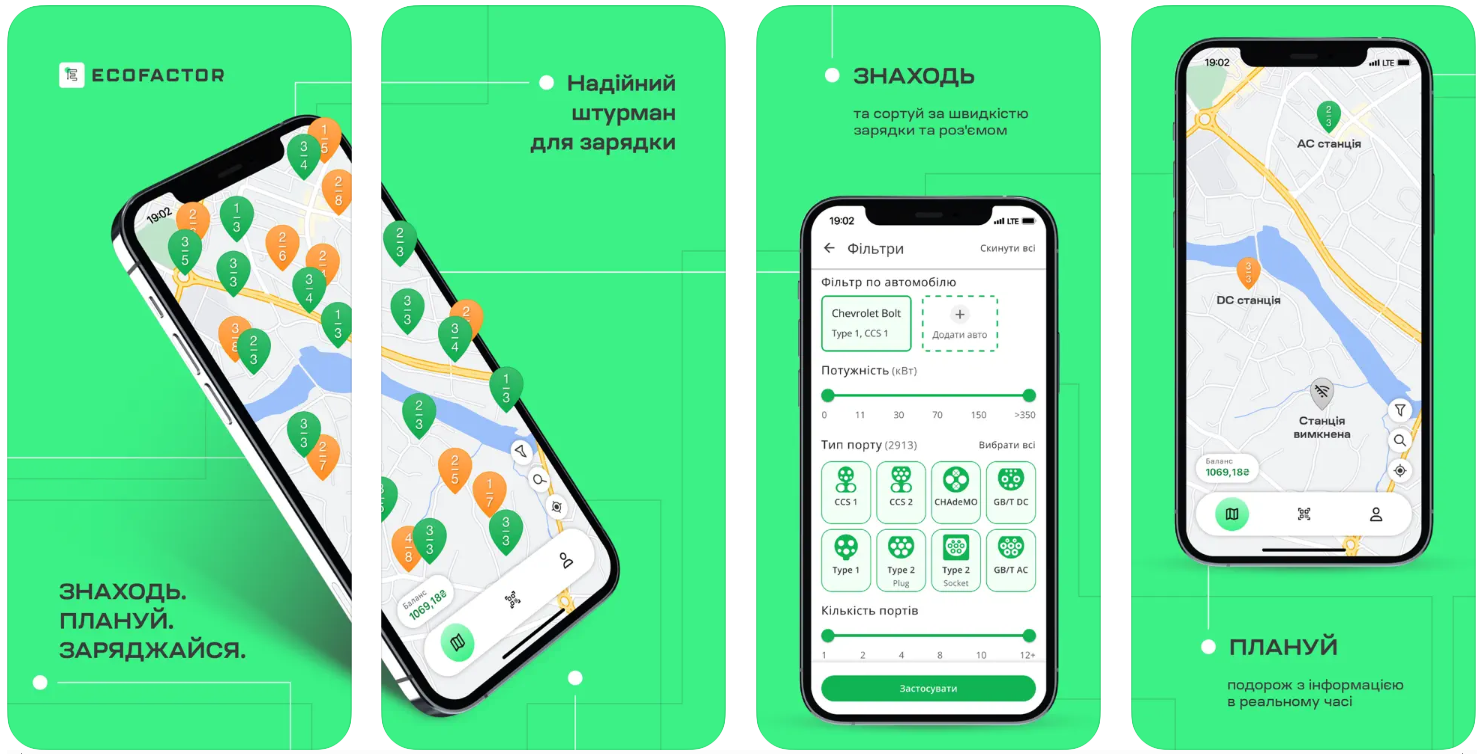
At ECOFACTOR, we have created an app that doesn't just build a route, but truly understands the needs of electric vehicle drivers. Our app combines map of charging stations across Ukraine with the real state of the equipment, allows you to reserve charging, tracks your travel history and energy consumption, and automatically plots a route based on the battery level. This is a tool that works specifically for Ukrainian realities, not just a translated foreign service.
Most importantly, it's all connected to our platform and network of charging stations. The app shows which stations are free, which are busy, and which are temporarily unavailable. You can choose a station by connector type, power, operator, and even by convenience - near a cafe, shop, or recreation area. We don't just display points on a map, but allow you to manage every detail of your trip. There's also a smart notification system that reminds you when it's time to charge, when the station status changes, or when there are network updates.
We make charging a simple part of your journey. No need to guess, no need to ask. Just open the app, choose a station and go. The app is available on iOS and Android.
We also offer a full range of solutions for electromobility: we develop and manufacture charging stations in Ukraine, we select equipment to meet the specific needs of businesses and drivers, and in our online store you can find mobile charging solutions, cables, adapters and other accessories for comfortable charging. All in one place, with support and real people in touch.
Contact information:
- Website: ecofactortech.com
- App Store: apps.apple.com/ua/app/ecofactor-ev-charging/id1438716797
- Google Play: play.google.com/store/apps/details?id=eu.ecofactor
- E-mail: [email protected]
- Facebook: www.facebook.com/ecofactor.ua
- Instagram: www.instagram.com/ecofactor.ua
- Address: 113 Otamana Holovatogo St., Odesa, Odesa region, 65000
- Phone number: +38 (097) 798 88 80
2. A Better Routeplanner (ABRP)
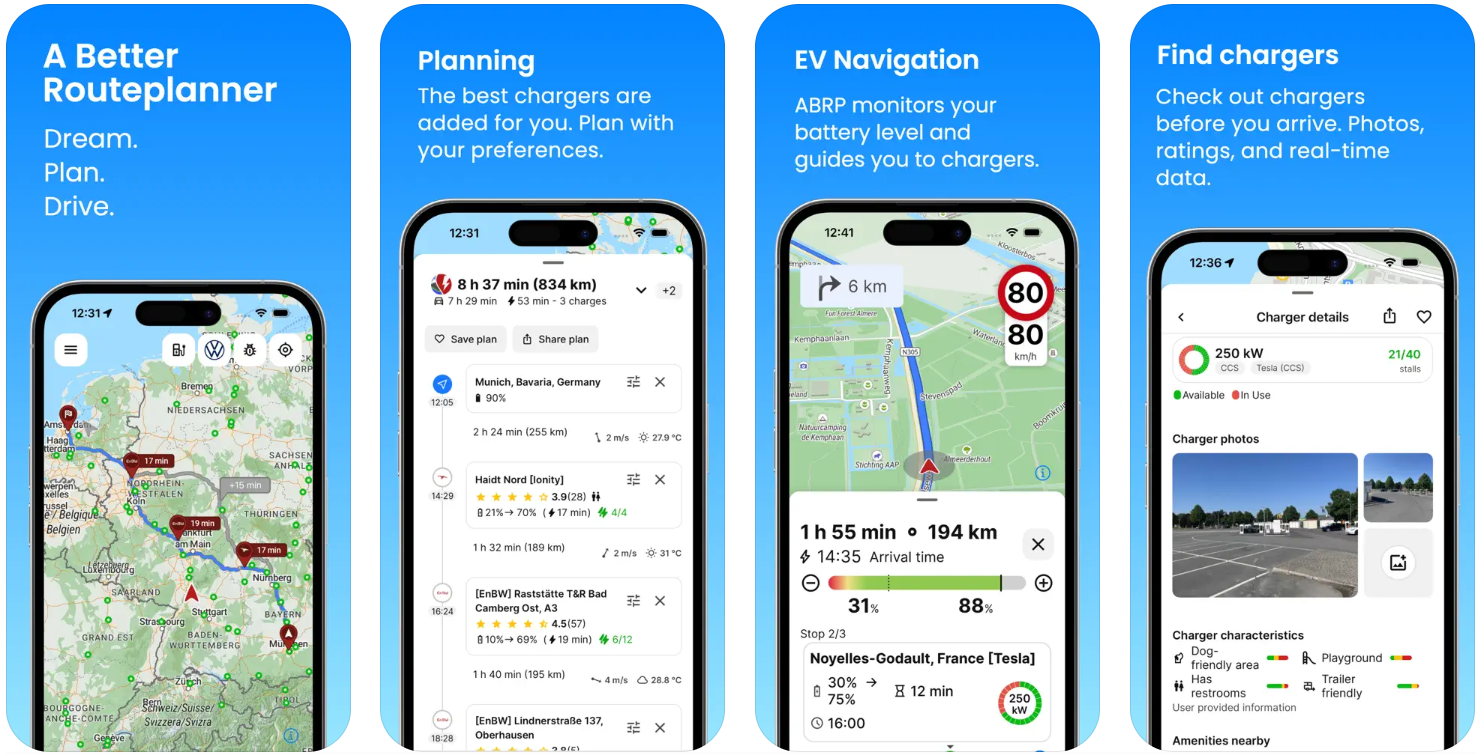
ABRP is a service that helps electric vehicle drivers plan their route with charging stops in mind. The user selects the model of their car, enters the destination, and the app calculates where to stop, how long the journey will take, and when to recharge. ABRP supports the vast majority of electric cars, so there is no need to manually adjust the settings. Once the trip has started, you can switch to driving mode and the app will monitor changes in real time.
The app allows you to adjust the route while you are driving, if, for example, the selected station is temporarily unavailable or there are traffic jams. This makes the journey less stressful, especially when driving in unfamiliar terrain. Some users note the limited ability to filter charging station networks, which can make it difficult to choose if, for example, a loyalty card is valid only for a specific network.
Despite some minor drawbacks, A Better Routeplanner is often chosen by those who want more control over their route. The app is more like a working tool than a regular map. It is suitable for long journeys when every charge counts and time on the road is limited. It's not just navigation, but rather a personal trip planner based on the actual state of the battery.
Contact information:
- Website: abetterrouteplanner.com
- App Store: apps.apple.com/ua/app/a-better-routeplanner-abrp/id1490860521
- Google Play: play.google.com/store/apps/details?id=com.iternio.abrpapp
- E-mail: [email protected]
- Address: Scheelevägen 15 223 70 Lund Sweden
- Phone number: +46 70 611 59 22
3. Google Maps.
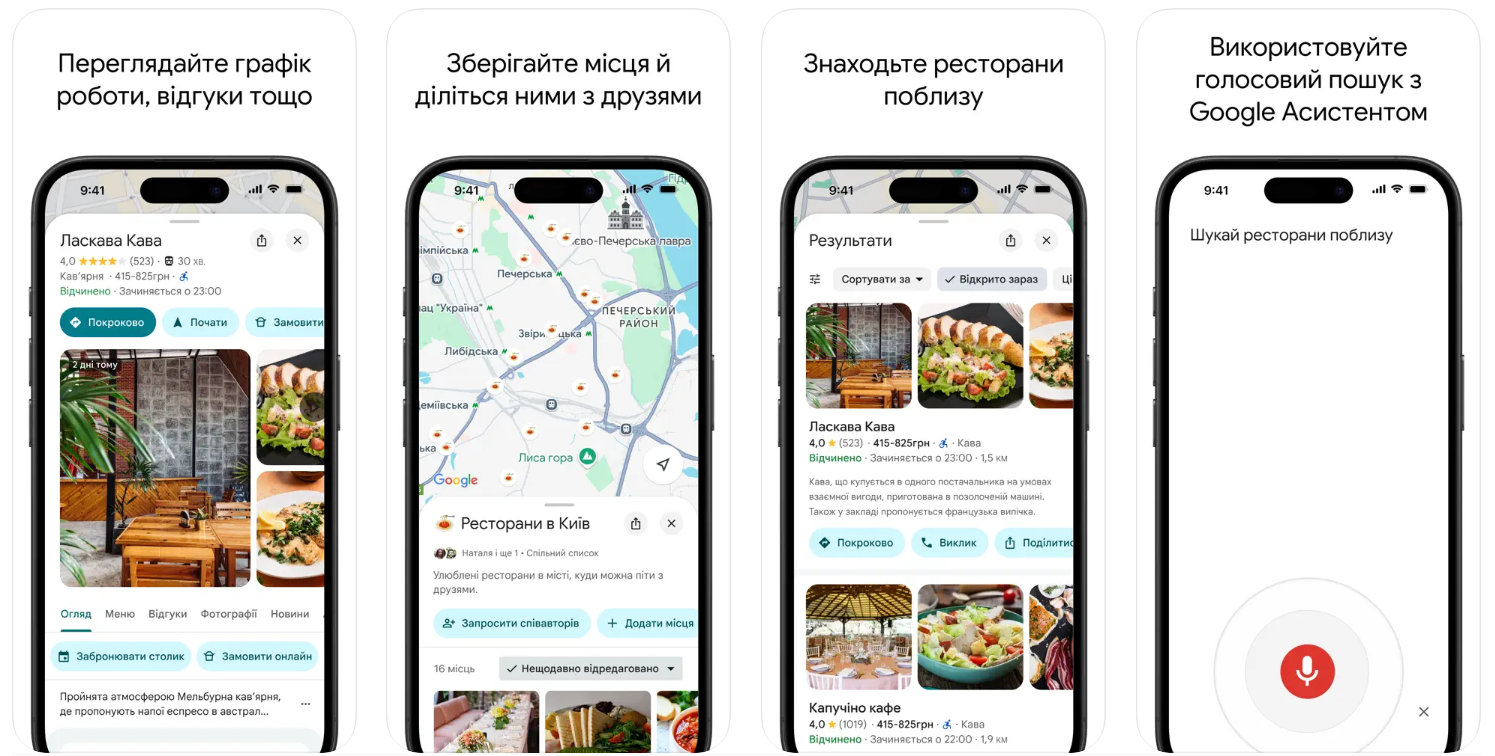
Almost everyone knows Google Maps, and there is hardly a person who hasn't used the app at least once. But when it comes to routes for an electric vehicle, things are a little more complicated. The main advantage is the abundance of up-to-date data: traffic jams, repair work, closed sections - everything is taken into account automatically. Navigation adapts to the conditions on the road, changing the route in real time. There is also a fuel economy mode that can be used to calculate the most efficient route.
However, the app is not designed exclusively for electric cars. It does not have deep integration with the charging station network, and the user has to search for these points on their own or use additional services. This can be inconvenient, especially on a long journey, where it is important to know not just the location of the charging station, but also its compatibility, speed and availability.
As a general-purpose navigator, Google Maps is quite reliable, but electric car drivers may lack specific functionality. However, for short trips around the city, where there is a range and no plans to charge on the road, the app performs its role without any unnecessary complications.
Contact information:
- Website: www.google.com/maps/about
- App Store: apps.apple.com/ua/app/google maps/id585027354
- Google Play: play.google.com/store/apps/details?id=com.google.android.apps.maps
- Facebook: www.facebook.com/googleworkspace
- Twitter: x.com/googleworkspace
- LinkedIn: www.linkedin.com/showcase/googleworkspace
- Instagram: www.instagram.com/googleworkspace
- Address: 1600 Amphitheatre Pkwy, Mountain View, California 94043, USA

4. PlugShare
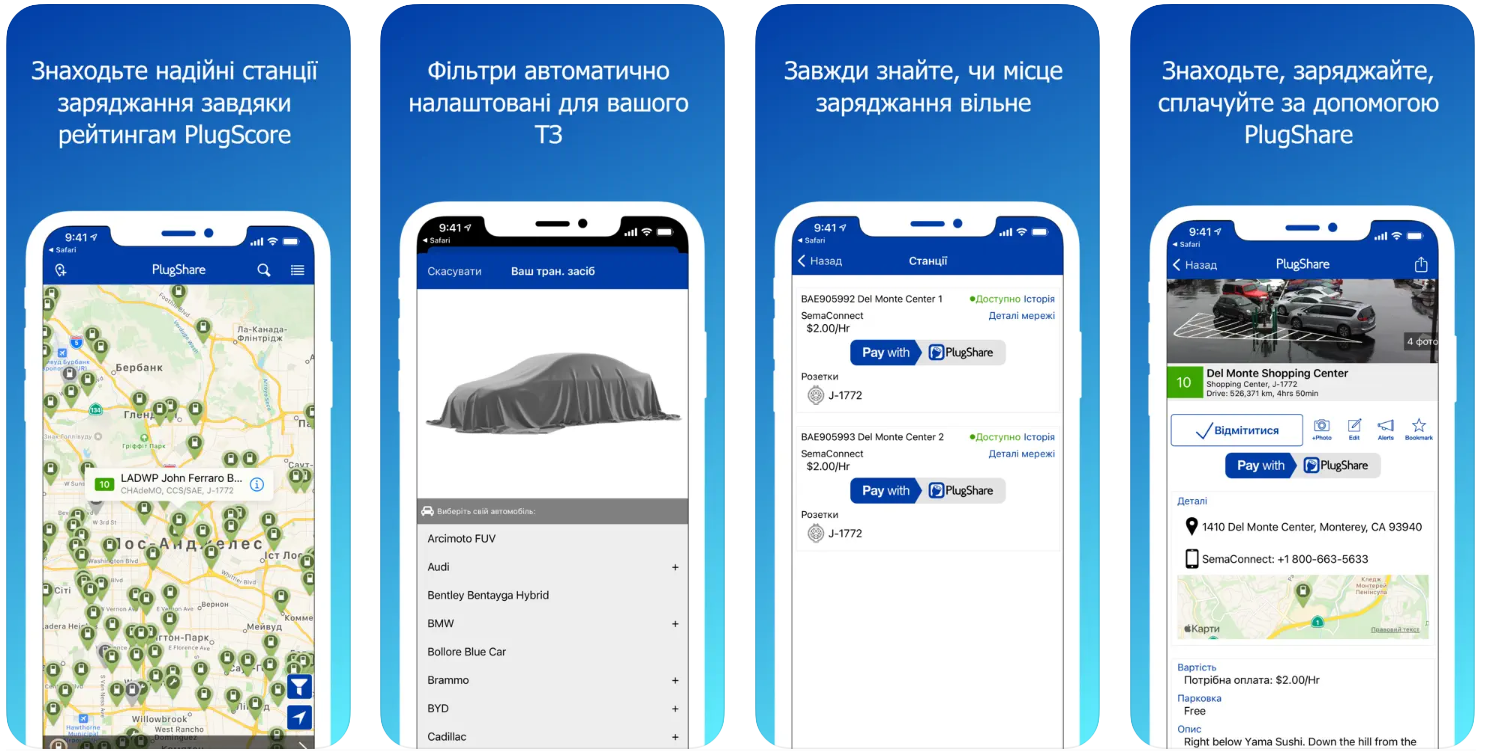
PlugShare is not just a map of charging points, but a whole community of electric car drivers who share reviews, photos and their own observations about the stations. Here you can find charging points by connector type, speed, accessibility, or even the presence of a nearby toilet or cafe. The app has a handy filter that allows you to remove unnecessary options at a glance. And if the stop is new, the driver can add it to the map.
This app is especially useful for those who travel frequently. It has a route planning function that takes into account charging stations along the way, as well as integration with other navigation apps. Additionally, you can turn on notifications about new charging stations in the selected region, which is useful if you often repeat routes.
PlugShare is best suited as a supplement to the main navigation. It is convenient to have it at hand to quickly check whether the charger is in good condition, how much the charge costs, and whether there have been any recent problems. For Ukraine, a relevant advantage is the support of local providers, such as YASNO, TOKA, AutoEnterprise, which greatly simplifies the use for our drivers.
Contact information:
- Website: www.plugshare.com
- App Store: apps.apple.com/ua/app/plugshare-charging-stations/id421788217
- Google Play: play.google.com/store/apps/details?id=com.xatori.Plugshare
- E-mail: [email protected]
- Facebook: www.facebook.com/plugshare
- Twitter: x.com/plugshare
- LinkedIn: www.linkedin.com/company/plugshare
- Instagram: www.instagram.com/plugshare

5. Waze
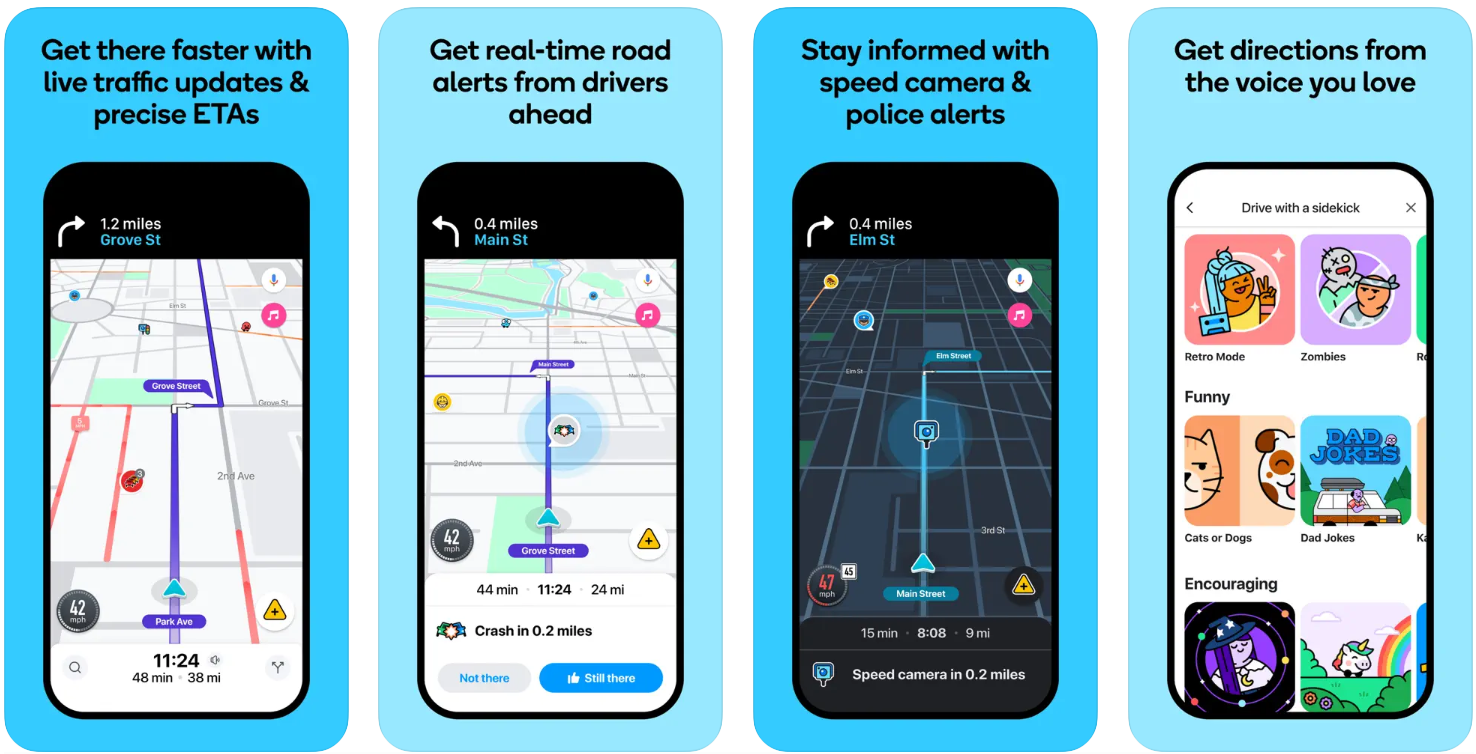
Waze is a navigation app that many drivers appreciate for the ability to see the situation on the road before it happens. The app constantly updates data based on user reports: traffic jams, accidents, roadworks, police, potholes, speed limits - all of this appears on the map in real time. This is useful not only in a big city, but also on the highways, where it is not always possible to find out about obstacles quickly.
When it comes to electric vehicles, Waze is not yet fully geared towards them. Yes, you can find charging stations along your route in the app, but you can't filter them by connector type or power. For EV owners, this can be critical, especially when there are only a few options and charging time is important. Some users also complain about unstable integration with CarPlay and difficult access to settings while driving.
Despite these limitations, Waze remains a good tool for avoiding surprises on the road. Its main strength lies in the social element, when drivers share information with each other. But when it comes to fully planning electric car trips with charging, this app is best combined with more specialised solutions.
Contact information:
- Website: www.waze.com
- App Store: apps.apple.com/ua/app/waze-navigation-live-traffic/id323229106
- Google Play: play.google.com/store/apps/details?id=com.waze
- Facebook: www.facebook.com/Waze
- Twitter: x.com/waze
- LinkedIn: www.linkedin.com/company/waze
- Instagram: www.instagram.com/waze
6. 6.
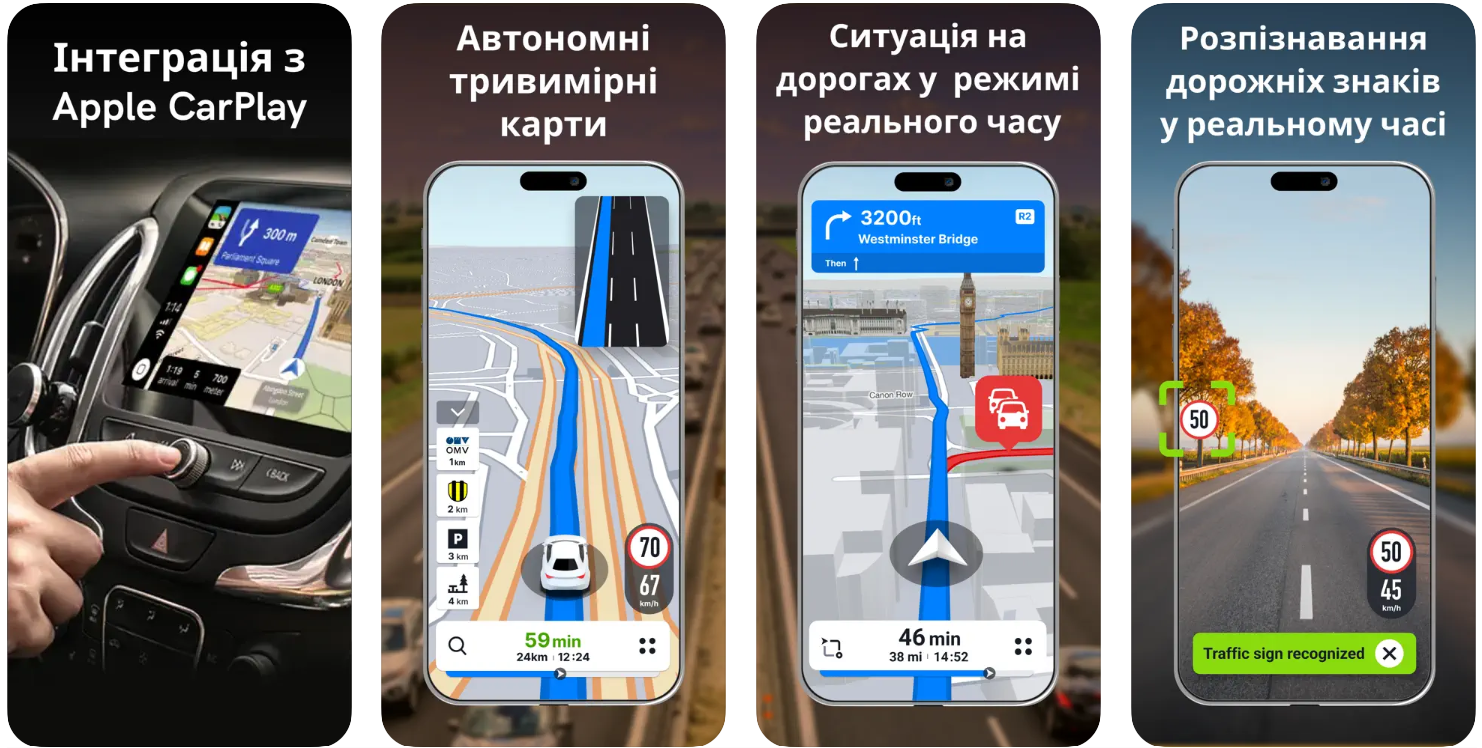
Sygic is an offline navigator with a focus on autonomy and safety, suitable for those who frequently travel outside of stable mobile coverage. The app allows you to download maps in advance, as well as use voice navigation and 3D maps. For electric vehicle drivers, it is important that Sygic allows you to add fuel type and displays charging stations, but full integration of EV features is still in development.
One of the notable advantages of the app is a large set of additional features that are not often found in other applications. For example, HUD projection of navigation on the windscreen, realistic route augmentation via the smartphone camera, Dashcam function and real-time detection of road signs. These features are more focused on driving comfort than on the specifics of electric travel, but they can be useful for drivers of any car.
Sygic is suitable for those who want to have a comprehensive solution at their fingertips, even if some EV functions are not yet up to the level of specialised services. For long trips with a predetermined route, when you need accurate navigation and stable operation without the Internet, this app can be a practical choice. But as the main route planner for an electric vehicle, it is more of a complement than a complete replacement for specialised solutions.
Contact information:
- Website: www.sygic.com
- App Store: apps.apple.com/ua/app/sygic-gps-navigation-and-maps/id585193266
- Google Play: play.google.com/store/apps/details?id=com.sygic.aura
- Facebook: www.facebook.com/sygicofficial
- Twitter: x.com/sygicofficial
- LinkedIn: www.linkedin.com/company/sygic

7. GO TO-U
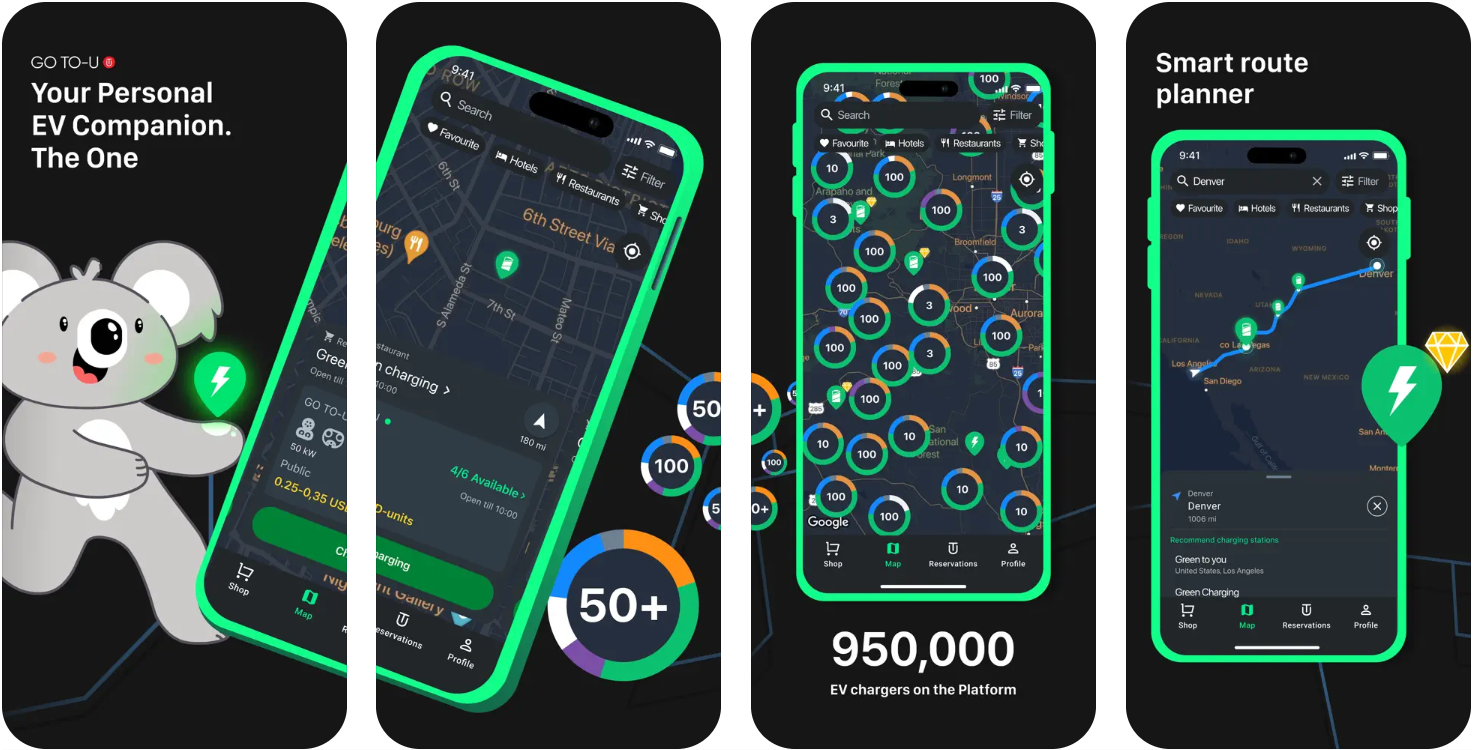
GO TO-U is a Ukrainian app that was created specifically for electric vehicles. It not only shows the nearest charging stations, but also allows you to plan your trips taking into account the remaining charge, the type of connector and the power of the stations. One of the key features is the ability to reserve a charge in advance. This is useful when the route passes through busy locations or during rush hour, and you don't want to waste time waiting.
In the app, you can filter stations by operator, check whether they are currently free, and receive notifications about new points in the area. GO TO-U also supports payment through a built-in wallet and shows the history of charges, which is convenient for those who keep track of expenses or report to the company. For Ukrainian users, it is also important that the app supports most local networks and shows stations that are often not visible in Western services.
GO TO-U looks like a solution that was created with real user experience in mind. There is nothing superfluous here, and at the same time, there is something that is often lacking in other apps - predictability. If you need not only to get there, but also to know where to charge your car on the way, this app does it better than universal navigators.
Contact information:
- Website: goto-u.com
- App Store: apps.apple.com/ua/app/go-to-u-ev-charging-app/id1175538017
- Google Play: play.google.com/store/apps/details?id=com.go.tou
- E-mail: [email protected]
- Facebook: www.facebook.com/gotougreen
- Twitter: x.com/GoToUgreen
- LinkedIn: www.linkedin.com/company/gotougreen
- Instagram: www.instagram.com/gotougreen
- Address: 345 South Sepulveda Blvd, Suite 1100, Los Angeles, California, 90034
- Phone number: +18887731410
8. Apple Maps.
Apple Maps is a basic navigation application for iOS devices that is suitable for daily commuting or city navigation. The app offers turn-by-turn navigation, supports car, bike, pedestrian and public transport, and provides real-time information about traffic, congestion and accidents. Users can download offline maps, which is convenient in places without stable internet. Location updates, opening hours, reviews and photos are also available directly in the app.
In terms of route planning for electric vehicles, Apple Maps still has limited functionality. The app does not allow you to filter charging stations by connector type or charging speed, and it does not integrate with most local providers. The app also doesn't allow you to build a route in advance, taking into account charging stops or battery level. This creates certain difficulties for users who drive not only in the city but also over long distances.
For those who use the Apple ecosystem and don't have high demands on planning flexibility, Apple Maps can be a convenient choice. But for electric vehicle drivers who want more control, better integration with charging infrastructure, and the ability to adapt their route, they will need to use additional tools or other navigation services.

Contact information:
- Website: maps.apple.com
- App Store: apps.apple.com/ua/app/maps/id915056765
- Facebook: www.facebook.com/apple
- Twitter: x.com/apple
- LinkedIn: www.linkedin.com/company/apple
- Instagram: www.instagram.com/apple

9. 9.
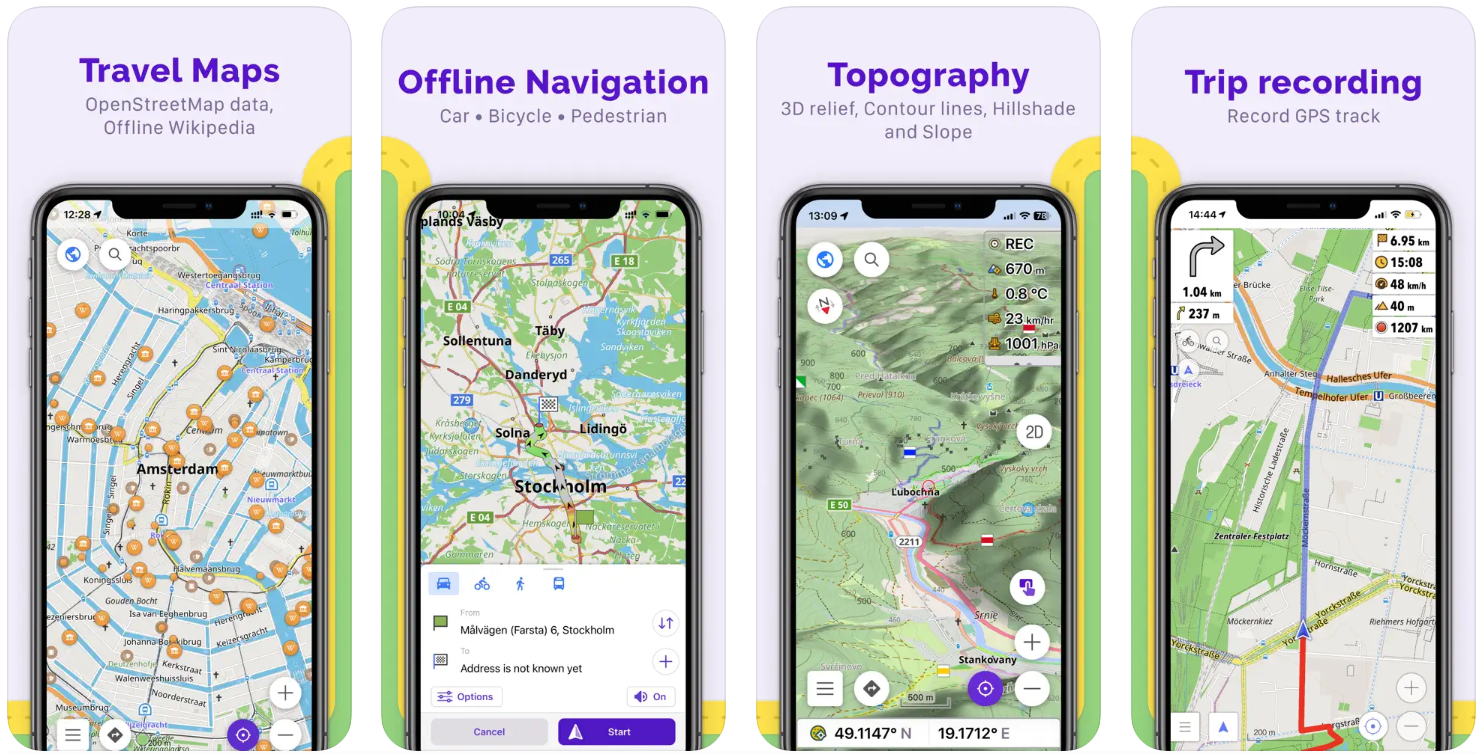
OsmAnd is an open-source navigation application that is primarily focused on offline use. Drivers can download maps of any region of the world, build routes without the Internet, and even manually change the route to exclude certain types of roads. The app supports many types of transport, including cars, bicycles, motorcycles and pedestrian mode, and allows you to customise the route to suit the specifics of the car or road conditions.
This solution is interesting for electric car drivers because it can display points of interest that can be adapted to charging stations, although there is no direct support for EV infrastructure or integration with charging operators. Instead, OsmAnd allows you to save your own GPX tracks, build a route with slopes, keep trip statistics, and see a detailed route profile with ascents and descents. For advanced users, it can be even more convenient than classic online navigators.
This app is suitable for those who want full control over their map, are not dependent on the Internet and appreciate the possibility of deep customisation. OsmAnd is more focused on hikers, expeditions, or cycling, but it can also be adapted for electric car trips if you want - although this will require more manual work.
Contact information:
- Website: osmand.net
- App Store: apps.apple.com/ua/app/osmand-maps-travel-navigate/id934850257
- Google Play: play.google.com/store/apps/details?id=net.osmand
- Facebook: www.facebook.com/osmandapp
- Twitter: x.com/osmandapp
- E-mail: [email protected]

10. Petal Maps
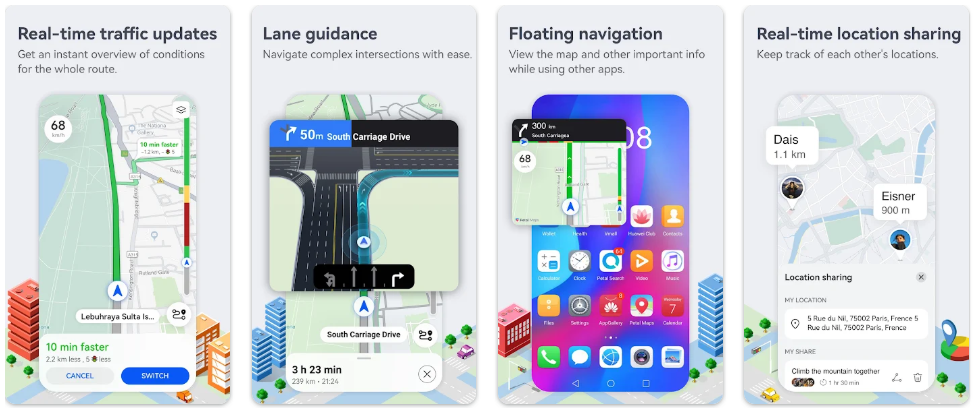
Petal Maps is a navigation app from Huawei that is available on many devices and covers most of the popular features, including real-time navigation, support for multiple transport modes and the ability to download offline maps. The app allows you to add stops to your route, report police or accidents, use voice search, and sync data between devices. There are basic functions for EV users, including searching for charging stations along the route.
Despite this, electric vehicles are not in the focus of development. The app does not filter stations by connector type, speed, or operator. There's also no route planning function based on battery power or charging backup. Users will have to check the details themselves or use additional services. It's worth noting that some users complain about the large amount of maps to download, which can be a problem for devices with limited storage space.
Petal Maps is better suited for daily city trips or as an alternative to Google Maps on Huawei devices. For drivers of electric vehicles, the app can be useful as basic navigation, but when it comes to long journeys with clear charging plans, its functionality will not be enough.
Contact information:
- Website: www.petalmaps.com
- Google Play: play.google.com/store/apps/details?id=com.huawei.maps.app
- E-mail: [email protected]
Bottom line.
The world of electric vehicles is developing at an insanely fast pace - and what seemed difficult yesterday has become commonplace today. But even with all the advantages of electric cars, comfort on the road directly depends on how well you have prepared your route. That's why a good navigation app is not a luxury, but a real necessity.
We have compiled a selection of services that really work in the Ukrainian context. Some of them are universal assistants, others are more specialised. But all of them have one thing in common: they help you avoid surprises and allow you to focus on the road, not on finding a power outlet in the middle of the road.
Although there is no perfect app for every occasion, we recommend choosing the one that works best for you - depending on your habits, driving style, car type and where you are going. And if you're looking for a solution tailored to Ukrainian realities, with a proven charging network and easy navigation, then ECOFACTOR EV Charging is the right choice.
Frequently asked questions
Is it necessary to use a special app to travel by electric car?
It's not necessary, but it's highly desirable. Without it, you risk either spending a lot of time looking for a charger or getting stuck on the road altogether. Even if it's Google Maps, it's better to have at least a basic tool for planning recharging stops.
Which app works best in Ukraine?
ECOFACTOR or GO TO-U are best suited for daily use and travelling around the country - both are designed with the Ukrainian infrastructure in mind, support local operators and show the real status of charges.
Why aren't Google Maps or Waze always convenient for an electric car?
Because they don't take into account the battery charge, don't show whether the station is compatible with your car, and don't always update charging statuses. This works well in the city, but on long-distance journeys you need more control.
Does it make sense to pay for premium features in such applications?
If you travel frequently, yes. Paid versions often have better analytics, more filters, more accurate cost forecasts, and access to additional features such as charging reservations. If you drive mostly in the city, the basic functionality may be enough.
What to do if you don't have mobile internet on the road?
Download offline maps in advance. Most apps, such as ABRP or Sygic, allow you to work even without the internet. But of course, you won't be able to update the status of stations without a connection.


