





Choosing a mobile charger for Tesla Model S 2013: a complete practical guide
The 2013 Tesla Model S belongs to a generation of electric vehicles that has been on the market for quite some time. Many owners of such cars have experienced difficulties in finding charging stations, especially outside of large cities. Although the infrastructure for electric vehicles is gradually developing, in many regions it is still insufficient. This creates situations where access to a power source becomes a problem. In such [...]
Content:
The 2013 Tesla Model S belongs to a generation of electric vehicles that has been on the market for quite some time. Many owners of such cars have experienced difficulties in finding charging stations, especially outside of large cities. Although the infrastructure for electric vehicles is gradually developing, in many regions it is still insufficient. This creates situations where access to a power source becomes a problem.
In such cases, a mobile charging station can be a convenient solution. It allows you to charge your car in places where there is no access to specialised stations. For example, in a private yard, in the country, on a business trip or while travelling. This is especially true for cars that have been in use for several years, as their batteries can discharge faster than new ones.
We remind you that you can purchase home and commercial charging stations in our online storeand also use the public charging stations ECOFACTORcharging points located throughout Ukraine. For convenient access to charging infrastructure, we recommend using our mobile applicationwhich is available on iOS and Android.
A mobile station is not a one-size-fits-all solution, but it can partially compensate for the lack of charging infrastructure. This is especially noticeable in winter, when electric vehicles consume more energy. For the Tesla Model S 2013, this issue becomes practical rather than theoretical. If the owner does not have access to a home wallbox or does not want to search for public charging every time, the portable version can help to get out of many situations.
In the article below, we'll take a look at how mobile charging stations work, which ones are compatible with the Tesla Model S 2013, what to look for when choosing one, what are the pros and cons, how to use them safely, and how to take care of them to make them last longer.
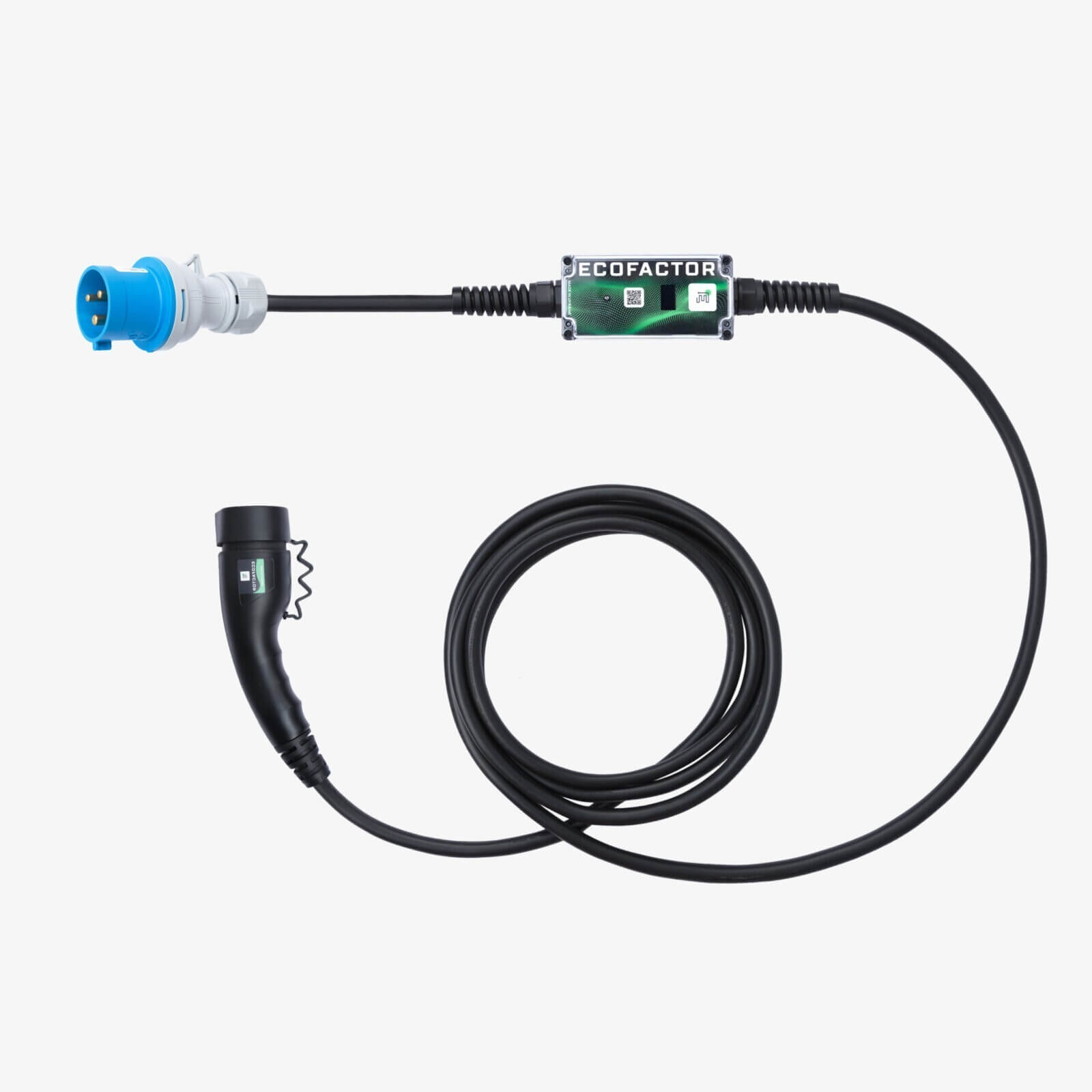
What is a mobile charging station and how it works in the case of Tesla Model S 2013
A mobile charging station is a portable device designed to charge an electric vehicle in conditions where stationary charging is not available or inconvenient. It is connected to a standard electrical network - domestic or industrial - and allows current to be transferred directly to the car battery. In most cases, the station consists of a housing with built-in electronics, a cable with a power connector and a charging cable with a suitable plug for the car.
The Tesla Model S 2013 is compatible with the proprietary Tesla connector, but also supports charging via the J1772 adapter. This means that when choosing a mobile charging station, you should pay attention to the type of connector or the availability of a suitable adapter. Most often in Ukraine, stations with Type 1 or Type 2 connectors are used, so a Tesla adapter will be necessary if the station does not have a branded cable.
Mobile charging is suitable for long, slow charging, for example at night or when you are stopped on the road. The device does not provide the same speed as a supercharger, but it is sufficient for most daily needs. For example, if you leave the car connected for 8-10 hours, you can get an additional 100-150 km of range, depending on the power.
Another important consideration is the ambient temperature. Charging in cold or hot weather affects the efficiency and speed of the process. Therefore, it is worth choosing a station with temperature control or at least with built-in overheating protection.
The mobile charging station does not require any complicated installation. In most cases, it is enough to plug it into a regular 220V outlet and insert the plug into the car's charging port. However, there are models that support a three-phase connection or have variable power - this expands the charging capabilities, but requires a more careful selection of parameters.
For owners of the Tesla Model S 2013, a mobile charging station can be the main way to replenish the charge when home charging is not possible or when routes are not covered by fast charging stations. Ease of use, compatibility with the household network and flexibility in connection make this option a practical addition to the electric vehicle.
Main features of the mobile charging station for Tesla Model S 2013
For a mobile charging station to be truly useful and meet the technical features of the Tesla Model S 2013, you need to carefully analyse its parameters. There are many models available on the market that look very similar, but in practice can vary greatly in terms of functionality, speed and safety. If you choose the wrong device, it will either charge too slowly, or not be able to connect to the car at all due to an incompatible connector, or work unstably due to power problems.
This is especially true for cars released earlier, such as the 2013 Tesla Model S. It has a limit on the maximum receiving power, a specific adapter system and does not support the latest fast charging standards. Some Model S 2013 with Dual Charger support up to 22 kW, check the specification of your car. That's why it's important to carefully review the key specifications before purchasing a mobile charging station. In this section, we discuss five key parameters that you should pay special attention to.
Charging power
This is one of the main parameters that determines how long it will take to replenish the battery. The power is indicated in kilowatts. But it's important to understand that the car itself also has power intake limitations. Some Model S 2013 with Dual Charger support up to 22 kW. This means that more powerful charging stations will not make sense, because the car will not be able to physically accept more power.
- 3.6 kW: The most common and affordable option. It works from a regular 16 amp socket. A full charge takes approximately 17-24 hours for the 100%. Suitable for overnight use or when the car is parked for a long time.
- 7.2 kW: Optimal for daily use. Requires a 32 amp connection. Charges Tesla Model S in 10-12 hours up to 100%, 6-8 hours up to 80%. Requires a stable power supply.
- 11 kW: Maximum for AC power that the Tesla Model S 2013 can use. Three-phase power supply is required. Charging takes approximately 7-8 hours for 100%, 4-5 hours for 80%. Only makes sense where such a network is actually available.
Connector type
This is the physical connection between the charging station cable and the vehicle. If the type of connector does not match the car port or there is no adapter, you will not be able to charge the car.
- Tesla connector: The proprietary Tesla Connector, which is used directly with Tesla cars. The most convenient option, as it does not require any adapters. It is most often found in chargers designed specifically for Tesla.
- J1772: A common standard in North America. Tesla Model S 2013 supports it via an adapter. Such an adapter is often included with the car.
- Type 2: European standard. Also compatible with Tesla via an adapter. Widely used at public charging stations in Ukraine and other European countries.
Power supply type
This is a parameter that indicates which power grid the charging station can connect to. This determines not only the power but also the stability of the operation.
- 220 V (single-phase): The most common type. It works from a regular household outlet. Supports up to 7.2 kW.
- 380 V (three-phase): Required for 11 kW of power. It is not available everywhere, but it significantly speeds up charging.
- Schuko, CEE, NEMA sockets: Physical connection options. The more the station supports, the better. It is most convenient if there are interchangeable plugs or adapters.
Degree of protection of the housing
This parameter indicates how well the charging station is protected against dust, moisture and weather conditions. It is indicated by a two-digit IP code. The higher the numbers, the better the protection.
- IP54: Basic level of protection. Protects against dust and water splashes. This enclosure is suitable for use under a canopy or in dry weather conditions.
- IP65: It provides protection against heavy rain and dust. This station can safely operate outdoors even during precipitation.
- IP67: Maximum protection. The case is sealed, the device is not afraid of immersion in water. Ideal for harsh weather conditions, but rarely found among mobile models.
Cable length
This parameter is important from the point of view of convenience. If the cable is too short, you will have to park the car very precisely or you will not be able to reach the socket at all. A cable that is too long will be heavy and inconvenient to store.
- 3-5 metres: Only suitable for very close proximity to a power outlet. In most cases, it may be inconvenient.
- 6-8 metres: The most versatile option. Long enough to connect comfortably in most conditions. At the same time, it does not create problems with weight and storage.
- 10 metres and more: It is good for situations when the car is far from a power outlet. But this cable is heavier, takes up more space, and is more expensive.

ECOFACTOR: Innovative solutions for environmentally friendly and efficient charging of electric vehicles
About us ECOFACTOR We create modern solutions for charging electric vehicles, combining efficiency, safety and environmental care. Our focus is on reducing energy consumption, optimising the charging process and extending battery life. We offer charging stationsThe new models meet modern technical requirements and provide comfort for everyday use.
In addition to basic chargers, we also develop cables and adaptersThe Tesla Model S is equipped with European standard-compliant connectivity that guarantees a stable connection in all conditions. Tesla Model S owners can use smart features to monitor, schedule charging and analyse energy consumption.
We are constantly improving our products by introducing new technical solutions that make charging even more convenient and profitable. Our systems help:
- Reduce energy costs: thanks to precise consumption control.
- Improve charging efficiencyminimising energy transmission losses.
- Control charging from your smartphone: through mobile application, available at iOS and Android.
- Promote sustainability: helping to reduce CO₂ emissions through the use of clean energy.
Choosing solutions from ECOFACTORBy choosing us, you are investing in reliability, energy efficiency and sustainability. We also support map of charging stations, which helps drivers quickly find the nearest charging points.
Advantages and disadvantages of mobile charging stations for Tesla Model X
Mobile charging stations have become an important part of the electric vehicle package. For owners of the 2013 Tesla Model S, especially those who travel frequently or are unable to install a stationary charger, a portable station can dramatically change the experience of using a car. However, like any technical device, a mobile charging station has not only advantages, but also certain limitations. In this section, we'll look at both sides - what it offers the user and what its weaknesses are.
These advantages and disadvantages should not be evaluated in isolation, but in the context of the specific conditions in which the car is used. If you use your car in a city with a good charging infrastructure, you may rarely need a mobile station. But if you often drive long distances, stay overnight in private estates, or travel in regions with no public charging points, this solution may be indispensable.
Advantages.
The mobile charging station has several obvious advantages that make it convenient for everyday use.
Independence from charging infrastructure
The presence of a mobile station allows you to charge your car almost anywhere there is electricity. This is especially useful outside the city, in rural areas, in the countryside or in the mountains. You are not dependent on whether there is a public charging station nearby, whether it is working or busy.
Can be charged at night or when stopped
The portable station can be plugged into a regular power outlet - for example, in a hotel, car park or garage. This allows you to charge your car at night or while you are doing other things. This way, you can make the most of your downtime.
Easy to transport
Most mobile stations are compact and weigh 2-6 kilograms. They are easy to store in the trunk and do not take up much space. This allows you to always have a device on hand, even if you rarely use it.
Easy to connect
There is no need to install or configure anything to start charging. Simply plug the plug into a socket and connect the cable to your car. There are no apps, registrations or authorisations. This is especially important for older users or in emergency situations.
Savings on infrastructure
In many cases, the installation of a home wallbox requires a project, permits, and a new power line. A mobile station is cheaper, requires no installation and can be used immediately after purchase.
Disadvantages.
Despite its convenience, a mobile charging station also has certain limitations that you should consider before purchasing.
Low charging speed
Compared to stationary or superchargers, mobile stations are slow. When connected to a standard household outlet, charging can take more than 10 hours. This limits their use on short trips or when time is limited.
Dependence on the quality of the power grid
In many older buildings or in rural areas, the power grid is unstable. Power surges, loose contacts or overloads can lead to malfunctions or even damage to the station. In such conditions, models with automatic current control and protection are required.
Risks in case of improper use
Insufficient housing protection, improper connection, or use on a damp surface can cause a short circuit or even a fire. If the user ignores the instructions or connects the station to an unreliable outlet, the consequences can be serious.
Lack of additional features
Unlike expensive stationary solutions, mobile stations rarely have displays, remote control or smartphone monitoring functions. This makes it difficult to control the charging process. In the event of a failure, it is not always clear what happened.
Time spent on long journeys
When travelling, especially over long distances, you have to take into account the time required for charging. A mobile station may require you to stop for several hours, which makes your route less flexible if you don't have access to a fast charging network.
How to use the Tesla Model X mobile charger safely?
The correct use of a mobile charging station is no less important than its technical characteristics. The Tesla Model S 2013 is a car with sophisticated electronics, and any power failures can negatively affect the battery or control systems. Therefore, it is important that the charging station is not only technically suitable, but also used correctly. In this section, we will look at the basic principles of safe operation of a portable charging station in real-world conditions.
Always check the power supply before connecting
Not all sockets are the same. In older buildings or temporary structures, the wiring may be worn, the contacts may be loose, and the voltage may be unstable. Before connecting the station, check whether the socket is warm, whether the plug sparks, or whether you can smell melted plastic. If in doubt, it is better to refrain from charging in this place.
Do not connect the charging station to extension cords
Many people try to compensate for a short cable with an extension cord. This is a serious mistake. Even a high-quality household extension cord may not be able to withstand the current consumed by the charging station, especially with a power of 7 kilowatts or more. This can lead to overheating, contact melting or short circuits.
Use only earthed sockets
The Tesla Model S has a built-in system that can block charging if it detects a lack of grounding. But even if the car starts charging, it will be dangerous. Grounding provides protection in the event of a voltage breakdown on the body. If it is not, the risk of electric shock increases significantly.
Do not charge the car in the rain without proper protection of the case
If the station has a protection rating lower than IP65, it is better not to use it outdoors during precipitation. Moisture can get into the electronics, causing malfunctions or short circuits. If you need to charge outdoors, use a cover or a station with full water protection.
Do not twist, pull or bend the cable
The charging station cable has thick insulation, but even this does not last forever. If the cable is constantly pulled, stepped on, or rolled up with excessive force, microdamages will appear over time. This can cause heating, loss of contact, or complete station failure.
Monitor the temperature of the device while charging
Some charging stations have built-in temperature sensors. If your model does not have them, periodically check the case with your hands. If it becomes hot, it is a reason to interrupt charging and check the conditions. Overheating can be caused by a weak network, poor contact, or overload.
Do not leave the charger unattended in unfamiliar locations
If you are charging your car in a hotel courtyard, in someone else's garage or at an unguarded petrol station, do not leave the charging station unattended. This is expensive equipment, and cases of theft or deliberate damage are not uncommon. If there is a risk, it is better to stay nearby or find a safer place.
How to extend the service life of a mobile charging station?
To ensure that your mobile charging station will last a long time and operate stably, it must be used in accordance with basic care instructions. Even a high-quality device can fail due to improper storage, overheating, or mechanical damage. Below are some basic tips to help keep your charging station in good condition.
- Do not leave the station in direct sun or rain. Even with protection, it is best to avoid prolonged exposure to the weather.
- Store your device in a case or bag. This reduces wear and tear from vibrations, dust and bumps in the boot.
- Check the cable and connectors. If there are cracks, exposures, or abrasions, do not use the station until repaired.
- Do not bend the cable in one place. Try to roll it evenly to avoid damaging the insulation.
- Avoid dirt and dust. Do not use the station in construction sites or in areas with high humidity.
- Allow the device to cool down after charging. Do not put it immediately in a bag or under other items.
- Clean the plugs with a dry, soft cloth. Moisture and aggressive agents are not permitted.
- Do not keep the station plugged in at all times. Switch it off when charging is complete.
Conclusion.
The mobile charging station for Tesla Model S 2013 is a practical solution in situations where access to stationary charging equipment is unavailable or unreliable. It allows you to charge your car anywhere there is electricity, making it convenient for both daily use and travelling.
To ensure that the station operates stably, safely and meets the capabilities of the vehicle, you should pay attention to the key characteristics before purchasing. These include power, connector type, type of connection to the network, housing protection and cable length. It is also important to understand the conditions in which you plan to use it and whether the chosen option is compatible with your power supply.
Regular maintenance, adherence to basic safety rules and conscious use of the charging station help to avoid problems and extend its service life. Owners of the Tesla Model S 2013 can fully rely on the mobile station as a primary or backup charging source if the device is selected correctly and used within the practical limitations.
Frequently asked questions (FAQ)
1. Can I charge the Tesla Model S 2013 from a 10 amp household outlet?
You can, but charging will be very slow. The power will not exceed 2 kilowatts. At this level of charging, a full battery will take more than 15 hours to charge. This is acceptable only in conditions where there is no other option.
2. What should I do if the charging station does not detect the connected car?
Check that the cable is firmly inserted into the port, that there is no damage to the contacts, and that the charging mode is set correctly. Also make sure that the adapter is in good condition and matches the type of connector.
3. Does the air temperature affect the operation of the charging station?
Yes. At low temperatures, the cable becomes stiffer and the electronics may malfunction. In extreme heat, overheating is possible. Most stations have an operating range of approximately -25 to +50 degrees Celsius.
4. How much electricity does the charging station consume in standby mode?
Usually very little - no more than 1-2 watts per hour. However, it is recommended that you unplug it after charging to avoid unnecessary strain on the mains and to extend the life of the device.
5. Is it necessary to certify a mobile station in Ukraine for legal use?
Certification is not required for private use. However, if the station is to be used in public places or as part of a service, you should ensure that it has the appropriate compliance documents.
6. Can I charge other electric cars at the same station as my Tesla?
Yes, if the station is universal or has interchangeable cables. In this case, you just need to find an adapter for the connector of another car. However, not all stations support automatic recognition of different standards, so you should check compatibility separately.


