





Kia Niro EV vs Hyundai Ioniq Electric: a full analysis for Ukrainian drivers
The Kia Niro EV and Hyundai Ioniq Electric are two popular electric cars that have already proven themselves on the Ukrainian market. They attract with an adequate price, good functionality and the ability to operate in conditions that are far from ideal. The Niro is distinguished by its dynamics, spacious interior, higher seating position and a range of up to 385 km. Ioniq, although it has a slightly shorter range (up to 270 [...]
Content:
The Kia Niro EV and Hyundai Ioniq Electric are two popular electric cars that have already proven themselves on the Ukrainian market. They attract with an adequate price, good functionality and the ability to operate in conditions that are far from ideal.
The Niro is distinguished by its dynamism, spacious interior, higher seating position and a range of up to 385 km. The Ioniq, although it has a slightly shorter range (up to 270 km), makes up for it with its affordable price, comfortable interior and eco-friendly materials in the trim.
Both models are equipped with a modern multimedia system, support AC and DC charging, and are suitable for daily trips both in the city and on the highway. Next, we compare everything in turn: design, comfort, practicality, charging, and price. And all this is done through the prism of Ukrainian experience.
We remind you that you can purchase home and commercial charging stations in our online storeand also use the public charging stations ECOFACTORcharging points located throughout Ukraine. For convenient access to charging infrastructure, we recommend using our mobile applicationwhich is available on iOS and Android.
Introduction to Kia Niro EV and Hyundai Ioniq Electric
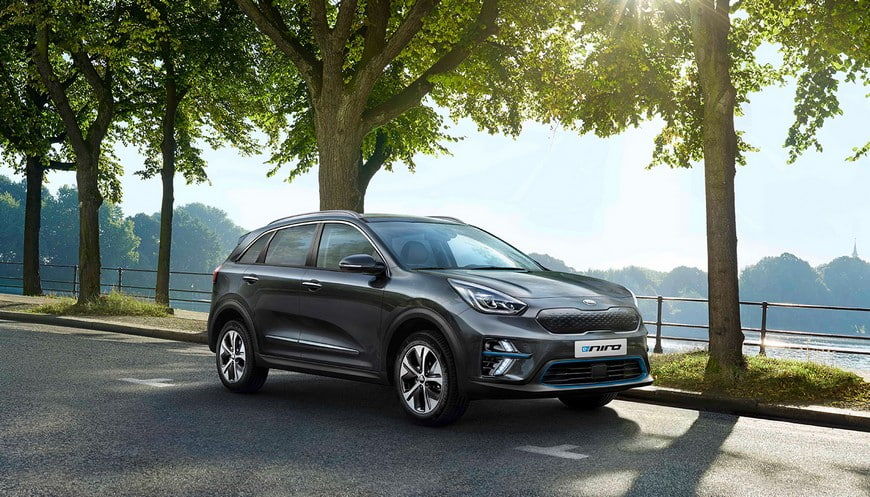
The Kia Niro EV is an electric crossover that has become quite popular among those looking for something between a classic car and an SUV. It offers a real five-seater layout, comfortable seating, good dynamics and a range that is sufficient not only for the city. In Ukraine, it is often bought second-hand from Korea or the United States, and it feels good both on asphalt and on broken roads.
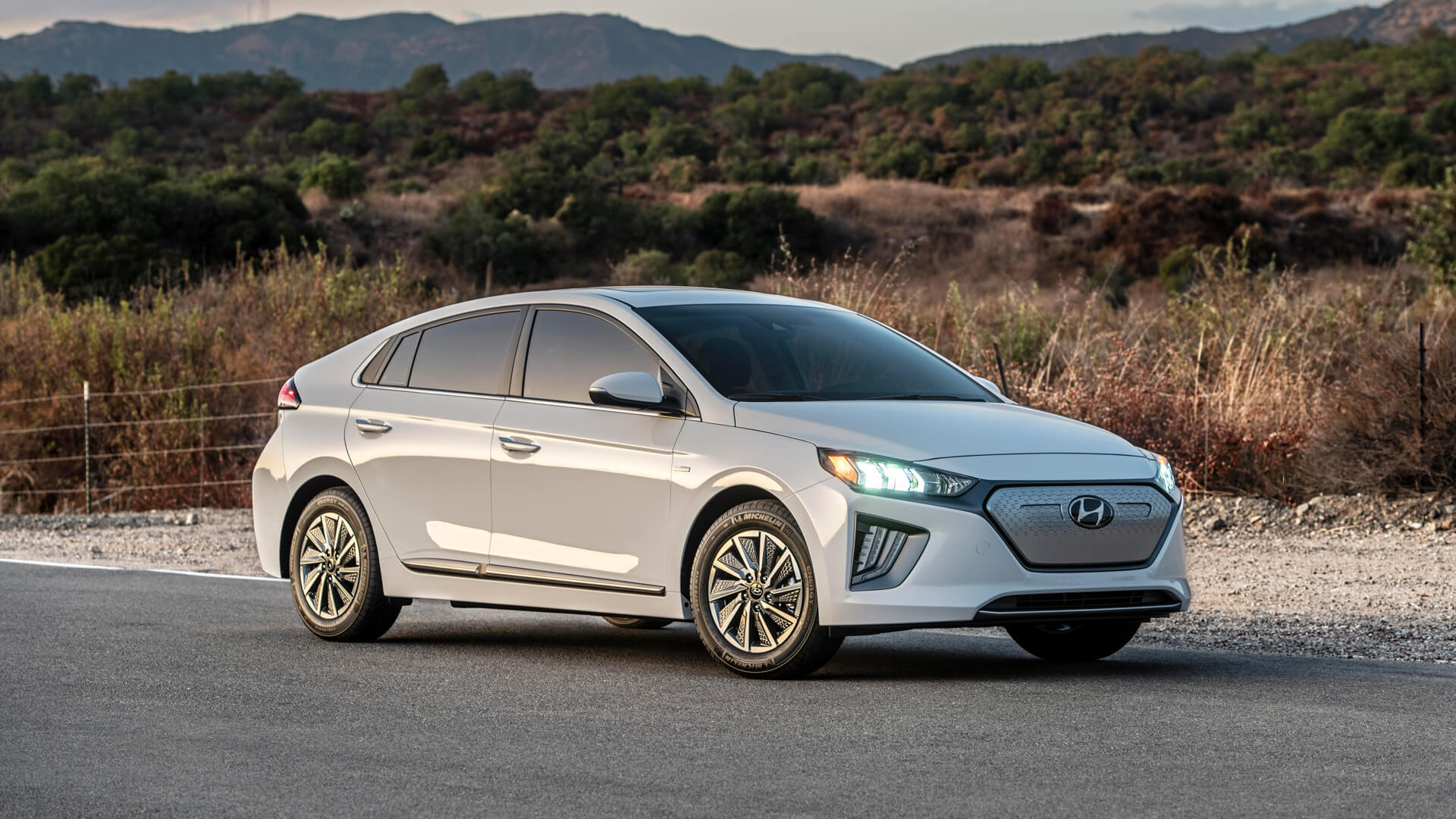
The Hyundai Ioniq Electric is less noticeable at first glance. It's a liftback, a cross between a hatchback and a sedan, but it looks rather restrained. Nevertheless, behind the outward simplicity is good ergonomics, efficiency and attention to detail. Many people choose it because of its affordability, minimal costs and pleasant experience in the city.
Design: similar in appearance, but each with its own character
Appearance
The Niro EV looks confident - not aggressive, but certainly not modest. Thanks to its high stance and distinctive front profile, it looks more like a crossover than a raised car. The black plastic body kit, wide taillights, and massive snout all look functional and modern. It is important that this silhouette adds convenience in Ukrainian conditions - when you need to pull over to the side of the road or jump over a pit.
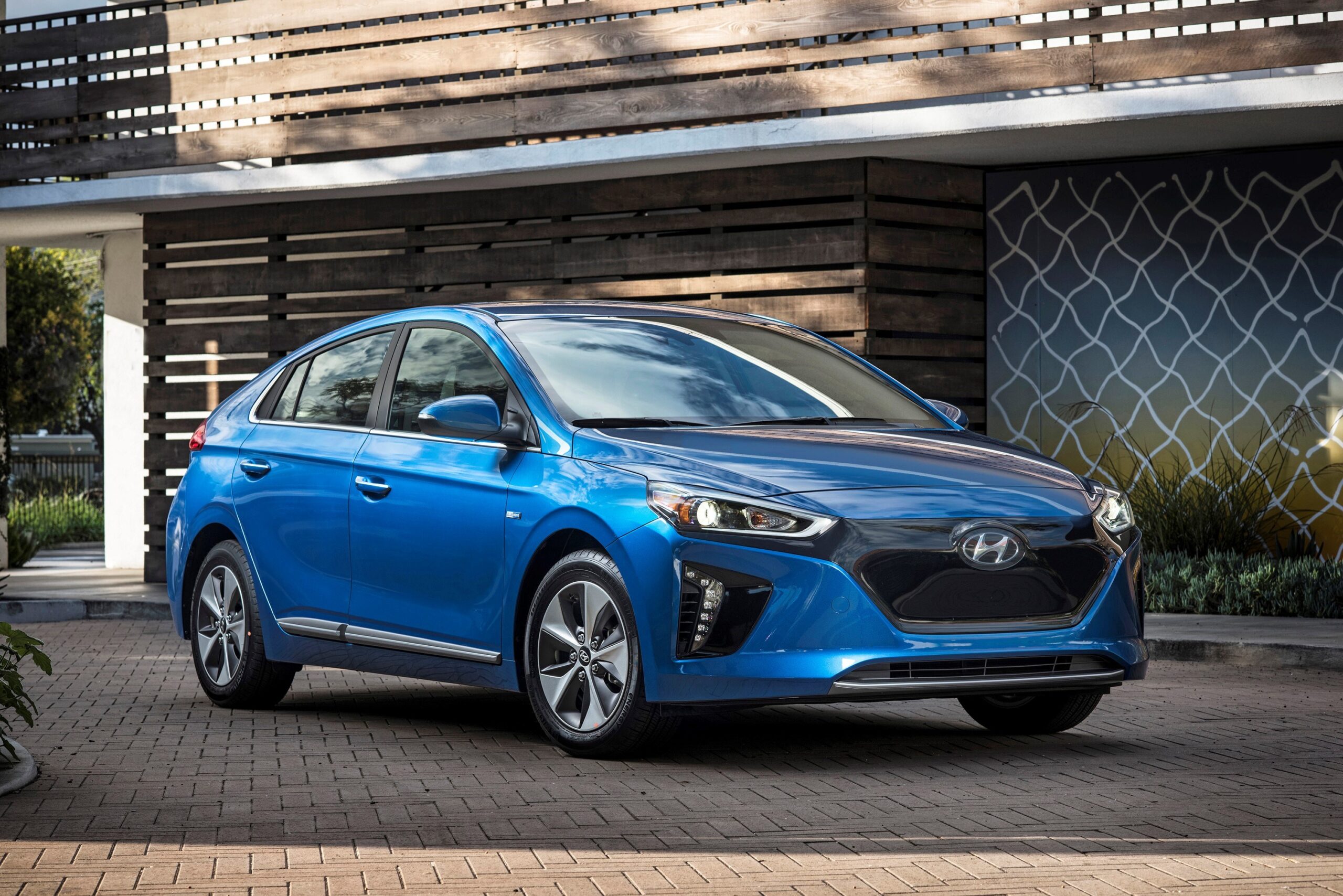
The Ioniq Electric, on the other hand, is all about smoothness and economy. The narrow profile, streamlined lines, low stance - all this contributes to less air resistance and, accordingly, more economical use of the charge. The Ioniq looks calm, even a little ascetic, but for many people, this restraint is an advantage.
Salon
The Niro has a spacious interior with logical button and instrument layout. The front seats are comfortable, and the rear row is one of the best in its class in terms of legroom. Multimedia works stably, and there is support for Android Auto and Apple CarPlay. Also worth mentioning is the large boot, which is really handy in everyday life.
Ioniq is not far behind either. Although there is less space, the interior uses eco-friendly materials - a nice bonus for those who care about the environment. The plastic is recycled, the fabric is organic. At the same time, everything looks laconic and not "cheap". The control panel is simple but convenient, with a large multimedia screen.
Practicality in everyday use
Kia Niro EV is a good option for a family or those who often transport something. The trunk is large, the rear row is not "for show". Plus, it has a comfortable fit: you don't have to "fall" into or out of the cabin. It is well suited for those who drive a lot on the roads, because the suspension can withstand bumps better than average.
Hyundai Ioniq Electric, although smaller, is suitable for those who live in the city. Manoeuvrability, compactness, and better parking are all important in dense urban areas. If you drive alone or together, there will be plenty of space. But if you often carry something bulky, it will be more difficult, although the seats fold down and this saves the situation a little.
Dynamics: who drives better?
In terms of dynamics, both electric cars offer a typical EV experience - instant torque, quiet interior and smooth driving. But they still have different personalities.
The Kia Niro EV is equipped with a 204 hp electric motor and 255 Nm of torque, which is available immediately from the start. This ensures quite lively acceleration - approximately 7.8 seconds to 100 km/h. This is great for city driving: you can quickly break out of traffic, overtake a minibus, or keep up the pace at short junctions. In sport mode, the pedal response is even sharper, and the car feels more energetic. On the highway, when overtaking, this dynamics is also very useful.
In terms of handling, the Niro is stable, although its height makes itself felt - moderate rolls are possible in corners. However, this is expected for a crossover. The suspension works well - it's not too stiff, but it's not "cottony" either, which is especially important on uneven Ukrainian roads.
The Hyundai Ioniq Electric, on the other hand, has 136 hp and 295 Nm of torque. It's not as sharp as the Niro, but it makes up for it with a smooth ride and stability. Acceleration to hundreds is about 9.7 seconds, and you can feel it: the car starts softer, does not push in the back, but does not slow down either. For drivers who prefer a quieter driving style, the Ioniq can be even more comfortable.
Its main advantage is its lower centre of gravity. This makes it better at cornering, especially on winding roads. The steering is lighter, but predictable - not sporty, but accurate. At high speeds, the car stays in the lane confidently, without any unnecessary nerves.
Noise insulation is also worth mentioning. In both cars, it's decent, but the Ioniq has a slight advantage in the city: you can hear rubber and street noise less, especially at low speeds. The Niro, on the other hand, better isolates road bumps and doesn't make as much noise on broken asphalt.
Power reserve and real distances: who will go further?
Cruising range is one of the most important parameters when choosing an electric vehicle, especially in Ukraine, where the charging infrastructure is still developing. And here, Kia Niro EV definitely comes out on top.
Thanks to its 64.8 kWh battery, the Niro can deliver up to 385 km on the WLTP cycle. In real-world conditions - with traffic lights, traffic jams, air conditioning or heating - you can expect 280-310 km. This is enough to drive safely from Kyiv to Vinnytsia without recharging. Even in winter, when consumption increases due to the heating of the cabin and the battery, the range rarely falls below 230-250 km, if you do not push the gas too hard.
The Hyundai Ioniq Electric, on the other hand, has a smaller battery - 38.3 kWh - and a WLTP range of up to 250 km. In practice, this is usually 200-220 km, and in cold weather it is closer to 180 km. This is quite enough for urban use or short trips between cities, but for long journeys, you will have to plan your route more carefully.
Another point is the stability of consumption. In the Niro, energy consumption is more predictable, even when driving fast. In the Ioniq, the figures fluctuate more significantly depending on driving style and terrain.
As a result, if you often travel outside the city or just don't want to think about charging all the time, the Niro EV will give you more peace of mind. If your daily routine is 30-50 km around the city and a trip to a neighbouring district centre once a week at most, then the Ioniq Electric will be enough. But the difference in autonomy between them is really noticeable.
Charging in Ukraine
The Niro supports fast charging up to 100 kW, which means that at a good DC station, you can charge 10 to 80% in about 50-55 minutes. At home, from 7 kW - about 9-10 hours.
The Ioniq only supports up to 50 kW on DC, so although the time on the 80% is the same (smaller battery), it requires more planning on the highway. However, it charges faster at home - about 6 hours from the same charge.
Unfortunately, there are not 100 kW stations everywhere in Ukraine. Often it's 22 or even 11 kW, so sometimes Ioniq looks more practical because of its smaller battery capacity.
Prices and availability
Ioniq Electric is often cheaper on the secondary market. Used cars from Korea or the United States can be found from $14-15 thousand. Taking into account customs clearance, this is a good option for those who want an electric car "to try".
Niro EV will cost more - from $19-20 thousand for the early years. But it is still cheaper than Tesla or ID.4. The cost of maintenance for the two is about the same, but Niro has more combinations and configurations.
Both brands already have a service base in Ukraine. Hyundai is a little easier to service due to its larger market presence, but this is not critical.
Alternatives to consider
If you're still not sure about your choice after seeing the Niro and Ioniq, that's okay. Fortunately, the Ukrainian aftermarket for electric cars already has plenty to choose from. Here are some alternatives worth considering.
Nissan Leaf is a true veteran among electric vehicles. It is easy to find at any Ukrainian car dealership. And the prices are reasonable - especially for the first generations. But there is a caveat: early versions have a range of only 150-170 km at best. That's fine for the city, but if you want to go further out of the region at least once a month, it won't be enough. But spare parts are available, many people have already learned how to service them, and you will definitely not be the first Leaf owner at your service station.
Renault Zoe is small, nimble and quite economical. It's perfect for the city: narrow streets, close parking, short daily runs - all this is about Zoe. However, if you plan to travel on the highway, it is not so convenient: a small ground clearance, not very powerful charging and limited space in the cabin can make themselves felt.
The Volkswagen ID.3 has a modern platform, a bigger battery, a modern design and more technology. The car is clearly "for growth". But the price is closer to Tesla than to Ioniq. If you have a little more budget and want something new, not "beaten from America," this is an option that is definitely worth considering.
Tesla Model 3 is a different story. It's not just an electric car - it's almost a status symbol. It is powerful, fast, and technologically advanced. But it also requires more attention: specific maintenance, charging is not convenient everywhere, and repair prices bite. If you are a fan of technology and are ready to tinker with it sometimes, this is an option that gives you emotions.
Bottom line: when choosing between the Niro, Ioniq, and alternatives, it's important to understand how you drive, what you carry, and how much you're willing to invest in charging infrastructure. There is no perfect car, but you can definitely find your own electric car.

ECOFACTOR: charging infrastructure in Ukraine
If you're reading this and choosing between the Kia Niro EV and the Hyundai Ioniq Electric, you're probably either planning to switch to an electric car or already driving one. At ECOFACTOR, we are well aware that after choosing a car, an equally important story begins - how, where and how convenient it is to charge it.
We create solutions that make life easier for electric car owners in Ukraine. This is not only charging stations - mobile, AC up to 44 kW or DC up to 420 kW - but an entire ecosystem. Drivers of Kia, Hyundai and other EVs can connect to our platform via the app for iOS and Androidwhere available map of charging stationsYou can see the real status of each point, tariffs, charge history and instant payment. Our system also supports roaming with a network in 11 countries, so if you are planning a trip to Europe, the infrastructure is already in place.
For those who are just setting up a charging point at home or at a business facility, we have online shop. There you can find not only the most stationsbut also the necessary cables and adaptersaccessories, RFID cards, adapters, holders and other equipment. If you are having difficulty finding something, our team is always ready to help with the selection.
We also support operators and businesses through our network management platform. This is especially relevant for hotels, residential buildings, shopping centres or cafes that want to offer charging to their customers - even if they arrive with an Ioniq or Niro.
Our goal is to make charging an electric car in Ukraine as easy as refuelling a car with an internal combustion engine. Regardless of which model you choose, ECOFACTOR is already working to make your journey not only electric, but also truly convenient.
Bottom line: Kia Niro EV or Hyundai Ioniq Electric?
Both the Kia Niro EV and the Hyundai Ioniq Electric are truly worthy options in the world of electric vehicles, and each has its own logic. They have different approaches to the task of being convenient daily transport: one is a little more powerful and versatile, the other is more restrained, but simpler and more affordable.
The Niro EV will definitely be appreciated by those who want a little more from their car. It is faster, taller, has a longer range and feels more comfortable on a long journey. If you often drive on the highway, drive your family or just don't want to worry about where to charge the battery, this option is more of a "backup" in everything.
The Ioniq Electric, on the other hand, takes rationality. It has a lower price tag, is easier to charge at home, convenient in the city, compact and easy to drive. In addition, its interior made of eco-friendly materials is not just a gimmick, but a pleasant feeling that you are really driving a green car.
In terms of design and equipment, the two machines are quite similar - it's all about personal taste. But in terms of practicality and endurance, the Niro has an advantage. At the same time, the Ioniq looks like a logical choice for those who are looking for their "first electric car" without spending too much money and with an eye on the city.
The bottom line is simple: if you want more drive, space and power, look no further than the Niro. If you are interested in simplicity, accessibility and comfort within the city, the Ioniq will not let you down.
Frequently asked questions
Will the Ioniq Electric have enough range for daily use?
Yes, if most of your trips are in the city or short trips outside. In the city, the Ioniq confidently holds 200-220 km, which is quite enough even for a busy day. But if you often drive on the highway or plan trips of 300+ km, then it's better to pay attention to the Niro.
Which model is better for a family with children?
In this case, it makes more sense to look towards the Kia Niro EV. It has more space in the back, it's easier to install two child seats, and the boot allows you to throw a stroller in without a headache. The Ioniq can also be adapted, but it is still more suitable for a driver and one or two passengers.
If you have only a regular socket at home, which of these electric cars should you choose?
Then, to be honest, it will be easier with Ioniq. Due to its smaller battery capacity, it charges faster even from a slow network. But it's still better to have at least a 7-kilowatt charger - with it, any variant charges adequately overnight.
Is it difficult to find spare parts for these models in Ukraine?
No, it's not difficult. Both Kia and Hyundai have been present on the Ukrainian market for a long time, so spare parts - both new and used - are available. There are services that restore batteries, repair electronics and diagnose EVs. Plus, many cars are imported from Korea, so the flow of parts is stable.


