





Tesla Connector: full overview, specifications, compatibility and usage
The Tesla Connector is a proprietary charging connector used by Tesla to charge its electric vehicles. It allows charging cars with both alternating current (AC) and direct current (DC), making it versatile for everyday use. In North America, this connector has become the standard for Tesla cars, while in Europe the company has switched to CCS Combo 2.
Content:
The Tesla Connector is a proprietary charging connector used by Tesla to charge its electric vehicles. It allows charging cars with both alternating current (AC) and direct current (DC), making it versatile for everyday use. In North America, this connector has become the standard for Tesla cars, while in Europe the company has switched to CCS Combo 2.
The Tesla Connector has a compact design and built-in security system that prevents the cable from being accidentally disconnected during charging. It also supports automatic locking when connected, which helps to avoid loss of contact or unauthorised disconnection of the charger. It is worth noting that the Tesla Connector is now called NACS and is recognised by the SAE J3400 standard in North America.
We remind you that you can purchase home and commercial charging stations in our online storeand also use the public charging stations ECOFACTORcharging points located throughout Ukraine. For convenient access to charging infrastructure, we recommend using our mobile applicationwhich is available on iOS and Android.
In this article, we will take a closer look at the features of the Tesla Connector, its technical characteristics, contact layout, adaptability to other standards, and compare it with other charging connectors.
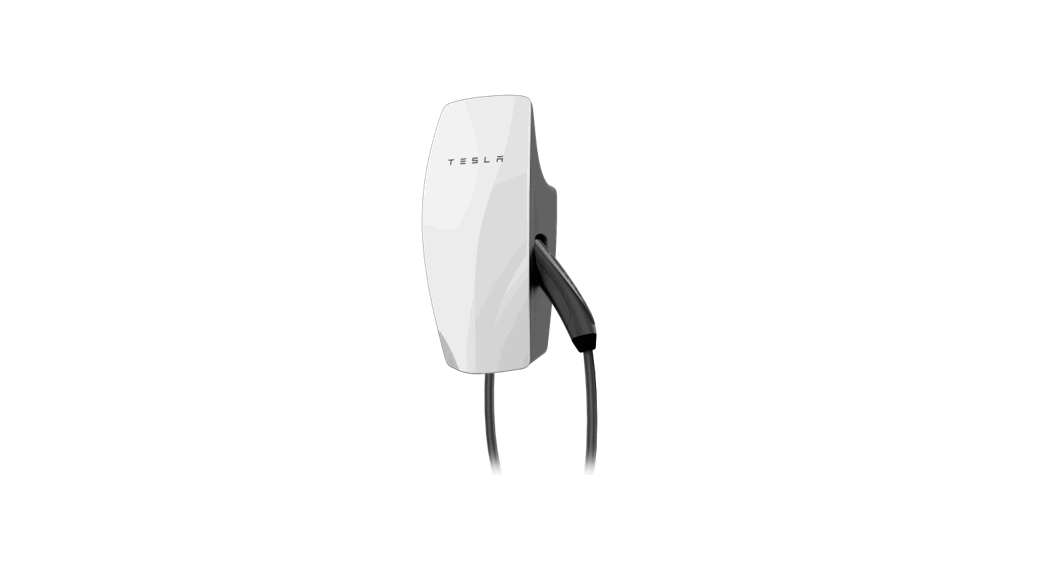
What is the Tesla Connector
The Tesla Connector is a patented charging connector developed by Tesla for connecting electric vehicles to AC and DC power grids. Unlike the CCS or CHAdeMO standards, the Tesla Connector combines AC and DC charging capabilities in one compact connector.
This connector is used in all Tesla vehicles in North America and at Supercharger stations. It may also be compatible with some third-party charging stations via adapters.
The main features of the Tesla Connector:
- Versatility (support for AC/DC charging)
- Compactness
- Built-in security system
- Automatic locking when connected
- Fast charging at Tesla Supercharger stations
Technical specifications
The Tesla Connector is designed to charge electric vehicles efficiently and safely in a variety of environments, from slow home charging to fast DC charging at Tesla Supercharger stations. With a unified connector, it combines AC and DC charging capabilities, reducing the need for separate ports for different current types.
The connector supports two-way communication between the vehicle and the charging station. This means that before the charging process begins, the car transmits the battery status and charging parameters, and the station adjusts the power supply according to the battery's capabilities. This mechanism prevents the battery from overheating and ensures a stable charging process.
The physical design of the Tesla Connector is compact and easy to use. Unlike CCS or CHAdeMO standards, it has a smaller footprint and lighter charging cable, making it easier to connect. In addition, a locking mechanism locks the connector into the socket during charging, preventing accidental disconnection.
The main technical parameters of Tesla Connector:
- Current type: supports alternating current (AC) and direct current (DC) charging
- Maximum power outputUp to 11-22 kW in AC and up to 250 kW in DC
- Operating voltage: 240 V for AC and up to 1000 V for DC (Supercharger V4).
- Current strengthUp to 48 A at AC and 630 A at DC
- Number of contacts: 5 (L1, L2, PE, PP, CP)
- Locking mechanism: automatic locking of the connector during charging
- Data exchange: maintaining communication between the vehicle and the charging station to regulate the energy supply
The Tesla Connector ensures stable contact between the car and the charging station, which minimises energy loss and reduces the risk of battery damage. In the event of an emergency, the system automatically stops charging, which increases safety.
Detailed pinout diagram
Tesla Connector has five main contacts, each of which performs a separate function during the charging process. A distinctive feature of this connector is the integration of AC and DC charging contacts in one connector, which avoids the use of separate ports for different types of charging.
The contacts of the Tesla Connector are positioned to ensure a secure connection and minimise energy loss. In addition, thanks to the automatic locking mechanism, the connected connector remains locked until the charging process is complete. This increases safety and prevents accidental contact breakage during the charging cycle.
The main contacts of Tesla Connector:
- L1 (Phase 1 AC or +DC): transmits alternating current during AC charging or positive contact during DC charging
- L2 (Phase 2 AC or -DC): serves as a neutral contact for AC charging or negative for DC charging
- PE (Protective Earth): ensures electrical safety during charging
- PP (Proximity Pilot, plug detection)transmits a signal that the connector is physically connected to the vehicle
- CP (Control Pilot): used to exchange information between the charging station and the vehicle
The control pilot (CP) plays a key role in the safety system, as it regulates the start and end of charging and monitors the power level to avoid overloading the network or overheating the battery.
A distinctive feature of the connector is that when connected to the charger, the contacts are compressed at a certain angle, which ensures a reliable connection even in the event of connector wear or mechanical stress. In combination with the automatic locking, this avoids sparking and increases component durability.
Compatibility and adapters
Since the Tesla Connector is a proprietary standard, it is not compatible with common standards without additional adapters. However, for the convenience of users, Tesla has released several adapters that allow you to charge your Tesla at third-party stations or use the Tesla Supercharger to charge other brands of electric vehicles.
Adapters available for Tesla Connector:
- J1772 Adapter - allows Tesla vehicles to be connected to Level 2 charging stations that use the J1772 standard. This is a common solution for slow charging in North America.
- CHAdeMO Adapter - is used to charge Teslas at CHAdeMO stations, which are popular in Japan and the United States. Although this standard is gradually losing popularity, some charging networks still support it.
- CCS Combo 1 Adapter - an adapter for charging Tesla at CCS1 stations in North America. It allows you to connect your car to DC fast charging stations that do not support the Tesla Connector.
- CCS Combo 2 Adapter - an adapter used in Europe to connect to CCS2 stations. It is required for owners of older Tesla models that do not have a built-in CCS2
In 2022, Tesla began to open its Supercharger network to other brands of electric vehicles. In some regions, owners of CCS2 cars can charge at Tesla stations using a special adapter that expands the possibilities of using Supercharger. Thanks to the adapters, Tesla owners can charge their cars not only in the Tesla network but also at third-party stations.
In addition to public charging stations, Tesla offers home solutions, such as the Wall Connector, a wall charger that supports AC charging with a capacity of up to 22 kW. It can be connected to both a standard outlet and a three-phase network for faster charging.
In 2023, Tesla introduced the Magic Dock, a special built-in adapter that integrates directly into the Supercharger charging station body and allows electric vehicles with a CCS1 connector to charge without additional adapters. This solution was key to opening up the Supercharger network in the US to other brands, as the Magic Dock automatically supplies the appropriate type of connector depending on the car model, ensuring CCS1 compatibility without losing charging speed.
How the Tesla Connector works
The Tesla Connector operates according to the standard principle for electric vehicle chargers, but has some unique features that distinguish it from other connectors. The charging process takes place in several stages and includes both a physical connection and data exchange between the car and the charging station.
Connecting the connector to the vehicle
The user inserts the plug into the charging port of the Tesla electric vehicle. Thanks to its ergonomic design, the connection is easy and can be done with one hand.
Checking and blocking
After connection, the contact is automatically checked and a special mechanism locks the connector in the charging port. This ensures that the connector is not accidentally pulled out during charging.
Data exchange via a control pilot (CP)
The CP pin starts to transfer information between the vehicle and the charger. The vehicle reports the battery charge level and the charging station sets the optimum current delivery parameters.
Start of the charging process
When the system determines that all the conditions for safe charging are met, voltage is applied. When charging with alternating current (AC), the vehicle's internal charger converts the electricity. When charging with direct current (DC), the electricity is supplied directly to the battery.
Monitoring of current and voltage levels
Tesla Connector supports dynamic charging power adjustment. If the battery is severely discharged, the power can be increased to quickly replenish the charge. When the charge level reaches 80-90%, the charging speed is reduced to avoid overheating.
Finish charging and unlock the connector
When the charge reaches the set level or the user stops the process manually via the Tesla mobile app, the power supply is stopped. The connector automatically unlocks and can be removed from the port.
The Tesla Connector also supports the function of preheating the battery before charging. This is especially useful in cold weather, when the battery may not be able to deliver its maximum power due to low temperatures.

ECOFACTOR: Innovative technologies for environmentally friendly charging of electric vehicles
About the company ECOFACTOR We specialise in creating advanced charging solutions for electric vehicles, focusing on high efficiency and reduced environmental impact. Our goal is to reduce energy consumption, optimise the charging process and extend battery life. We offer charging stationsThe company's products meet the highest standards of safety and efficiency, providing comfort and reliability for every user.
In addition to basic chargers, we also offer cables and adaptersWe offer European-standard charging points that ensure reliable connectivity in all conditions. Tesla Model 3 owners can take advantage of our intelligent solutions to monitor and optimise energy consumption, enabling fast and stable charging.
We are constantly improving our technology by integrating the latest developments to ensure an even more cost-effective and convenient charging experience. Here's how our innovative solutions help:
- Reduce energy costsECOFACTOR technologies significantly reduce energy consumption, which helps to reduce the cost of charging electric vehicles.
- Improve charging efficiency:: Thanks to special algorithms, we minimise energy losses, which allows us to make the most of the power supplied.
- Manage charging via a mobile app:Our systems allow drivers to control the entire charging process through mobile application, available for iOS і Android. This makes it possible to monitor the charge level, choose the best time to charge, and get full analytics of energy consumption.
- Contribute to the preservation of the environment:ECOFACTOR charging stations contribute to reducing CO₂ emissions and help to integrate clean energy into our infrastructure.
Choosing solutions from ECOFACTOR - is an investment not only in convenience but also in sustainable development. Our technologies help to save energy and provide maximum comfort for users.
We are actively expanding our network of charging stations and providing access to maps of charging stationsto help drivers find the nearest fast and safe charging points across the country.
Comparison with other connectors
Tesla Connector has several differences from other charging standards such as CCS, CHAdeMO and J1772. The main feature is that Tesla has combined AC and DC capabilities in one compact connector, while most other standards use separate contacts for different types of charging.
CCS (Combined Charging System) is one of the most widely used standards in Europe and North America. Unlike the Tesla Connector, CCS uses two additional contacts to transmit DC power, and charging stations that support it can work with different brands of electric vehicles. However, the CCS connector is significantly larger than the Tesla Connector, and the connection process is more complex due to the additional pins.
CHAdeMO is a standard that is widely used in Japan and partly in the United States. It only supports high-speed DC charging and requires a separate connection port. Tesla used to offer a CHAdeMO adapter, but now this standard is losing popularity due to its low charging power (up to 100 kW) compared to modern solutions.
The J1772 is used for AC charging in North America. It does not support DC fast charging, so Tesla owners can only connect to such stations via the J1772 adapter. The main difference is that J1772 is a universal standard for public AC stations, while Tesla Connector is used mainly in Tesla infrastructure.
Thus, Tesla Connector has the advantage of being compact and supporting two charging modes without the need for separate ports. However, its main limitation is that most stations in North America, except for Tesla Supercharger, do not support this standard without additional adapters.
Which socket is used with the Tesla Connector
The Tesla Connector can be connected to different outlets depending on the charging method.
For home use, Tesla offers the Wall Connector, a wall charger that plugs into standard 240V outlets or a three-phase network. The most common options are:
- NEMA 14-50 - a 240 V socket that provides charging with a power of up to 11-22 kW. It is one of the best options for installation in a garage or parking space.
- NEMA 5-15 - a standard 120 V household socket that provides slow charging with a maximum power of about 1.8 kW.
For high-speed charging, the Tesla Connector is used at Supercharger stations that operate at high voltage and maintain a constant current. In this case, no additional sockets are required - the user simply plugs the connector into the car.
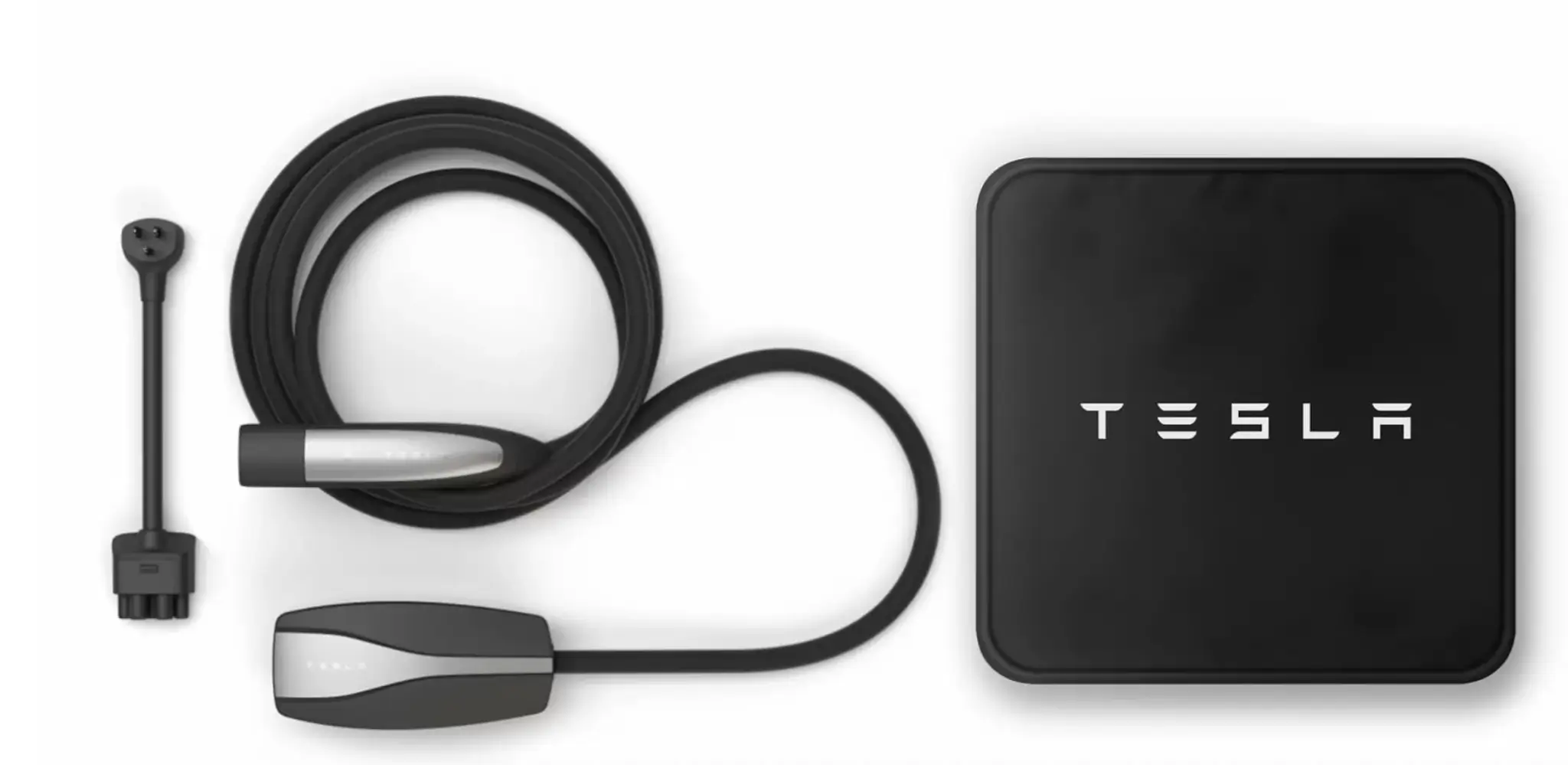
Tesla also offers a mobile charger with various adapters that allows you to charge your car from different types of outlets on the go.
Regional use
Tesla uses different charging standards in different countries, which is related to local requirements and existing infrastructure.
In North America, the Tesla Connector is the standard connector for all Tesla vehicles, and the Supercharger network only supports this format. Recently, however, Tesla has started to open its stations to other brands of electric vehicles through CCS1 adapters.
In Europe, all new Tesla models such as the Model 3 and Model Y are equipped with a CCS2 connector. This is because CCS2 is the standard for fast charging in the European Union. Older models, such as the Model S and Model X, can use adapters to connect to CCS2.
In Japan, Tesla initially supported CHAdeMO as it is the main standard in the country. However, new Tesla models in Japan are equipped with CCS2 or support CCS adapters.
In general, Tesla Connector remains dominant in North America, while in Europe and other regions, the company is gradually switching to CCS2.
Compatibility with cars
The Tesla Connector is compatible with all Tesla vehicles manufactured for the North American market. These include:
- Model S
- Model 3
- Model X
- Model Y
Older versions of the Model S and Model X use the same connector, but may require adapters to connect to newer types of charging stations.
Recently, several major automakers have announced the transition to Tesla Connector. For example, Ford, General Motors, Rivian, and several other companies have announced that their future electric vehicles will be equipped with this standard or will support it through adapters.
This means that Tesla Connector may gradually become more common among other brands of electric vehicles, especially in North America.
Conclusion.
The Tesla Connector is a charging connector that combines AC and DC charging capabilities in one compact package. Its main advantages are ease of use, compact size and support for fast DC charging.
However, compared to other standards such as CCS, Tesla Connector is not yet a universal solution and requires the use of adapters to connect to third-party stations.
With the Supercharger network opening up to other cars and other automakers adopting the standard, the Tesla Connector could become one of the dominant connectors for electric vehicles in the future.
Frequently asked questions (FAQ)
1. Can I charge my Tesla from a generator or solar panels?
Yes, it is possible. Charging from a generator requires a stable current and sufficient power (at least 5 kW). Solar panels require an inverter or energy storage system (e.g. Tesla Powerwall) to ensure stable charging.
2. Can I charge my Tesla in the rain or snow?
Yes, charging in rain or snow is safe. The connector and charging port are waterproof, and the electric current is only applied after the connection has been checked to ensure that it is secure, preventing any risks.
3. Why doesn't Tesla use CCS in the US if this standard is popular?
Tesla developed its own standard before CCS came along. Since Tesla built its network on its own connector, the company continues to use it. However, some manufacturers have now announced a switch to the Tesla Connector in the US, which could make it the mainstream standard.
4. Can I leave my car on charge overnight?
Yes, it is absolutely safe. Tesla automatically stops charging when the desired charge level is reached. You can also set the charge limit to not exceed 80-90%, which is useful for extended battery life.
5. Why is charging at Tesla Supercharger faster than at other stations?
Tesla uses a special protocol that allows for faster energy transfer compared to other stations, and also has a higher charging capacity - up to 250 kW on the Supercharger V3.
6. Can I charge other electric vehicles at Tesla stations?
Yes, in Europe, Tesla Superchargers support CCS2, so you can charge any electric vehicle with this connector. In the United States, you need a Tesla-to-CCS adapter for third-party vehicles.


