Table of contents:
Electric pick-up trucks are usually associated with loud promises, futuristic designs and a price that makes you think. The Maxus T90 EV takes a different approach. This is not an attempt to impress, but an attempt to offer a work tool in a new format – without a diesel engine, but with a body, load capacity and clear logic of use.
In this review, we look at the Maxus T90 EV without rose-coloured glasses. How it behaves in real conditions, what is convenient and what raises questions, and whether such a pickup truck makes sense for business or everyday tasks. No advertising wording, no exaggerations, and no attempts to pass it off as a universal solution. Just a calm, practical analysis of what this electric pickup actually is.
We remind you that you can purchase home and commercial
Car concept: electric traction without fantasy
The Maxus T90 EV is not an attempt to create a revolution. Rather, it is an attempt to do something that has been avoided in the past: take a conventional pickup truck, remove the diesel engine and install an electric traction system. And that’s it. No superstructures, no expensive sensors, no automatic doors, no virtual assistants. And this may be its main idea.
The T90 EV is the result of evolution, not experimentation. SAIC has been producing pickup trucks for many years, first under the LDV brand, then as Maxus. In China, these vehicles have long been used in the commercial sector: in construction, logistics, and infrastructure maintenance. The electric version simply adds a different type of drive to this picture – no more, no less.
It does not claim to be a premium vehicle, does not compete with the Tesla Cybertruck, and does not try to be an electric sports car. It is designed to transport goods and people within the city or nearby suburbs, and to do so cheaper than a diesel truck. In fact, this is the main reason for its existence: to optimise costs while maintaining the basic function.
The Maxus T90 EV was not created for driving or status. Its mission is to be an understandable, accessible tool. And in this context, its solutions look logical, even if they seem to be restrictive at first glance.
Body and layout: what a pickup truck that grew out of a van looks like
The story of the Maxus T90 EV did not start from scratch. This is not a separately developed electric platform, but an adaptation of the T90 diesel pickup truck, which is sold in China with classic internal combustion engines. The electric version is the result of a compromise: we took a familiar platform, removed the engine and tank, and installed an 88.5 kWh battery and an electric motor on the rear axle.
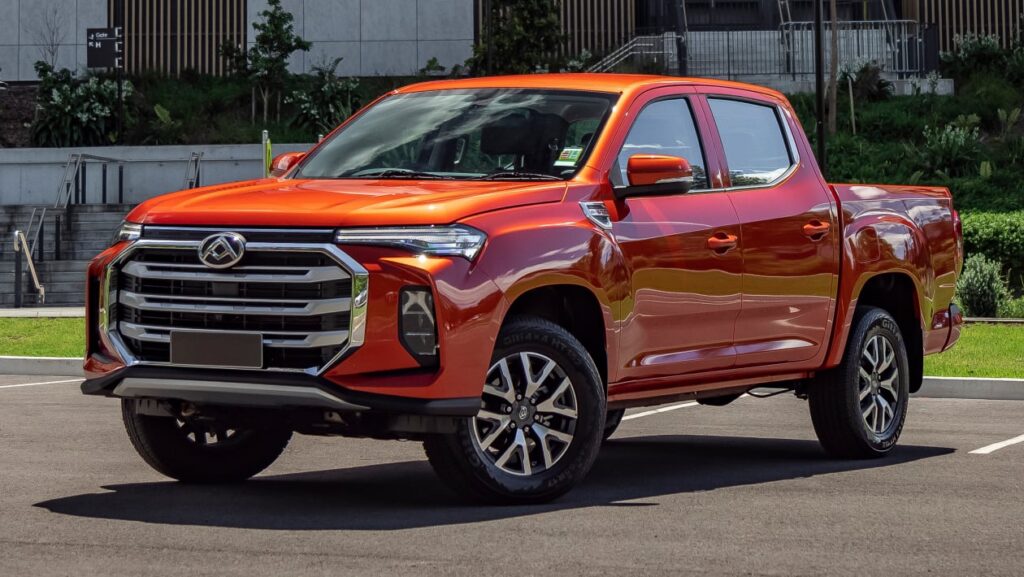
The T90 EV has the usual shape of a classic pickup truck: double cab, 1485 mm long cargo platform, cab protection pipes, chrome elements. Everything looks familiar. At the same time, there is a battery under the bottom, which significantly affects ground clearance. Ground clearance is only 187 mm. This is less than some urban crossovers, not to mention the Hilux or Ranger.
Payload and towing: the minimum for business
The maximum payload is exactly 1000 kg. And this is no coincidence. In the UK, for example, this figure allows you to classify a car as a commercial vehicle and receive tax benefits. A trailer: also up to 1000 kg with brakes. If you plan to tow something on a regular basis, this restriction should be taken into account immediately.
Loading platform parameters:
- Length: 1485 mm
- Width: 1510 mm
- Height of the sides: 530 mm
- Securing the load: external hooks
- Protective coating: option
Drive, engine and dynamics: rear-wheel drive, no surprises
The T90 EV is powered by a single electric motor with approximately 130 kW (180 hp) and 310 Nm. It is located on the rear differential. This means not only rear-wheel drive, but also limited off-road capabilities. The weight is more than 2.3 tonnes. All-wheel drive is not provided in this layout – the battery does not leave room for front-wheel drive.
What you need to know:
- 0-50 km/h: approximately 5 seconds (with an empty car)
- 0-100 km/h: approximately 13 seconds
- Maximum speed: limited to 120 km/h
- Driving modes: Eco, Normal, Power
In Eco mode, the car actively uses recuperation. In Power mode, it hardly brakes with the engine. In the city, this makes you often use the conventional braking system, which has a sharp pedal and takes some getting used to.
Power reserve: 330 km or 471 km – how do you count?
The range is up to 330 km according to the WLTP for commercial vehicles. A value of 471 km is only possible in the urban cycle or under ideal conditions. In cold weather, it is even less: 220-250 km.
Real-life scenarios look like this:
- Kyiv – Chernihiv and back without recharging: possible, but in Eco mode and up to 90 km/h.
- With full load and climate control: The stock is declining significantly.
- In the city: It’s quite normal, especially if you have nighttime charging.
Charging: not lightning fast, but enough for most scenarios
An electric pickup truck with a battery of almost 90 kWh cannot be charged in 10 minutes – it’s just physics. And the Maxus T90 EV shows this clearly. The maximum direct current (DC) fast charging power here is limited to 80 kW. It’s not a record, but it’s not a failure either. Under ideal conditions, this allows you to charge a car from 20 to 80% in about 45 minutes.
But it’s worth remembering that the latest 20%s always last longer. This is not a Maxus problem, it is a limitation of all lithium batteries. After 80%, the charging current is reduced so as not to harm the battery. If you’re in a hurry, it’s better not to wait for 100%, but to continue your trip with 80% and recharge later.
Conventional alternating current (AC) charging is also in place here. The T90 EV takes it easily via the Type 2 port:
- 11 kWFull charge in approximately 9 hours.
- 7 kWIt’s already 13-14 hours, which fits in well with a nightly charge.
That is, if you have a wall charger at home (not even the most powerful one), you simply park the car in the evening and pick it up in the morning with a full battery.
Another important point is battery balancing. Maxus explicitly states that at least once a month, a slow full charge (more than 10 hours) is required to synchronise the battery cells and extend their service life. This is a standard recommendation for electric vehicles, but it is often ignored.

Where to charge Maxus T90 EV: infrastructure that works
For an electric pickup truck to be truly convenient for everyday use, you need more than just a battery and a cable. That’s why we’re building an ecosystem that covers the entire cycle. All of this is integrated into one platform, ECOFACTOR, designed for drivers, operators and businesses.
We develop charging stations is made entirely in Ukraine – from electronics to the case. This is not only about local production, but also about adapting to real-world conditions: voltage drops, humidity, temperature changes. Our product line includes AC models with a capacity of up to 44 kW, DC stations up to 420 kW, as well as mobile chargers. If you need help choosing, our experts will help you find the right solution.
To make it easy for drivers to find a charging point, we have created
For business, we offer a separate platform for managing a charging network is a SaaS solution that allows you to administer charging points, see statistics, set tariffs and serve customers. If you have your own station, you can connect it to our platform or integrate it into your network.
In addition, we have online shopwhere you can order everything you need – from the simplest charging accessories to inverters and adapters and home chargers. This is convenient for those who want to charge the T90 EV both at home and on the go, without relying on public infrastructure.
We don’t see the T90 EV as an isolated piece of technology, but as part of a larger system. An electric vehicle makes sense when it is connected to the grid – not only in terms of a cable, but also in terms of service. And it is important that this network is alive, stable and understandable for the driver.
Interior: functional but without luxury
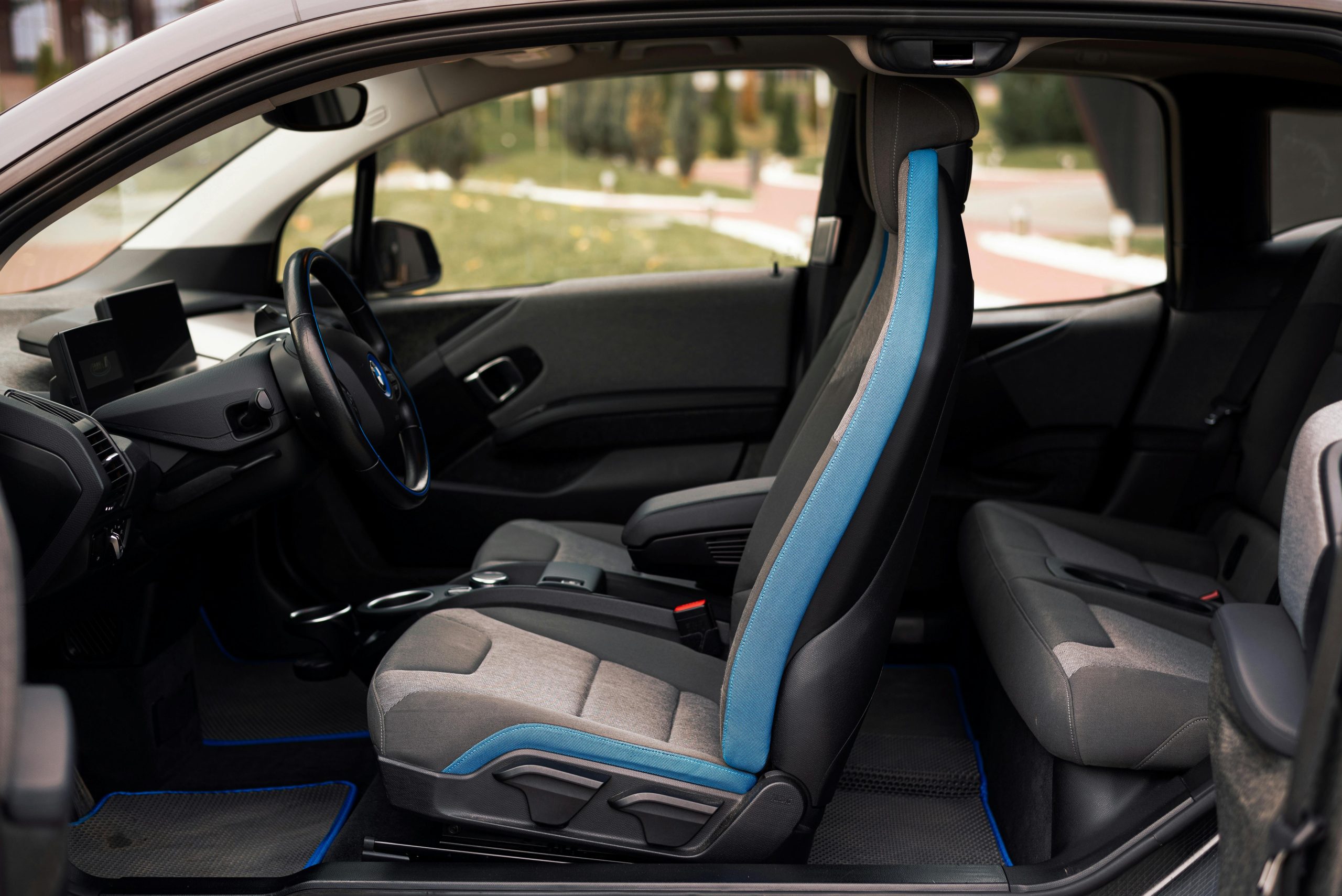
The interior of the Maxus T90 EV looks like a pickup truck interior: practical, no frills, a lot of hard plastic. Someone may think it looks “oaky”, but from the point of view of operation, there is less risk of scratches, it is easier to clean, and there is no harm in damaging it.
The seats are upholstered in eco-leather and have 6-way power adjustment. Heated seats are optional, not standard. Android Auto or Apple CarPlay connection works, but only via cable. The screen is 10.25 inches, a separate dashboard display is also digital.
Interior equipment:
- Air conditioning with a filter.
- Electric power steering.
- Electric window lifters.
- Steering wheel buttons (audio, phone).
- Rear view camera.
- 12V and 220V sockets (up to 150W).
Daily operation: rigidity, noise, stability, dimensions, safety
Suspension – leaf springs at the rear. Rigid. In the literal sense. An empty pickup bounces on bumps, and if the roads are far from ideal, the ride becomes uncomfortable. This is a standard story for pickups with this type of rear suspension, but in the electric version it is felt even more because of the weight of the battery.
The steering is very light, without clear feedback. You have to steer at speed, especially if the car is partially loaded. On the plus side, the car has a low centre of gravity, which improves stability in corners.
Security: a basic set, no frills
Maxus T90 EV has a standard set of active and passive safety systems. There are front airbags, side curtains, a stabilisation system, AEB, HAS and tyre pressure monitoring. Cruise control is not available in the vast majority of trims, but basic cruise (not adaptive) is available in some markets.
Dimensions and weight: what you need to know
- Length: 5365 mm
- Width: 1900 mm
- Height: 1809 mm
- Wheelbase: 3155 mm
- Ground clearance: 187 mm
- Brod: to 550 мм
- The weight of an empty car: ≈2300 kg
- Gross weight: 3300 kg
Pros and cons: honestly, as it is
As with everything, there are some things that are better to know in advance.
Pros:
- Zero emissions
- Full load capacity
- Spacious interior
- Good equipment
- Quiet operation
- The battery warranty is 8 years or 200 thousand km in Ukraine; it may vary in other markets.
- Charging ports and CCS adaptability
Cons:
- Rear-wheel drive only
- Rigid suspension
- Limited range in winter
- Poor off-road traction
- No cruise control
- Slow charging (max. 80 kW)
- Towing capacity of only 1000 kg

Who is the Maxus T90 EV for?
This solution is not for everyone. If you are looking for a comfortable electric car with a soft suspension, no. If you plan to drive with a trailer or through marshes every day, no.
But if you need an electric pickup truck:
- for urban logistics
- for commercial vehicle fleet
- for short trips out of town
- with business benefits
- and the ability to charge at night
…тоді Maxus T90 EV can бути варіантом. Особливо якщо на перше place ви ставите вартість експлуатації, а не позашляхові можливості.
Conclusion
The Maxus T90 EV is a typical example of the transitional generation of electric vehicles. It is not radically new, not revolutionary, but necessary. It does not solve all problems, but it definitely covers some of the business needs.
If you need a no-frills, straightforward electric pickup truck with straightforward functionality, the T90 EV is worth considering. But it’s important to be honest with yourself about your expectations, and then it won’t be a disappointment, but a practical decision.
Frequently asked questions
u003cstrongu003eIs there enough power reserve for daily use?u003c/strongu003e
Yes, unless you plan to ride 300 km or more every day. In the summer, you can do 300 km without cargo. In winter – less, especially with cargo or heating. For city and suburban trips, it’s more than enough. But if you need to drive a lot on the highway, it’s better to figure out your route and charging points right away.
u003cstrongu003eWhy does the T90 EV have only rear-wheel drive?u003c/strongu003e
Because of the layout. The battery takes up almost all the space under the bottom, and the engine is mounted on the rear axle. There is simply nowhere to fit all-wheel drive without a radical rebuild of the chassis. This is one of the compromises made to keep the payload and cost down.
u003cstrongu003eHow stiff is the suspension?u003c/strongu003e
Rigid. It’s a pickup truck with springs, adapted for cargo. When you drive empty, it shakes. It gets better with a load. If you have never driven a commercial pickup before, it will be unusual at first. But it’s not critical for business or work tasks, you just need to understand what you’re getting into.
u003cstrongu003eHow long does it really take to charge at home?u003c/strongu003e
From a household outlet – for a long time, up to 30 hours. From a 7 kW wall charger – about 13 hours. If it is possible to install an 11 kW home AC station, a full charge will take 9 hours. But this is provided that the battery is almost empty. In reality, it almost always manages to charge fully overnight.
u003cstrongu003eDoes the car have cruise control?u003c/strongu003e
No. Not even a regular one, let alone an adaptive one. This is surprising, especially considering the price. Probably, in future versions, something will be added, but now it’s just a foot on the pedal.
u003cstrongu003eHow does the ECOFACTOR app work with this model?u003c/strongu003e
The T90 EV is not tied to any branded charging network, so you can charge anywhere. But the ECOFACTOR app makes it easy to find stations, see their status, and start charging from your smartphone. Plus, you can use the charging map and additional functions on the go. This is especially important for those who often travel around the city or regions.