


Table of contents:
When you get behind the wheel of the Toyota RAV4 Plug-in Hybrid, a logical question arises: how do you actually charge it? It looks like a regular crossover, but under the hood is a hybrid system with electric and petrol drive. Of course, charging is not a space technology, but it’s not exactly “plug and play” either. In this article, we will discuss how and where you can charge this car in Ukraine, how long it takes, and what you should know to make sure the battery lasts a long time.
We remind you that you can purchase home and commercial
Technical characteristics of the Toyota RAV4 Plug-in Hybrid
The plug-in hybrid version of the Toyota RAV4 combines a petrol engine and an electric motor with a battery. This system allows you to make part of your daily journeys on electric power, reducing fuel consumption and emissions. Below are the key technical characteristics that will help you better understand the car’s capabilities.
Battery and dynamic performance
- Battery capacity: 18.1 kWh: A medium-sized battery for a plug-in hybrid. This is enough to cover short daily routes (for example, the journey to and from work) without using petrol. This battery capacity allows the car to be charged relatively quickly – in less than 3 hours under optimal conditions.
- Electric range: up to 74 km: This is a realistic mileage on electric traction in urban conditions without switching on the petrol engine. In a mixed cycle (city and highway), the range may be slightly less – approximately 50-60 km. The range is also reduced when the climate system, heating or high speed is actively used.
- Petrol engine 2.5 litres, 4-cylinder: The car is equipped with an atmospheric petrol engine that works together with an electric motor in hybrid mode. This increases the total power of the system to more than 300 horsepower (in total).
- Dynamics 0-100 km/h in 6 seconds: Як для кросовера – це дуже жвавий показник. Електромотор дає моментальний старт, а бензиновий двигун підтримує динаміку на трасі. Авто досить легко обганяє, навіть коли їде з пасажирами або вантажем.
- Top speed: about 180 km/h: This is more than enough for motorway journeys. At high speeds, however, the car behaves like a conventional petrol hybrid rather than an electric car.
- All-wheel drive (AWD): available on most models: The E-Four system adds a rear electric motor for all-wheel drive. This improves stability in difficult weather conditions or on snow.
- Trunk capacity is up to 520 litres: Despite the battery, there is plenty of space in the boot for family trips. With the rear seats folded down, the volume increases significantly.
CO₂ emissions
The officially declared level of carbon dioxide emissions for the Toyota RAV4 Plug-in Hybrid is 22 g/km. This is a very low figure, especially considering the car’s dimensions and power. This result is achieved thanks to the car’s ability to cover short distances solely on electric power without the participation of a petrol engine. In a real city cycle, when the battery is regularly recharged, the car emits almost no harmful gases into the air, making it a convenient choice for city trips.
At the same time, it should be understood that the actual level of emissions depends on the style of operation. If the driver rarely charges the car or does not use the electric mode at all, the car operates as a conventional hybrid, and emissions increase significantly. That is why the efficiency of the Toyota RAV4 Plug-in Hybrid is directly related to the regular use of the EV mode.
In some countries, low-CO₂ models enjoy benefits such as reduced taxes, purchase subsidies, or free entry to urban green zones. In Ukraine, there are few such benefits yet, but with the development of the electric vehicle market and legislative initiatives, similar incentives may be introduced for plug-in hybrids.
Charging type and connector
The Toyota RAV4 Plug-in Hybrid supports alternating current (AC) charging via a Type 2 (Mennekes) connector. The maximum charging speed is 6.6 kW. This means that when you try to charge with a high-power charger, for example, 22 kW, the car adjusts the consumption to its maximum. Models from 2021-2025 do not support DC charging (fast “direct current” charging), but models from 2026 may have support for fast charging via the CCS connector. Check the model year as not all stations are suitable for older models.
Charging time depending on type
The charging time depends on the power of the charging station. Here is a guide for charging 10 to 80 %:
| Charging type | Power | Time (10-80 %) |
| Household socket (3-pin, AC) | 2.3 kW | ~5 h 30 min |
| Home/small station | 3.6 kW | ~3 h 30 min |
| AC station (Type 2) | 6.6 kW | ~1 h 54 min |
| Fast AC station (up to 22 kW) | 6.6 kW | ~1 h 54 min |
Household socket (2.3 kW)
This is a common socket found in every home. To charge, you will need an adapter from Type 2 to a standard outlet (often supplied with the car).
This option is suitable for those who do not have a special charging station but have access to the power grid, for example, in a private garage or at a summer cottage. This is the longest option in terms of time – approximately 5.5 hours to charge 10 to 80 %.
It is not recommended to use extension cords or leave the car charging unattended, as the home network is not always designed to handle this level of load for a long time.
Home charging station or low-power AC charging (3.6 kW)
This option involves installing a stationary charging point in the yard, on the wall of the house or in the garage. Compared to a power outlet, this is a safer and more efficient way to charge.
Charging from 10 to 80 % takes approximately 3 hours and 30 minutes. For most users, this is quite convenient – you can leave the car overnight and have a sufficient range for the day in the morning. This option is ideal for those who leave home every morning and have the opportunity to charge regularly.
Type 2 charging station with a power of 6.6 kW
This is the best option for the Toyota RAV4 Plug-in Hybrid. The charging power is perfectly matched to the maximum permissible receiving power of the car.
Charging from 10 to 80 % takes approximately 1 hour and 54 minutes. Such chargers can be found in public car parks, shopping malls, near offices or at petrol stations where electric vehicles are allowed. Often, they are part of large public networks with payment via mobile apps or cards.
Stations with a power of 22 kW (AC)
Despite the higher declared power, the Toyota RAV4 Plug-in Hybrid will still charge no faster than 6.6 kW. That is, even when connected to a 22-kilowatt station, the car will only take its “ceiling”.
Charging time такий самий – близько 1 години 54 minutes. Перевага цих stations у тому, що вони частіше встановлені в зонах швидкого обслуговування, наприклад, на автомагістралях, у логістичних вузлах, біля готелів чи офісних центрів. Однак для водія RAV4 це більше питання доступності, а не пришвидшення процесу.
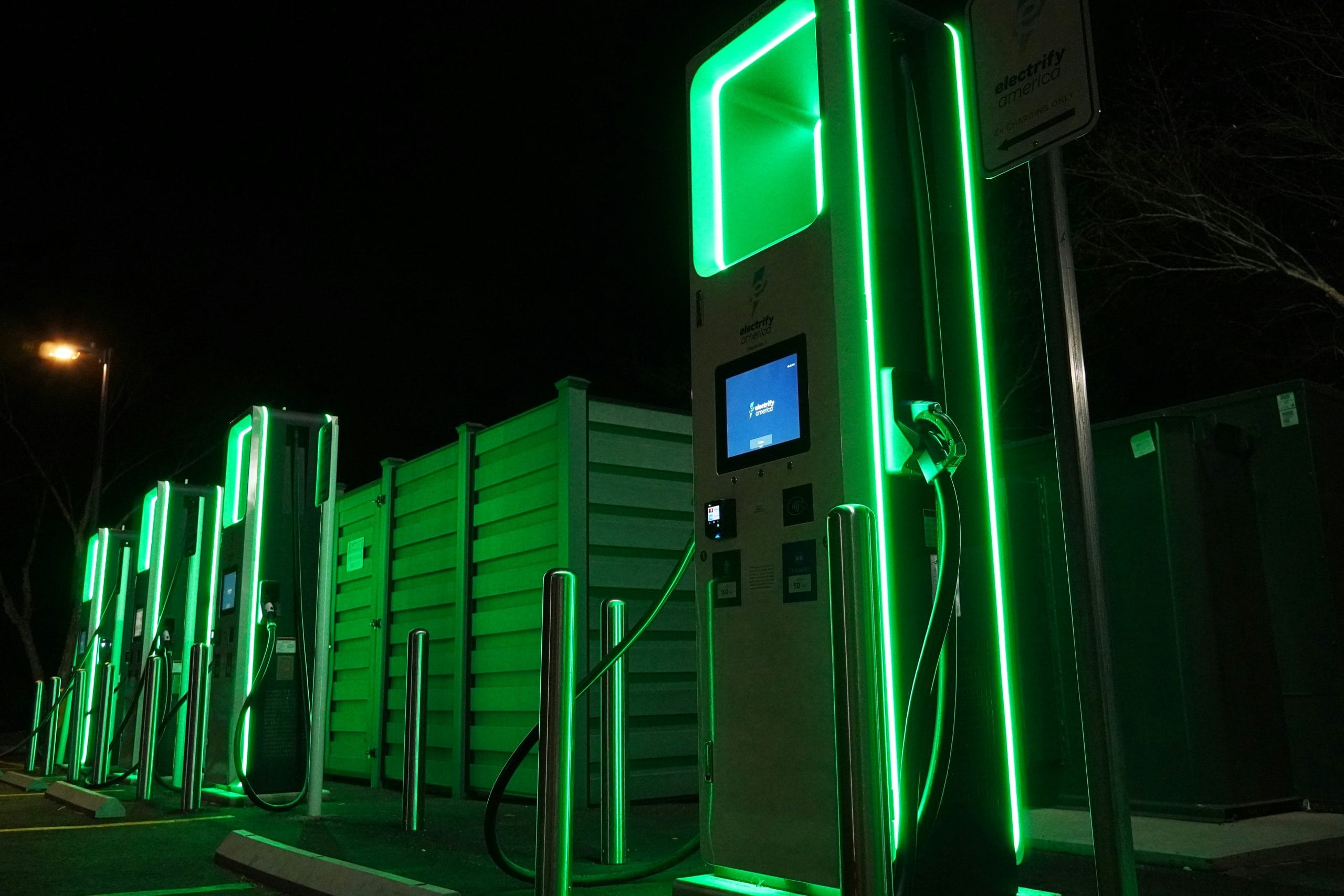
Where to charge Toyota RAV4 Plug-in Hybrid in Ukraine
The Toyota RAV4 Plug-in Hybrid can be charged in a variety of places – at home, at work or at public charging stations. Each option has its own characteristics and is suitable for different usage scenarios. Let’s take a closer look at each of them below.
1. Charging at home
Charging вдома – це один із найзручніших і доступніших способів поповнення заряду. Ви можете використовувати звичайну розетку або set up спеціальну charging station (Wallbox).
Advantages:
- Convenient: не потрібно їхати кудись – просто під’єднуєш машину ввечері й знімаєш вранці повністю заряджену.
- Economical: The night tariff or the “Emergency” tariff is much cheaper than the daytime tariff. You can charge your car while you sleep and save on electricity.
- Predictable: You don’t depend on queues, station availability or cable availability.
Disadvantages:
- For a long time: if charged from a regular household outlet, the process will take more than 7 hours (full charge).
- We need infrastructure: To install a home Wallbox, you need a separate car park or garage, as well as access to a power supply with sufficient capacity.
- Additional costs: Installing home charging costs money. In Ukrainian cities, there are currently almost no subsidies or government support programmes.
2. Charging at work
More and more companies, especially in the IT and tech sector, are installing electric vehicle chargers in their car parks. If you work in an office with such an option, this is a good option for charging during working hours.
Advantages:
- It is convenient to combine with the working day: the car charges while you are at work, without wasting any extra time.
- Sometimes for free: Some companies pay for charging as a bonus or part of a social package for employees.
- Less need for home charging: If you regularly charge your car at work, you can do without installing a station at home.
Disadvantages:
- Not everyone has access: наявність зарядок на роботі – все ще рідкість in Ukraine. Особливо поза великими містами.
- Limited number of ports: If many employees have electric cars, there may be a queue or need to take turns.
- We need an organisation: Sometimes registration or pre-registration is required to access the charging point.
3. Public charging stations
This is the most versatile option, suitable for those who are travelling or do not have access to home charging. The number of public charging stations is gradually increasing in Ukraine, particularly in cities, near shopping malls, petrol stations and business centres.

ECOFACTOR – наша інфраструктура для electric vehiclesв
Ми – ECOFACTOR, компанія, яка створює and підтримує інфраструктуру charging stations for electric vehicles in Ukraine. Our work covers the full cycle – from developing chargers to building digital solutions for network management and user support.
We produce both AC and DC power plants (up to 420 kW) that meet international standards. All devices are designed and assembled in Ukraine. We have more than 3,500 charging ports in our network, and more than 215,000 drivers are connected to our mobile app.
Through our app, available for iOS and AndroidThe drivers are able to:
- find charging stations on the map,
- view the status in real time,
- see the tariffs,
- pay for charging via mobile means.
Окремий напрямок нашої роботи – рішення для бізнесу. Ми надаємо charging stations для ТРЦ, житлових комплексів, готелів, ресторанів, а також SaaS-a platform for operators, що allows керувати станціями, відслідковувати споживання енергії and встановлювати тарифи.
In addition, we offer online shop accessories – cables, adaptersRFID cards, charging solutions. Усе обладнання – з повною документацією and підтримкою.
Advantages:
- Wide geography: stations є в більшості великих міст – Київ, Львів, Харків, Дніпро, Одеса, а також уздовж основних трас.
- Charging speed: Although the Toyota RAV4 Plug-in Hybrid does not support DC charging, many AC stations have an optimum capacity of 6.6 kW.
- Flexibility: you can заряджатися будь-де – у супермаркеті, біля офісу чи на парковці.
Disadvantages:
- Incompatibility with DC: The Toyota RAV4 PHEV does not charge at direct current (DC) stations, so you will not be able to use ultra-fast charging.
- Registration is required: Many stations operate through apps. Sometimes a subscription, card or QR scan is required, which is not always convenient.
- Price: without a network subscription, prices may be higher, especially in the city centre or on highways.
For maximum convenience, it is recommended to have your own Type 2 cable so that you can use not only the tethered stations (with cable), but also those with a universal connector.
Conclusion
Toyota RAV4 Plug-in Hybrid – це авто для тих, хто хоче поєднати комфорт, економію and екологічність. Щоб машина працювала ефективно, а батарея служила довше, важливо знати, як її правильно заряджати, які stations підходять і як обрати найзручніший спосіб charges під свої умови. Вдома, на роботі чи в місті – варіантів вистачає, головне зрозуміти, що саме підходить тобі. І пам’ятай: регулярна підзарядка and турбота про акумулятор – це найкраща інвестиція в стабільну роботу твого авто.
Frequently asked questions
u003cstrongu003eWhat is the range of the Toyota RAV4 Plug-in Hybrid on a single charge?u003c/strongu003e
On average, up to 74 km in urban conditions. In mixed mode (a little city, a little highway) – about 50-60 km.
u003cstrongu003eCan I charge the Toyota RAV4 PHEV from a regular outlet?u003c/strongu003e
Yes, but this is the slowest option. A full charge (10-80 %) will take over 5 hours. It is recommended to use only tested sockets without extension cords.
u003cstrongu003eDoes the car support fast DC charging?u003c/strongu003e
No. The Toyota RAV4 Plug-in Hybrid can only be charged via a Type 2 AC connector and does not support direct current (DC).
u003cstrongu003eHow long does it take to charge from the home station (Wallbox)?u003c/strongu003e
At 3.6 kW – approximately 3.5 hours from 10 to 80 %. At a power of 6.6 kW – almost 2 hours.
u003cstrongu003eIs it necessary to install the station at home?u003c/strongu003e
It is not necessary, but it is more convenient and faster. If you can charge at work or near your home, you can do without it.
u003cstrongu003eWhat charging networks are operating in Ukraine?u003c/strongu003e
In Ukraine, there are services such as AutoEnterprise, PlugShare, and ECOFACTOR, with a large number of AC stations compatible with Toyota RAV4 PHEV.