

Table of contents:
Short Summary: Opening an EV charging station in Ukraine in 2026 requires location analysis, choice of charging station type (AC or DC), legal registration, investments from 500 thousand to 3 million UAH, and connection to the power grid. Business payback is 2-4 years with proper monetization and selection of a high-traffic location. State support includes loans at 10% per annum for distributed generation projects.
The number of electric vehicles in Ukraine continues to grow even in difficult economic conditions. And this creates real demand for charging infrastructure.
EV charging stations are no longer exotic — this is a full-fledged business with clear economic indicators. But how to launch it correctly?
This guide breaks down the practical steps from location analysis to reaching payback.
We remind you that you can purchase home and commercial charging stations in our online store, as well as use public charging stations ECOFACTOR located throughout Ukraine. For convenient access to charging infrastructure, we recommend using our mobile app, available on iOS and Android.
Why EV Charging Stations Are a Promising Business in 2026
The electric vehicle market in Ukraine shows stable growth despite all challenges. EV drivers need accessible and convenient infrastructure.
As of early 2026, some networks have set tariffs at 30-32 UAH per kWh, while previously the typical level was in the range of 16-18 UAH per kWh. This makes the business financially more attractive for operators.
State support is also working, so the trend toward transport electrification is not going anywhere. On the contrary — it is only gaining momentum.
Step 1: Determining the Type of Charging Station
The first strategic choice is the station format. There are two main types.
AC Charging Stations (Slow)
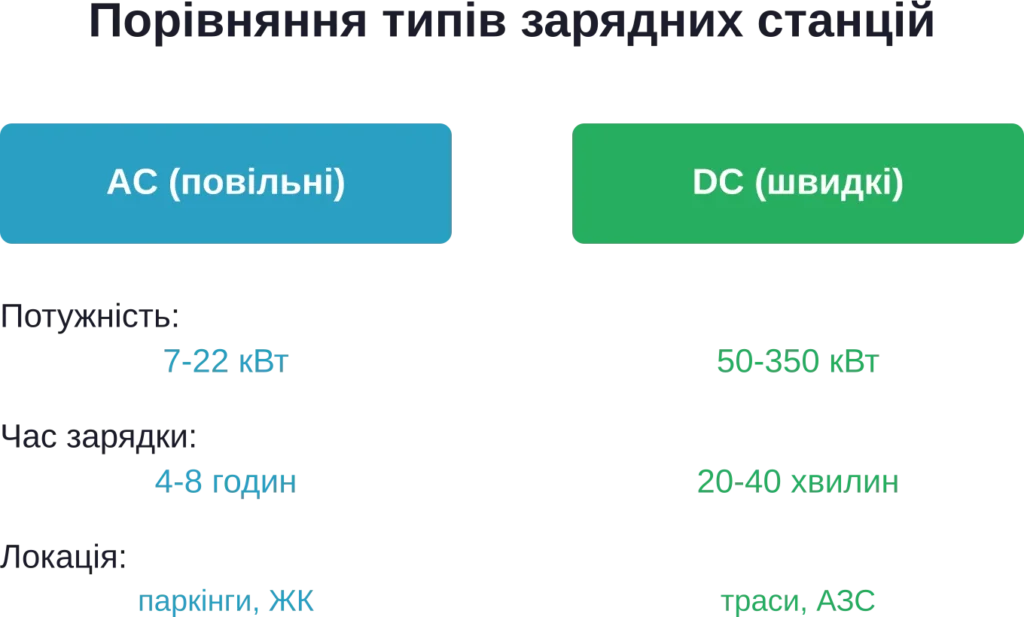
The power of such stations is from 7 to 22 kW. The full charging time for an electric vehicle is 4-8 hours.
These stations are suitable for parking lots of shopping centers, residential complexes, office buildings — places where the car stays for a long time.
Investments are lower, but earnings per charging session are also smaller.
DC Charging Stations (Fast)
Power ranges from 50 to 350 kW. Charging time to 80% battery capacity is only 20-40 minutes.
This is the choice for highways, gas stations, and locations with high traffic of passing drivers.
The cost of equipment is significantly higher, but so is customer turnover.
Step 2: Demand Analysis and Location Selection
Location is the critical success factor. Even the best equipment will not bring profit in an empty place.
What to consider when choosing a spot:
- Presence of electric vehicles in the region: check registration statistics
- Traffic of potential customers: number of passing cars or visitors to the location
- Competition: distance to the nearest charging stations
- Power grid availability: capacity and possibility of connection
- Additional infrastructure: cafes, shops, recreation areas nearby
Ideal locations for AC stations: large shopping centers, business centers, hotels, premium residential complexes.
Ideal locations for DC stations: highways between major cities, city entrances, petrol stations, roadside complexes.
Step 3: Legal Business Registration
A proper organizational structure is required to operate. Most often, an Individual Entrepreneur (FOP) or Limited Liability Company (LLC) is chosen.
FOP is suitable for small projects — one or two stations, minimal bureaucracy, simplified reporting.
LLC is better for large-scale plans — attracting investors, a network of stations, greater financial flexibility.
Required permits and documents:
- Lease agreement or ownership rights to the land plot
- Technical conditions for connection to the power grid
- Project documentation for electrical works
- Permit for construction works (if reconstruction is needed)
- Commissioning certificate
The process of obtaining technical conditions and grid connection can take from 2 to 6 months depending on the region.
Step 4: Equipment Selection and Purchase
Equipment is the largest cost item. Saving here is risky, but overpaying for unnecessary features is also not worth it.
What is included in the kit:
- The charging station itself (charger)
- Management and billing system (software platform)
- Cables and connectors
- Additional equipment: distribution cabinets, protection, meters
Both international suppliers and local manufacturers operate on the Ukrainian market. The choice depends on budget and functionality requirements.
| Station Type | Equipment Cost | Installation Cost | Total Investment |
|---|---|---|---|
| AC 7-22 kW (1 port) | ₴150,000 – ₴300,000 | ₴50,000 – ₴150,000 | ₴200,000 – ₴450,000 |
| DC 50 kW (1 port) | ₴800,000 – ₴1,200,000 | ₴200,000 – ₴400,000 | ₴1,000,000 – ₴1,600,000 |
| DC 150 kW (2 ports) | ₴1,800,000 – ₴2,500,000 | ₴300,000 – ₴500,000 | ₴2,100,000 – ₴3,000,000 |
Step 5: Grid Connection and Integration
The technical part requires qualified specialists. Self-connection is prohibited and dangerous.
Main stages:
- Obtaining technical conditions from the power supplier
- Design of the power supply system
- Construction and installation works
- Installation of charging equipment
- Connection to the power grid
- Software configuration
- Integration with the payment system
It is important to connect immediately to charging aggregators — mobile apps that show available stations to drivers. This significantly increases visibility and the number of customers.

Build an EV Charging Station That Works and Generates Income
After choosing the location and station type, the next question is how you will manage charging, customers, and payments. Without this, even a good spot will not deliver stable results.
ECOFACTOR closes these tasks as a single system. There is an operator platform for managing stations, tariffs, and users. For drivers, the mobile app for Android and iOS works, and the map of charging stations makes your point visible in the network. If the launch is planned under your own brand, white-label solutions are available. For equipment selection, use the charging station configurator — through it you can select an AC station for parking lots or a DC station for high-traffic locations.
All basic components can be covered through the online store — accessories, cables, and mobile chargers for different connection scenarios. Energy-efficient solutions for integration with generation and reduction of electricity costs are also available.
Contact ECOFACTOR and build an EV charging station as a full-fledged business, not a single charging point.
Monetization Models: How to Earn from an EV Charging Station
There are several main earning schemes for charging stations.
Payment per kWh
The most common model. The client pays for the actual electricity consumed.
As of early 2026, some networks have set tariffs at 30-32 UAH per kWh, while previously the typical level was in the range of 16-18 UAH per kWh depending on the station type and speed.
Payment per Charging Time
The model is convenient for AC stations in parking lots. The client pays per minute or hour of connection.
A combined scheme is often used: payment per kWh plus a fee for idle time after charging is complete.
Subscription Models
For corporate clients or residential complex owners, you can offer a fixed monthly fee for unlimited use.
Additional Sources of Income
Advertising on station screens, partnership programs with nearby cafes/shops, car wash or service services.
Payback Calculation: Real Numbers
Payback depends on many factors, including location, customer traffic, and operating costs. Below are typical scenarios based on 2026 market conditions.
For a 22 kW AC station:
- Investment: ₴400,000
- Average sessions per day: 3-5
- Average charge volume: 30 kWh per session
- Tariff: ₴20 per kWh
- Monthly revenue: ₴36,000 – ₴60,000
- Operating costs: ₴15,000 – ₴25,000
- Net profit: ₴21,000 – ₴35,000
- Payback period: 12-20 months
For a 50 kW DC station:
- Investment: ₴1,400,000
- Average sessions per day: 8-12
- Average charge volume: 35 kWh per session
- Tariff: ₴28 per kWh
- Monthly revenue: ₴235,000 – ₴350,000
- Operating costs: ₴100,000 – ₴150,000
- Net profit: ₴135,000 – ₴200,000
- Payback period: 8-11 months
Real payback can be either faster or slower depending on the specific location.
Operating Costs: What Requires Funds Monthly
The charging business does not end after installation. There are regular expenses.
Main items:
- Electricity: the largest item, usually 40-50% of the cost of sold charging
- Land or space rental: from ₴5,000 to ₴50,000 depending on location
- Equipment maintenance: ₴3,000-10,000 per month
- Payment system commissions: 2-5% of turnover
- Charging aggregator commissions: 10-20% of turnover
- Internet and communication: ₴500-1,500
Total operating costs usually amount to 50-65% of revenue.
State Support and Financing
The Government of Ukraine is developing support programs for the energy sector. On June 18, 2024, the Cabinet of Ministers of Ukraine adopted Resolution No. 721 (with subsequent amendments), which introduced lending for distributed generation projects, and the “Affordable Loans 5-7-9%” program was expanded to energy needs.
In addition, international organizations provide grants for infrastructure restoration. On August 15, 2023, UNDP in cooperation with the Government of Germany allocated 7.6 million euros for rapid economic recovery projects, part of which concerned energy infrastructure.
It is worth following updates to small and medium business support programs in the energy sector.
Risks and How to Manage Them
Like any business, EV charging stations have risks and ways to reduce them:
- Low customer traffic: a thorough location analysis before investment and integration with all popular driver apps will help.
- Rising electricity prices: flexible pricing and integration of own generation sources (solar panels) can be used.
- Equipment breakdown: a service contract with the supplier and spare parts will help.
- High aggregator commissions: your own mobile app and direct work with corporate clients will help.
- Vandalism: video surveillance, choice of guarded locations, and equipment insurance will partially save the day.
Practical Tips from Operators
Based on the experience of those already working in the market:
- Don’t skimp on the software platform: Quality billing and a convenient interface for customers are critically important. A poor software part can ruin the impression even from the best equipment.
- Place stations in clusters: If you are planning a network, it is better to have several stations in one area rather than scattered points. This reduces maintenance logistics.
- Work with corporate clients: Contracts with taxi fleets, car-sharing services, and logistics companies provide a stable flow and predictable income.
- Invest in marketing: Even an ideal location needs promotion. Social networks, Google Maps, specialized apps — everything should work.
Market Future: What to Expect in 2026-2027
The market for electric vehicles and charging infrastructure continues to evolve.
Further growth in station power is expected — 350 kW will become the new standard for highways. Charging time will decrease to 10-15 minutes.
Integration with renewable energy sources will become an important competitive advantage. Stations with solar panels and battery storage systems will be able to operate autonomously and offer lower tariffs.
The development of infrastructure for commercial transport — trucks and buses — will open a new market segment with different requirements for power and location.
Frequently Asked Questions
How Much Does It Cost to Open an EV Charging Station in Ukraine?
The cost depends on the station type. An AC station of 7-22 kW costs from ₴200,000 to ₴450,000 with installation. A 50 kW DC station — from ₴1,000,000 to ₴1,600,000. More powerful 150 kW DC stations require investments of ₴2,100,000-3,000,000.
What Is the Payback Period for a Charging Station?
With the right location choice, AC stations pay back in 12-20 months, DC stations — in 8-14 months. The actual period depends on customer traffic, tariffs, and operating costs.
What Documents Are Needed to Open an EV Charging Station?
Required: registration of FOP or LLC, lease/ownership agreement for the land plot, technical conditions for connection to the power grid, project documentation, construction permit (if needed), and commissioning certificate.
How to Choose a Location for an EV Charging Station?
Key factors: concentration of electric vehicles in the region, traffic of potential customers, distance to competitors, availability of powerful power grid, and presence of additional infrastructure nearby. For AC stations, choose parking lots with long vehicle stays; for DC — highways and high-traffic points.
How Much Can You Earn Monthly from an EV Charging Station?
Net profit for an AC station is ₴21,000-35,000 per month, for DC stations — ₴135,000-200,000. Specific figures depend on location, number of charging sessions, tariffs, and operating costs.
Are Special Skills Needed to Operate an EV Charging Station?
Technical installation is performed by contractors, but the operator needs to understand the basic principles of equipment operation, payment systems, and billing. Marketing skills, financial management, and customer service are also important.
Conclusion
Opening an EV charging station in Ukraine in 2026 is a real business opportunity with clear economics and predictable payback.
The market is growing, infrastructure is developing, and the state provides support. But success depends on careful planning.
The right location, quality equipment, a well-thought-out monetization model, and active promotion are the key components of a profitable project.
If you are ready to invest time and money in analysis and launch — EV charging stations can become a stable source of income for years to come.