


Table of contents:
Quick Summary: IoT fleet management integrates internet-connected devices like GPS trackers, telematics sensors, and engine monitors into vehicles to collect and transmit real-time data for optimized fleet operations. This technology enables fleet managers to track vehicle location, monitor driver behavior, predict maintenance needs, and reduce operational costs through data-driven decision making. The system transforms traditional fleet management into a proactive, intelligent operation that delivers measurable ROI through reduced fuel consumption, fewer breakdowns, and improved safety.
The fleet management industry has undergone a dramatic transformation over the past decade. What used to rely on spreadsheets, paper logs, and reactive maintenance has evolved into a sophisticated network of connected devices that communicate continuously with central management systems.
IoT fleet management represents this shift—transforming commercial vehicles into intelligent assets that generate actionable insights. For logistics companies, transportation providers, and any organization managing multiple vehicles, understanding this technology isn’t optional anymore. It’s become foundational to competitive operations.
Here’s the thing though—the market is growing fast. The global IoT fleet management market reached $7.03 billion in 2023 and is projected to grow at a compound annual growth rate of 17.0% from 2024 to 2030. By 2030, the market is expected to reach around $20+ billion driven by increasing adoption across commercial fleets.
We remind you that you can purchase home and commercial charging stations in our online store, as well as use public charging stations ECOFACTOR located throughout Ukraine. For convenient access to charging infrastructure, we recommend using our mobile app, available on iOS and Android.
Understanding IoT Fleet Management: The Basics
IoT fleet management is the integration of internet-connected devices to collect and exchange data for real-time monitoring and optimization of vehicle fleets. These systems combine hardware sensors, wireless connectivity, cloud-based platforms, and analytics software to create a continuous feedback loop between vehicles and fleet operations centers.
The core concept is straightforward: equip each vehicle with sensors and communication devices that track dozens of data points, transmit that information via cellular networks to cloud servers, and present actionable insights through dashboards and automated alerts.
But the execution is anything but simple.
Modern IoT fleet systems monitor vehicle location through GPS, engine performance through OBD-II diagnostics, driver behavior through accelerometers and gyroscopes, cargo conditions through environmental sensors, and fuel consumption through flow meters. Each of these data streams flows into analytics engines that identify patterns, flag anomalies, and trigger responses.
How IoT Transforms Traditional Fleet Operations
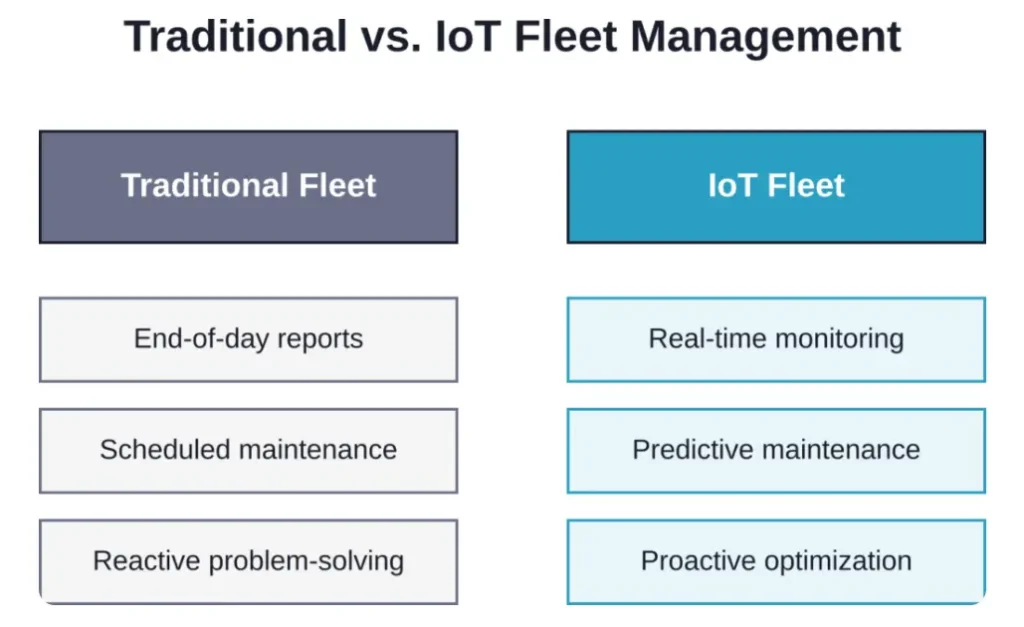
Traditional fleet management relied on end-of-day reports, scheduled maintenance intervals based on time or mileage, and reactive problem-solving when vehicles broke down or drivers reported issues. Managers operated with limited visibility into what was actually happening on the road.
IoT changes that fundamental dynamic. Instead of waiting for monthly reports, fleet managers see live dashboards showing every vehicle’s location, speed, fuel level, and health status. Instead of changing oil every 5,000 miles regardless of actual engine condition, sensors detect oil degradation and trigger maintenance only when needed.
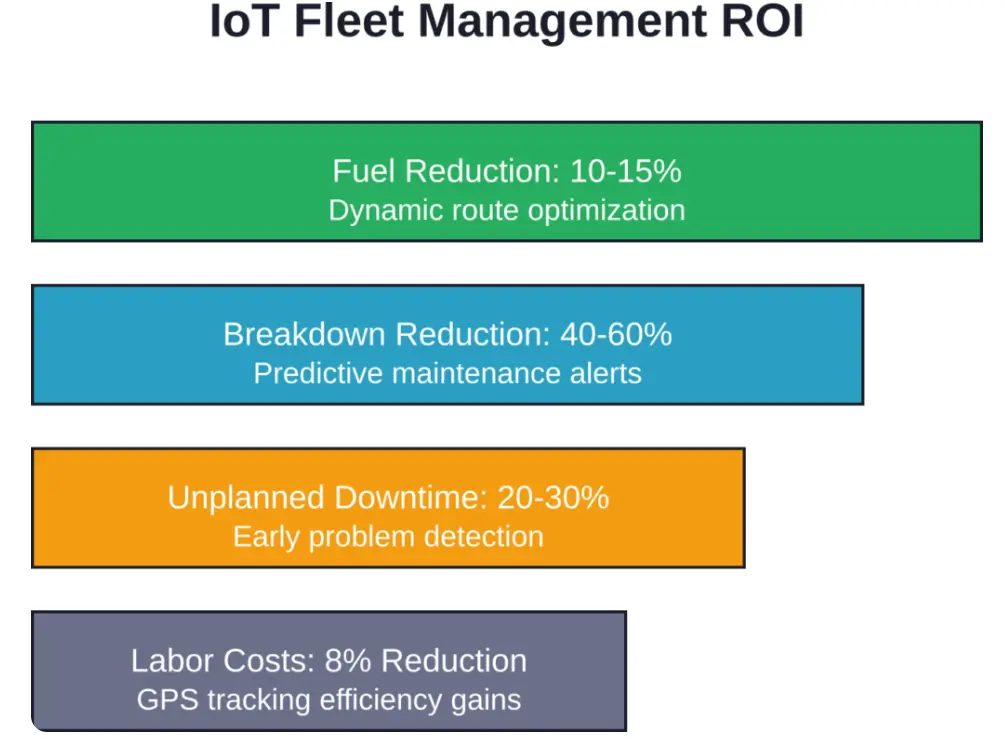
The shift from reactive to proactive operations represents the real value proposition. Predictive maintenance analytics reduce unexpected breakdowns by 40 to 60 percent by detecting early warning signs—a developing transmission problem generates alerts when minor symptoms first appear, enabling repair before catastrophic failure.
Key Components of IoT Fleet Management Systems
An effective IoT fleet management system consists of several integrated layers working together. Understanding these components helps clarify how the technology delivers its benefits.
GPS Trackers and Location Services
GPS trackers form the foundational layer of most IoT fleet systems. These devices use satellite-based navigation to provide precise location data, typically updating every few seconds. Modern GPS fleet tracking systems deliver more than just coordinates—they calculate speed, direction, idle time, and geofence violations.
Fleets adopting GPS fleet tracking reported an 8% reduction in labor costs by identifying inefficiencies in routes, unauthorized stops, and excessive idle time that previously went undetected.
Telematics Sensors and Engine Diagnostics
Telematics devices connect directly to a vehicle’s onboard diagnostics port, accessing real-time engine data. These sensors monitor hundreds of parameters: fuel consumption, engine temperature, RPM, throttle position, brake usage, and diagnostic trouble codes.
Advanced telematics capabilities have delivered significant operational efficiency gains through vehicle data insights that optimize everything from driver training to route planning.
Environmental and Cargo Sensors
Beyond vehicle health, IoT systems can monitor cargo conditions through temperature sensors, humidity monitors, shock detectors, and door sensors. For fleets transporting temperature-sensitive goods—pharmaceuticals, food, chemicals—these sensors ensure compliance and product integrity.
Auxiliary sensors also track auxiliary systems: refrigeration unit performance, hydraulic lift operations, PTO (power take-off) usage, and more.
Connectivity and Communication Networks
Essential to all IoT fleet operations is reliable cellular connectivity. Devices transmit data through 4G LTE or 5G networks, with some systems incorporating satellite backup for remote areas. The connectivity layer determines data transmission frequency, latency, and reliability.
Real-time data streaming requires consistent network availability—a challenge for fleets operating across varied geographic regions with inconsistent coverage.
Cloud Platforms and Analytics Engines
Data from thousands of sensors flows into cloud-based platforms that store, process, and analyze the information. These platforms run algorithms that calculate optimal routes, detect anomalies, score driver behavior, forecast maintenance needs, and generate automated reports.
The analytics layer is where raw data transforms into actionable intelligence. Machine learning models improve over time, identifying patterns that human analysts might miss.
| Component | Primary Function | Key Data Generated |
|---|---|---|
| GPS Trackers | Location and movement tracking | Coordinates, speed, idle time, geofencing |
| Telematics Sensors | Engine and vehicle diagnostics | Fuel consumption, RPM, trouble codes, brake usage |
| Environmental Sensors | Cargo condition monitoring | Temperature, humidity, shock events, door status |
| Cellular Connectivity | Data transmission | Network status, signal strength, data usage |
| Cloud Analytics | Data processing and insights | Reports, alerts, predictions, optimization recommendations |
Support EV Charging Solutions With ECOFACTOR Tools
IoT fleet management is about using connected tools to track, monitor, and manage vehicle-related activity more clearly. In electric fleets, charging stations and driver access also need to be organized. ECOFACTOR supports this area with charging stations, station management tools, and a mobile app for iOS and Android.
Their charging station map helps drivers find charging points and check station information when they need to charge. ECOFACTOR also offers chargers, cables and adapters through its online store for companies that need equipment for offices, depots, parking areas, or commercial locations.
ECOFACTOR can help EV fleet teams with:
- Connected charging station management
- Driver access to charging information through mobile tools
- Charging equipment for shared or business use
- Hardware for daily EV charging needs
Contact ECOFACTOR to bring more structure to the charging part of connected fleet operations.
Measurable Benefits of IoT Fleet Management
The business case for IoT fleet management rests on quantifiable improvements across multiple operational dimensions. These aren’t theoretical advantages—they’re documented outcomes from fleets that have implemented connected vehicle systems.
Cost Reduction Through Multiple Channels
Dynamic route optimization using real-time IoT data reduces fuel consumption by 10-15% by avoiding traffic congestion, eliminating unnecessary mileage, and reducing idle time. For a fleet burning thousands of gallons monthly, these percentages translate to significant budget impact.
IoT-based fleet management helps companies decrease repair costs by up to 20% through better maintenance timing and reduced secondary damage from undetected problems. Predictive maintenance adds another 20-30% reduction in unplanned downtime beyond traditional preventive maintenance schedules.
Safety Improvements and Risk Mitigation
Driver behavior monitoring through IoT sensors identifies harsh braking, rapid acceleration, aggressive cornering, and speeding. Fleet managers use this data for targeted coaching, reducing accident rates and associated costs.
Real-time alerts enable immediate intervention when dangerous behavior occurs. Geofencing capabilities trigger notifications when vehicles enter unauthorized areas or deviate from planned routes.
Compliance and Regulatory Management
Electronic logging devices automatically record hours of service, ensuring compliance with transportation regulations while eliminating manual logbook errors. IoT systems generate audit trails that simplify regulatory inspections and reduce violation risks.
Maintenance records, inspection reports, and driver certification tracking all integrate into compliance management dashboards that flag upcoming deadlines and overdue requirements.
Operational Efficiency Gains
Connected systems eliminate duplicate data entry, automate billing processes, and streamline dispatch operations. Real-time visibility enables faster response to customer requests, more accurate delivery windows, and proactive communication when delays occur. These operational improvements translate directly to customer satisfaction and retention.
Common Use Cases Across Industries
IoT fleet management applications extend across diverse sectors, each leveraging the technology to address industry-specific challenges.
Logistics and Transportation
Long-haul trucking companies use IoT systems to optimize routes across thousands of miles, monitor driver fatigue through hours-of-service tracking, and provide customers with real-time shipment visibility. Temperature-controlled cargo monitoring ensures cold-chain integrity for food and pharmaceutical shipments.
Service and Field Operations
Field service fleets—utilities, telecommunications, HVAC, plumbing—use IoT to dispatch the nearest available technician, track parts inventory in service vehicles, and verify service completion through geofencing. Automated scheduling based on location data maximizes daily service calls.
Construction and Heavy Equipment
Construction fleets monitor equipment utilization rates, track machine hours for maintenance scheduling, and prevent theft through location alerts. Fuel monitoring on heavy equipment helps identify inefficient operation or unauthorized usage.
Delivery and Last-Mile Services
Delivery fleets leverage IoT for proof-of-delivery confirmation, customer notification systems, and route density optimization. Package condition monitoring through shock sensors protects high-value or fragile shipments.
Implementation Challenges and Considerations
Despite clear benefits, IoT fleet management implementation faces several obstacles that organizations must address for successful deployment.
Data Security and Privacy Concerns
Connected vehicles generate sensitive data about operations, routes, and personnel. Securing this data against unauthorized access, ensuring compliance with privacy regulations, and protecting against cyber threats requires robust security protocols across the entire IoT ecosystem.
Encryption of data in transit and at rest, secure authentication for platform access, and regular security audits form essential components of IoT fleet security strategies.
Integration Complexity
Legacy systems, multiple software platforms, and incompatible data formats create integration challenges. Connecting IoT platforms with existing ERP systems, accounting software, customer relationship management tools, and dispatch systems requires technical expertise and often custom development work.
Network Reliability and Coverage
Cellular connectivity gaps in rural areas, underground facilities, or remote regions interrupt data transmission and real-time tracking capabilities. Fleet operations spanning varied geographic territories must plan for connectivity inconsistencies.
Some systems incorporate edge computing capabilities that process data locally on the device when network connectivity is unavailable, syncing to cloud platforms when connection resumes.
Change Management and User Adoption
Drivers sometimes resist IoT monitoring systems, viewing them as invasive surveillance rather than operational tools. Successful implementation requires clear communication about system purposes, transparent policies on data usage, and demonstrated benefits for drivers themselves—such as automated mileage logging or exoneration in accident disputes.
Training fleet managers and dispatchers to effectively use IoT platforms represents another adoption hurdle. Sophisticated analytics capabilities deliver value only when personnel understand how to interpret data and act on insights.
Selecting the Right IoT Fleet Management Solution
The IoT fleet management market includes dozens of vendors offering varied capabilities at different price points. Selecting an appropriate solution requires evaluating several critical factors.
Hardware Compatibility and Installation
Some systems use plug-and-play OBD-II devices that install in minutes without professional help. Others require hardwired installation that integrates more deeply with vehicle systems but demands professional installation. Mixed fleets with varied vehicle types may need multiple hardware options.
Scalability and Future Growth
Solutions should accommodate fleet expansion without requiring platform migration. Cloud-based systems generally scale more easily than on-premise deployments, adding vehicles through simple device provisioning rather than infrastructure upgrades.
Integration Capabilities
API availability, pre-built connectors for common business systems, and data export options determine how well an IoT platform integrates with existing technology stacks. Open platforms that support third-party integrations offer more flexibility than closed ecosystems.
Analytics and Reporting Features
Basic systems provide raw data and simple reports. Advanced platforms incorporate predictive analytics, machine learning-based recommendations, and customizable dashboards. Evaluating whether standard reports meet specific business requirements prevents costly customization after implementation.
Total Cost of Ownership
Beyond subscription fees, consider hardware costs, installation expenses, cellular data charges, integration development, training, and ongoing support. While IoT systems can deliver significant annual savings per vehicle through combined operational efficiencies, that ROI depends on selecting solutions appropriate to fleet size and complexity.
| Evaluation Criteria | Key Questions to Ask |
|---|---|
| Hardware | Installation complexity? Compatibility with vehicle types? Ruggedness for operating environment? |
| Connectivity | Network provider? Coverage in operating regions? Backup options for connectivity gaps? |
| Platform | Cloud vs. on-premise? Mobile app availability? Dashboard customization options? |
| Integration | API documentation? Pre-built connectors? Data export formats? |
| Support | Training provided? Technical support availability? Implementation assistance? |
| Pricing | Per-vehicle fees? Data overage charges? Contract terms and flexibility? |
Future Trends in IoT Fleet Management
The technology continues evolving rapidly. Several emerging trends will shape IoT fleet management over the next few years.
Artificial Intelligence and Machine Learning
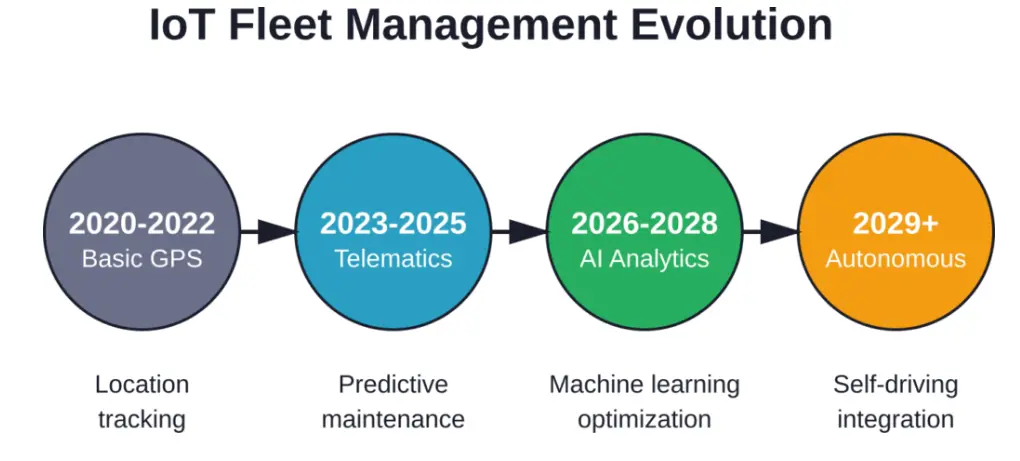
AI-powered analytics go beyond descriptive reporting to prescriptive recommendations. Academic research has demonstrated that stacked ensemble deep learning algorithms achieved 80.3% decision accuracy in risk management system research, significantly outperforming traditional machine learning approaches.
These algorithms will increasingly automate complex decisions around route optimization, maintenance scheduling, and resource allocation that currently require human judgment.
Electric Vehicle Fleet Integration
As fleets transition to electric vehicles, IoT systems will integrate battery health monitoring, charging station location and availability, range prediction based on route and weather, and charging schedule optimization to minimize electricity costs.
5G Connectivity and Edge Computing
5G networks will enable higher data transmission speeds and lower latency, supporting more sophisticated real-time applications. Edge computing will process more data locally on vehicles, reducing bandwidth requirements while enabling faster decision-making for time-sensitive applications.
Autonomous Vehicle Integration
IoT fleet management platforms will eventually manage mixed fleets of autonomous and human-driven vehicles, coordinating routing and scheduling across both categories while monitoring autonomous vehicle system health and intervention requirements.
Getting Started with IoT Fleet Management
Organizations considering IoT fleet management should approach implementation systematically to maximize success probability.
Define Clear Objectives
Identify specific business problems to solve rather than implementing technology for its own sake. Whether the goal is reducing fuel costs, improving safety scores, ensuring compliance, or enhancing customer service, clear objectives guide vendor selection and success metrics.
Start with a Pilot Program
Deploy IoT systems to a subset of vehicles before full fleet rollout. Pilot programs reveal integration challenges, validate ROI assumptions, and generate internal case studies that build support for broader adoption. A pilot involving 10-20% of fleet vehicles provides meaningful data while limiting risk.
Invest in Training and Change Management
Technical implementation represents only part of the challenge. Investing in driver communication, dispatcher training, and manager education ensures the organization can effectively use the new capabilities. Addressing privacy concerns transparently builds trust that supports adoption.
Establish Data Governance Policies
Before collecting vast quantities of operational data, establish policies governing data access, retention, privacy protection, and acceptable use. These policies protect both the organization and its employees while ensuring compliance with relevant regulations.
Frequently Asked Questions
What is the difference between fleet management and IoT fleet management?
Traditional fleet management relies on manual processes, scheduled maintenance, and end-of-day reporting to track vehicles and manage operations. IoT fleet management uses internet-connected sensors and devices to collect real-time data automatically, enabling proactive decision-making, predictive maintenance, and continuous monitoring of vehicle health, location, and driver behavior.
How much does IoT fleet management cost?
Pricing varies significantly based on fleet size, hardware requirements, and feature sets. Typical costs include hardware devices ranging from basic plug-in units to hardwired systems, monthly subscription fees per vehicle, cellular data charges, and installation expenses. IoT systems can deliver significant annual savings per vehicle through operational efficiencies that often exceed implementation costs within the first year.
What data do IoT fleet management systems collect?
IoT fleet systems collect GPS location coordinates, vehicle speed and direction, engine diagnostics including trouble codes and performance metrics, fuel consumption and efficiency, driver behavior data like harsh braking and acceleration, idle time, maintenance alerts, cargo conditions for temperature-sensitive loads, and hours of service for compliance tracking. The specific data collected depends on installed sensors and system configuration.
Can IoT fleet management improve driver safety?
IoT systems significantly enhance driver safety through real-time monitoring of risky behaviors like speeding, harsh braking, rapid acceleration, and aggressive cornering. Fleet managers receive immediate alerts when dangerous events occur and can use data for targeted driver coaching. Continuous monitoring encourages safer driving habits, while automated crash detection enables faster emergency response when incidents occur.
How does predictive maintenance work in IoT fleet systems?
Predictive maintenance analyzes real-time sensor data from engine diagnostics, fluid levels, component temperatures, vibration patterns, and performance metrics to detect early warning signs of potential failures. Machine learning algorithms identify patterns that precede breakdowns, generating maintenance alerts when components show degradation rather than waiting for scheduled intervals. This approach reduces unexpected breakdowns by 40-60% and extends component life through early intervention.
Is IoT fleet management secure from cyber threats?
Security depends on system architecture and implementation practices. Reputable IoT fleet platforms employ encryption for data transmission and storage, secure authentication mechanisms, regular security audits, and compliance with industry standards. Organizations should evaluate vendor security practices, implement strong access controls, keep firmware updated, and establish security policies that address the expanded attack surface created by connected devices.
What fleet size benefits most from IoT management systems?
While IoT benefits scale with fleet size, even small fleets of 5-10 vehicles can achieve positive ROI through fuel savings, reduced maintenance costs, and improved utilization. Larger fleets realize greater absolute savings and can leverage more sophisticated analytics, but the percentage improvements in efficiency, safety, and compliance apply across fleet sizes. The key determinant is operational complexity rather than vehicle count alone.
Conclusion
IoT fleet management has transitioned from emerging technology to operational necessity for organizations managing vehicle fleets. The combination of real-time visibility, predictive analytics, and automated monitoring delivers measurable improvements in cost efficiency, safety, compliance, and customer service.
The market growth trajectory—from $7.03 billion in 2023 to a projected $20+ billion by 2030—reflects widespread recognition of these benefits across industries. As connectivity costs decline, sensor capabilities expand, and analytics platforms become more sophisticated, the value proposition strengthens further.
Organizations still operating traditional fleet management face growing competitive disadvantages. The gap between IoT-enabled fleets and those relying on manual processes widens as technology advances and operational expectations rise.
But successful implementation requires more than technology deployment. Clear objectives, effective change management, thoughtful vendor selection, and ongoing optimization separate transformative deployments from disappointing ones. The organizations realizing the full potential of IoT fleet management treat it as an operational strategy rather than a software purchase.
Ready to modernize fleet operations? Start by evaluating current pain points, researching solutions that address specific needs, and considering a pilot program that demonstrates value before full-scale implementation. The competitive advantages of IoT fleet management are too significant to ignore.