

Table of contents:
Quick Summary: Fleet management costs can be reduced by up to 30% through strategic implementation of preventive maintenance programs, telematics technology, right-sizing fleet composition, fuel optimization strategies, and data-driven decision making. The key is balancing cost reduction with operational efficiency to avoid false economies that lead to higher long-term expenses.
Managing fleet costs isn’t just about cutting expenses—it’s about spending smarter. With NAFA members controlling assets and services well above $122 billion each year across 4.8 million vehicles that drive an estimated 84 billion miles annually, the stakes are high.
Here’s the thing though—many fleet managers feel pressure to slash budgets wherever possible. But cutting the wrong costs can backfire spectacularly, leading to increased downtime, expensive emergency repairs, and shortened vehicle lifecycles. The goal isn’t to spend less. It’s to spend strategically.
This guide breaks down proven, data-driven strategies that reduce fleet management costs without sacrificing operational efficiency or safety. These aren’t theoretical concepts—they’re practical approaches tested across government agencies, corporate fleets, and commercial operations.
We remind you that you can purchase home and commercial charging stations in our online store, as well as use public charging stations ECOFACTOR located throughout Ukraine. For convenient access to charging infrastructure, we recommend using our mobile app, available on iOS and Android.
Understanding Fleet Cost Structure
Before tackling cost reduction, fleet managers need to understand where money actually goes. Fleet expenses fall into three broad categories: fixed costs, variable costs, and indirect costs.
Fixed costs remain relatively constant regardless of usage. These include vehicle financing or lease payments, insurance premiums, licensing fees, and management salaries. In the trucking industry, fixed financing costs represent an average of 17% of total marginal costs.
Variable costs fluctuate with fleet activity. Fuel typically represents the largest variable expense at around 21% of total costs in commercial trucking operations. Maintenance costs hover around 9%, though this varies significantly based on vehicle age, type, and preventive maintenance practices.
Indirect costs are harder to quantify but equally important. These include administrative overhead, downtime losses, compliance management, and the opportunity cost of capital tied up in fleet assets.
The Cost Per Mile Framework
Smart fleet managers calculate costs using a standardized metric: cost per mile (CPM). This framework enables apples-to-apples comparisons across vehicles, routes, and time periods.
The CPM formula is straightforward. Take the total maintenance costs for a vehicle over a specific period, divided by the total mileage of the vehicle during the same period. If a vehicle had $950 in maintenance costs in a month and drove 2,000 miles, its maintenance CPM would be $950 / 2,000 miles = $0.475 per mile.
This calculation can be applied to any cost category—fuel CPM, insurance CPM, total CPM. The metric reveals which vehicles are cost-efficient and which are draining resources.
Strategy 1: Implement Preventive Maintenance Programs
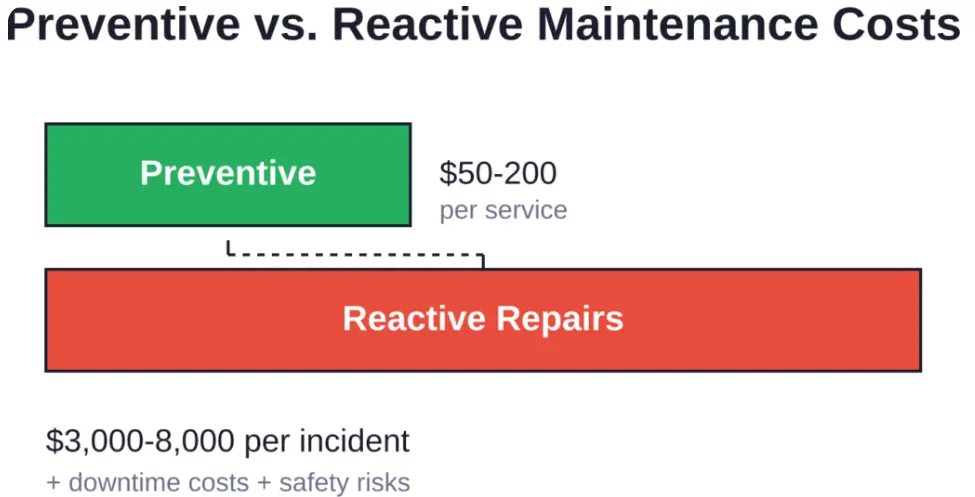
Preventive maintenance is far cheaper than reactive repairs. Period. When fleets skip routine service, small fixes turn into major failures.
The math is simple. A $50 oil change prevents a $5,000 engine replacement. A $200 brake inspection avoids a $3,000 accident repair—not to mention the downtime costs and safety risks.
Real talk: downtime is one of the most expensive hidden costs in fleet operations. A vehicle sitting in the shop generates zero revenue while still incurring fixed costs. Preventive maintenance reduces unplanned downtime by catching issues before they force vehicles off the road.
Build a maintenance schedule based on manufacturer recommendations, operating conditions, and vehicle usage patterns. Track compliance religiously. Modern fleet management software automates service reminders and tracks maintenance history across the entire fleet.
Strategy 2: Leverage Telematics Technology
Telematics systems provide real-time data on vehicle location, driver behavior, fuel consumption, idle time, and maintenance needs. This visibility transforms fleet management from reactive guesswork to proactive optimization.
The technology pays for itself quickly. Telematics identifies excessive idling, harsh braking, speeding, and inefficient routing—all of which waste fuel and accelerate wear. By addressing these behaviors, fleets typically see significant fuel savings within the first year.
But wait. Telematics also enables more accurate maintenance scheduling based on actual operating conditions rather than arbitrary mileage intervals. An engine running in stop-and-go city traffic needs different service intervals than one cruising highways.
Data-Driven Decision Making
The real value of telematics lies in the data analytics capabilities. Fleet managers can identify trends, benchmark performance, and make evidence-based decisions about vehicle replacement, route optimization, and driver training needs.
For example, data might reveal that certain vehicles consistently underperform on fuel efficiency. That insight prompts investigation—maybe it’s a maintenance issue, maybe the vehicle is mismatched to its assigned route, or maybe a driver needs additional training.
Strategy 3: Right-Size Your Fleet
Many organizations maintain more vehicles than they actually need. Each underutilized vehicle carries fixed costs—financing, insurance, registration—while sitting idle more than it should.
Fleet utilization analysis reveals the truth. Optimal utilization rates fall between 70-85%. Vehicles below 50% utilization are candidates for elimination or reassignment.
The calculation is straightforward: track how many hours or miles each vehicle operates versus how many it could theoretically operate. A delivery van that runs 4 hours per day when it could run 8 hours is 50% utilized.
| Utilization Rate | Status | Action |
|---|---|---|
| Above 85% | Overutilized | Consider adding capacity to prevent burnout and excessive maintenance |
| 70-85% | Optimal | Maintain current allocation |
| 50-70% | Underutilized | Reassign, share across departments, or consider vehicle pooling |
| Below 50% | Severely underutilized | Strong candidate for elimination or sale |
Right-sizing doesn’t always mean cutting vehicles. Sometimes it means adding vehicles to prevent overworking existing assets, which accelerates maintenance needs and shortens lifecycles.
Strategy 4: Optimize Fuel Management
Fuel represents the single largest variable cost for most fleets. Small percentage improvements translate to significant dollar savings across hundreds or thousands of vehicles.
Multiple levers control fuel costs. Route optimization reduces unnecessary miles. Driver training reduces aggressive acceleration, harsh braking, and excessive idling—behaviors that can increase fuel consumption by 20-30%.
Now, this is where it gets interesting. Alternative fuels and advanced vehicle technologies can drive substantial savings depending on fleet composition and operating conditions. NAFA’s Sustainable Fleet Technology Webinar Series has explored how biodiesel, natural gas, and propane can reduce both carbon emissions and costs.
The Electric Vehicle Equation
Electric vehicles present both opportunities and challenges for cost reduction. While fewer than 10 percent of vehicles on the road today are EVs, adoption is accelerating—particularly in government and corporate fleets with sustainability mandates.
The economics vary dramatically by use case. Research from the University of Minnesota’s Center for Transportation Studies found that only 15% of survey respondents have EVs in their fleets. Why the skepticism? Calculating return on investment for a single vehicle is straightforward—but for a fleet, it’s complex. EV fleets require charging infrastructure, maintenance staff with specialized knowledge, and careful analysis of duty cycles to ensure range adequacy.
That said, the National Renewable Energy Laboratory’s analysis shows that strategic implementation can yield significant savings. Research on behind-the-meter battery storage at Fort Carson demonstrated annual utility bill savings of approximately $500,000. The battery, along with an existing solar photovoltaic system, was projected to shave an estimated $500,000 off Fort Carson’s utility bill each year.
Strategy 5: Extend Vehicle Lifecycles Strategically
Replacing vehicles too early wastes the remaining useful life. Replacing too late incurs excessive maintenance costs and downtime. The trick is finding the optimal replacement point for each vehicle class.
This requires lifecycle cost analysis that considers acquisition cost, maintenance trajectory, fuel efficiency degradation, resale value, and downtime risk. Generally speaking, vehicles hit an inflection point where cumulative repair costs and downtime losses exceed the benefit of keeping them in service.
For light-duty vehicles, this often occurs between 150,000-200,000 miles or 8-10 years. For heavy-duty trucks, it might be 500,000 miles or more. The specific threshold depends on vehicle quality, maintenance history, and operating conditions.
Track maintenance costs per vehicle monthly. When a vehicle’s maintenance CPM exceeds a predetermined threshold—say, twice the fleet average—flag it for replacement evaluation.
Strategy 6: Negotiate Better Supplier Relationships
Fleet managers with purchasing power can negotiate volume discounts on fuel, parts, maintenance services, and insurance. Even modest percentage improvements compound across large fleets.
Consider establishing preferred vendor relationships with maintenance providers. In exchange for guaranteed volume, negotiate discounted labor rates and parts pricing. Many fleet service providers offer customized maintenance plans that reduce per-service costs.
Bulk fuel purchasing or fleet fuel cards provide transaction-level data and often include per-gallon discounts. The data alone is valuable—it enables identification of fuel theft, unauthorized usage, and purchasing pattern optimization.
Strategy 7: Implement Driver Training Programs
Drivers directly influence fuel consumption, accident rates, vehicle wear, and maintenance costs. Training programs that emphasize safe, efficient driving techniques deliver measurable ROI.
Focus areas include smooth acceleration and braking, optimal speed maintenance, proper gear selection (for manual transmissions), route familiarization, and vehicle inspection procedures. Defensive driving training reduces accident frequency and severity, cutting insurance claims and vehicle damage costs.
Telematics systems enable driver scorecarding based on objective metrics: harsh braking events, speeding incidents, idle time, seatbelt usage. Gamification—leaderboards, recognition programs, small incentives—drives behavioral improvement without punitive measures.
Strategy 8: Standardize Fleet Composition
Fleet standardization reduces complexity, simplifies maintenance, and improves parts inventory management. When every vehicle is a different make and model, mechanics need broader knowledge, parts inventory explodes, and troubleshooting takes longer.
Standardizing around fewer vehicle platforms means mechanics develop deep expertise with specific models. Parts inventory becomes more efficient—higher-volume purchases of fewer SKUs. Warranty administration simplifies. Resale values often improve because standardized fleets generate maintenance records that demonstrate consistent care.
Sound familiar? That’s because large commercial fleets figured this out decades ago. The principle applies equally to smaller operations.
Strategy 9: Use Data Analytics for Continuous Improvement
Technology enables granular tracking of virtually every fleet metric. The challenge isn’t data availability—it’s extracting actionable insights from the noise.
Establish key performance indicators (KPIs) aligned with cost reduction goals: fuel cost per mile, maintenance cost per mile, vehicle utilization rate, accident frequency, on-time delivery percentage, downtime hours. Track these monthly and investigate variances.

Benchmark against industry standards and historical performance. If maintenance costs spike, drill down to identify whether it’s a specific vehicle, vendor, part category, or systemic issue. Root cause analysis prevents recurring problems.
Reduce EV Charging Issues With ECOFACTOR
Reducing fleet management costs often starts with avoiding small operational problems that repeat every day. For electric fleets, poor charging access, missing equipment, or unclear station availability can slow vehicles down. ECOFACTOR helps businesses organize this side with charging stations, station management tools, and a mobile app for iOS and Android.
Drivers can use the charging station map to plan charging more clearly during the workday. ECOFACTOR also has an online store with chargers, cables and adapters, so businesses can prepare the equipment needed for offices, parking areas, service points, or fleet locations.
ECOFACTOR can help companies reduce charging-related friction through:
- Better charging access at company locations
- Equipment for regular EV fleet use
- Mobile tools that help drivers find charging points
- Accessories that support everyday charging needs
Contact ECOFACTOR to make EV charging easier to plan and avoid daily issues that can add extra time and cost to fleet operations.
Avoiding False Economies
Not all cost-cutting measures actually save money. Some create expensive problems down the road.
Skipping preventive maintenance saves money this month but costs far more when vehicles break down. Extending oil change intervals beyond manufacturer specifications voids warranties and accelerates engine wear. Buying the cheapest tires might seem smart until premature wear forces replacement—and the safety implications.
The short answer? Cutting the wrong costs increases total spend. Smart fleet management distinguishes between productive cost reduction and penny-wise-pound-foolish decisions.
| False Economy | Short-Term Savings | Long-Term Cost |
|---|---|---|
| Delaying preventive maintenance | $200 per service | $3,000-8,000 in emergency repairs plus downtime |
| Buying cheapest parts/fluids | 10-20% on parts | Premature failure, warranty voidance, reduced resale value |
| Keeping aging vehicles too long | No replacement cost | Escalating maintenance, fuel inefficiency, reliability issues |
| Eliminating driver training | Training program costs | Higher accident rates, fuel waste, accelerated wear |
Building a Cost Reduction Roadmap
Implementing all these strategies simultaneously is overwhelming and unnecessary. Prioritize based on current pain points and potential impact.
Start with data collection. Without accurate baseline metrics, progress can’t be measured. Implement systems that automatically track fuel consumption, maintenance costs, utilization rates, and driver behavior.
Next, identify the biggest cost drivers. For most fleets, that’s fuel and maintenance. Focus initial efforts where potential savings are largest. A 5% reduction in fuel costs typically saves more than a 20% reduction in insurance costs simply because fuel represents a much larger expense category.
Set specific, measurable goals: reduce fuel costs by 12% over 12 months, decrease unplanned maintenance by 25%, improve utilization rates to 75% fleet-wide. Assign ownership and track progress monthly.
Technology Investment ROI
Fleet management software, telematics systems, and maintenance tracking tools require upfront investment. The question is whether ROI justifies the expense.
For most fleets above 20-25 vehicles, technology investment pays for itself within 12-18 months through fuel savings, maintenance optimization, and improved utilization. Larger fleets see even faster payback.
Look for solutions that integrate rather than create data silos. The ideal system consolidates fuel data, maintenance records, telematics feeds, driver information, and financial tracking in a single platform with robust analytics capabilities.
Frequently Asked Questions
What is the average cost per mile for fleet management?
Total cost per mile varies widely based on vehicle type, fuel prices, and operational factors. Commercial trucking operations typically see total costs between $1.50-2.50 per mile, with fuel around $0.40-0.60 per mile and maintenance around $0.15-0.25 per mile. Light-duty fleet vehicles often run $0.50-0.80 per mile total. These figures fluctuate with fuel prices, vehicle age, and regional factors.
What is the average cost per mile for fleet management?
Total cost per mile varies widely based on vehicle type, fuel prices, and operational factors. Commercial trucking operations typically see total costs between $1.50-2.50 per mile, with fuel around $0.40-0.60 per mile and maintenance around $0.15-0.25 per mile. Light-duty fleet vehicles often run $0.50-0.80 per mile total. These figures fluctuate with fuel prices, vehicle age, and regional factors.
How much can preventive maintenance reduce fleet costs?
Comprehensive preventive maintenance programs can reduce maintenance spending compared to reactive approaches. More importantly, they decrease unplanned downtime, which often represents the larger financial impact. The exact savings depend on current maintenance practices, vehicle age distribution, and program implementation quality.
Are electric vehicles cost-effective for fleet operations?
EV cost-effectiveness depends heavily on duty cycle, charging infrastructure availability, and local electricity rates. For fleets with predictable routes under 150 miles per day and access to low-cost charging, EVs may reduce operating costs compared to gasoline vehicles in favorable conditions. However, higher acquisition costs and charging infrastructure requirements mean total lifecycle savings vary. Currently, only 15% of survey respondents have EVs in their fleets, with adoption concentrated in specific use cases where economics are favorable.
What fleet utilization rate should managers target?
Optimal fleet utilization typically falls between 70-85%. Below 70%, vehicles are underutilized and may be candidates for elimination or reassignment. Vehicles below 50% utilization are strong candidates for removal from the fleet. Above 85%, vehicles may be overworked, leading to accelerated wear and inadequate backup capacity for maintenance and unexpected demand.
How do telematics systems reduce fleet costs?
Telematics reduces costs through multiple mechanisms: identifying and correcting inefficient driving behaviors, optimizing routes, enabling predictive maintenance, reducing idle time, improving asset utilization, and providing data for insurance discounts. Fleets may see measurable total cost reduction within the first year of implementation, with larger fleets achieving higher percentages.
What percentage of fleet costs are fixed versus variable?
In commercial trucking operations, fixed costs (financing, insurance, licensing, management) represent approximately 17% of total marginal costs, while variable costs (fuel at 21%, maintenance at 9%, and other operational expenses) make up the majority. The exact split varies by fleet type, with rental and delivery fleets showing different proportions. Understanding this breakdown helps managers focus cost reduction efforts where impact is greatest.
When should vehicles be replaced to minimize lifecycle costs?
Optimal replacement timing depends on vehicle class and usage patterns. Light-duty vehicles typically hit the replacement inflection point between 150,000-200,000 miles or 8-10 years. Heavy-duty trucks may run economically to 500,000 miles or more with proper maintenance. The key indicator is when monthly maintenance costs consistently exceed a threshold—often defined as twice the fleet average cost per mile for that vehicle class. Track maintenance CPM monthly and evaluate replacement when costs escalate sharply.
Taking Action on Cost Reduction
Fleet cost reduction isn’t a one-time project—it’s an ongoing discipline. The strategies outlined here work, but only with consistent implementation and measurement.
Start small. Pick two or three strategies that address current pain points. Implement them thoroughly, measure results, and refine based on data. Then expand to additional areas.
Remember that the goal isn’t minimum spending—it’s optimal spending. Invest in preventive maintenance, driver training, and technology where ROI is clear. Cut waste, improve efficiency, and eliminate underutilized assets.
The fleets that succeed long-term balance cost control with operational excellence. They spend strategically, measure relentlessly, and continuously improve. That approach doesn’t just reduce costs—it builds competitive advantage.