


Table of contents:
Quick Summary: Choosing the best fleet management company requires evaluating their technology capabilities, industry experience, customer support quality, and pricing transparency. The right provider should offer scalable solutions that match your fleet size, integrate seamlessly with existing systems, and demonstrate proven ROI through features like real-time GPS tracking, maintenance management, and comprehensive reporting. Look for companies with strong client testimonials, certified expertise, and a clear understanding of your specific operational challenges.
Fleet management decisions shape operational efficiency for years. The company behind your solution matters just as much as the platform itself.
With fleet costs consuming significant portions of operational budgets—fuel is a significant operational cost component—choosing the wrong provider can mean wasted resources and missed opportunities. The right partner transforms vehicles from cost centers into competitive advantages.
But here’s the thing: not all fleet management companies deliver the same value. Some specialize in small business needs, while others excel with enterprise deployments. Some prioritize GPS tracking, others focus on maintenance optimization.
This guide breaks down exactly what separates exceptional providers from mediocre ones.
We remind you that you can purchase home and commercial charging stations in our online store, as well as use public charging stations ECOFACTOR located throughout Ukraine. For convenient access to charging infrastructure, we recommend using our mobile app, available on iOS and Android.
What Fleet Management Companies Actually Do
A fleet management company provides hardware, software, and services that help businesses track, maintain, and optimize vehicle operations. These solutions typically combine telematics devices installed in vehicles with cloud-based platforms that collect and analyze operational data.
The best providers go beyond basic vehicle tracking. They offer comprehensive tools for driver safety monitoring, fuel management, maintenance scheduling, compliance reporting, and route optimization.
Real talk: the difference between a basic provider and a top-tier one often shows up in the details. Can their system send automated maintenance alerts before issues become breakdowns? Does their platform integrate with your existing accounting software? Can they provide industry-specific reporting that matches your operational metrics?
Core Features Every Quality Provider Should Offer
Before evaluating specific companies, understand the baseline capabilities any serious fleet management provider must deliver.
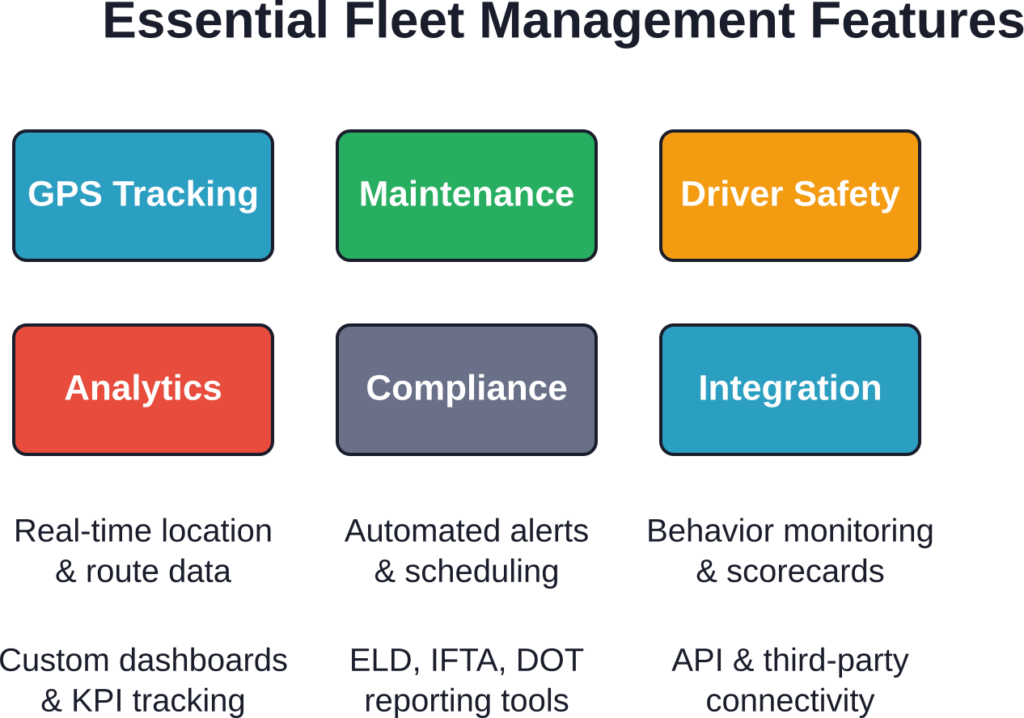
Real-Time GPS Tracking and Vehicle Visibility
Vehicle tracking allows businesses to monitor location, speed, and direction in real time. This capability consistently ranks as the most critical feature—94% of Capterra reviewers rated it as a critical feature according to industry reviews.
Quality GPS tracking enables accurate ETAs for customer service, theft prevention, and accountability for vehicle usage. The technology should update location data at least every 30 seconds during operation.
Maintenance Management and Asset Tracking
Preventive maintenance scheduling extends vehicle lifespan and prevents costly breakdowns. Top providers offer automated alerts based on mileage, engine hours, or calendar intervals.
The system should track maintenance history, generate work orders, and integrate with service providers. This aligns with NAFA’s Criteria for Excellence, which emphasizes strategic asset management as a core competency for fleet operations.
Driver Behavior Monitoring and Safety Features
Driver safety tools monitor behaviors like harsh braking, rapid acceleration, speeding, and idling. These features directly impact insurance costs and accident rates.
Consider the financial impact: idling represents a significant cost that varies by fuel prices and vehicle specifications. Multiply that across a fleet, and behavior monitoring pays for itself quickly.
Reporting and Analytics Capabilities
Data only creates value when it’s actionable. The best fleet management companies provide customizable dashboards, automated reports, and analytics that identify cost-saving opportunities.
Look for providers that offer both standard reports (fuel usage, maintenance costs, utilization rates) and the flexibility to create custom views matching your specific KPIs.
Key Criteria for Evaluating Fleet Management Providers
Now, this is where it gets interesting. Features matter, but provider qualities determine long-term success.
Industry Experience and Track Record
Experience in your specific industry makes a substantial difference. A provider serving construction fleets understands different challenges than one focused on last-mile delivery or public sector operations.
Look for testimonials from businesses similar to yours in size and industry. The NAFA Fleet Management Association recognizes peak-performing operations through programs like the 100 Best Fleets in the Americas, which identifies innovation and performance excellence across public and commercial sectors.
Providers serving award-winning fleets typically maintain higher standards and proven methodologies.
Technology Deployment and Innovation Strategy
Technology evolves rapidly. According to NAFA’s Criteria for Excellence, top fleet operations maintain technology deployment plans reviewed and updated annually.
Ask potential providers about their development roadmap. How frequently do they release updates? What emerging technologies are they incorporating? Can they demonstrate innovation in areas like electric vehicle support, AI-powered analytics, or mobile app functionality?
Scalability and Flexibility
The fleet needs change. A company managing 15 vehicles today might operate 50 in three years. The right provider scales seamlessly without forcing platform migrations or dramatic cost increases.
Test this during evaluation: ask how their pricing and capabilities adjust as fleet size grows. Request examples of clients who’ve successfully scaled with their platform.
Integration Capabilities
Fleet management doesn’t exist in isolation. The system needs to connect with accounting software, fuel card programs, maintenance vendors, and potentially customer relationship management platforms.
Evaluate both pre-built integrations and API capabilities for custom connections. According to research on fleet technology, open integration platforms typically deliver more value than closed ecosystems.
Customer Support and Training Quality
Software problems at 6 PM on Friday shouldn’t wait until Monday. Assess support availability, response times, and support channel options (phone, email, chat, knowledge base).
Training quality matters equally. How does the provider onboard new clients? Do they offer ongoing education as features expand? Are training resources accessible to all team members who’ll use the system?
Pricing Transparency and Total Cost of Ownership
Hidden costs destroy budgets. Some providers advertise low per-vehicle pricing but charge separately for essential features, installation, support, or contract modifications.
Request complete cost breakdowns including hardware, software subscriptions, installation, training, and ongoing support. Calculate total cost of ownership across the expected contract period, not just monthly fees.
For context: fleet management costs include asset acquisition, licensing, maintenance, labor, and disposal. A comprehensive analysis divides total fleet costs by total miles driven. For example, a fleet with $226,000 in annual costs driving 100,000 miles operates at $2.26 per mile.
| Evaluation Criterion | What to Ask | Red Flags |
|---|---|---|
| Experience | How many clients in my industry? Case studies? | No relevant testimonials; generic responses |
| Technology | Update frequency? Development roadmap? | No clear innovation plan; outdated interfaces |
| Scalability | How does pricing adjust? Migration process? | Forced upgrades; unclear expansion costs |
| Integration | Pre-built connections? API documentation? | Closed system; limited third-party support |
| Support | Availability hours? Average response time? | Business hours only; slow ticket resolution |
| Pricing | All-in costs? Contract terms? Hidden fees? | Vague pricing; mandatory long-term contracts |
Choose ECOFACTOR for EV Charging Support
Choosing a fleet management company often depends on what your vehicles need in daily operation. For businesses with electric vehicles, ECOFACTOR can help cover the charging side with charging stations, station management tools, and mobile access for drivers through iOS and Android.
Its charging station map helps drivers find charging points and check station details, while the online store gives businesses access to chargers, cables and adapters for offices, parking areas, service bases, and commercial locations.
ECOFACTOR can be useful for companies that need:
- EV charging infrastructure for business use
- Tools for managing station access and activity
- Driver support through mobile charging tools
- Equipment and accessories for regular EV operation
Contact ECOFACTOR to see whether its charging stations, software, and EV equipment fit your fleet needs.
Matching Provider Capabilities to Fleet Size and Type
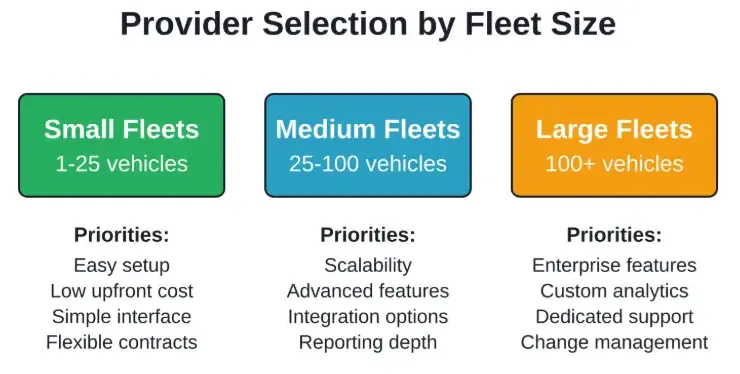
Small business fleets (under 25 vehicles) need different solutions than enterprise operations managing hundreds of assets.
Small Fleet Considerations
Smaller operations prioritize ease of use, quick setup, and straightforward pricing. Over 65% of small businesses use credit cards on a frequent basis, indicating preference for flexible payment options without lengthy procurement processes.
Look for providers offering month-to-month or annual contracts rather than multi-year commitments. Cloud-based solutions with minimal hardware requirements reduce upfront investment.
Large Fleet Requirements
Enterprise fleets require advanced analytics, custom reporting, role-based access controls, and dedicated account management. NAFA’s accountability criteria emphasize published performance measures and review mechanisms for team productivity—capabilities that demand sophisticated platforms.
Large fleet providers should demonstrate experience with complex deployments, phased rollouts, and change management support for organizations with established processes.
Industry-Specific Needs
Construction fleets need equipment tracking beyond vehicles. Delivery fleets prioritize route optimization. Public sector fleets require detailed compliance documentation and taxpayer accountability reporting.
Verify that potential providers understand regulatory requirements specific to your industry, whether that’s DOT compliance for commercial carriers, public sector procurement standards, or specialized insurance requirements.
ROI Expectations and Performance Metrics
The best fleet management companies don’t just track metrics—they improve them. But what constitutes realistic ROI?
Fleets actively using telematics have reduced fuel costs by up to 14%, according to Telematics Wire Market research. Implementing fleet management solutions can drive cost savings of 15-20% through improved efficiency, reduced idle time, optimized routing, and preventive maintenance.
Ask potential providers for case studies with quantified results. Specific examples might include percentage reductions in fuel consumption, decreased maintenance costs, improved on-time delivery rates, or reduced insurance premiums.
NAFA’s accountability criterion requires published performance measures and mechanisms to track progress toward objectives—standards that quality providers should mirror in their own client reporting.
The Evaluation Process: From Research to Decision
Sound familiar? Spreadsheets full of features, pricing variations, conflicting sales pitches. Here’s a structured approach that cuts through the noise.
Step 1: Define Requirements
Document current pain points, must-have features, and success metrics before contacting providers. Include input from drivers, maintenance staff, and accounting teams who’ll interact with the system.
Step 2: Research and Shortlist
Identify 4-6 providers matching fleet size and industry focus. Review third-party evaluations, not just marketing materials. Check for certifications like NAFA’s Certified Automotive Fleet Manager (CAFM) program among their staff, indicating professional expertise.
Step 3: Request Demonstrations
Live demos reveal what documentation can’t. Prepare specific scenarios from daily operations and ask providers to demonstrate how their platform handles them. Test the actual interface, not just curated presentations.
Step 4: Validate References
Contact current clients, particularly those in similar industries or facing comparable challenges. Ask about implementation experience, ongoing support quality, and whether promised ROI materialized.
Step 5: Pilot When Possible
Some providers offer pilot programs with limited deployments. Testing with a subset of vehicles reduces risk and validates performance claims before full commitment.
Step 6: Review Contracts Carefully
Examine contract terms beyond pricing. What are termination conditions? Data ownership and export capabilities if switching providers? Update and support obligations? Liability limitations?
The SBA recommends checking testimonials from businesses similar to yours when evaluating business software—advice that applies equally to fleet management selection.
Common Mistakes to Avoid
Even thorough evaluations can miss critical issues. Watch for these common pitfalls:
- Focusing Solely on Price: The cheapest option rarely delivers the best value. A system saving $50 monthly but costing thousands in operational inefficiency is no bargain.
- Ignoring User Experience: If drivers and staff find the system frustrating, adoption fails regardless of capabilities. Interface design and mobile app quality matter tremendously.
- Overlooking Data Ownership: Clarify who owns the operational data collected. Can data be exported easily if changing providers? Are there restrictions on data usage or analysis?
- Underestimating Implementation Time: Hardware installation, software configuration, and staff training require time. Rushed deployments create problems that persist for years.
- Skipping Compliance Verification: Verify that the provider’s solution meets industry-specific regulatory requirements. Non-compliant systems create liability exposure.
Frequently Asked Questions
How much should fleet management services cost per vehicle?
Pricing varies significantly based on features, fleet size, and hardware requirements. Basic GPS tracking might cost $15-30 per vehicle monthly, while comprehensive platforms with advanced analytics and hardware range from $30-60+ per vehicle. Request detailed quotes including all costs—hardware, installation, training, and support—to calculate true total cost of ownership. Many providers offer volume discounts for larger fleets.
What’s the typical implementation timeline for fleet management systems?
Implementation timeframes depend on fleet size and system complexity. Small deployments (under 25 vehicles) with straightforward requirements might complete in 2-4 weeks. Medium to large fleets typically require 6-12 weeks for phased rollouts including hardware installation, software configuration, integration setup, and comprehensive training. Factor in additional time for custom reporting development or complex integrations with existing systems.
Can fleet management systems integrate with existing accounting software?
Most established providers offer integration capabilities with common accounting platforms like QuickBooks, Sage, and enterprise ERP systems. Integration depth varies—some provide pre-built connectors for automatic data syncing, while others require API-based custom development. Clarify integration capabilities during evaluation, including what data transfers automatically, update frequency, and any additional costs for integration setup or maintenance.
How do fleet management companies handle data security and privacy?
Reputable providers implement encryption for data transmission and storage, regular security audits, and compliance with relevant privacy regulations. Ask specific questions about data center certifications, backup procedures, access controls, and incident response protocols. For operations handling sensitive information or government contracts, verify that the provider meets required security standards like SOC 2, ISO 27001, or FedRAMP certification.
What happens to our data if we switch providers?
Data portability varies by provider. Before signing contracts, verify data export capabilities including available formats, historical data access, and any restrictions or fees for data extraction. Quality providers offer straightforward export tools and don’t hold data hostage. Review contract language regarding data ownership and post-termination access to ensure continued access to historical records for compliance and operational needs.
Should small fleets invest in comprehensive systems or start with basic tracking?
The answer depends on specific operational challenges and growth plans. Basic GPS tracking delivers value for simple location visibility needs. However, fleets experiencing maintenance issues, compliance challenges, or fuel cost concerns often benefit from comprehensive platforms immediately. Consider starting with core features and a provider offering easy feature expansion as needs grow, avoiding the disruption of platform migrations later.
How quickly can fleets expect to see ROI from fleet management systems?
ROI timelines vary based on implementation quality and feature utilization. Organizations actively using telematics for route optimization, idle time reduction, and maintenance management typically see measurable savings within 3-6 months. Full ROI—where cumulative savings exceed total implementation and subscription costs—often occurs within 12-18 months. Providers should offer ROI calculators or projections based on fleet size and identified cost-saving opportunities during the evaluation process.
Making Your Final Decision
Choosing the best fleet management company comes down to alignment: how well does their technology, expertise, and support model match your operational reality?
The provider offering the most features won’t necessarily deliver the best results. Success requires a company understanding your industry challenges, providing technology your team will actually use, and supporting long-term operational excellence.
Start with clear requirements, evaluate systematically against criteria that matter for your operation, and validate claims through demonstrations and reference checks. The right provider becomes a strategic partner in fleet optimization, not just a software vendor.
Remember that fleet management is an evolving discipline. NAFA’s emphasis on annual technology plan reviews and continuous performance improvement reflects an industry that adapts quickly. Choose a provider committed to innovation and continuous improvement alongside your operation.
Take the time to select wisely. The decision impacts operational efficiency, cost management, and competitive advantage for years. A thorough evaluation process now prevents expensive mistakes and platform migrations later.
Ready to find your ideal fleet management partner? Define your requirements, shortlist providers with proven expertise in your industry, and start scheduling demonstrations. The investment in proper evaluation pays dividends in operational performance and cost savings for years ahead.