

Table of contents:
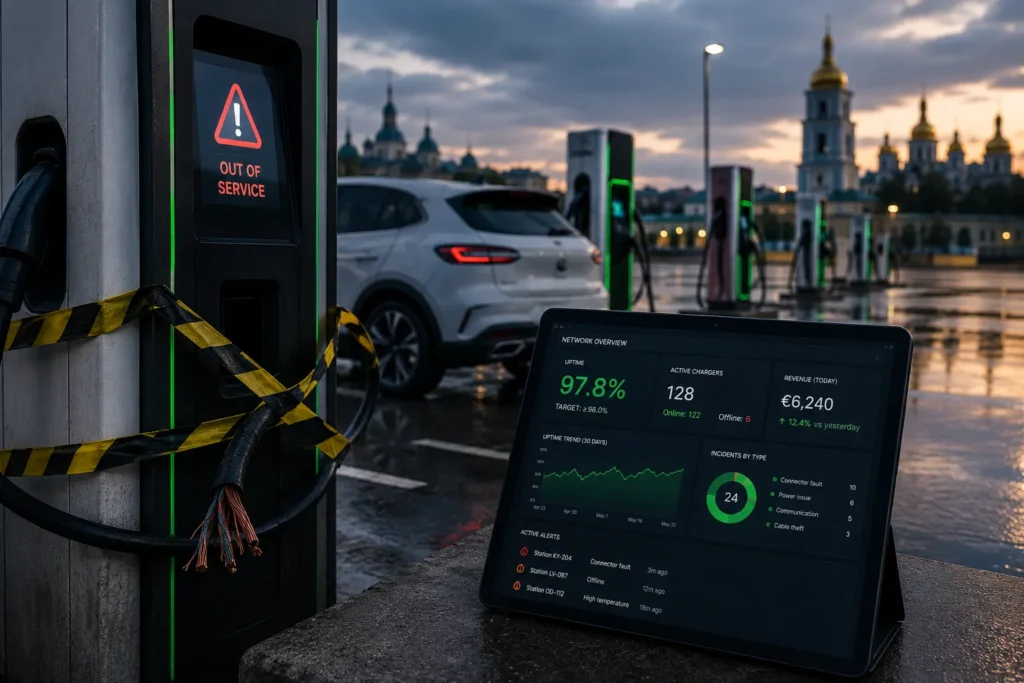
A charger going offline is rarely just one broken unit. It can mean lost charging sessions, unhappy drivers, extra support requests, and maintenance teams rushing to fix problems that could have been prevented. As charging networks grow, those small disruptions become much harder to manage.
Keeping chargers online isn’t simply a maintenance task anymore. It’s part of running a reliable charging business. The operators with the highest uptime are usually the ones that detect issues early, resolve many of them remotely, and use real operational data to plan maintenance instead of waiting for failures.
In this article, we’ll look at the real cost of charger downtime, why it becomes more expensive as networks expand, and what charging network operators can do to reduce outages across hundreds or even thousands of charge points.
We remind you that you can purchase home and commercial charging stations in our store, as well as use public charging stations ECOFACTOR located throughout Ukraine. For convenient access to charging infrastructure, we recommend using our mobile app, available on iOS and Android.
The Cost of One Offline Charger Is Bigger Than It Looks
A charging station rarely fails at a convenient time. It happens when a driver is low on battery, a delivery vehicle needs to return to work, or a fleet is preparing for the morning shift.
At first, downtime looks like lost revenue from missed charging sessions. In reality, the cost is wider. Drivers look for another station, support teams receive complaints, technicians need to investigate, and operators lose time on issues that could often be detected earlier.
For networks with dozens or hundreds of chargers, these problems rarely stay isolated. Small interruptions across different locations can turn into a constant stream of urgent repairs. Without a clear maintenance strategy, operators spend more time reacting to failures than improving reliability.
That is why experienced Charge Point Operators track more than charging sessions. Charger health, response times, recurring faults, and remote resolution rates often show problems before drivers report them.
This approach is becoming increasingly important in the Ukrainian market, where public and commercial charging infrastructure continues to expand. As more chargers are deployed across cities, highways, logistics hubs, retail locations, residential complexes, and workplaces, maintaining high availability becomes just as important as installing new equipment. Growth is not only about installing new chargers. It is about keeping every existing location dependable day after day.
Why Downtime Grows Faster Than Charging Networks
Adding more chargers creates more business opportunities, but it also makes maintenance harder to manage.
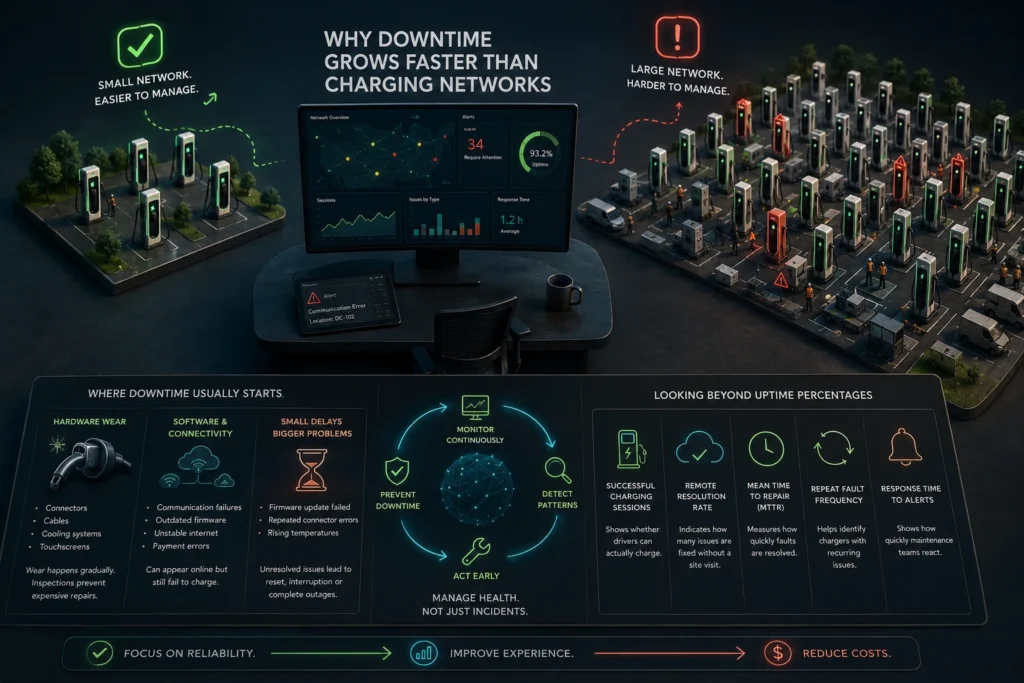
Ten chargers can often be monitored manually. One hundred chargers cannot. As networks spread across different locations, even a small percentage of unavailable chargers can create a steady flow of service requests, site visits, and driver complaints.
Not every problem looks like a full outage. A charger may appear online while drivers still face failed authorization, interrupted charging, communication errors, slow charging, or payment issues. On the dashboard, the station may seem available. At the site, it may be useless.
As networks grow, operators usually face more equipment across different locations, different charger models and maintenance needs, more firmware updates, more integrations between chargers, payment systems, and platforms, more coordination with field service teams, and higher driver expectations. This is why scaling a charging network is not only about adding hardware. Every new station becomes an asset that needs monitoring, updates, repairs, and performance tracking.
Mature operators do not treat downtime as separate one-off incidents. They look for patterns across the network. If several chargers show similar communication errors or one connector type fails too often, the issue can be addressed before it spreads further. That shift from fixing single failures to managing the health of the whole network is what makes large-scale charging operations more reliable.
Where Downtime Usually Starts
Many charger failures do not begin with a major hardware fault. In practice, small issues that go unnoticed for too long are far more common.
Hardware Wear Is Only Part of the Story
Connectors, cables, cooling systems, and touchscreens naturally wear over time, especially at busy locations. Exposure to rain, dust, heat, or frequent daily use gradually affects components, increasing the risk of faults if inspections are delayed. Regular physical checks help identify damage before it leads to an unavailable charger or a costly repair.
Software and Connectivity Problems
A charger can appear online while still being unable to start a charging session. Communication failures between the charger and the management platform, outdated firmware, unstable internet connections, or payment processing errors often prevent successful charging without any visible hardware damage. These issues are difficult to spot without continuous monitoring, which is why many operators rely on remote diagnostics instead of waiting for driver reports.
Small Delays Become Bigger Problems
Not every fault requires an immediate technician visit, but every unresolved fault increases the chance of longer downtime. A failed firmware update, repeated connector errors, or rising operating temperatures may seem minor on their own. Left unattended, they can lead to charger resets, interrupted sessions, or complete outages. The goal is not to eliminate every fault. It is to detect issues while they are still easy and inexpensive to fix.
Looking Beyond Uptime Percentages
High uptime looks good on paper, but it does not always reflect the experience drivers have. A charger may report as available while failing to authorize charging, process payments, or complete a session. From the operator’s perspective, the station is online. From the driver’s perspective, it is out of service.
For that reason, uptime should be measured together with other operational indicators.
| Metric | Why it matters |
|---|---|
| Successful charging sessions | Shows whether drivers can actually charge. |
| Remote resolution rate | Indicates how many issues are fixed without a site visit. |
| Mean time to repair (MTTR) | Measures how quickly faults are resolved. |
| Repeat fault frequency | Helps identify chargers with recurring issues. |
| Response time to alerts | Shows how quickly maintenance teams react. |
Looking at these metrics together provides a much clearer picture of network reliability than uptime alone. It helps operators focus on improving the charging experience, not just the numbers shown on a dashboard.
Building a System That Prevents Downtime
Keeping chargers online becomes much easier when maintenance is built around prevention instead of emergency repairs. The objective is to identify issues early, resolve as many as possible remotely, and send technicians only when necessary.
Real-Time Monitoring
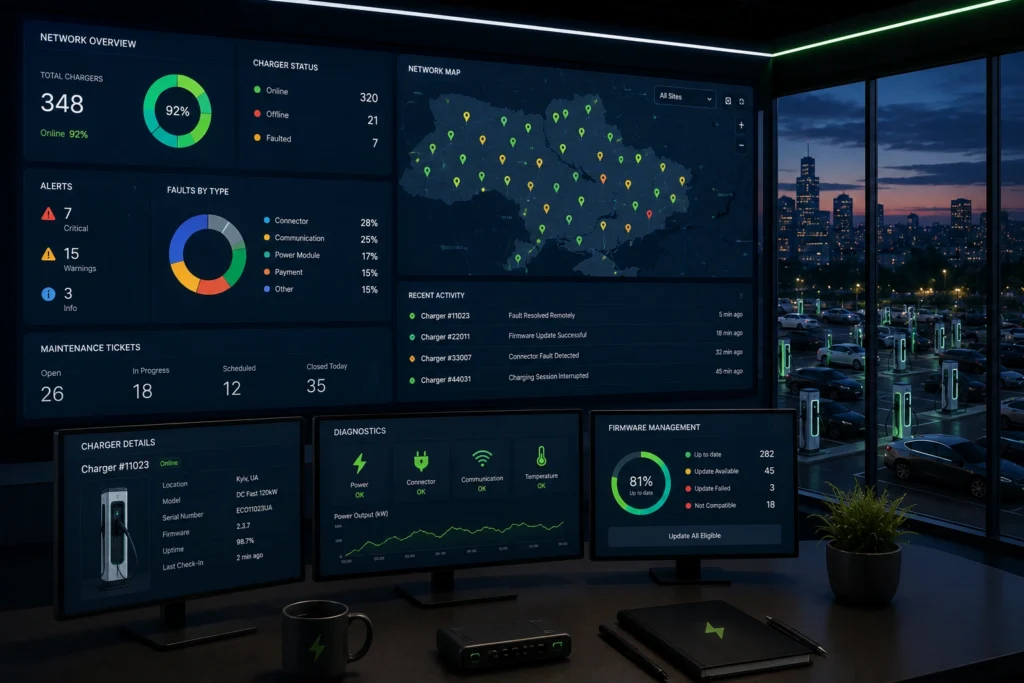
Continuous monitoring gives operators visibility into the condition of every charger without visiting the site. Instead of waiting for customer complaints, teams receive alerts when a charger loses connectivity, reports repeated fault codes, overheats, or stops communicating with the management platform. Faster detection usually means shorter outages.
Remote Diagnostics
Not every issue requires field service. Many communication errors, software faults, or stalled processes can be diagnosed and resolved remotely. Restarting a charger, checking logs, adjusting settings, or deploying firmware updates often restores normal operation without dispatching a technician. This reduces both maintenance costs and response times.
Preventive Maintenance
Routine maintenance remains one of the most effective ways to avoid unexpected failures. A practical maintenance schedule typically includes inspecting cables and connectors for wear, checking cooling systems and ventilation, testing payment and authorization functions, verifying network connectivity, installing firmware updates, and reviewing recurring fault logs. These tasks take far less time than responding to unplanned outages.
Predictive Maintenance
Preventive maintenance follows a schedule. Predictive maintenance follows the data. Modern charging platforms analyze charger performance over time to identify equipment that is beginning to behave differently. Rising temperatures, repeated communication failures, or frequent charging interruptions may indicate that a component is approaching failure.
Rather than replacing parts on every charger at fixed intervals, operators can focus maintenance where it is actually needed. As charging networks continue to expand, this approach helps reduce unnecessary service visits while keeping availability high.

Build Reliable Charging Infrastructure With ECOFACTOR
Charger downtime can affect both network performance and user experience, making infrastructure quality an important consideration for charging operators. Alongside charging stations, ECOFACTOR provides complementary energy solutions, including hybrid inverters, battery systems, and solar panels. Through its iOS and Android app, drivers can also use the charging station map to locate available charging points.
ECOFACTOR can support charging infrastructure through:
- Charging stations for public and commercial deployment
- Energy storage solutions for charging projects
- Equipment that supports long-term network operation
- Cables and accessories for charging site maintenance
Contact ECOFACTOR to discuss infrastructure solutions that support reliable charging operations at scale.
Managing Hundreds of Chargers Without Growing Your Team
Expanding a charging network should not mean expanding maintenance costs at the same pace. The most efficient operators are not the ones with the largest service teams. They are the ones that automate routine work and give technicians the information they need before arriving on site.
A modern charge point management system helps reduce manual work by detecting charger faults automatically, sending alerts based on fault severity, creating maintenance tickets with diagnostic data, tracking repair history for every charger, managing firmware updates across the network, and monitoring charger availability from one dashboard. Instead of checking chargers one by one, operators can prioritize the issues that have the biggest impact on drivers and business operations.
Remote tools make an even bigger difference. If a software issue can be resolved in minutes from the control center, there is no reason to schedule a site visit. Field technicians can focus on hardware repairs that genuinely require their presence.
As networks continue to grow across Ukraine, this approach becomes increasingly valuable. Charging infrastructure is expanding into retail locations, residential developments, logistics hubs, workplaces, and public roads. Managing all of these assets efficiently requires more than a maintenance schedule. It requires visibility across the entire network.
What Operators Should Measure Besides Uptime
Uptime remains an important KPI, but it should not be the only one. A broader set of metrics helps operators understand where maintenance efforts will have the greatest impact.
| Metric | What it shows |
|---|---|
| Successful charging sessions | Whether chargers complete charging sessions without interruption. |
| Mean time to repair (MTTR) | How quickly faults are resolved after detection. |
| Mean time between failures (MTBF) | How often chargers experience recurring failures. |
| Remote resolution rate | Percentage of issues solved without dispatching a technician. |
| Repeat fault rate | Chargers that continue reporting the same issue after repairs. |
| Firmware compliance | Whether chargers are running approved software versions. |
| Preventive maintenance completion | Whether scheduled maintenance is carried out on time. |
Looking at these metrics together helps operators identify long-term trends instead of reacting to individual incidents. It also makes it easier to plan maintenance budgets, improve service quality, and prioritize upgrades where they deliver the greatest value.
Final Thoughts
Downtime is rarely caused by a single major failure. More often, it begins with small issues that remain unnoticed until drivers are affected.
The most effective way to reduce downtime is not to react faster after a charger fails. It is to build an operation that identifies problems early, resolves routine issues remotely, and uses maintenance data to prevent future failures.
As charging networks continue to grow, reliability becomes one of the factors that separates successful operators from the rest. Keeping chargers available protects revenue, improves the driver experience, and creates a stronger foundation for future expansion.
Frequently Asked Questions
What is the most common cause of EV charger downtime?
Many outages are caused by software, connectivity, or communication issues rather than hardware failures. Regular monitoring and timely firmware updates can prevent many of these problems before drivers notice them.
Is 99% uptime good enough for a charging network?
It depends on the size of the network. While 99% sounds high, even 1% downtime across hundreds of chargers can mean a significant number of unavailable charging sessions. Operators should look at successful charging sessions and repair times alongside uptime.
Can charger problems be fixed without sending a technician?
Yes. Many faults can be diagnosed and resolved remotely through a Charge Point Management System. Restarting a charger, updating firmware, or correcting software settings often restores normal operation without a site visit.
How often should EV charging stations be maintained?
There is no single schedule that fits every network. High-traffic locations usually need more frequent inspections, while software updates, remote monitoring, and preventive maintenance should be part of an ongoing maintenance program.
Which metrics matter besides uptime?
Successful charging sessions, mean time to repair (MTTR), repeat fault rate, remote resolution rate, and preventive maintenance completion all provide a better picture of network reliability than uptime alone.