

Table of contents:
Launching an EV charging hub is not only about installing chargers. Businesses want infrastructure that is ready to serve drivers without long delays, complicated coordination, or months of waiting before the first charging session.
At ECOFACTOR, we focus on making that process as efficient as possible. By combining our own charging hardware with project expertise, we help partners move from planning to operation faster while keeping quality and reliability at every stage.
The projects at HitMall and the Kyiv Hippodrome show how this approach works in practice. Although the locations serve different audiences, both demonstrate how well-planned deployment can quickly turn everyday destinations into convenient places to charge an electric vehicle.
We remind you that you can purchase home and commercial charging stations in our store, as well as use public charging stations ECOFACTOR located throughout Ukraine. For convenient access to charging infrastructure, we recommend using our mobile app, available on iOS and Android.
Why Speed Matters More Than Ever in EV Charging Projects
Every EV charging project starts with a clear business need: a shopping center wants to improve visitor service, a property owner looks for new revenue, or an operator plans network growth.
The real challenge is not deciding whether to install chargers. It is getting them ready for drivers without delays.
We built our deployment process around that exact point. Because we manufacture our own hardware, develop our own software, and manage the project as one connected process, our partners do not have to coordinate several disconnected suppliers.
For Ukrainian businesses, timing matters. A charging hub starts creating value only when drivers can actually use it. That is why we focus on reducing the time from project approval to public launch, while fully testing every charger before opening.
From Idea to Opening Day: How We Approach Every Deployment
No two locations are identical. A retail destination has different traffic patterns than a transport hub. A city center requires a different layout than a roadside charging site. Still, our overall approach follows the same structure because consistency makes projects more predictable.
We Start with the Location, Not the Hardware
Before selecting chargers, we look at how the site actually works. Questions such as where vehicles enter and leave, how long visitors usually stay, what charging speed fits those visits, how many charging points the site will need today, and whether the location can support future expansion all shape the project from the beginning.
The answers influence everything from charger placement to cable routing and electrical design. This early planning often prevents changes later, when adjustments become more expensive and time-consuming.
We Prepare Hardware Before Installation Begins
Because we manufacture our own charging stations, we do not have to wait for equipment from several different suppliers before moving to the next stage. Hardware is prepared, configured, and tested before it reaches the site—including charger configuration, connector verification, software integration, communication testing, and initial quality checks.
By completing much of this work before installation, we reduce the amount of commissioning required on location. It is a simple idea, but it saves valuable time once construction is underway.
Installation and Launch Work as One Process
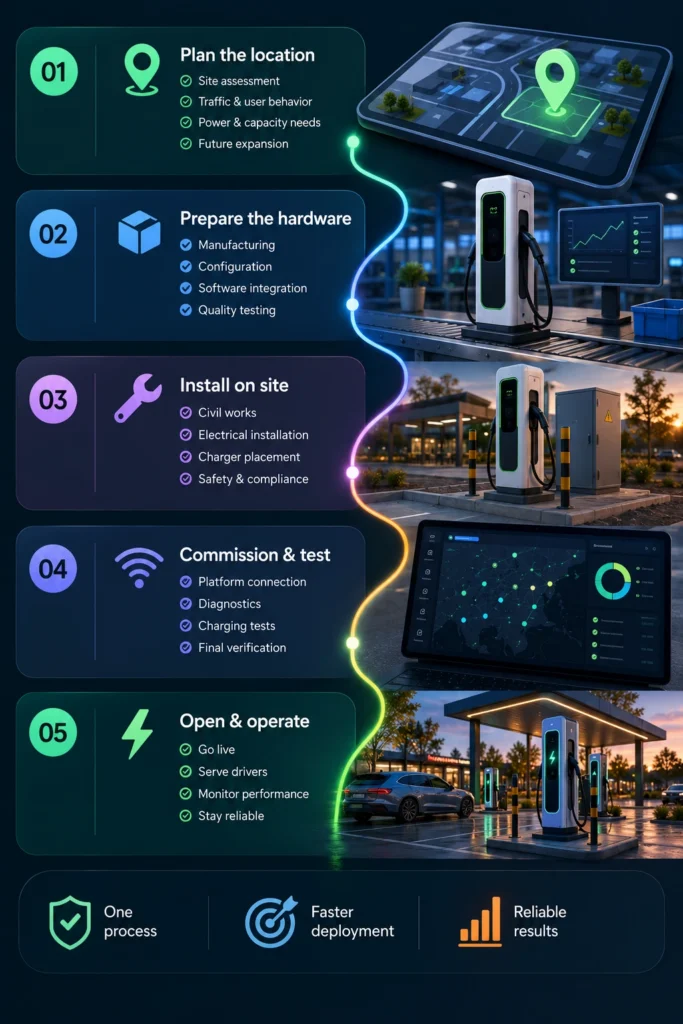
Many people imagine that installation ends when the chargers are physically mounted. In reality, that is only one milestone. Every charger still needs to communicate correctly with the management platform, process charging sessions, report operational status, and perform as expected under real conditions.
Our deployment process combines several stages instead of treating them as separate projects.
| Stage | Our focus |
|---|---|
| Planning | Site assessment, technical design, power requirements |
| Preparation | Hardware manufacturing, configuration, testing |
| Installation | Physical deployment and electrical connection |
| Commissioning | Platform integration, diagnostics, verification |
| Launch | Charging hub opens for public use |
Keeping these stages connected helps us avoid situations where completed hardware waits for software, or installed chargers remain unavailable because final configuration has not been completed.
For our partners, the objective is straightforward. They are not measuring progress by how many chargers have been delivered to the site. They care about the day drivers can actually arrive, plug in, and start charging. That is the milestone we build every project around.
HitMall: Building a Charging Hub Around Everyday Shopping
Retail locations have become some of the most practical places for public EV charging. People already plan to spend time there. They shop for groceries, meet friends, grab a coffee, or browse stores. Charging fits naturally into that routine because the vehicle is parked anyway. Drivers are not waiting for the battery. They are simply going about their day.
That was exactly the idea behind our project at HitMall in Kyiv. Our goal was not to place a few chargers in a parking lot. Together with our partner, we wanted to create a charging hub that could serve many drivers at the same time while remaining easy to use during busy shopping hours.
The result was a large-scale charging location equipped with multiple high-power charging options. Drivers can find DC charging through CCS Combo 2, GB/T DC, and CHAdeMO, alongside AC charging for vehicles that do not require rapid charging. The hub includes 160 kW charging with 9 CCS Combo 2 connectors, 160 kW charging with 6 GB/T DC connectors, 50 kW CHAdeMO charging, 22 kW AC charging with 2 Type 2 connectors, and 7 kW Type 1 charging.
This combination allows the location to accommodate different vehicle models instead of focusing on only one charging standard. Another advantage becomes clear during peak periods. When several charging points are available in one location, drivers spend less time looking for an available connector. That creates a smoother experience and helps the site continue serving customers even when EV traffic increases.
Independent market research has shown how significant this hub has become. EVBOOST included the HitMall partner hub among Ukraine’s largest urban EV hubs, highlighting its concentration of DC charging connectors within one location. For us, that recognition confirms something we consider important from the beginning: successful charging infrastructure is measured by how well it serves drivers after launch, not simply by the number of chargers installed.
Kyiv Hippodrome: A Different Location with Different Priorities
The Kyiv Hippodrome presented a completely different challenge. Unlike a shopping center, people visit the Hippodrome for events, recreation, and leisure. Traffic is influenced by the event schedule, weekends, and seasonal activities rather than daily shopping habits.
That changes how we think about deployment. Instead of designing for continuous turnover throughout the day, we focus on helping visitors charge while they enjoy their time at the venue. For this project, we installed three ultra-fast charging stations, each delivering up to 160 kW and supporting both CCS Combo 2 and GB/T connectors.
Although the installation is smaller than the one at HitMall, the principle remains the same. Charging should fit naturally into the purpose of the location. Visitors should be able to arrive, connect their vehicle, attend an event or spend time with family, and return to a charged car without rearranging their plans.
That is often overlooked when discussing charging infrastructure. Drivers do not judge a charging hub only by its maximum power output. They remember whether charging was easy, whether the location made sense, and whether the stop fit comfortably into the rest of their day.
Different Locations, One Deployment Approach
Looking at HitMall and the Kyiv Hippodrome side by side, it would be easy to focus only on what makes them different. One is a busy shopping center where visitors come and go throughout the day. The other is a destination built around leisure, events, and community activities. The pace is different, the visitor flow is different, and the charging patterns are different.
From our perspective, though, the foundation of both projects is remarkably similar. We start by understanding how people use the location. Only then do we decide what the charging infrastructure should look like. That helps us avoid a common mistake: choosing equipment first and trying to make it fit later.
| Project | HitMall | Kyiv Hippodrome |
|---|---|---|
| Primary visitor purpose | Shopping and everyday errands | Leisure, events, recreation |
| Charging approach | High-capacity urban charging hub | Ultra-fast charging during visits |
| Charging standards | CCS Combo 2, GB/T DC, CHAdeMO, Type 2, Type 1 | CCS Combo 2, GB/T |
| Focus during planning | Supporting high daily traffic | Supporting predictable event traffic |
| Goal | Convenient charging while shopping | Convenient charging while visitors enjoy the venue |
Although the finished projects look different, the process behind them follows the same principles. Every deployment begins with careful planning, realistic technical decisions, and close coordination between everyone involved.
That consistency helps us move faster from planning to commissioning because our team is not creating a completely new process every time. We adapt the solution, not the way we manage the project.

Simplify Network Growth With ECOFACTOR
As charging networks grow, operators often need reliable infrastructure, accessible information, and scalable solutions. Alongside charging stations, we support charging networks with hybrid inverters, battery systems, and solar panels. Through the iOS and Android app and charging station map, drivers can also access charging information more easily.
Here is what we can help with:
- Infrastructure solutions for expanding charging networks
- Energy technologies for integrated charging projects
- Tools that improve access to charging locations
- Cables and accessories for operational support
Contact ECOFACTOR to discuss solutions for scaling charging infrastructure more efficiently.
What Helps Us Deliver Projects Faster Without Cutting Corners
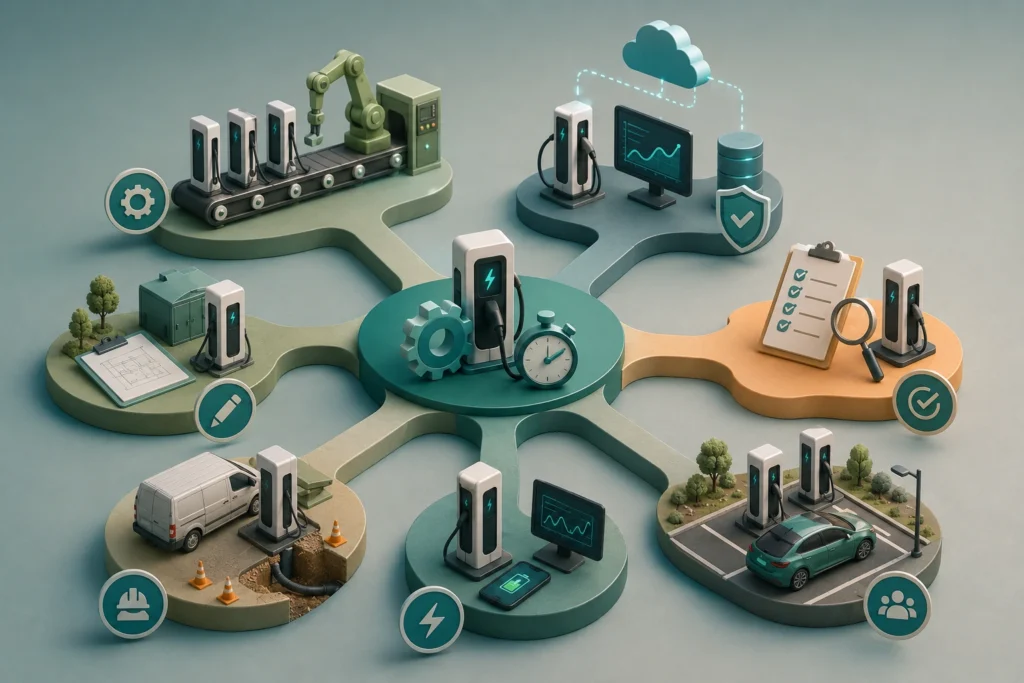
People often assume that speed comes from simplifying the work. In reality, the opposite is usually true. Projects move faster when fewer unexpected problems appear along the way. That only happens when preparation is done properly.
Several parts of our approach help us keep projects moving.
We Build the Hardware Ourselves
Using our own charging stations gives us much better control over the project timeline. We know exactly how the hardware is designed, how it communicates with our software, and how it should perform before it reaches the installation site. That reduces the amount of troubleshooting that often happens when equipment from several manufacturers has to work together for the first time.
Hardware and Software Are Ready to Work Together
Launching a charging hub involves much more than supplying electricity. The chargers need to communicate with the Charge Point Management System, report their status, support remote monitoring, and be ready for public charging sessions. Because we develop both hardware and the management platform, integration becomes part of the deployment process instead of another separate project. That saves time during commissioning and makes the first days of operation more predictable.
Standardized Work Does Not Mean Identical Projects
Every location is unique, but many deployment activities do not need to be reinvented. Over time, we have standardized tasks such as site planning workflows, hardware preparation, software configuration, commissioning procedures, and operational testing before launch. This allows our engineers to spend more time solving location-specific challenges instead of repeating the same administrative work on every project.
Testing Before Drivers Arrive
For us, opening day is not the moment to discover whether something works. Before a charging hub becomes available, we verify that charging sessions can start correctly, communication with the management platform is stable, and every installed charger behaves as expected. That reduces the chance of early operational issues and gives both us and our partners greater confidence before the site opens to the public.
Every New Project Makes the Next One Better
One advantage of building charging infrastructure at scale is that every completed project teaches us something useful. Sometimes it is a small technical improvement. Sometimes it is a better way to organize installation work. Other times it comes from watching how drivers actually use a location after it opens.
Those lessons become part of our standard approach instead of staying with one project team. For example, projects at destinations such as HitMall confirmed how important connector variety can be in busy public locations. Supporting different charging standards allows more drivers to use the hub without worrying about compatibility.
Projects like the Kyiv Hippodrome highlighted something different. The charging equipment itself is only one part of the experience. Easy access, logical placement, and reliable operation matter just as much when people are visiting a venue for leisure rather than making a dedicated charging stop. That ongoing feedback helps us improve future deployments without changing the overall process that keeps projects moving efficiently.
Frequently Asked Questions
How long does it usually take to deploy an EV charging hub?
The timeline depends on the site’s electrical infrastructure, permits, and project size. Good planning and close coordination between all parties can significantly reduce the time from approval to launch.
Why does using one provider help speed up deployment?
When hardware, software, and project management are handled by the same team, there are fewer coordination delays. It simplifies communication and helps avoid compatibility issues during commissioning.
How do you choose the right charging equipment for a location?
We start with the location itself. Visitor traffic, parking time, available power, and expected demand all influence the number of chargers, charging speed, and connector types we recommend.
Why are shopping centers good locations for charging hubs?
People already spend time there, so charging fits naturally into their visit. Drivers can shop, have a meal, or meet friends while their vehicle charges instead of making a separate stop just for charging.
Can an EV charging hub be expanded later?
Yes. We always consider future growth during the planning stage. If demand increases, many locations can add charging capacity without redesigning the entire project.
What makes a charging hub successful after it opens?
Reliable operation is only part of the picture. A successful hub is easy to access, offers the right charging options for drivers, and fits naturally into the way people already use the location.
Final Thoughts
The demand for public EV charging in Ukraine is changing quickly. Drivers expect charging to be available where they already spend time, whether that is a shopping center, a workplace, a transport hub, or a leisure destination. Businesses are increasingly looking for infrastructure that can be deployed efficiently and begin serving customers without long implementation periods.
That is exactly where we focus our work. Projects like HitMall and the Kyiv Hippodrome demonstrate that fast deployment does not have to come at the expense of quality. With careful planning, integrated hardware and software, and a structured deployment process, charging hubs can move from concept to operation in a predictable way.
Every successful launch strengthens more than a single location. It expands the charging network available to drivers, gives our partners another valuable service to offer, and contributes to a stronger EV ecosystem across Ukraine.
As we continue developing new projects, our objective remains the same as it was with these deployments: build charging infrastructure that is reliable from day one, practical for drivers, and ready to support the next stage of electric mobility.