

Table of contents:
Electric vehicle adoption is growing faster than many power grids were originally designed to handle. More charging stations mean higher electricity demand, especially during busy hours when many vehicles plug in at the same time. Simply adding more grid capacity is not always the quickest or most practical solution.
That is where distributed energy resources, or DERs, come in. By combining technologies like battery storage, solar power, and smart energy management, charging sites can use electricity more efficiently while putting less pressure on the grid. Utilities, charging operators, and businesses are increasingly looking at DERs as a practical way to support reliable EV charging without sacrificing performance or driving up energy costs.
In this article, we’ll look at how DERs work with EV charging infrastructure, why utilities are investing in them, and what they mean for the future of charging networks.
We remind you that you can purchase home and commercial charging stations in our store, as well as use public charging stations ECOFACTOR located throughout Ukraine. For convenient access to charging infrastructure, we recommend using our mobile app, available on iOS and Android.
What Distributed Energy Resources Add to EV Charging
The electricity grid has powered homes, businesses, and industries for decades, but the way electricity is produced and consumed is changing. Renewable energy, battery storage, and electric vehicles are no longer separate technologies. They increasingly work together, especially where EV charging demand continues to grow.
For charging operators, utilities, and businesses, adding more chargers is only part of the challenge. Every new charging point adds demand to the local grid, and in some locations that demand can grow faster than the available capacity. Grid upgrades remain important, but they often require significant investment and time.
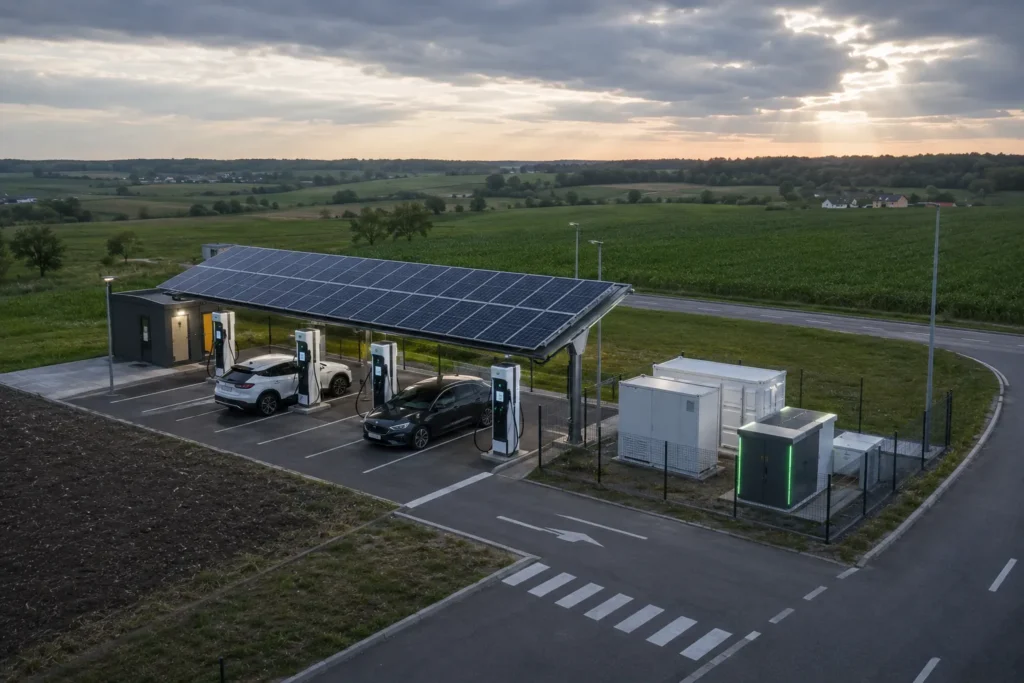
Distributed Energy Resources, commonly known as DERs, offer another way to expand charging infrastructure. Instead of relying entirely on electricity supplied directly from the grid, charging sites can generate, store, and manage part of their own energy. That changes how charging stations interact with the power system and gives operators more flexibility when electricity demand changes throughout the day.
Understanding Distributed Energy Resources
Distributed Energy Resources are relatively small energy assets installed close to where electricity is consumed rather than at large centralized power plants. They either produce electricity, store it, or help manage when and how it is used.
For EV charging infrastructure, DERs most commonly include solar photovoltaic systems, Battery Energy Storage Systems (BESS), smart energy management software, electric vehicles with bidirectional charging capabilities, and other local renewable energy sources.
Unlike traditional electricity generation, these resources operate at the local level. Energy may come directly from rooftop solar panels, from batteries charged earlier in the day, or from the grid when electricity prices and demand are lower. Instead of thinking about the charging station as a device that simply draws electricity, it becomes part of a broader local energy system.
Why Utilities Are Paying More Attention to DERs
Electric vehicle adoption changes the daily load profile of the electricity network. A residential neighborhood may experience increased demand in the evening as drivers return home. Commercial charging hubs often see peaks during business hours. Fleet depots can create very high demand when dozens of vehicles begin charging after completing daily routes.
Without proper management, these charging patterns can place significant pressure on local distribution networks. Utilities are increasingly looking at DERs because they help reduce that pressure before expensive infrastructure upgrades become necessary.
Several factors make this approach attractive: local batteries can supply electricity during charging peaks, solar generation reduces the amount of electricity drawn from the grid, smart charging spreads demand across available capacity, flexible charging schedules reduce simultaneous high loads, and energy can be stored when electricity is cheaper and used later.
Rather than solving every capacity issue by expanding substations or distribution lines, utilities can combine traditional grid investments with distributed energy management. For countries like Ukraine, where parts of the power system continue to modernize while supporting growing electrification, this flexibility is becoming increasingly valuable.
Combining Grid Power, Solar, and Batteries at One Site
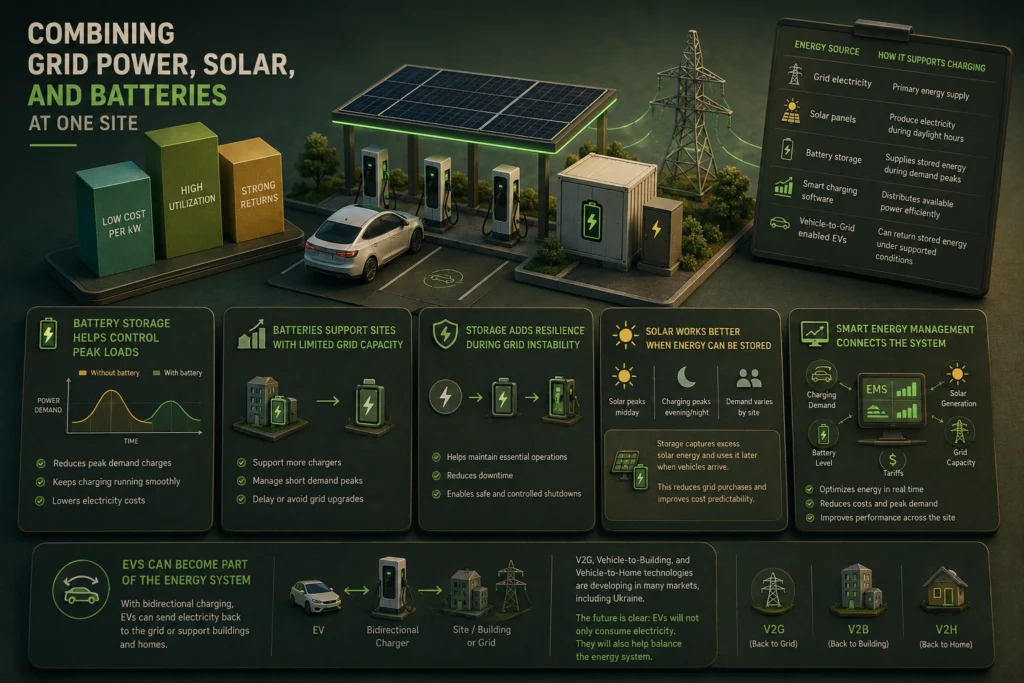
Many people imagine a charging station receiving electricity from only one source: the local grid. Modern charging sites often work differently. A single location may combine more.
| Energy source | How it supports charging |
|---|---|
| Grid electricity | Primary energy supply |
| Solar panels | Produce electricity during daylight hours |
| Battery storage | Supplies stored energy during demand peaks |
| Smart charging software | Distributes available power efficiently |
| Vehicle-to-Grid enabled EVs | Can return stored energy under supported conditions |
The charging process becomes dynamic instead of fixed. Software continuously decides where electricity should come from based on available generation, battery capacity, charging demand, and grid conditions. Drivers usually notice none of this. They simply connect the vehicle and begin charging while the underlying energy system optimizes electricity use.
Battery Storage Helps Control Peak Loads
Battery Energy Storage Systems are one of the most practical DER tools for charging infrastructure. Their job is simple: store electricity when it is available or cheaper, then use it when charging demand rises.
This helps reduce peak demand. Many commercial electricity tariffs include demand charges based on the highest power draw during a billing period. If several vehicles begin charging at the same time, that peak can become expensive. Instead of pulling all required power from the grid, the battery supplies part of the load. Charging continues, but the site draws less electricity from the grid at the most expensive moment.
Batteries Support Sites With Limited Grid Capacity
Not every location can easily get a larger grid connection. In Ukraine, this can be a very real issue for commercial sites, logistics facilities, shopping centers, and roadside charging locations. A grid upgrade may take time, require additional approvals, or make the project less attractive financially.
Battery storage gives operators more room to work with the capacity they already have. It can support additional chargers, help manage short demand peaks, and delay or reduce the need for grid reinforcement.
Storage Adds Resilience During Grid Instability
Battery storage is not always a full backup system, and it should not be presented as one unless the project is designed that way. Still, it can help during short interruptions or unstable grid conditions.
For charging operators, even limited backup capacity can matter. It may help keep essential charging available, reduce downtime, or give the system time to shut down safely instead of stopping abruptly.
Solar Works Better When Energy Can Be Stored
Solar panels can reduce electricity purchases during daylight hours, but EV charging demand does not always match solar production. Solar generation usually peaks around midday, fleet charging often happens in the evening or overnight, public charging can rise during commuting hours, and retail charging depends on visitor traffic.
Without storage, part of the solar energy may be used immediately, exported, or wasted depending on the site setup. With a battery, excess solar power can be stored and used later when vehicles arrive. For businesses with available roof space, parking canopies, or open land, solar plus storage can make EV charging more predictable and less dependent on grid electricity prices.
Smart Energy Management Connects the System
A charging site with solar, batteries, grid power, and multiple chargers needs coordination. Otherwise, the system can become inefficient very quickly.
Energy management software tracks what is happening across the site, including current charging demand, battery charge level, solar generation, available grid capacity, electricity tariffs, and energy use from the building or facility. Based on that data, the system decides how to distribute power. It can limit charger output during peaks, use stored energy when grid demand is high, prioritize certain vehicles, or shift charging to cheaper periods.
This is where DERs stop being separate pieces of equipment and become part of one controlled charging system.
EVs Can Become Part of the Energy System
Electric vehicles are usually seen as electricity consumers. With bidirectional charging, they can also become energy assets.
Vehicle-to-Grid, or V2G, allows an EV battery to send electricity back to the grid when supported by the vehicle, charger, software, and local regulations. Similar models include Vehicle-to-Building and Vehicle-to-Home, where a vehicle can support a facility or home.
These technologies are still developing in many markets, including Ukraine. They are not yet something every operator can use tomorrow. But they point to where charging infrastructure is going: EVs will not only take electricity from the system. In some cases, they will help balance it.

Connect Energy and EV Charging Solutions With ECOFACTOR
The relationship between EV charging and distributed energy resources is becoming increasingly important for utilities and infrastructure operators. Alongside charging stations, ECOFACTOR supports this transition with hybrid inverters, battery systems, and solar panels. The company also provides digital tools through its iOS and Android app and charging station map.
ECOFACTOR can help support integrated energy projects through:
- Charging infrastructure for public and commercial use
- Energy storage and power management solutions
- Renewable energy technologies for charging projects
- Cables and accessories for installation and operation
Contact ECOFACTOR to discuss solutions for integrating charging and energy infrastructure.
Where DERs Make the Biggest Difference
Not every charging site requires battery storage or solar generation. However, DER integration becomes particularly valuable in locations where energy demand changes rapidly or grid capacity is limited.
Examples include fleet depots with scheduled charging windows, shopping centres with long customer parking times, hotels and hospitality businesses, public fast charging hubs, residential developments, logistics facilities, and office buildings with employee charging. Each location has different charging behaviour, making energy management strategies equally important as charger selection.
Planning DER Integration From the Beginning
Many charging projects begin with hardware selection. In practice, energy planning should happen much earlier.
Questions worth answering before installation include how much grid capacity is available, whether charging demand will increase over the next five years, whether solar generation can be installed, whether battery storage is financially justified, whether electricity tariffs will change throughout the day, and whether future V2G capabilities could become relevant. Planning these aspects early often reduces future upgrade costs. It also avoids situations where chargers are installed first and energy limitations become apparent only after demand increases.
Common Misconceptions About DERs
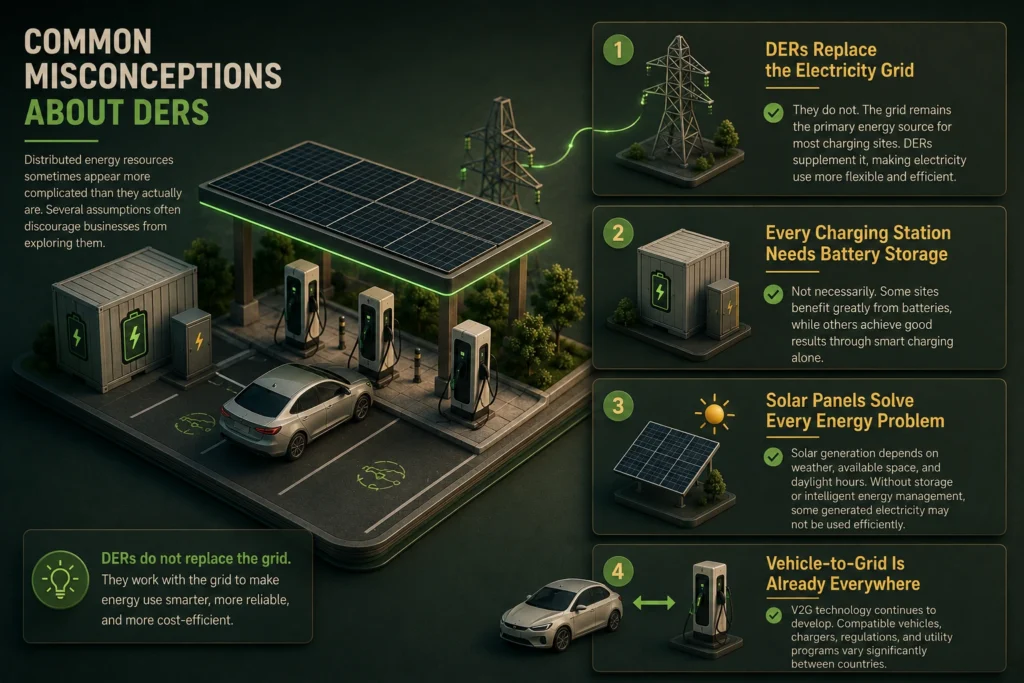
Distributed energy resources sometimes appear more complicated than they actually are. Several assumptions often discourage businesses from exploring them.
DERs replace the electricity grid. They do not. The grid remains the primary energy source for most charging sites. DERs supplement it, making electricity use more flexible and efficient.
Every charging station needs battery storage. Not necessarily. Some sites benefit greatly from batteries, while others achieve good results through smart charging alone.
Solar panels solve every energy problem. Solar generation depends on weather, available space, and daylight hours. Without storage or intelligent energy management, some generated electricity may not be used efficiently.
Vehicle-to-Grid is already everywhere. V2G technology continues to develop. Compatible vehicles, chargers, regulations, and utility programs vary significantly between countries.
Frequently Asked Questions
What is a distributed energy resource in EV charging?
A distributed energy resource (DER) is a local energy asset that generates, stores, or manages electricity close to where it is used. In EV charging, this usually means solar panels, battery storage, smart energy management, or EVs that support bidirectional charging.
Do all EV charging stations need battery storage?
No. Battery storage is most valuable at locations with limited grid capacity, high demand charges, or uneven charging patterns. Some sites operate efficiently with smart charging alone, while others benefit from combining batteries with solar power.
Can solar panels power EV chargers without the grid?
They can supply part of the required electricity, but most commercial charging sites still rely on the grid. Pairing solar panels with battery storage makes renewable energy more useful because excess electricity can be stored and used later.
How do DERs help reduce charging costs?
DERs can lower electricity costs by reducing peak demand, increasing the use of locally generated energy, and shifting charging to times when electricity is less expensive. The exact savings depend on the site’s energy use and local electricity tariffs.
What is Vehicle-to-Grid (V2G)?
Vehicle-to-Grid, or V2G, is a technology that allows compatible electric vehicles to send electricity back to the grid through a bidirectional charger. This can help balance electricity demand while making better use of the energy stored in EV batteries.
Are DERs becoming important for EV charging in Ukraine?
Yes. As Ukraine continues to expand its charging infrastructure, DERs can help operators make better use of available grid capacity, integrate renewable energy, and build charging sites that are more flexible as EV adoption continues to grow.
Conclusion
Electric mobility continues to grow across Europe, including Ukraine. Charging infrastructure must expand alongside it, but expansion is no longer measured only by the number of installed chargers. The ability to manage electricity efficiently is becoming just as important.
Distributed Energy Resources help operators make better use of existing grid connections, integrate renewable energy, reduce operating costs, and prepare charging networks for future demand. Solar panels, battery storage, smart energy management, and eventually bidirectional EV charging all contribute to a charging ecosystem that is more flexible than traditional grid-only infrastructure.
As utilities, businesses, and charging operators continue investing in EV infrastructure, DERs are becoming less of an optional addition and more of a practical part of long-term planning. The strongest charging networks will not necessarily consume the most electricity. They will be the ones that know how to manage it.