

Table of contents:
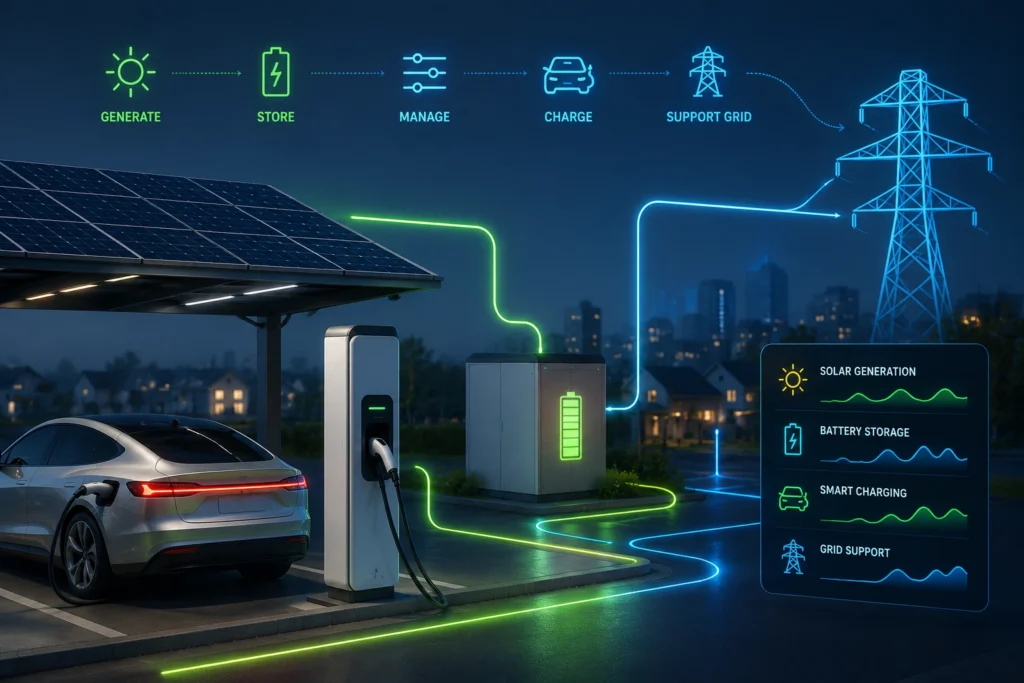
Electric vehicles are becoming part of everyday life, but charging them all at the same time can put unexpected pressure on the local electricity network. In many places, the challenge is not producing enough electricity. It is making sure the existing grid can deliver that power where and when it is needed.
Grid-friendly charging helps solve that problem. Instead of allowing every charger to draw maximum power at once, it uses smart controls to spread demand more evenly and stay within the site’s available capacity. That approach keeps charging reliable, reduces the risk of local congestion, and can often postpone expensive grid upgrades.
In this article, we’ll look at how grid-friendly charging works, why it matters for CPOs and businesses, and the technologies that make it possible.
We remind you that you can purchase home and commercial charging stations in our store, as well as use public charging stations ECOFACTOR located throughout Ukraine. For convenient access to charging infrastructure, we recommend using our mobile app, available on iOS and Android.
What Causes Local Network Congestion
The electricity grid is built to handle changing demand, but every part of that network has physical limits. Local transformers, cables, feeders, and substations can safely carry only a certain amount of power at any given moment. When demand approaches those limits, operators begin to face congestion.
EV charging can contribute to that problem because charging sessions often start at similar times. Drivers return home in the evening, employees plug in after arriving at work, or fleet vehicles begin charging together after completing daily routes. Individually, a charger may not create much pressure. Hundreds of chargers operating simultaneously can produce a very different picture.
This is why congestion is usually a local issue rather than a nationwide one. A city may have enough electricity generation overall while a single neighborhood, business park, or commercial site struggles to deliver enough power during peak hours. For Ukrainian businesses planning new charging locations, this distinction matters. Available grid capacity depends on the specific connection point, not simply on the amount of electricity produced in the country.
How Grid-Friendly Charging Balances Power Demand
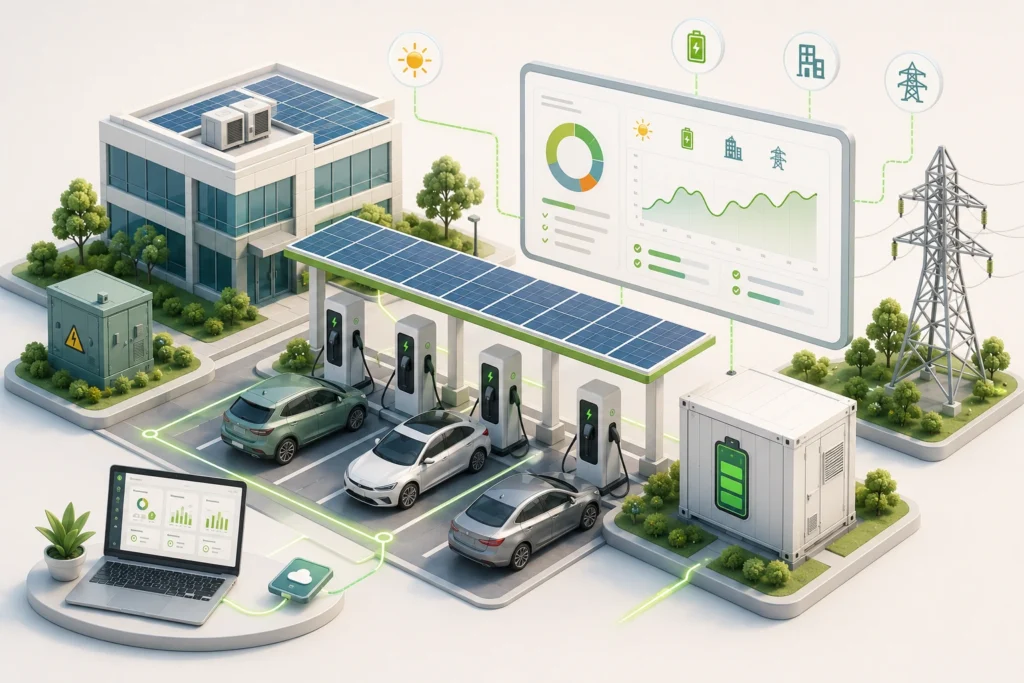
The phrase “grid-friendly charging” sometimes sounds as if charging becomes slower by default. That is not what happens in practice. The goal is to match charging demand with the actual capacity available at the site. Whenever spare capacity exists, chargers can operate normally. When demand increases, software automatically distributes available power where it delivers the greatest value.
This approach allows charging infrastructure to remain responsive while preventing sudden spikes that could overload local equipment. Instead of treating every charging session equally, modern charging platforms consider multiple factors, including available site capacity, current building electricity consumption, charger occupancy, vehicle charging priority, departure schedules, renewable energy generation, and battery storage availability. As a result, charging becomes coordinated instead of competitive.
Smart Control Keeps Charging Within Available Capacity
A charging site does not use electricity in isolation. The chargers share the same connection with lighting, ventilation, elevators, office equipment, refrigeration, production lines, or other building systems. That is why fixed charger settings are often too rough for real operation.
Smart control gives the site a live view of electricity use and adjusts charging before the local connection is pushed too far. It does not turn charging into a guessing game. It keeps the whole site within safe limits while still giving drivers as much power as the site can provide.
Dynamic Load Management Tracks the Whole Site
Dynamic load management controls charging based on the site’s total electricity consumption. Instead of assigning every charger its maximum rated power, the system measures how much electricity the entire location is using at that moment. It then calculates how much capacity is still available for EV charging.
When office equipment, HVAC systems, refrigeration, or industrial machinery increase electricity use, charging power is automatically reduced to stay within the site’s power limit. When those building loads decrease, charging power can increase again without manual intervention. This helps businesses use existing electrical infrastructure more efficiently instead of immediately requesting a larger grid connection.
Dynamic Load Balancing Shares Power Between Vehicles
Dynamic load balancing focuses on how available charging power is distributed between connected vehicles. Imagine a site with ten chargers but only enough available capacity for six vehicles charging at full speed. Instead of switching four chargers off completely, the system shares power across active sessions in a controlled way.
Charging rates can change during the day as vehicles arrive, disconnect, or finish charging. The result is a smoother demand profile, fewer sudden peaks, and more chargers staying available for users.

Build Grid-Ready Charging Infrastructure With ECOFACTOR
As EV adoption grows, charging infrastructure increasingly needs to work alongside local energy systems rather than place additional pressure on them. Alongside charging stations, ECOFACTOR provides hybrid inverters, battery systems, and solar panels that support modern energy projects. The company also offers digital tools through its iOS and Android app, while the charging station map helps drivers find available charging locations.
ECOFACTOR can support grid-friendly charging projects with:
- Energy solutions that complement charging infrastructure
- Charging equipment for commercial and public locations
- Technologies that support renewable energy integration
- Cables and accessories for installation and operation
Contact ECOFACTOR to discuss charging infrastructure that supports reliable energy management.
Why Charging Schedules Matter More Than Maximum Power
Many charging projects begin with one obvious question: how much power should every charger deliver? In reality, another question is often more important. When does every vehicle actually need to be fully charged?
A delivery fleet parked overnight has very different requirements from public fast chargers near a highway. Office employees typically leave their vehicles parked for several hours, giving operators far more flexibility than they may initially expect.
When charging deadlines are known, software can spread energy delivery across longer periods instead of concentrating it into the first available hour. This reduces simultaneous demand without affecting daily operations. For many commercial sites, simply changing charging schedules can postpone expensive electrical upgrades for years.
Different Locations Need Different Congestion Strategies
Not every charging site experiences congestion for the same reasons. Operational priorities vary considerably depending on how drivers use the location.
| Site type | Typical approach |
|---|---|
| Fleet depots | Prioritize vehicles by departure time, enforce site power limits, reserve capacity for urgent charging |
| Office and workplace parking | Shift charging toward periods of lower building demand and balance power across vehicles |
| Shopping centers | Limit simultaneous charging power while maintaining charger availability for visitors |
| Public charging hubs | Combine queue management, dynamic power allocation, and pricing strategies to reduce peak demand |
| Residential complexes | Coordinate charging across multiple users while protecting the building’s electrical infrastructure |
A charging strategy that works well for a logistics depot may perform poorly at a retail location. Understanding how vehicles actually use the site is just as important as selecting the hardware.
Building a More Flexible Charging Site
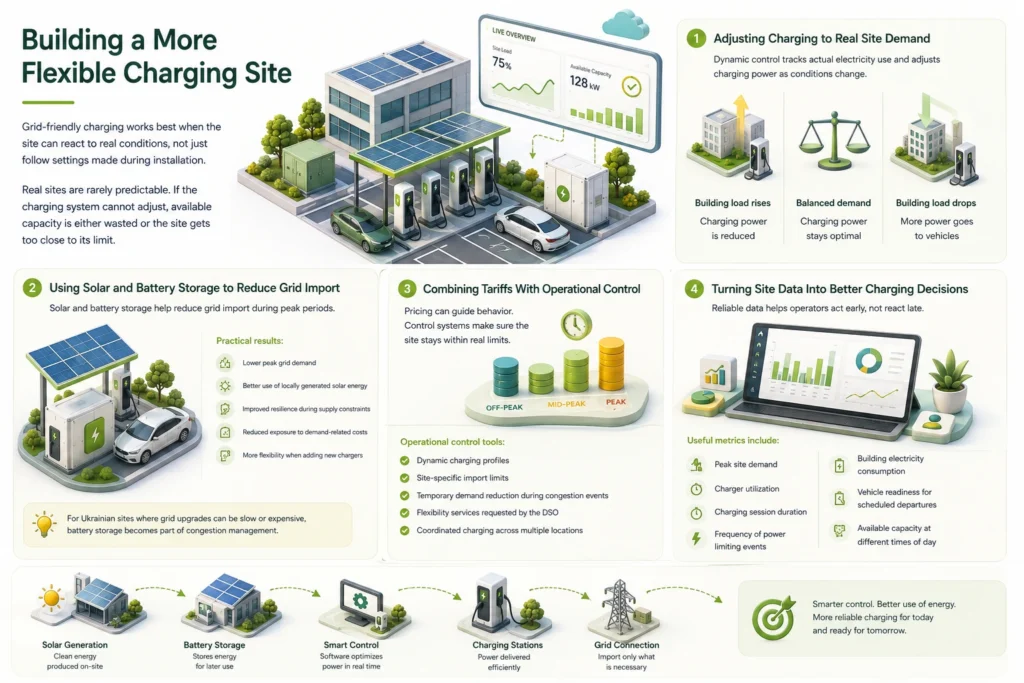
Grid-friendly charging works best when the site can react to real conditions, not just follow settings made during installation. A fixed power limit may protect the connection from overload, but it does not understand what is happening across the building, the chargers, solar panels, battery storage, or the local grid.
Real sites are rarely predictable. Office occupancy changes, hotels have seasonal peaks, warehouses may run longer shifts, and retail locations can see sudden traffic during weekends or holidays. If the charging system cannot adjust, available capacity is either wasted or the site gets too close to its limit.
Adjusting Charging to Real Site Demand
Some charging installations still rely on fixed limits configured during commissioning. That approach is simple, but it assumes the site will behave the same way every day. Dynamic control works differently. It tracks actual electricity use and adjusts charging power as conditions change. If the building load rises, charging can be reduced. If the building load drops, more power can go to vehicles. That flexibility helps businesses use available capacity more efficiently while keeping a safe margin for the electrical infrastructure.
Using Solar and Battery Storage to Reduce Grid Import
Grid-friendly charging becomes stronger when it is connected with on-site energy resources. Solar generation does not always match charging demand. An office building may produce the most solar power during the day, while many vehicles need more energy later in the afternoon or evening. Battery Energy Storage Systems help close that gap.
A battery can store electricity when demand is low or solar production is high, then supply part of the charging load during peak periods. This reduces grid import when local infrastructure is under the most pressure. This combination can help sites achieve lower peak grid demand, better use of locally generated solar energy, improved resilience during supply constraints, reduced exposure to demand-related costs, and more flexibility when adding new chargers.
For Ukrainian sites where grid upgrades can be slow, expensive, or hard to schedule, battery storage can become part of congestion management, not just an extra energy asset.
Combining Tariffs With Operational Control
Time-of-use pricing can encourage drivers and operators to shift charging into cheaper periods. It has value, especially when electricity demand is lower at night or during specific off-peak windows. But tariffs do not always reflect what is happening on a particular feeder, transformer, or commercial site. If too many users respond to the same cheap tariff window, a new peak can appear at another time.
That is why pricing signals work better when paired with operational control. Modern congestion management can use dynamic charging profiles, site-specific import limits, temporary demand reduction during congestion events, flexibility services requested by the distribution operator, and coordinated charging across several locations. Pricing can guide behavior. Control systems make sure the site stays within real technical limits.
Turning Site Data Into Better Charging Decisions
Every smart charging decision depends on reliable data. A platform needs to see what is happening across chargers, meters, building systems, and connected energy assets. With that information, operators do not have to wait for overloads, failed sessions, or complaints from drivers. They can spot demand patterns early and adjust charging rules before problems grow.
Useful metrics include peak site demand, charger utilization, charging session duration, frequency of power limiting events, building electricity consumption, vehicle readiness for scheduled departures, and available capacity at different times of day. Over time, this data helps businesses plan expansion with more confidence. They can see whether the site needs more chargers, more grid capacity, better scheduling, battery storage, or simply better charging rules.
Planning for Growth Instead of Today’s Demand
Many charging projects begin with only a handful of chargers. That is normal. A business may want to test demand first, understand driver behavior, or avoid overspending before the site proves itself. But if the location works well, expansion often comes sooner than expected.
This is why grid-friendly charging should be planned from the beginning, not added only after the site starts hitting capacity limits. The first installation should leave room for the second and third stage of growth. That can mean reserving switchgear capacity, preparing cable routes, choosing software that can manage more chargers later, and making sure communication infrastructure is ready for remote monitoring and control.
Flexible power allocation also matters from day one. If every charger is configured as a separate fixed load, scaling becomes harder. A smarter setup allows the site to add more charge points while keeping total demand within the available grid capacity.
These decisions are much easier to make during the initial installation. Adding them later can mean new construction work, longer downtime, extra approvals, and higher costs. For CPOs, fleets, shopping centers, residential complexes, and business sites in Ukraine, this can make the difference between smooth expansion and a project that gets stuck at the first capacity limit.
Common Planning Mistakes That Lead to Congestion
Congestion problems often develop gradually rather than appearing overnight.
Several planning mistakes increase the likelihood of future constraints: assuming chargers will rarely operate simultaneously without analyzing real charging patterns, ignoring building electricity demand when planning charger capacity, sizing infrastructure only for current needs rather than future growth, depending entirely on manual charging schedules that cannot respond to changing conditions, monitoring only charger power without measuring total site consumption, and giving every charging session the same priority regardless of fleet departure times or vehicle type.
Most of these issues can be avoided through better planning and intelligent energy management rather than larger electrical connections.
Frequently Asked Questions
What is grid-friendly charging?
Grid-friendly charging is a way of managing EV charging so it stays within the available capacity of the local electricity network. Instead of allowing every charger to draw maximum power at once, the system adjusts charging in real time to reduce congestion while keeping vehicles charged.
Does grid-friendly charging make EV charging slower?
Not necessarily. When enough capacity is available, chargers can operate at full power. Charging speeds are adjusted only when demand approaches the site’s limits, helping avoid overloads without interrupting normal operation.
Can grid-friendly charging reduce the need for grid upgrades?
In many cases, yes. Dynamic load management, smart scheduling, and battery storage can help businesses use their existing grid connection more efficiently. That can delay or reduce the need for expensive infrastructure upgrades.
Is grid-friendly charging useful only for large charging networks?
No. Even sites with a small number of chargers can benefit, especially if charging shares the same electrical connection with offices, warehouses, hotels, or other buildings. Managing demand early often makes future expansion much easier.
How do solar panels and battery storage help prevent congestion?
Solar panels can supply part of the charging demand when generation is available, while battery storage can save energy for later use during peak periods. Together, they reduce electricity imported from the grid when local capacity is under the most pressure.
What information is needed for smart charging to work effectively?
A charging platform typically uses data from chargers, electricity meters, and building systems to understand how much power is available. With that information, it can adjust charging automatically instead of relying on fixed schedules or manual intervention.
Final Thoughts
As EV adoption continues to grow across Ukraine and Europe, the conversation is shifting away from simply installing more chargers. The bigger challenge is making those chargers work efficiently within the capacity already available.
Grid-friendly charging offers a practical path forward. By combining dynamic load management, intelligent scheduling, real-time monitoring, and coordination with on-site energy resources, businesses can expand charging infrastructure while reducing pressure on local distribution networks.
For charge point operators, commercial property owners, fleet managers, and municipalities, this approach supports reliable charging today and creates room for future growth without treating every expansion project as a reason for immediate grid reinforcement. The result is a charging network that responds to changing conditions instead of adding unnecessary strain to the electricity system.