

Table of contents:
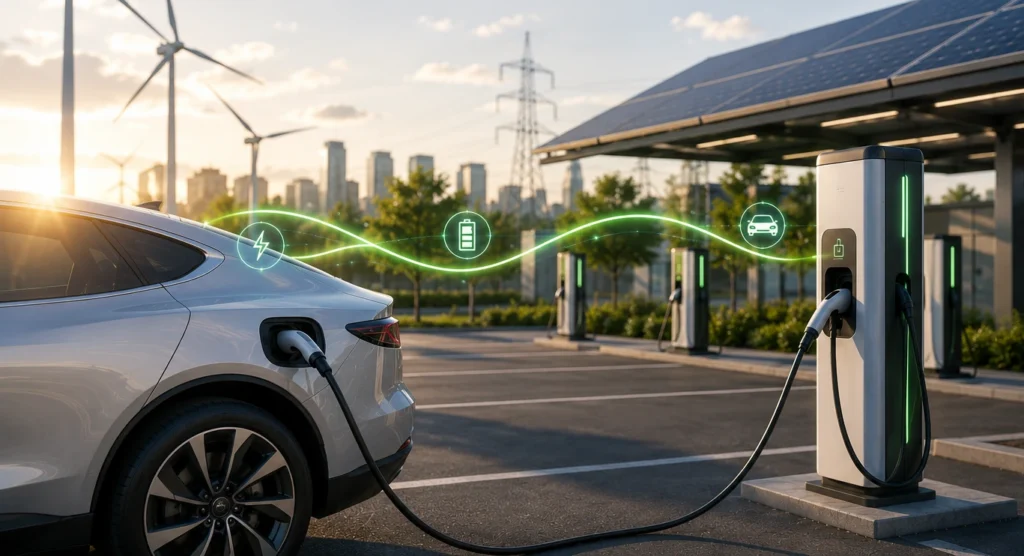
Wind and solar power are changing how electricity is produced. Unlike traditional power plants, they generate energy when the weather allows, not always when demand is highest. On a sunny afternoon, solar panels may produce more electricity than the grid needs. A few hours later, when the sun sets and people return home, demand rises while solar generation disappears.
That mismatch creates one of the biggest challenges for modern power systems. Building more renewable generation is only part of the solution. Using that electricity at the right time matters just as much.
This is where smart charging becomes valuable. Instead of treating every charging session the same, it adjusts when and how vehicles charge based on available power, grid conditions, and site demand. For businesses, charging network operators, and utilities, it offers a practical way to make better use of renewable energy while keeping charging reliable and efficient.
We remind you that you can purchase home and commercial charging stations in our store, as well as use public charging stations ECOFACTOR located throughout Ukraine. For convenient access to charging infrastructure, we recommend using our mobile app, available on iOS and Android.
What Smart Charging Means
A standard EV charger starts charging as soon as a vehicle is plugged in. It continues until the battery reaches the requested level, without considering what is happening elsewhere on the site or across the electricity grid.
Smart charging works differently. It controls when charging starts, how much power each vehicle receives, and how charging responds to changing conditions throughout the day. Instead of treating every charging session the same, a smart charging platform can consider factors such as available grid capacity, building electricity demand, renewable energy production, electricity tariffs, the number of connected vehicles, and the driver’s departure time.
For example, if several vehicles arrive at the same time, the system can distribute available power between them instead of overloading the site’s electrical connection. If rooftop solar begins producing more electricity, charging power can increase automatically. When building demand rises, charging can temporarily slow down without interrupting the session. These decisions happen automatically through the charge point management system, giving operators more control while drivers simply plug in and return to a charged vehicle.
Why Renewable Energy Needs Flexible Electricity Demand
Solar and wind power generate electricity when natural conditions allow, not necessarily when demand is highest. Solar production peaks during the middle of the day, while wind output can rise or fall at any hour. Electricity consumption follows a different pattern. Homes, offices, businesses, and charging stations often create demand in the morning, late afternoon, and evening. As renewable generation grows, these two patterns do not always match.
That creates periods when clean electricity is available but cannot be fully used, followed by periods when demand remains high even though renewable production has fallen. Flexible electricity demand helps reduce this mismatch. Instead of consuming electricity immediately, some loads can move to times when renewable generation is higher.
EV charging is well suited for this because vehicles usually remain parked much longer than they need to charge. An employee may leave a car connected all day, a hotel guest overnight, or a fleet vehicle between scheduled trips. Smart charging uses this flexibility to schedule charging more efficiently while ensuring the vehicle is ready when it is needed.
How Smart Charging Helps Balance Renewable Generation
Renewable electricity is most valuable when it can be used as it is generated. The challenge is that EV charging demand does not automatically follow solar or wind production. Smart charging helps bridge that gap by making charging sessions flexible instead of fixed. Rather than treating every connected vehicle as an immediate priority, the system adjusts charging based on available energy and grid conditions while still making sure vehicles are ready when drivers need them.
Charging When Renewable Electricity Is Available
Many EVs remain connected for several hours, even though they only need a fraction of that time to recharge. Smart charging uses this flexibility to shift electricity demand toward periods when renewable generation is higher.
For example, a company with rooftop solar panels may generate most of its electricity around midday. Instead of charging every vehicle at full power early in the morning, the charging platform can increase charging later in the day when more solar energy is available. Depending on the site and charging infrastructure, the system may consider current solar or wind generation, available grid capacity, electricity demand at the site, expected vehicle departure time, and charging priorities for different users. By matching charging demand more closely with renewable production, businesses can make better use of clean electricity while reducing unnecessary pressure on the grid.
Adjusting Charging Throughout the Day
Renewable generation and electricity demand rarely stay the same for long. A cloud passing over a solar installation can reduce generation within minutes, while electricity consumption inside a building may increase as equipment, lighting, or cooling systems switch on.
Smart charging responds to these changes automatically. Instead of keeping every charger at a fixed output, the platform continuously adjusts charging power as conditions change. Some charging sessions may slow down for a short period, while others continue normally depending on available capacity and charging priorities. Once more renewable electricity becomes available or site demand decreases, charging power increases again. These adjustments are usually small enough that drivers never notice them. Across an entire charging network, however, they help smooth electricity demand, improve the use of renewable generation, and reduce unnecessary peak loads.
Smart Charging Works With More Than the Grid
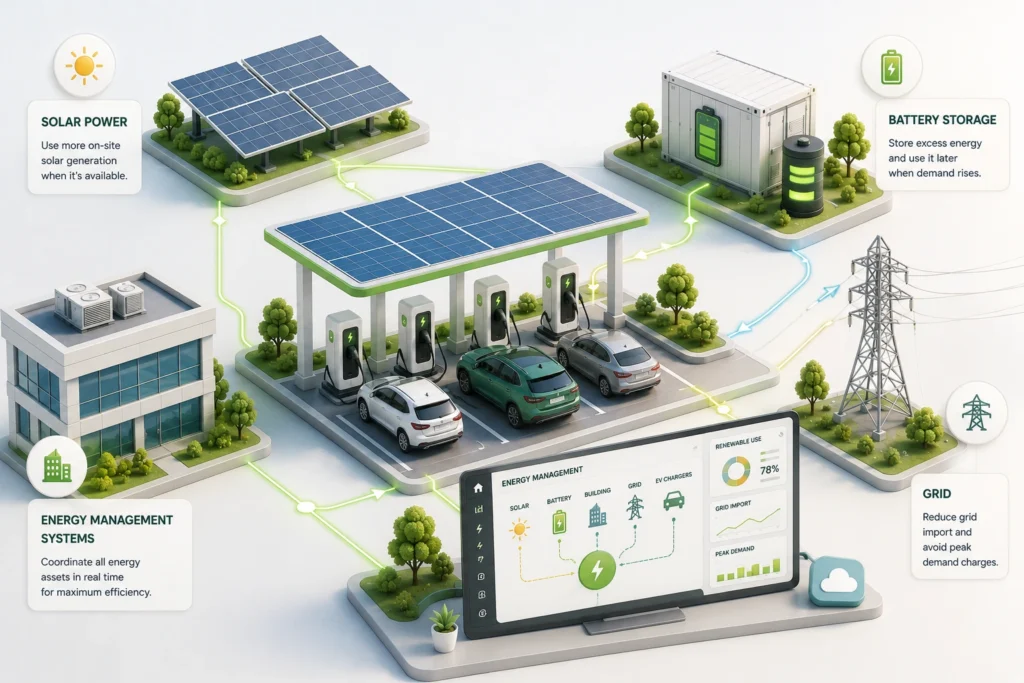
Balancing renewable generation is not only about the electricity grid. At many commercial sites, EV chargers operate alongside solar panels, battery storage, and other electrical equipment. When these systems work independently, part of their potential is lost. When they are connected through one management platform, energy can be used much more efficiently.
Solar Power
Solar panels and EV charging are a natural combination because many vehicles stay parked during daylight hours, when solar generation is at its highest. Without smart charging, a vehicle may start charging as soon as it is connected, even if solar production is still low. By the time rooftop panels reach peak output, the charging session may already be complete.
Smart charging makes better use of on-site solar generation by increasing charging when more renewable electricity is available. This helps businesses consume more of the electricity they produce instead of relying entirely on grid imports or exporting excess power back to the network.
Battery Storage
Battery energy storage adds another layer of flexibility. Instead of using renewable electricity immediately, excess energy can be stored and used later when generation falls or electricity demand increases.
Smart charging and battery storage complement each other rather than serving the same purpose. Battery storage helps by storing surplus renewable electricity, supplying power during periods of high demand, reducing electricity imported from the grid, and lowering peak demand charges. At the same time, smart charging decides when vehicles should consume that stored energy based on charging priorities and available capacity.
Energy Management Systems
As charging infrastructure grows, managing chargers separately from the rest of a site’s electrical equipment becomes less practical. An Energy Management System coordinates multiple energy assets from one platform. Instead of making decisions based only on the charging station, it considers the site’s overall electricity consumption.
For example, if building demand suddenly increases, the system can temporarily reduce charging power. If rooftop solar begins generating more electricity or battery storage becomes available, charging capacity can increase again. This coordinated approach helps businesses install more charging stations, use renewable electricity more effectively, and avoid unnecessary upgrades to their electrical connection.

Combine Smart Charging and Energy Solutions
Smart charging is becoming an important part of balancing EV demand with renewable energy generation. Alongside charging stations, ECOFACTOR supports this approach with hybrid inverters, battery systems, and solar panels, alongside digital tools available through its iOS and Android app and charging station map.
ECOFACTOR can help support energy-focused charging projects through:
- Charging infrastructure for different deployment scenarios
- Renewable energy technologies for EV charging sites
- Energy storage solutions for integrated projects
- Cables and accessories for charging installations
Contact ECOFACTOR to discuss charging solutions that fit renewable energy projects.
Benefits for Businesses and Operators
Smart charging is often associated with renewable energy, but its advantages go well beyond using more solar or wind power. It changes how electricity is managed across an entire charging site and, when adopted at scale, helps the wider electricity network operate more efficiently.
The exact benefits depend on who is using the system. A business owner has different priorities than a charging network operator or a utility, but all of them gain from making charging demand more flexible.
For Commercial Charging Sites
For businesses, smart charging helps make better use of the electrical capacity they already have. Instead of sizing the infrastructure for every charger to operate at full power simultaneously, available electricity can be shared more intelligently across connected vehicles.
This can help businesses reduce peak electricity demand, make better use of on-site renewable generation, postpone expensive grid connection upgrades, support more charging stations within the same power limit, and lower electricity costs where time-based tariffs apply. These improvements become more noticeable as charging demand grows. A site with two chargers may never reach its electrical limit, but a location with twenty or fifty chargers is much more likely to benefit from dynamic power management.
For Utilities and Grid Operators
From the grid’s perspective, unmanaged charging creates another source of electricity demand that can appear at almost any time. If hundreds of vehicles begin charging at full power during the evening, local distribution networks experience much higher loads.
Smart charging helps spread that demand over longer periods. Instead of creating short but significant peaks, charging sessions can be distributed more evenly based on available capacity and renewable generation. For utilities and network operators, this supports smoother electricity demand throughout the day, better utilisation of existing grid infrastructure, fewer local overloads during busy periods, improved planning for future charging growth, and delayed investment in new distribution infrastructure in some locations. It does not eliminate the need for grid expansion, especially as EV adoption continues to grow, but it helps existing infrastructure operate more efficiently while that transition takes place.
Smart Charging at Different Types of Locations
Not every charging site operates the same way. The amount of flexibility available depends largely on how long vehicles remain connected and how the location is used.
| Location | How smart charging helps |
|---|---|
| Office buildings | Uses long parking times to align charging with daytime solar generation and building demand. |
| Hotels | Optimises overnight charging and avoids unnecessary evening peaks. |
| Shopping centres | Shares available power between several vehicles during busy periods. |
| Fleet depots | Schedules charging around vehicle departure times and operational requirements. |
| Residential complexes | Coordinates charging across multiple residents to reduce simultaneous peak demand. |
The technology remains the same, but the charging strategy changes from one location to another. That flexibility is one of the reasons smart charging has become an important part of modern charging infrastructure rather than simply an optional software feature.
Smart Charging Today and Vehicle-to-Grid Tomorrow
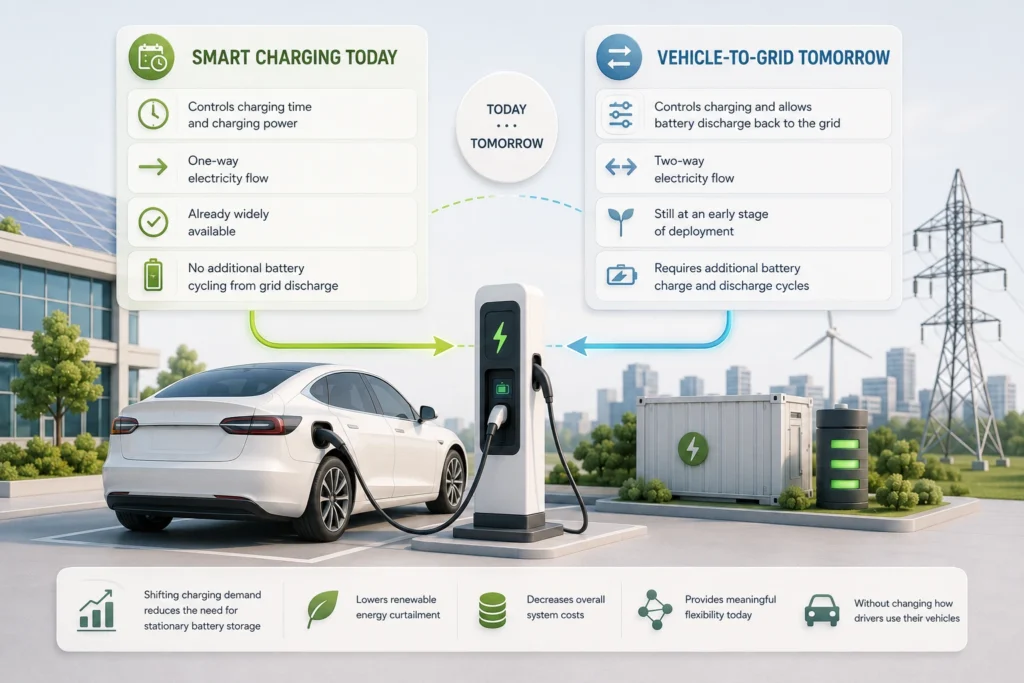
Smart charging and Vehicle-to-Grid (V2G) are often mentioned together, but they are not the same technology. Smart charging controls when and how fast a vehicle charges. Electricity flows in one direction, from the grid to the vehicle. This approach is already supported by many commercial charging platforms and is becoming a standard feature of modern charging infrastructure.
V2G goes one step further. It allows electricity stored in an EV battery to flow back into the grid when additional power is needed. In this model, parked vehicles become distributed energy resources that can help balance renewable generation and support the electricity network during periods of high demand.
| Smart charging | Vehicle-to-Grid (V2G) |
|---|---|
| Controls charging time and charging power | Controls charging and allows battery discharge back to the grid |
| One-way electricity flow | Two-way electricity flow |
| Already widely available | Still at an early stage of deployment |
| No additional battery cycling from grid discharge | Requires additional battery charge and discharge cycles |
Although V2G attracts significant attention, smart charging is expected to deliver most of the immediate benefits because it is easier to implement and does not require bidirectional charging hardware. Research also shows that simply shifting charging demand can substantially reduce the need for stationary battery storage, lower renewable energy curtailment, and decrease overall system costs. V2G can build on those benefits in the future, but smart charging already provides meaningful flexibility without changing how drivers use their vehicles.
What Businesses Should Consider Before Implementing
Installing smart charging involves more than choosing compatible charging stations. The best results come from understanding how the site uses electricity today and how charging demand is likely to grow over the next several years. A small office with four chargers has different requirements than a logistics depot operating dozens of electric vans or a retail site serving public charging throughout the day.
Before implementing smart charging, businesses should evaluate available grid connection capacity, expected number of charging sessions, typical parking duration, compatibility with OCPP and the chosen Charge Point Management System, plans for rooftop solar or battery storage, future expansion of charging infrastructure, and electricity tariff structure and peak demand charges.
It is equally important to choose software that can adapt over time. Charging demand, electricity prices, and grid requirements continue to evolve, so a flexible management platform will usually provide greater long-term value than a system built only for today’s needs.
Frequently Asked Questions
Does smart charging make EV charging slower?
Not necessarily. Smart charging adjusts when and how power is delivered based on available capacity and charging priorities. In many cases, drivers will not notice any difference because the vehicle still reaches the requested charge level before departure.
Can smart charging work without solar panels?
Yes. While smart charging works well with solar power, it can improve charging efficiency even without on-site renewable generation. It can respond to grid capacity, electricity prices, building demand, and the number of connected vehicles.
Is smart charging useful for small businesses?
It can be. Even a site with a few chargers can benefit if electrical capacity is limited or if charging demand is expected to grow. Starting with smart charging may reduce the need for costly electrical upgrades later.
What is the difference between smart charging and dynamic load balancing?
Dynamic load balancing is one feature of smart charging. It automatically distributes available power between connected chargers. Smart charging is a broader approach that may include scheduling, remote management, renewable energy integration, tariff optimization, and charging priorities.
Does smart charging require special electric vehicles?
Most modern EVs can use smart charging through a compatible charging station and Charge Point Management System. Vehicle-to-Grid services may require additional hardware and vehicle support, but standard smart charging usually does not.
Can smart charging reduce electricity costs?
Yes, if the site uses time-based electricity tariffs or generates renewable energy. Charging during lower-cost periods or using more on-site solar electricity can help reduce overall operating costs while making better use of available energy.
Conclusion
Renewable energy and electric mobility are developing together, and both rely on a more flexible electricity system than the one built around conventional power generation.
Smart charging helps create that flexibility by adjusting charging sessions to match available renewable electricity, site demand, and grid capacity. Instead of increasing electricity consumption whenever a vehicle is plugged in, charging becomes something that can respond to changing conditions throughout the day.
For businesses, this means better use of existing electrical infrastructure, easier integration of solar power and battery storage, and more efficient operation as charging networks expand. For electricity providers, it helps smooth demand and supports a grid with a growing share of renewable generation.
As EV adoption continues across Ukraine and Europe, unmanaged charging will become increasingly difficult to scale. Smart charging offers a practical way to support both reliable EV charging and a cleaner, more flexible energy system.