


Table of contents:
Installing an EV charger is only part of the job. Keeping that infrastructure useful, compliant, and easy to operate over the next five or ten years is a much bigger challenge.
Rules for public charging are changing, customer expectations are growing, and charging networks are becoming more connected with payment systems, energy management, and digital services. A charging station that works well today may need new capabilities tomorrow, and not every system is built to adapt.
Planning for regulatory readiness from the beginning can help businesses avoid expensive upgrades, reduce operational headaches, and keep charging infrastructure aligned with changing requirements. In this article, we’ll look at what regulatory-ready charging infrastructure really means, why it matters, and how it helps lower long-term business risk.
We remind you that you can purchase home and commercial charging stations in our store, as well as use public charging stations ECOFACTOR located throughout Ukraine. For convenient access to charging infrastructure, we recommend using our mobile app, available on iOS and Android.
EV Charging Risk Has Moved Beyond Hardware
Not long ago, most charging projects focused on the physical installation. The priorities were straightforward: select the right charger, provide enough electrical capacity, and make sure the equipment worked reliably.
That is still important, but it is no longer the whole picture. Public charging infrastructure now depends on software, payment services, communication protocols, cloud platforms, and energy management. A charging station is expected to do much more than deliver electricity. It must process payments, exchange data with external systems, receive software updates, and support changing regulatory requirements throughout its lifetime.
As a result, long-term risk has changed as well. A charger may continue working perfectly from an electrical perspective while becoming difficult or expensive to operate because its software, communication capabilities, or integrations can no longer keep up. Building regulatory-ready infrastructure is largely about reducing those risks before they become expensive problems.
What Regulatory-Ready Charging Infrastructure Really Means
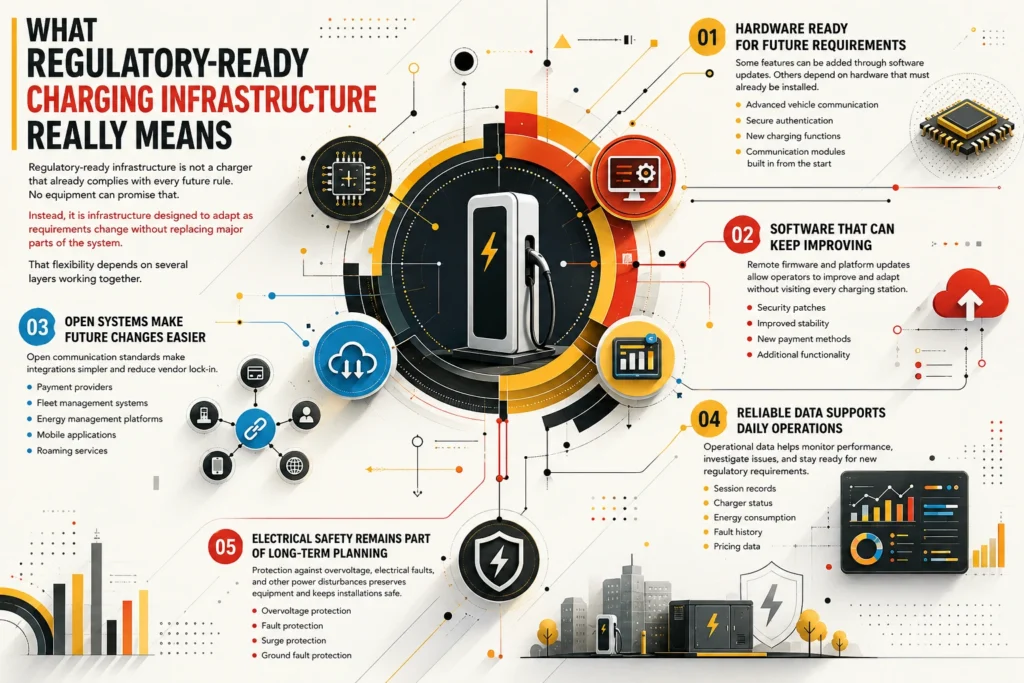
Regulatory-ready infrastructure is not a charger that already complies with every future rule. No equipment can promise that. Instead, it is infrastructure designed to adapt as requirements change without replacing major parts of the system. That flexibility depends on several layers working together.
Hardware Ready for Future Requirements
Some features can be added through software updates. Others depend on hardware that must already be installed. For example, advanced vehicle communication, secure authentication, or new charging functions may require specific communication modules that cannot simply be added later. Choosing equipment with modern communication capabilities gives operators more options as standards continue evolving.
Software That Can Keep Improving
Charging software should not remain exactly as it was on installation day. Remote firmware and platform updates allow operators to introduce security patches, improve stability, support new payment methods, and add functionality without visiting every charging station. For growing charging networks, this saves both time and maintenance costs.
Open Systems Make Future Changes Easier
Charging infrastructure rarely operates on its own. Many businesses connect chargers with payment providers, fleet management systems, energy management platforms, mobile applications, and roaming services. Systems built around open communication standards make these integrations much easier than proprietary environments that depend on a single vendor.
Reliable Data Supports Daily Operations
Modern charging infrastructure continuously generates operational information. Session records, charger status, energy consumption, fault history, and pricing data support much more than reporting. They help operators monitor network performance, investigate problems, and prepare for changing regulatory requirements.
Electrical Safety Remains Part of Long-Term Planning
Digital compliance receives a great deal of attention, but electrical protection remains just as important. Protection against overvoltage, electrical faults, and other power disturbances helps preserve both charging equipment and the safety systems that keep installations operating reliably for years.

Invest in Future-Ready Charging Solutions With ECOFACTOR
Long-term infrastructure projects often benefit from solutions that can adapt to changing operational and technical requirements. Alongside charging stations, ECOFACTOR provides hybrid inverters, battery systems, and solar panels, as well as digital tools available through its iOS and Android app and charging station map.
ECOFACTOR can support long-term infrastructure projects with:
- Charging infrastructure for scalable EV networks
- Energy technologies for integrated charging systems
- Solutions that support long-term project development
- Cables and accessories for installation and maintenance
Contact ECOFACTOR to discuss charging infrastructure that supports your long-term plans.
The Long-Term Risks of Building Only for Today
Choosing charging equipment based only on today’s requirements can look like a sensible way to reduce project costs. The problem usually appears several years later, when the network needs new capabilities that the original infrastructure cannot support. In many cases, the charger itself is still in good condition. What becomes outdated is everything around it.
Expensive Hardware Replacement
Some upgrades cannot be solved through software alone. If the charging station lacks the necessary communication hardware or processing capacity, adding new functionality may require replacing control boards or the charger itself. That is far more disruptive than installing adaptable equipment from the beginning.
Software That Cannot Keep Up
Charging networks rarely stay the same after launch. New payment methods appear, communication standards evolve, cybersecurity requirements become stricter, and operators often want additional management tools. Platforms that do not receive regular updates gradually become harder to maintain and integrate with other services.
Payment and Access Become More Complicated
Drivers expect charging to be simple. Requirements such as transparent pricing, contactless payments, and convenient access are becoming standard across Europe. If existing infrastructure cannot support these functions, operators may face additional integration work or hardware upgrades to meet customer expectations.
Reporting Takes More Manual Work
Charging operators increasingly rely on operational data for maintenance, billing, business analysis, and regulatory reporting. When information is spread across multiple disconnected systems, routine reporting becomes slower and more prone to errors. A centralized management platform makes it much easier to collect consistent data across the entire network.
Downtime Costs More Than Repairs
Every period when a charger is unavailable affects drivers and site owners. Networks that support remote diagnostics, software updates, and continuous monitoring often resolve issues much faster than installations that require every problem to be investigated on-site. For operators managing dozens or hundreds of chargers, reducing maintenance visits can make a noticeable difference over time.
Electrical Problems Do Not Always Appear Immediately
Electrical disturbances often cause gradual damage rather than sudden failure. Repeated voltage spikes can shorten the lifespan of electronic components, weaken protective devices, and increase maintenance needs long before the charger stops working. Designing the electrical installation with proper protection helps reduce these hidden risks throughout the equipment’s operating life.
How Regulations Now Shape Charging Operations
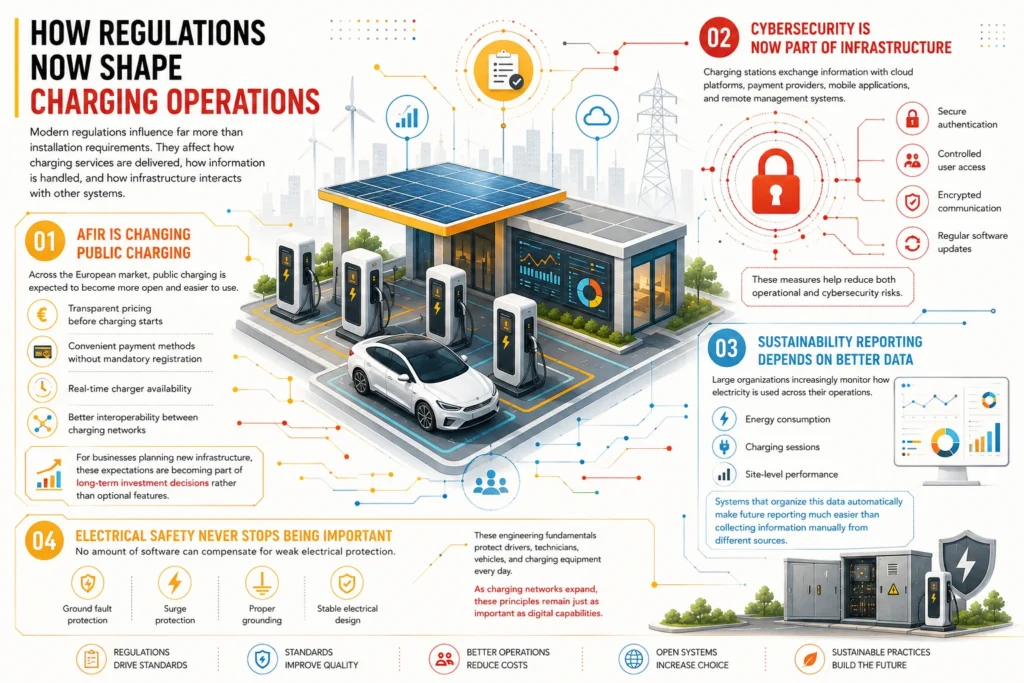
Modern regulations influence far more than installation requirements. They affect how charging services are delivered, how information is handled, and how infrastructure interacts with other systems.
AFIR Is Changing Public Charging
Across the European market, public charging is expected to become more open and easier to use. That includes requirements related to transparent pricing before charging starts, convenient payment methods without mandatory registration, real-time charger availability, and better interoperability between charging networks. For businesses planning new infrastructure, these expectations are becoming part of long-term investment decisions rather than optional features.
Cybersecurity Is Now Part of Infrastructure
Charging stations exchange information with cloud platforms, payment providers, mobile applications, and remote management systems. Protecting those connections has become part of operating a professional charging network. Secure authentication, controlled user access, encrypted communication, and regular software updates help reduce both operational and cybersecurity risks.
Sustainability Reporting Depends on Better Data
Large organizations increasingly monitor how electricity is used across their operations. Charging infrastructure can contribute valuable information, including energy consumption, charging sessions, and site-level performance. Systems that organize this data automatically make future reporting much easier than collecting information manually from different sources.
Electrical Safety Never Stops Being Important
No amount of software can compensate for weak electrical protection. Ground fault protection, surge protection, proper grounding, and stable electrical design continue protecting drivers, technicians, vehicles, and charging equipment every day. As charging networks expand, these engineering fundamentals remain just as important as digital capabilities.
Why Open and Connected Infrastructure Lowers Risk
A charging station rarely operates on its own. Even a single public charger may communicate with a management platform, payment provider, mobile app, energy management system, and roaming partners. The more isolated those systems are, the harder they become to maintain as requirements change.
Open infrastructure gives operators more flexibility because it is designed to work with other platforms instead of depending on a single ecosystem. That flexibility becomes valuable throughout the lifetime of a charging network. Businesses can introduce new services, expand into different markets, or connect additional software without redesigning the entire system.
Some of the practical advantages include easier integration with payment providers, compatibility with different charging hardware, better support for roaming platforms, simpler connection with energy management systems, more reliable reporting through centralized data, and greater freedom to expand or modernize the network over time. For businesses that expect their charging infrastructure to grow, open architecture is often one of the best ways to reduce future operational risk.
What to Check Before Choosing Charging Infrastructure
Looking beyond the purchase price can prevent expensive upgrades later. Before investing in charging equipment, it is worth asking a few practical questions.
| Question | Why it matters |
|---|---|
| Can the chargers receive remote firmware updates? | New features and security improvements can be deployed without visiting every site. |
| Does the platform support open integrations? | Makes it easier to connect payment systems, business software, and future services. |
| Can pricing and payment options be updated? | Helps adapt to changing customer expectations and market requirements. |
| Is charging data available through one management platform? | Simplifies monitoring, reporting, and maintenance. |
| Does the site support dynamic load management? | Makes better use of available electrical capacity. |
| Is proper electrical protection included in the design? | Helps protect equipment from surges, faults, and other power disturbances. |
| Can the installation expand without major reconstruction? | Reduces future costs as charging demand grows. |
None of these questions focuses on a single regulation. Together, they help determine whether the infrastructure can continue meeting technical and operational requirements for years instead of only at the moment it is installed.
Regulatory-Ready Infrastructure Costs Less Over Time
The cost of charging infrastructure is not limited to purchasing equipment. Over its lifetime, a charging network will require software updates, maintenance, new integrations, operational reporting, and occasional expansion. Infrastructure that supports these changes without major reconstruction is usually less expensive to operate over the long term.
That does not mean every future requirement can be predicted. Technology will continue evolving, and regulations will continue changing. What businesses can control is how prepared their infrastructure is to adapt. Choosing charging hardware, software, and electrical design with flexibility in mind reduces the likelihood of costly replacements, simplifies maintenance, and gives operators more freedom as their networks expand.
Frequently Asked Questions
What does regulatory-ready charging infrastructure mean?
It refers to charging infrastructure that can adapt to changing technical and regulatory requirements without major rebuilding. That usually includes modern hardware, remote software updates, open communication standards, secure data handling, and scalable management tools.
Why is it cheaper to plan for compliance from the beginning?
Replacing chargers or redesigning an installation after new requirements appear is usually much more expensive than choosing flexible equipment from the start. Infrastructure that supports updates and integrations can stay in service much longer.
Does regulatory readiness only matter for public charging stations?
Public charging is affected by the most visible regulations, but commercial fleets, workplaces, hotels, and residential projects can benefit as well. Flexible infrastructure is easier to expand, maintain, and integrate with other business systems regardless of where it is installed.
How do software updates reduce long-term risk?
Remote updates allow operators to introduce security patches, improve performance, and add new features without sending technicians to every charging site. That helps keep the network current while reducing maintenance costs.
Why are open communication standards important?
Open standards make it easier to connect charging stations with payment providers, roaming platforms, energy management systems, and future software. They give businesses more flexibility and reduce dependence on a single vendor.
How does electrical protection support regulatory readiness?
Reliable electrical protection helps charging stations operate safely throughout their lifetime. Features such as surge protection, proper grounding, and fault protection reduce the risk of equipment damage, downtime, and costly repairs while supporting safe operation.
Final Thoughts
Regulatory-ready charging infrastructure is not about guessing every future rule. It is about avoiding obvious limitations from the start.
A charging site should be able to grow, update, share data, protect users, and work within real grid conditions. When those basics are planned early, businesses reduce the risk of expensive replacements, rushed upgrades, and operational gaps later.
For Ukraine, this approach makes practical sense. Charging infrastructure is still growing, grid capacity matters, and businesses need systems that can stay useful as the market becomes more mature and connected.