

Table of contents:
For years, buying EV charging equipment was mostly about comparing specifications, delivery times, and price. Those factors still matter, but the conversation has become much broader. Charging stations are no longer standalone electrical devices. They connect vehicles, buildings, energy management systems, and the grid through software, communication protocols, and remote services.
That shift makes manufacturing decisions more important than they used to be. Questions about where equipment is produced, how components are sourced, and how suppliers are managed now influence reliability, cybersecurity, product quality, and long-term support. While global supply chains remain an essential part of the industry, many businesses are looking more closely at manufacturing transparency and regional production when planning charging infrastructure that is expected to operate for years.
This article explains why European manufacturing has become part of the discussion around critical EV infrastructure, what practical advantages it can offer, and why supply chain visibility is becoming just as important as charger performance.
We remind you that you can purchase home and commercial charging stations in our store, as well as use public charging stations ECOFACTOR located throughout Ukraine. For convenient access to charging infrastructure, we recommend using our mobile app, available on iOS and Android.
Why Manufacturing Has Become Part of EV Infrastructure
Not long ago, choosing an EV charger was mostly a technical decision. Businesses compared charging power, connector types, installation requirements, and price. If the equipment met the specifications and fit the budget, that was often enough.
The industry has changed. Today’s charging stations communicate with vehicles, cloud platforms, mobile apps, payment systems, and energy management software. Many installations already support dynamic load balancing, while newer hardware is being designed to work with technologies such as ISO 15118 and Vehicle-to-Grid (V2G). A charger is no longer just supplying electricity. It has become part of a much larger digital and electrical ecosystem.
That shift changes how charging equipment should be evaluated. Performance still matters, but so do manufacturing practices, product development, and long-term support. The quality of the finished charger depends on decisions made long before it reaches the installation site.
For businesses planning charging infrastructure, especially projects expected to operate for ten years or more, manufacturing has become part of the investment decision rather than something happening behind the scenes.
What Makes Manufacturing Important
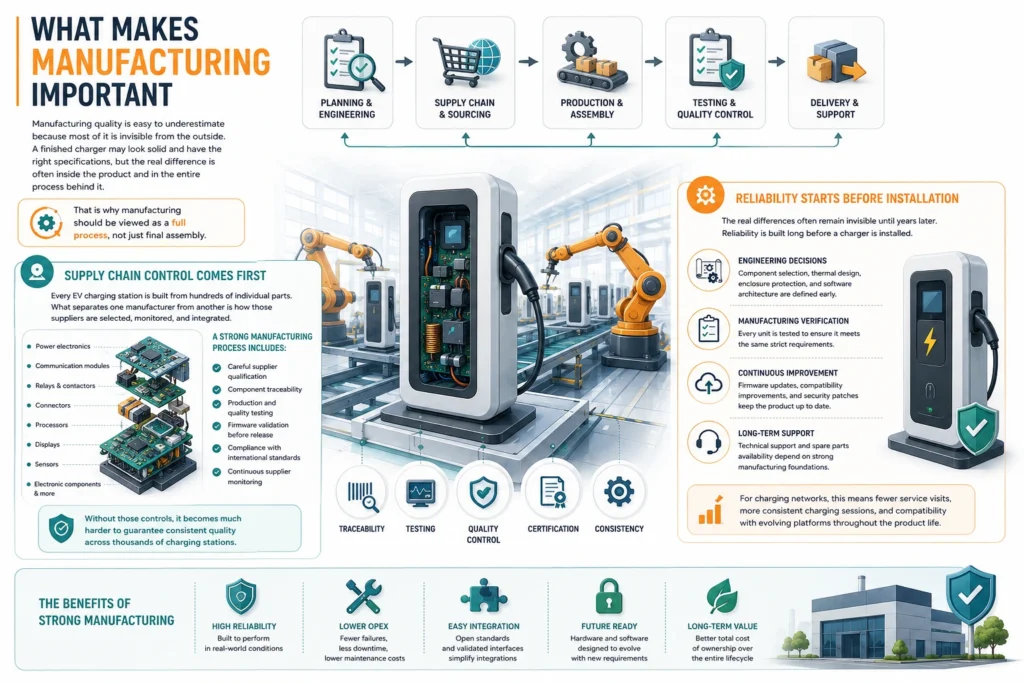
Manufacturing quality is easy to underestimate because most of it is invisible from the outside. A finished charger may look solid, have the right connector, and show the right power rating on the datasheet. But the real difference is often inside the product: how components were selected, how suppliers were checked, how firmware was tested, and how consistently each unit was produced.
That is why manufacturing should be viewed as a full process, not just final assembly.
Supply Chain Control Comes First
Every EV charging station is built from hundreds of individual parts. Power electronics, communication modules, relays, connectors, processors, displays, sensors, and countless smaller electronic components all come together to create one product.
Those parts rarely come from a single supplier. Even manufacturers with their own production facilities rely on global supply chains for many components. What separates one manufacturer from another is often not where every individual part originates, but how those suppliers are selected, monitored, and integrated into the production process.
A strong manufacturing process usually includes careful supplier qualification, component traceability, production and quality testing, firmware validation before release, compliance with international standards, and continuous supplier monitoring. Without those controls, it becomes much harder to guarantee consistent quality across thousands of charging stations.
Reliability Starts Before Installation
A charging station may look identical from the outside regardless of where it was manufactured. The real differences often remain invisible until years later.
Engineering teams make decisions about component selection, thermal design, enclosure protection, software architecture, and testing procedures long before production begins. Manufacturing teams then verify that every unit meets the same requirements before it leaves the factory.
That process continues after installation. Firmware updates, compatibility improvements, security patches, and technical support all depend on how the product was designed and maintained from the beginning. For charging networks, this directly affects everyday operations. Stable hardware generally requires fewer service visits, produces more consistent charging sessions, and remains compatible with evolving software platforms throughout its operating life.
What European Manufacturing Brings to Charging Infrastructure
European manufacturing is often discussed in terms of location, but geography is only one part of the picture. What many businesses are really looking for is confidence that the equipment will remain reliable, supported, and compatible throughout its service life.
That confidence comes from a combination of engineering, manufacturing processes, and long-term responsibility for the product.
Engineering and Manufacturing Stay Connected
When product development and manufacturing work closely together, improvements can move from testing to production much faster. Engineers receive direct feedback from manufacturing teams, quality specialists identify recurring issues earlier, and production processes can be refined without long communication chains. This continuous feedback helps manufacturers improve products over time instead of treating production as a fixed process.
Better Visibility Across the Supply Chain
Complete local sourcing is unrealistic for modern EV chargers. Electronic components are produced across the world, and nearly every manufacturer relies on international suppliers to some degree. The difference lies in how that supply chain is managed.
Manufacturers with established supplier approval processes typically evaluate factors such as component quality and consistency, production capabilities, documentation and certifications, quality management systems, and long-term supplier relationships. The goal is not simply to know where a component was purchased, but to understand how it fits into the finished product and whether it consistently meets the required standards.
Long-Term Product Support
Charging infrastructure is expected to remain in operation for many years. During that time, software evolves, communication standards develop, cybersecurity requirements change, and vehicles introduce new capabilities. A manufacturer’s responsibility does not end when the charger leaves the factory. Long-term support may include firmware updates, compatibility improvements, spare parts, technical documentation, and engineering assistance throughout the equipment’s lifecycle. For charging network operators, this ongoing support can be just as valuable as the hardware itself.

Choose Reliable EV Infrastructure With ECOFACTOR
Reliable charging infrastructure starts with dependable equipment and solutions designed for long-term operation. Alongside charging stations, ECOFACTOR provides hybrid inverters, battery systems, and solar panels for a wide range of infrastructure projects. Drivers can also use the iOS and Android app and charging station map to find available charging locations.
ECOFACTOR can help support charging projects through:
- Infrastructure solutions for commercial charging networks
- Energy systems that complement EV charging
- Equipment for expanding charging locations
- Cables and accessories for charging installations
Contact ECOFACTOR to discuss reliable solutions for your EV infrastructure project.
Cost Is Only One Part of the Decision
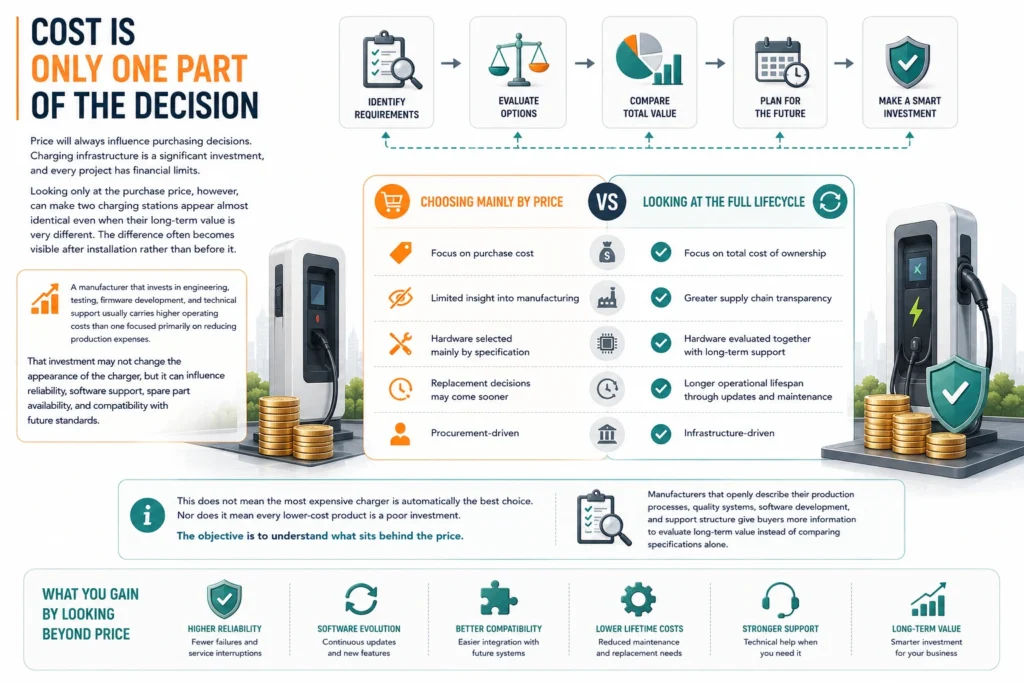
Price will always influence purchasing decisions. Charging infrastructure is a significant investment, and every project has financial limits. Looking only at the purchase price, however, can make two charging stations appear almost identical even when their long-term value is very different. The difference often becomes visible after installation rather than before it.
A manufacturer that invests in engineering, testing, firmware development, and technical support usually carries higher operating costs than one focused primarily on reducing production expenses. That investment may not change the appearance of the charger, but it can influence reliability, software support, spare part availability, and compatibility with future standards.
| Choosing Mainly by Price | Looking at the Full Lifecycle |
|---|---|
| Focus on purchase cost | Focus on total cost of ownership |
| Limited insight into manufacturing | Greater supply chain transparency |
| Hardware selected mainly by specification | Hardware evaluated together with long-term support |
| Replacement decisions may come sooner | Longer operational lifespan through updates and maintenance |
| Procurement-driven | Infrastructure-driven |
This does not mean the most expensive charger is automatically the best choice. Nor does it mean every lower-cost product is a poor investment. The objective is to understand what sits behind the price. Manufacturers that openly describe their production processes, quality systems, software development, and support structure give buyers more information to evaluate long-term value instead of comparing specifications alone.
What This Means for Charging Projects in Ukraine
Ukraine’s charging network continues to grow, and many of today’s installations are being planned with a long operating life in mind. Businesses investing in charging infrastructure are not simply purchasing equipment for current demand. They are building assets expected to support changing technologies, larger EV fleets, and closer integration with European markets. That makes manufacturing quality increasingly relevant.
As Ukraine continues aligning with European technical standards, charging equipment should be capable of supporting modern communication protocols, remote management, smart energy systems, and future software updates without requiring premature replacement.
Infrastructure resilience is another practical consideration. Reliable hardware, dependable technical support, and consistent spare part availability help operators reduce downtime and simplify maintenance. For commercial sites, fleets, retailers, hotels, and public charging networks, every unnecessary service visit adds operational costs.
Choosing a manufacturer with transparent production processes and established engineering capabilities does not eliminate every operational risk, but it gives businesses a stronger foundation for infrastructure that is expected to perform reliably over many years.
Questions Worth Asking Before Choosing Charging Equipment
Technical specifications remain important, but they tell only part of the story. Two chargers with similar power ratings and connector options may differ significantly in how they are manufactured, supported, and maintained over time.
Before selecting EV charging equipment, it is worth asking who designs and manufactures the hardware, how suppliers are selected and monitored, whether the manufacturer provides regular firmware updates, how products are tested before they leave the factory, whether the hardware is compatible with open Charge Point Management Systems, whether it supports current and future communication standards, whether spare parts and technical support will still be available years from now, and whether the equipment can integrate with smart energy management and future grid services.
These questions do not always have simple answers, but they help shift the discussion from purchase price alone to the overall value of the investment. A charging station is expected to remain in service for many years. Choosing equipment that can adapt to changing software, standards, and operational requirements often proves more practical than replacing hardware every time the industry moves forward.
Frequently Asked Questions
Is European manufacturing always better than manufacturing in other regions?
Not necessarily. Product quality depends on engineering, production processes, testing, and supplier management. European manufacturing is often valued because it can provide greater transparency, closer oversight, and long-term support, rather than because of its location alone.
Why does supply chain transparency matter for EV charging stations?
Modern charging stations contain hundreds of components from different suppliers. Knowing where those parts come from and how they are verified helps manufacturers maintain consistent quality, respond to issues faster, and support products throughout their lifecycle.
Does choosing a lower-priced charger always mean lower quality?
No. Price alone does not determine quality. A better approach is to look at the whole package, including manufacturing standards, firmware support, certifications, spare part availability, and the manufacturer’s track record.
How does manufacturing affect long-term operating costs?
Well-designed and thoroughly tested equipment is generally easier to maintain and less likely to require unexpected repairs. Regular firmware updates and reliable technical support can extend the useful life of charging infrastructure and reduce downtime.
Conclusion
The discussion around European manufacturing is about much more than where a charging station is assembled. As EV charging becomes part of critical energy infrastructure, businesses are paying closer attention to how products are designed, tested, manufactured, and supported throughout their lifecycle.
Global supply chains will remain an essential part of the industry, and no manufacturer operates entirely within one country or region. At the same time, greater transparency, stronger engineering oversight, and long-term product support are becoming increasingly important when evaluating charging equipment.
For businesses developing charging infrastructure in Ukraine, this perspective is particularly relevant. Investments made today are expected to serve drivers for many years while keeping pace with evolving technologies, software, and European standards. Looking beyond specifications and considering the manufacturing process itself can help create charging networks that remain reliable, adaptable, and easier to manage over the long term.