

Table of contents:
Short Summary: Proper charging of an electric vehicle involves choosing the right type of charging station (Level 1, Level 2, or DC fast charging), adhering to optimal battery charge limits (20-80%), using home chargers for daily top-ups, and using fast stations only when necessary. A smart approach increases battery life and reduces the cost of operating the electric car.
Electric vehicles are gaining popularity in Ukraine due to their cost-effectiveness and environmental friendliness. However, one of the most important aspects of their use remains proper charging.
How you charge your electric car affects not only everyday convenience, but also the longevity of the battery and the overall efficiency of the vehicle.
We remind you that you can purchase home and commercial charging stations in our online store, as well as use public charging stations ECOFACTOR located throughout Ukraine. For convenient access to charging infrastructure, we recommend using our mobile app, available on iOS and Android.
Types of Charging Devices for Electric Vehicles
The first thing to understand is that not all charging stations are the same. There are several main types, each with its own characteristics and area of application.
Level 1: Standard Home Outlet
The simplest charging method is connecting to a standard 220 V outlet. The power of such a connection is approximately 2-2.3 kW, which allows adding 8-12 km of range per hour.
A full charge can take 25-30 hours. According to the Rocky Mountain Institute Report, the cost of equipment for home Level 1 charging can range from $0 to $900 if no additional installation is required.
Level 2: Specialized Home Stations
These devices can be installed in a garage or parking space. Their power ranges from 7-11 kW, reducing charging time to 6-10 hours for a full cycle.
Type 2 charging stations can charge an electric car up to 80% in just a few hours. According to the Rocky Mountain Institute Report, the cost of a home Level 2 station ranges from $380 to $690, while public options cost about $3,500 per connector.
DC Fast Charging
The fastest option is DC stations with power from 50 kW and above. They allow charging the battery to 80% in 30 minutes – 1 hour.
According to NLR and INL data, the cost of a public DC fast charging station ranges from $38,000 to $90,000 per connector. Such stations are ideal for long trips but are not recommended for daily use due to increased stress on the battery.

Optimal Battery Charge Limits
It is important to understand one key point here: charging to 100% every time is not the best strategy for battery longevity.
Regular charging to 80-90% is optimal for increasing battery life. This is because continuing to charge after full capacity puts extra pressure on the internal materials of the battery and causes heating.
The lower limit is also important. Try not to let the charge drop below 20-30%. Deep discharge negatively affects the chemical processes inside the battery and reduces its overall lifespan.
Practical Recommendations for Charge Limits
- For daily use, keep the charge between 20% and 80%
- Charge to 100% only before long trips
- Avoid storing the electric car with a fully discharged or fully charged battery
- During long periods of inactivity, maintain the charge level at around 50%
Where and When to Charge Your Electric Vehicle
The Southwest Energy Efficiency Project conducted a study that showed: installing charging equipment in new buildings is 75% cheaper compared to retrofitting existing buildings.
This is an important point for those planning to buy an electric car and have the opportunity to install a home charging station during construction or renovation.
Home Charging
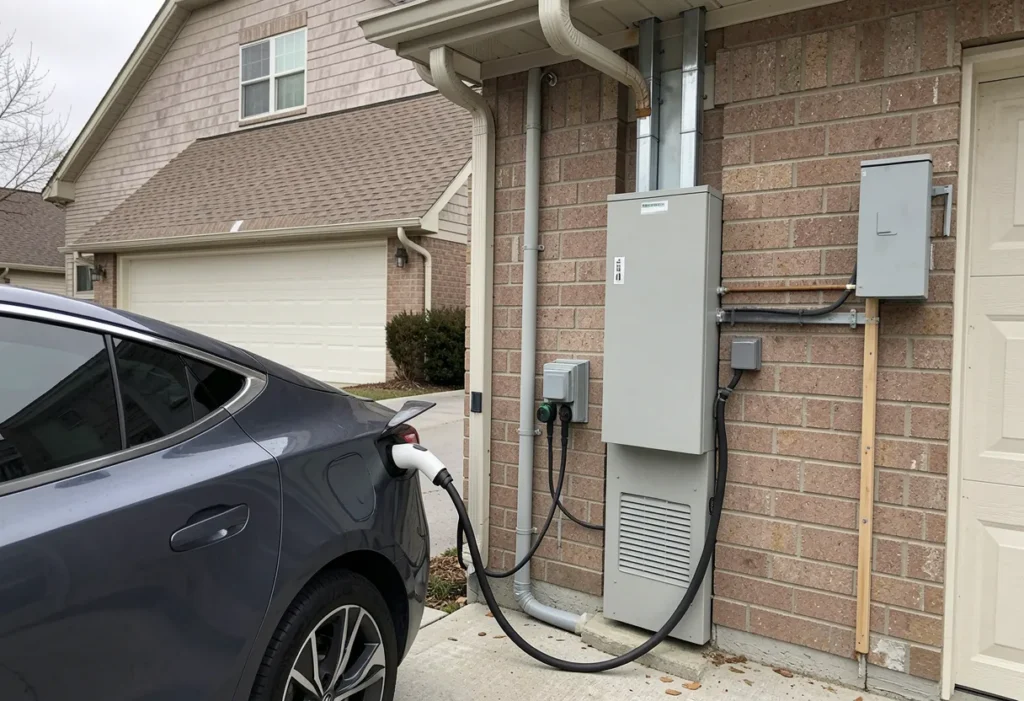
The most convenient option is a Level 2 charging station at home. Plug in your car in the evening and get a full charge in the morning for your daily needs.
This saves time and money, as home electricity is usually cheaper than public stations. It is best to charge at night when rates are lower.
Public Charging Stations
Use them as a supplement to home charging. Fast DC stations are ideal for recharging during long trips.
However, regular use of fast charging can accelerate battery degradation due to increased thermal stress. Research shows that fast charging at low temperatures can increase the risk of lithium plating on graphite electrodes, potentially reducing capacity.
| Charging Method | Power | Time to 80% | Recommended Use |
|---|---|---|---|
| 220 V Outlet | 2-2.3 kW | 20-25 hours | Emergency charging, rarely |
| Home Level 2 | 7-11 kW | 5-8 hours | Daily main charging |
| Public Level 2 | 7-22 kW | 3-6 hours | Top-up when needed |
| DC Fast | 50-350 kW | 30-60 minutes | Long trips, rarely |

Find the Right Charging Solution for Your Car
When it comes to proper electric vehicle charging, everything depends on real conditions — where you park your car, how often you drive, and whether you need fast charging access on the road.
ECOFACTOR offers a clear set of solutions for these tasks. There is a mobile app for Android and iOS for charge management, a map of charging stations for finding points and planning routes, as well as an online store where you can choose accessories, cables, and mobile chargers for your usage format. If you need your own station, use the charging station configurator — through it you can select an AC station for home or a DC station for higher loads.
If we are talking about a network or scaling, there is a platform for operators and a white-label solution for launching your own service. Additionally, energy-efficient solutions for home and business, as well as basic components and other equipment, are available.
Contact ECOFACTOR today and choose a charging solution without any extra effort.
Tips for Extending Battery Life
The battery is the most expensive component of an electric vehicle. Proper handling will pay off with savings in the long term.
Temperature Conditions
Extreme temperatures are the enemy of lithium-ion batteries. In hot weather, avoid leaving the car in the sun after charging, and in winter, preheat the battery before driving if the electric car has this function.
Parking in a garage or under a canopy helps maintain optimal temperature.
Charging Mode
Slow charging is always better for battery health than fast charging. Level 2 home stations provide the ideal balance between convenience and resource preservation.
Research on lithium-iron-phosphate (LiFePO4) batteries shows that intensive fast charging can accelerate the dissolution of transition metals and lithium plating, reducing overall service life.
Regular Use
Batteries love regularity. Long periods of inactivity with a full or empty charge harm the chemical balance inside the cells.
If you do not plan to use the electric car for a week or more, leave the charge at 50% and disconnect the charger.
Energy Savings During Charging
Night charging is often cheaper due to lower electricity tariffs. Many providers offer special plans for electric vehicle owners.
Use timer functions if available in the charging station or car. Set the charging start for the time of the lowest rates — usually from 23:00 to 7:00.
According to the Southwest Energy Efficiency Project study, the cost of installing charging infrastructure in new buildings is 75% lower compared to retrofitting, so planning ahead pays off with significant savings.
Regulatory Requirements and Standards
The International Building Code (IBC) 2021 edition includes requirements for electric vehicle charging stations in sections 406.2.7 and 1107.
According to these standards, a minimum of 5% of parking spaces with charging stations must be accessible to people with disabilities, but no less than one space. Charging stations must be installed in accordance with NFPA 70 and UL certified.
The international standard IEC 61851-23:2023 regulates electric vehicle supply equipment for direct current with rated voltage up to 1000 V AC or 1500 V DC.
Common Charging Mistakes
Many electric vehicle owners make the same mistakes. Here are the most common ones:
- First Mistake: regular charging to 100%. This is only justified before long trips. For daily use, the 80% limit is optimal.
- Second Mistake: using only fast DC stations. Yes, it is convenient, but constant fast charging reduces battery life due to thermal stress and mechanical electrode stress.
- Third Mistake: ignoring temperature conditions. Charging in frost or heat without prior battery conditioning reduces efficiency and can cause degradation.
Frequently Asked Questions
Can I charge an electric vehicle from a regular outlet?
Yes, you can use a standard 220 V outlet (Level 1), but this is the slowest method. A full charge can take 25-30 hours, which is only suitable for emergency situations or very short daily trips. In one hour of such charging, the electric car will gain approximately 8-12 km of range.
How much does it cost to install a home charging station?
According to the Rocky Mountain Institute Report, the cost of Level 2 equipment for home use ranges from $380 to $690. Installation can add another $200-500 depending on the complexity of the electrical work. If the charging station is installed during construction, costs are 75% lower compared to retrofitting existing housing.
Does fast charging harm the electric vehicle battery?
Fast DC charging creates increased thermal and mechanical stress on the battery. Regular use of fast charging accelerates degradation processes, including lithium plating and dissolution of transition metals. It is recommended to use fast charging only for long trips, and to perform daily charging through Level 2 stations.
To what level is it better to charge an electric vehicle daily?
The optimal range for daily use is from 20% to 80%. This strategy maximizes battery life by reducing chemical stress and heating. Charging to 100% is recommended only before long trips when maximum range is needed.
Is it safe to leave the electric vehicle plugged in overnight?
Yes, it is completely safe. Modern charging systems automatically stop the power supply after reaching the set charge level. Most electric vehicles have built-in battery management systems that prevent overcharging. Night charging also allows you to take advantage of lower electricity rates.
How does temperature affect electric vehicle charging?
Low temperatures slow down chemical processes in the battery and reduce charging speed. High temperature accelerates battery degradation. The optimal range for charging is from 15°C to 25°C. Many electric cars have a thermal regulation system that heats or cools the battery before charging to achieve optimal conditions.
How much electricity does electric vehicle charging consume?
Consumption depends on battery capacity and charging process efficiency. For an electric car with a 60 kWh battery, a full charge from 0% to 100% through a Level 2 station consumes approximately 65-70 kWh (including losses). At an average rate, this is equivalent to the cost of 200-300 km on a gasoline car.
Conclusion
Proper charging of an electric vehicle is a balance between convenience, savings, and care for the battery. A home Level 2 station for daily use, adherence to 20-80% charge limits, and limited use of fast charging — this is the formula for battery longevity.
Electrification of transport continues to develop, infrastructure is improving, and standards are becoming stricter. But the basic principles remain unchanged: moderation, regularity, and attention to temperature conditions.
Ready to switch to an electric vehicle or already an owner? Start with proper planning of home charging infrastructure — it will pay off with convenience and savings throughout the entire period of operation.