

Table of contents:
Short Summary: Electric vehicles in Ukraine are becoming increasingly popular due to falling battery prices (more than 25% in 2024) and the development of charging infrastructure. The main advantages are low operating costs, environmental friendliness, and fuel savings. At the same time, there are challenges: limited range, high battery replacement cost, and risks associated with the military situation and energy infrastructure. For urban use with access to charging, an electric car can be a beneficial solution.
The Ukrainian automotive market is undergoing a real revolution. Tesla, Nissan Leaf, Hyundai Kona Electric, and other electric cars are appearing on the roads more and more often. This is no longer an exotic novelty, but a real alternative to traditional petrol and diesel cars.
But is it really worth buying an electric vehicle right now? Let’s break down all the pros and cons in the context of Ukrainian reality — from the state of infrastructure to the impact of Russian military aggression on the energy system.
We remind you that you can purchase home and commercial charging stations in our online store, as well as use public charging stations ECOFACTOR located throughout Ukraine. For convenient access to charging infrastructure, we recommend using our mobile app, available on iOS and Android.
Global Trends: Electric Vehicles Are Taking Over the World
According to the International Energy Agency, global electric vehicle sales in 2024 exceeded 17 million units. This accounts for a significant portion of the total passenger car market worldwide.
In China, the share of electric vehicles (BEV and PHEV) in total new car sales in 2024 reached about 45-50%. In Europe, the share of EV sales remains at around 20%, and in the USA — about 10%.
The key growth factor is the decline in battery prices. In 2024, the global average price of battery packs fell by more than 25% compared to 2023. The drop in battery prices stimulated competition and allowed price reductions on some electric vehicle models.
Electric vehicles are already displacing about 1 million barrels of oil per day from global consumption. This is a real contribution to the fight against greenhouse gas emissions and energy independence.
The Situation with Electric Vehicles in Ukraine
Ukraine is also joining the global trend. Over recent years, the EV market has grown significantly, especially in million-plus cities.
Over the past 10 years, leading international and Ukrainian renewable energy investors have attracted over 12 billion US dollars in direct foreign investment into Ukraine’s economy. This created a foundation for the development of green infrastructure, including charging stations.
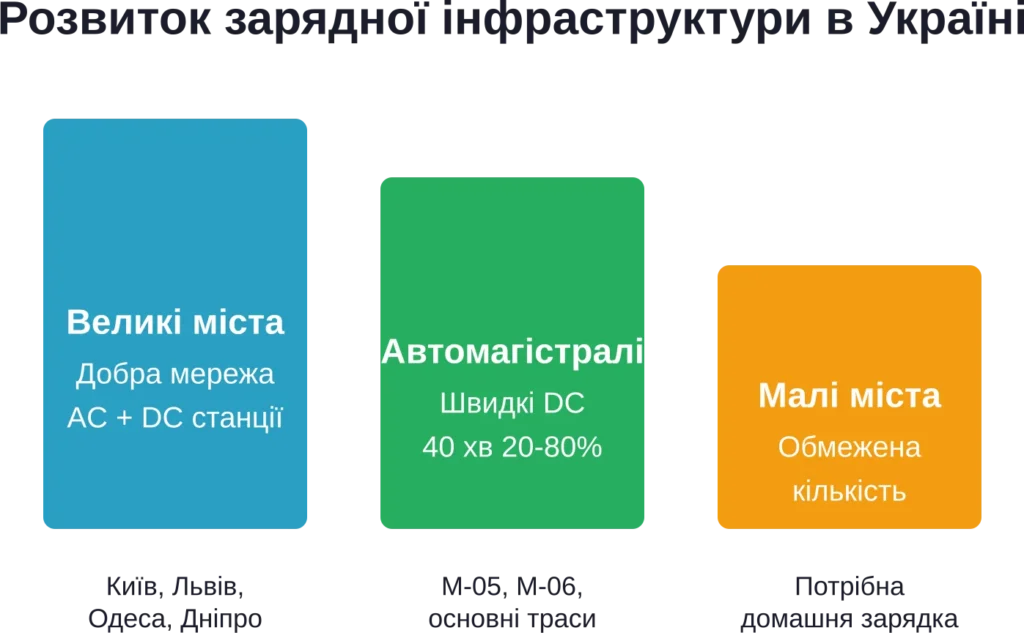
Currently, the situation with EV charging in Ukraine is quite good. In large cities and on major highways, fast charging stations are operating where charging from 20% to 80% capacity takes about 40 minutes.
However, military aggression has made its adjustments. Systematic attacks on electrical infrastructure create additional risks for electric vehicle owners, especially in eastern and southern regions.
Main Advantages of Electric Vehicles in Ukrainian Realities
Fuel and Maintenance Savings
The most obvious advantage is the cost of “refueling”. Electricity in Ukraine is significantly cheaper than petrol or diesel.
If charging at home on a night tariff, the cost of 100 km is approximately 30-50 UAH depending on the model. For a petrol car with 7-8 liters per 100 km consumption, this amount reaches 200-280 UAH at a petrol price of about 35 UAH per liter.
Maintenance savings are also significant. An electric vehicle has no oil to change, no spark plugs, timing belts, clutch, or complex transmission. Brake pads wear out more slowly thanks to regenerative braking.
Environmental Friendliness and Comfort
Electric cars produce no emissions while driving. This is especially important for large cities with air quality problems.
The absence of engine noise makes trips quieter and more comfortable. The instant torque of the electric motor provides smooth and fast acceleration without gear shift jerks.
Access to Benefits and Preferences
The VAT exemption (0%) benefit for importing electric vehicles was valid until December 31, 2025. From January 1, 2026, VAT at 20% must be paid when importing an electric vehicle.
Ease of Operation
Driving an electric vehicle is simpler — there is no complex mechanical gearbox, no need to warm up the engine in winter. Many operations can be performed remotely via a mobile app: pre-heat or cool the cabin, schedule charging for the night tariff, check battery status.
| Parameter | Electric Vehicle | Petrol Car |
|---|---|---|
| Cost per 100 km | 30-50 UAH (home charging) | 200-280 UAH |
| Oil change | Not required | Every 10-15 thousand km |
| Brake pads | Last twice as long | Standard wear |
| Transmission complexity | Single-speed | Multi-speed |
| Noise level | Minimal | Noticeable |
| CO2 emissions | 0 while driving | Significant |
Disadvantages and Challenges of Owning an Electric Vehicle in Ukraine
Limited Range and Charging Time
This is the most serious limitation for many potential buyers. Most available used electric vehicles have a real range of 200-350 km depending on battery condition, temperature, and driving style.
In summer, the range can be close to the declared one — for example, 450 km with about 15% remaining in the city. On the highway, this figure decreases due to higher speed and aerodynamic drag.
In winter, the situation is even more complicated. In frost, the range can drop by 30-40% because the battery works less efficiently and energy is spent on cabin heating.
Fast charging from 20% to 80% takes about 40 minutes at powerful DC stations. This is longer than filling a petrol tank. Slow charging from a household outlet can take 8-12 hours.
Battery Condition and Replacement Cost
The most expensive component of an electric vehicle is the traction battery. It gradually degrades over time, losing capacity.
When buying a used EV, it is critically important to check the battery condition. A car with more than 30% degradation may no longer meet the owner’s needs.
Battery replacement is an expensive procedure. The cost can reach 5000-10000 dollars depending on the model. This makes old electric vehicles with exhausted battery resources unattractive.
Energy System Risks During War
Systematic missile strikes on Ukraine’s energy infrastructure create serious challenges for electric vehicle owners.
During blackouts, access to charging stations may be limited. Home charging becomes problematic without electricity supply or during outage schedules.
This means that an electric vehicle as the only car in the family can be a risky choice, especially in regions with unstable power supply.
Limited Infrastructure Outside Major Cities
Although major highways are fairly well covered by charging stations, small towns and villages often remain outside the network.
For those who live in a private house with the ability to install home charging, this is not critical. But for residents of apartment buildings without their own parking, charging can become a real problem.
Technical Problems of Used Models
According to British researchers, the most common faults in new electric vehicles are software problems, as well as issues with the 12-volt battery, air conditioning, and cooling.
According to studies by British experts, older electric vehicles have problems with suspension components: 10% of faults in electric vehicles aged 5 to 9 years are associated with the suspension due to the large weight of the battery.
Popular Models and Prices on the Ukrainian Secondary Market
Nissan Leaf — The Most Popular Choice
The Nissan Leaf remains the most common electric vehicle on the Ukrainian secondary market. 2013-2017 models can be found in the range of 7000-12000 dollars.
The first generation has a 24 kWh battery with a real range of 120-150 km. The second generation (from 2017) offers 40 kWh and a range of up to 250 km.
The main advantage is the large number on the market, affordable spare parts, and service. The disadvantage is slow charging (CHAdeMO standard is less common in Europe).
Tesla Model S and Model 3
Tesla is the premium segment with the best range. 2015-2017 Model S costs 20000-30000 dollars, 2017-2020 Model 3 — from 25000 dollars.
Advantages: 400-500 km range, fast Supercharger charging, advanced autopilot technologies. Disadvantages: high repair costs, shortage of original spare parts in Ukraine.
Hyundai Kona Electric and Kia e-Niro
Crossovers with a 64 kWh battery and a range of about 400 km. Prices for 2020-2022 models start from 25000-28000 dollars.
These cars are well suited for Ukrainian roads thanks to increased ground clearance. CCS fast charging support makes them convenient for long trips.
Volkswagen e-Golf and Other Compact Models
Volkswagen e-Golf, BMW i3, Renault Zoe — compact electric vehicles with 30-40 kWh batteries. Prices for used 2015-2018 models: 10000-16000 dollars.
Suitable for city and short trips. Range is limited — 200-280 km in optimal conditions.
| Model | Year | Used Price (USD) | Range | For Whom |
|---|---|---|---|---|
| Nissan Leaf (24 kWh) | 2013-2016 | 7000-10000 | 120-150 km | City, second car |
| Nissan Leaf (40 kWh) | 2017-2020 | 12000-16000 | 220-280 km | City, suburbs |
| Tesla Model 3 | 2018-2020 | 25000-32000 | 400-500 km | Long trips |
| Hyundai Kona Electric | 2020-2022 | 25000-28000 | 350-420 km | Universal |
| Volkswagen e-Golf | 2015-2018 | 10000-14000 | 200-250 km | City |
| BMW i3 | 2015-2017 | 12000-16000 | 180-240 km | City, style |
Who Is an Electric Vehicle Suitable For in Ukraine
Ideal Buyer Profile
An electric vehicle is a good choice for those who:
- Mostly drive in the city and suburbs (up to 100-150 km per day)
- Have the ability to charge at home (garage, private house, parking with socket)
- Live in a region with stable power supply or have backup energy sources
- Consider an EV as a second car in the family for city trips
- Value low operating costs and environmental friendliness
Who Should Refrain
An electric vehicle may not be suitable if you:
- Regularly make trips over 300 km without the possibility of a long charging stop
- Live in an apartment building without access to charging and parking
- Plan to use the car in regions with unstable power supply
- Need to tow trailers or carry heavy loads (the battery drains quickly)
- Do not have a spare car in case of prolonged breakdown or lack of charging
What to Pay Attention to When Buying a Used Electric Vehicle
Battery Condition Check — Priority Number One
Battery condition is critically important. It is necessary to check the real capacity using diagnostic equipment or the on-board computer.
Degradation up to 15-20% is considered normal for a 5-7 year old car. Over 30% degradation is a signal that the battery will soon need replacement.
Ask the seller about charging history: frequent use of fast charging accelerates battery degradation.
Service History and Mileage Check
Electric vehicles are often bought for taxi or car-sharing use, which means intensive operation. Check the real mileage through diagnostics — it is harder to roll back in EVs, but still possible.
The service history should show regular checks of the battery cooling system, suspension condition (suffers from battery weight), and brake system condition.
Test Drive in Different Conditions
Be sure to test the car on fast and slow charging. Check if all modes work correctly.
While driving, pay attention to regeneration (regenerative braking), climate control operation, and the absence of extraneous noises from the power unit.
Legal Cleanliness and Customs Clearance
If the car was recently imported, make sure customs clearance was done correctly and there are no debts. Check the car in search and lien databases.
For old cars from the USA, check the history through Carfax or AutoCheck — hidden damage or flooding is possible.
Prospects of the Electric Vehicle Market in Ukraine
Global Market Growth Affects Ukraine
According to IEA data, the global electric vehicle market continues to grow, especially in developing markets. In Southeast Asia, growth was 50%, and the share of EV sales reached 9%.
This means that more and more affordable electric vehicles will enter the global secondary market, some of which will reach Ukraine.
Development of Domestic Production and Infrastructure
After the war, Ukraine plans large-scale restoration of energy infrastructure with an emphasis on renewable energy sources. In recent years, investments in new renewable energy projects in Ukraine have consistently exceeded investments in fossil fuels.
The development of solar and wind generation will create a base for mass electromobility. Home solar stations will allow charging electric cars almost for free.
Falling Battery Prices Make EVs More Affordable
Global decline in battery prices (more than 25% in 2024) is gradually reducing the cost of electric vehicles. In the USA, prices for electric crossovers fell by 3% per year, in China — by 10%.
This means that in 2-3 years, used electric vehicles with even better battery characteristics will enter the Ukrainian market at even more affordable prices.
State Support and Regulation
The issue of extending benefits for EV customs clearance remains open. However, Ukraine’s long-term strategy provides for transport decarbonization and support for electromobility.
Possible future incentives: purchase subsidies, tax benefits, development of charging station networks with state funds, special electricity tariffs for EV charging.

Real Operating Costs: Payback Calculation
Fuel Savings
At an A-95 petrol price of about 70-75 UAH per liter (as of April 2026), the cost per 100 km for a petrol car is approximately 490-600 UAH.
With standard night tariffs, a full battery charge is cheap compared to petrol, allowing significant fuel savings.
Maintenance Savings
Maintenance costs for a petrol car: 10000-15000 UAH per year (oil, filters, spark plugs, belts, brake pads).
Typical maintenance costs for an electric vehicle: 3000-5000 UAH per year (less frequent brake pads, coolant, tires).
Additional annual savings: about 8000 UAH.
Total Savings and Payback Period
With the calculated indicators, the total annual savings amount to about 45500 UAH.
If an electric vehicle is 5000 dollars more expensive than a similar petrol one (about 215000 UAH at the rate of 43 UAH/USD), the payback is:
185000 / 45500 ≈ 5 years
This is without taking into account tax benefits and rising petrol prices. With higher mileage, payback occurs faster.
Tips from Experienced Electric Vehicle Owners
The community of electric vehicle owners in Ukraine actively shares experience. Here are the key recommendations:
- Buy a model with a margin: if you need 200 km, take a car capable of 300 km — range drops in winter and with battery age
- Install home charging immediately: this saves time and money, increases convenience many times over
- Have a backup plan: know the location of chargers on regular routes, keep a portable charger in the car
- Monitor battery condition: use special apps (Leaf Spy for Nissan, Tesla Fi for Tesla) to control degradation
- Study niche forums: you will find information about typical problems of specific models and trusted service centers
- Don’t be afraid of winter: yes, range drops, but with experience you will learn to plan routes effectively
- Use regeneration: it saves energy and reduces brake pad wear

Ensure Stable Car Charging in Ukrainian Realities
The problem with an electric vehicle in Ukraine is not the car itself, but whether you can charge it when needed. This is what determines whether the EV will be convenient in everyday life.
ECOFACTOR offers several options so you don’t depend on one scenario. For trips, there is a map of charging stations, and the mobile app for Android and iOS allows you to start and monitor charging. If you need your own option, in the online store you can choose accessories, cables, and mobile chargers for different types of connections. For installation, use the charging station configurator – through it you can select an AC or DC option depending on your needs.
If you consider an electric vehicle as part of a larger system, other solutions are connected. This is the platform for operators to manage the network and users, as well as a white-label solution for launching your own service. Separately, energy-efficient solutions for home and business are available to reduce dependence on the power grid.
Contact ECOFACTOR and prepare charging infrastructure so that it works even in unstable conditions.
Conclusion: Is It Worth Buying an Electric Vehicle in Ukraine in 2026
There is no clear-cut answer — it all depends on the specific situation.
An electric vehicle is a profitable solution for city residents with access to home charging who mostly drive distances of up to 200-250 km per day. Savings on fuel and maintenance are real and substantial — up to 45000 UAH per year.
For those who regularly make long trips, do not have the opportunity for home charging, or live in regions with unstable power supply, an electric vehicle may create more problems than benefits.
The key to a successful choice is an honest assessment of your own needs. Analyze your typical daily mileage, charging infrastructure availability, and the presence of an alternative car in case of unforeseen situations.
The used EV market in Ukraine offers a sufficient selection of models in different price categories. Nissan Leaf for budget buyers, Tesla for those who value technology and range, Hyundai Kona Electric as a universal option.
The most important thing is a thorough check of the battery condition before purchase. Spend time on diagnostics or seek help from a specialist. This can save thousands of dollars in the future.
Global trends are on the side of electric vehicles: battery prices are falling, range is increasing, infrastructure is expanding. In Ukraine, despite wartime challenges, the market is also developing.
Ready to take a step towards electromobility? Start with an analysis of your own needs, study the available models on the market, join EV owner communities on social networks. Do a test drive of several models before making a final decision. The electric future is already here — the only question is whether you are ready to join it.
Frequently Asked Questions About Electric Vehicles in Ukraine
How Much Does It Cost to Charge an Electric Vehicle at Home?
Using the night tariff (about 2 UAH/kWh), a full charge of a 40 kWh battery costs about 80 UAH. This is enough for 200-250 km of driving. For comparison, the same distance in a petrol car will cost 400-500 UAH.
Can You Drive an Electric Vehicle in Winter in Ukraine?
Yes, but the range decreases by 30-40% due to low temperature and cabin heating use. At -10°C, an electric vehicle with a summer range of 300 km can realistically drive 180-210 km. It is critically important to plan routes taking this into account and know the location of charging stations.
What to Do During Blackouts?
During blackouts, EV owners can charge their cars at commercial charging stations with autonomous power or generators. Some install home generators or solar panels with batteries. It is also advisable to keep the car charged at 70-80% at all times to have a reserve in case of unexpected outages.
How Much Does It Cost to Replace an EV Battery?
Battery replacement cost depends on the model: for Nissan Leaf it is 5000-7000 dollars, for Tesla Model S — 10000-15000 dollars. However, modern batteries degrade slowly. With normal operation, the battery lasts 10-15 years, losing only 15-25% capacity. By that time, the cost of new batteries may decrease significantly.
What Are the Most Common Problems with Used Electric Vehicles?
The most frequent problems: traction battery degradation (natural process), 12-volt battery faults (cheap replacement), software issues (often solved by update), suspension wear due to heavy battery weight. Less often there are problems with the battery cooling system or electric motor.
Is It Profitable to Buy an Electric Vehicle for Taxi Use?
For taxi use, an electric vehicle can be very profitable due to low fuel costs with high mileage. At 200 km per day, savings amount to 10000+ UAH per month compared to a petrol car. Access to fast chargers is critically important. However, intensive use accelerates battery degradation, so it is worth choosing models with a large battery and limiting fast charging.
What Documents Are Needed to Register a Used Electric Vehicle?
The procedure is the same as for a regular car: purchase and sale agreement, technical passport, customs documents (if the car was recently imported), certificate of no encumbrances. For electric vehicles, it is additionally worth checking the availability of a certificate of conformity and documents on preferential customs clearance (if any). Re-registration at the MIA service center takes 1-2 days.