





Tesla Supercharger V4 Connector: full review, specifications, contacts, compatibility
Tesla continues to evolve its charging infrastructure for electric vehicles, and an important step in this process was the introduction of a new generation of charging stations - Supercharger V4. After the long dominance of Supercharger V2 and V3, the company decided to take a major step forward in terms of compatibility, charging speed and standardisation. The centrepiece of this infrastructure is the Tesla Supercharger V4 Connector, a new type of connector that [...]
Content:
Tesla continues to evolve its charging infrastructure for electric vehicles, and an important step in this process was the introduction of a new generation of charging stations - Supercharger V4. After the long dominance of Supercharger V2 and V3, the company decided to take a major step forward in terms of compatibility, charging speed and standardisation. The centrepiece of this infrastructure is the Tesla Supercharger V4 Connector, a new type of connector that supports not only Tesla owners but also opens up the network to other electric vehicles via CCS and NACS.
We remind you that you can purchase home and commercial charging stations in our online storeand also use the public charging stations ECOFACTORcharging points located throughout Ukraine. For convenient access to charging infrastructure, we recommend using our mobile applicationwhich is available on iOS and Android.
In this article, we will look at what the new connector is, how it works, how it differs from previous generations, what technical parameters it has and what vehicles it is compatible with.
What is the Tesla Supercharger V4 Connector
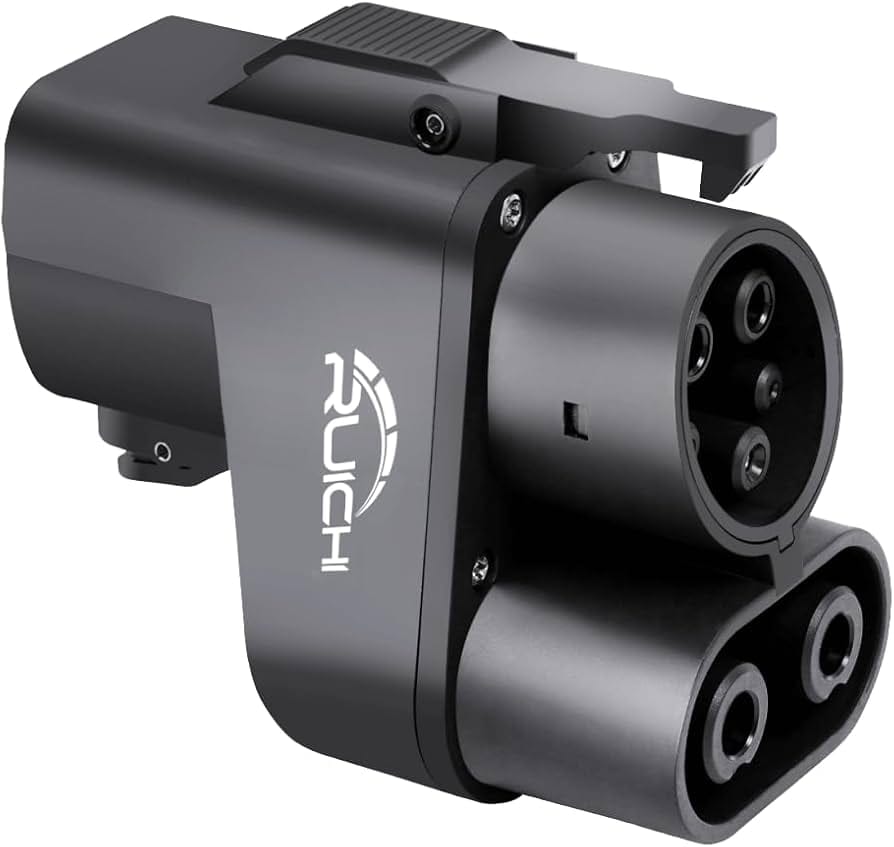
The Tesla Supercharger V4 Connector is a new generation of charging interface designed to work with the updated Tesla V4 charging stations that began rolling out in Europe in 2023 and later in other regions. The main purpose of this connector is to provide versatility, high power and compatibility with non-Tesla electric vehicles.
The new connector is physically similar to previous versions, but has a number of improvements. The V4 stations are designed to support CCS2 in Europe and NACS in the US, and the cables themselves are longer and thinner, allowing for convenient charging of electric vehicles with different port positions.
With the new connector and open access support, Tesla is opening up its network to other manufacturers, which is a significant strategic step in the development of global charging infrastructure.
Technical specifications
Tesla Supercharger V4 is a new generation charging station designed for maximum power, better adaptation to different types of electric vehicles and full compatibility with new standards. The main feature is that the V4 can work with both Tesla's own standard (NACS) and CCS2, depending on the region. Below are the key specifications for the V4 connector itself.
Power and current
- Maximum power outputup to 615 kW (technically possible, but in practice currently limited to 250-350 kW)
- Current and voltage: Current and voltage adapt to the vehicle's capabilities
- Dynamic power control depending on battery characteristics, temperature and charge level
Connector standards and types
- Europe: CCS Combo 2 connector
- USA / Canada: NACS (North American Charging Standard, formerly known as Tesla Connector) connector
Both variants support high-speed DC charging without the need for additional ports or adapters (if the car has the appropriate standard).
Cable and physical characteristics
- Cable length: approximately 2.8-3.2 metres, which provides greater flexibility when connecting to cars with different port locations
- Type of cable cooling: standard air or liquid cooling (for future versions with 500+ kW)
- Cable weight: reduced compared to previous versions due to improved materials and design
Data exchange protocols
- CAN: for basic interaction (used by Tesla)
- ISO 15118: supported in CCS2 versions for Plug & Charge and additional features such as automatic authorisation
- Over-the-air updatesV4 charging racks can receive firmware updates to add new features or improve the charging process
Safety and security
- Insulation of contacts: high level of electrical safety
- Automatic locking of the connector: prevents accidental disconnection
- Temperature controlIf overheating is detected, the system reduces power or stops the session
- Degree of protection: IP54 or higher (depending on the specific version)
These technical parameters make the Supercharger V4 ready for future market needs - including higher battery capacities, the transition to NACS in the US and the need for fast charging on the highway or in urban environments.
ECOFACTOR: new generation technology for efficient charging of electric vehicles
Modern electric transport requires an infrastructure that combines energy efficiency, environmental friendliness and convenience. These are the solutions that are being developed by ECOFACTOR - is a Ukrainian company that implements innovative systems for charging electric vehicles. Our developments are aimed at reducing the load on the grid, speeding up the charging process and ensuring stable battery performance in the long term. Our catalogue includes charging stationsThe newly developed machines combine a safe design with high performance.
We also offer cables and adaptersThe charging points are easily adaptable to different types of electric vehicles and charging infrastructure. They allow for a reliable connection even in challenging conditions, such as outdoor charging in bad weather. Users of the Tesla Model 3 and other modern models can take advantage of additional energy monitoring and management features for even greater efficiency.
Our products are built on the basis of deep integration of software and hardware solutions. This allows users to get not just a charger, but a complete energy management system. The key benefits we offer include:
- Smart energy consumption: Our chargers automatically adjust power levels to reduce consumption without sacrificing performance.
- High charging efficiency: Thanks to current optimisation algorithms, all available power is used with maximum efficiency.
- Full control via smartphone: our mobile application, available for iOS and Androidallows you to fully control the charging process, choose the time, view statistics and adjust schedules to your own rhythm of life.
- Environmental benefits: By using ECOFACTOR stations, drivers contribute to reducing emissions and building a cleaner energy ecosystem in Ukraine.
Every decision from ECOFACTOR is designed to meet the needs of modern drivers. We strive to make charging an electric vehicle as convenient and fast as plugging in a smartphone into a power outlet.
In addition to customised solutions, we are constantly expanding our network of public charging points across Ukraine. With the help of interactive map Every driver can easily find the nearest charging station and start charging without delay.
Detailed pinout diagram
The Tesla Supercharger V4 connector does not have a single contact configuration - it depends on the region, as CCS2 is used in Europe and NACS in North America. Both circuits have a relatively simple structure, where the main contacts are responsible for power transmission and signal exchange between the charging station and the car.
CCS2 contact configuration (Europe)
The Supercharger V4 in Europe uses the CCS Combo 2 standard, which combines a Type 2 (AC) connector with two additional contacts for DC.
Contacts:
- L1, L2, L3, N, PE: standard Type 2 contacts (for AC, inactive in CCS).
- DC+ / DC-Two DC power contacts. They transmit high-voltage currents (up to 1000 V, up to 615 A).
- CP (Control Pilot): contact for the exchange of signals between the vehicle and the station. It is used to adjust the power and confirm readiness.
- PP (Proximity Pilot)A contact that identifies the presence of a cable and transmits data about its characteristics (maximum current, etc.).
These signal contacts are also used for safety: charging only starts when the connection is complete and can only be disconnected after the session is complete.
NACS contact configuration (USA, Canada)
In North America, Tesla uses its own proprietary standard, NACS, which has a much smaller contact group. NACS has 5 pins: DC+, DC-, PE, CP, PP. Despite its smaller size, it supports both AC and DC charging in one housing.
Contacts:
- DC+ / DC-Two main power contacts for the transmission of direct current. They can also be operated in AC mode.
- CP/PPSignalling contacts integrated into the connector housing. They perform the same functions as the CCS: power management, connection verification, and data exchange.
The NACS contact group is integrated into a single housing with no unnecessary elements. This has made the connector compact, lightweight and easy to use, even at high power levels.
Adapters for Tesla Supercharger V4
Although most new electric vehicles are already moving to standards supported by the Supercharger V4, adapters are still required in some cases. Tesla is introducing several solutions that allow third-party vehicles to connect to its charging network, especially in the US, where different types of connectors are used.
Magic Dock
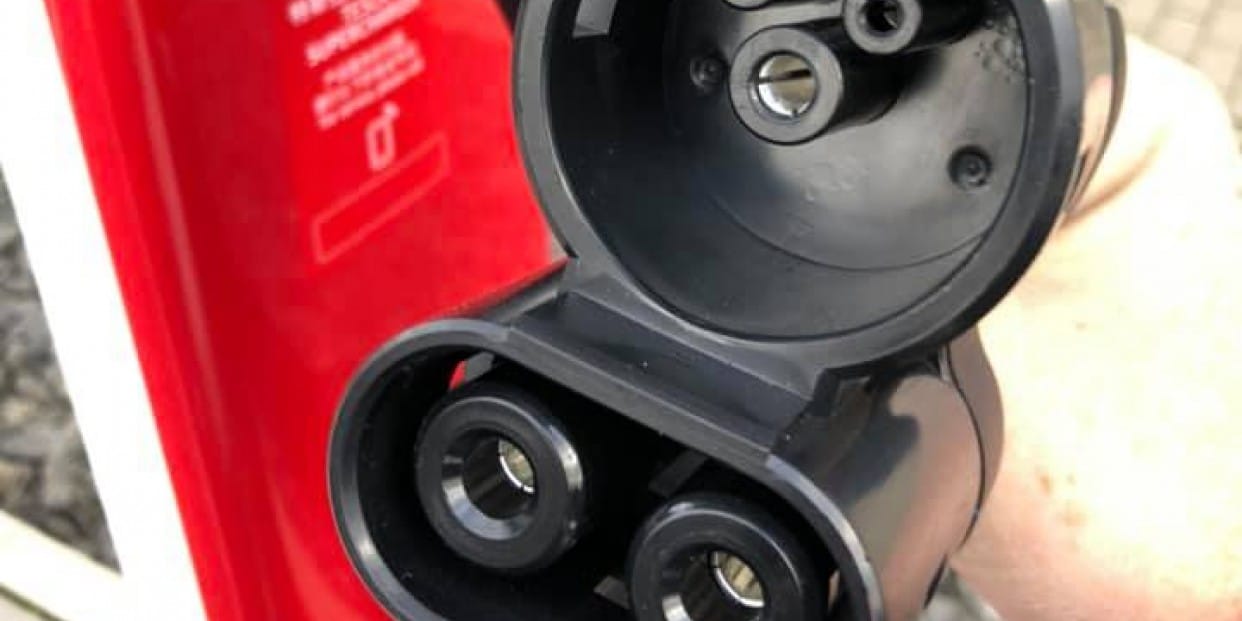
This is a built-in adapter that allows charging electric vehicles with a CCS1 connector at Tesla stations with a NACS connector (USA). The adapter is automatically activated when a third-party car is connected. It works in conjunction with the Tesla app, which is used to authorise and start charging.
Tesla CCS Combo 1 Adapter
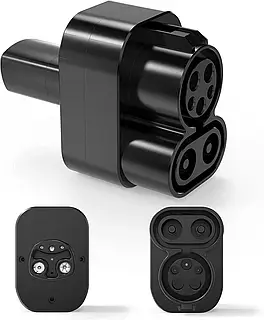
This adapter allows Tesla vehicles to charge at third-party stations with a CCS1 connector in the United States. It is not used directly on the Supercharger V4, but is important for those who want to have access to a wider infrastructure.
Other adapters
- NACS to CCS1 / CCS2: Adapters that allow third-party cars to charge from Tesla stations with NACS. They are currently being developed by several companies.
- CHAdeMO Adapter: Relevant for older Tesla models, but rarely used anymore.
The adapters cover most situations where the car and the station have different standards. In Europe, adapters are virtually unnecessary as Tesla uses CCS2, as do most other brands.
How the Tesla Supercharger V4 Connector works
The Tesla Supercharger V4 Connector is built on the idea of fast, automated, intelligent charging that minimises user involvement and interacts with the electric vehicle as efficiently as possible. With support for modern communication protocols, the V4 adapts to the needs of the vehicle in real time, providing both maximum power and safety.
The charging process looks like this step by step:
Physical connection of the cable to the vehicle
The user plugs the V4 Connector cable into the charging port of the electric vehicle. Thanks to the longer cable and the flexible shape of the connector, the connection is easy regardless of whether the port is located at the front, rear, left or right.
Vehicle identification
The connector detects the type of vehicle, its charging platform (Tesla, CCS2, NACS) and checks for a connection via CP and PP (Control Pilot and Proximity Pilot) signals.
Automatic data exchange
Via CAN or ISO 15118 (depending on the standard), the car transmits information about:
- battery status (SOC),
- maximum permissible power,
- temperature,
- current or voltage limitations.
Start charging
If all conditions are met, the station activates the DC power supply. The power output varies depending on the type of car, charge level, battery and cable temperature.
Monitoring and control
Throughout the session, the charging station monitors changes in temperature, voltage, and resistance and adjusts the parameters to prevent overheating or loss of contact. In critical situations, the system automatically stops charging.
Ending the session
When the desired charge level is reached or stopped via the app, the current flow stops and the user can safely disconnect the cable.
V4 also supports the upcoming upgrade to Plug & Charge - where the vehicle automatically logs in when connected, without the need for an app or RFID. This is particularly relevant for third-party electric vehicles that use CCS2 or, in the future, NACS. Plug & Charge for CCS2 is being partially implemented from 2024.
Comparison with other connectors
Compared to previous versions and other charging standards, the Tesla V4 Connector has significant advantages from both a technical and operational point of view.
Compared to the Supercharger V3:
- Higher potential power output (up to 615 kW vs. 250 kW in V3)
- Longer cable, suitable for vehicles with side or front ports
- Full open compatibility with CCS/NACS
- Updated body and rack design
Against CCS Combo:
- More compact in the case of NACS
- Tesla connector has fewer elements, is lighter, easier to maintain
- CCS has better Plug & Charge integration (but Tesla is also implementing it)
Against CHAdeMO:
- Higher charging power and speed
- Less prevalence of CHAdeMO in new cars
- Tesla V4 supports more modern features (V2X, ISO 15118, etc.)
Against GB/T (China):
- GB/T remains a regional standard and is not supported in the Tesla system
- Tesla V4 has global prospects, unlike GB/T
The Tesla V4 Connector is designed to become the main solution not only for Tesla, but also for all other brands, especially after a large number of car manufacturers in the US have switched to the NACS standard.
Which socket is used with the Tesla Supercharger V4 Connector
The Supercharger V4 does not use a socket in the classic sense. It is a charging station with an integrated cable that connects directly to the electric vehicle. The cable has the appropriate connector - NACS (in the USA) or CCS2 (in Europe).
The car owner doesn't have to connect their own cable - it's already built into the speaker. This solution allows you to:
- avoid contact with high voltage elements
- Minimise the complexity of connection
- Ensure constant monitoring of the cable condition
The stations are connected to the high-voltage grid via industrial transformers, so no home sockets or AC power are used in this context.
Regional use
The Tesla Supercharger V4 was launched in Europe in 2023 and will be rolled out in the US and other regions in 2024. This connector is designed as a global solution, adapted to the specifics of each market.
Europe (CCS2):
- The first stations were installed in the Netherlands, France, Germany, Austria, Belgium, Spain, and the UK.
- The connectors comply with the CCS Combo 2 standard, which is mandatory in the EU.
- Both Tesla and third-party electric vehicles have access to the stations.
- Authorisation via the Tesla mobile app works.
USA and Canada (NACS):
- The test deployment of V4 with NACS connectors has begun.
- Magic Dock support for CCS cars is implemented on individual stations.
- Mass adoption is expected in 2024-2025 as Ford, GM, Rivian, Volvo, and Honda switch to NACS.
- In North America, Tesla is building new V4 stations with more racks, longer cables, and improved space planning.
Asia and other markets:
- Pilot projects have been announced for Korea, the UAE, Australia, and Taiwan.
- In the future, it is expected to appear in Latin America and South Africa.
The regional adaptation of the connectors allows Tesla to use V4 as a global platform, taking into account local regulations. As a result, the company can quickly scale its infrastructure without the need to develop separate standards for each region.

Compatibility with cars
The Tesla Supercharger V4 Connector is designed not only for Tesla's own models, but also for a wide range of electric vehicles from other manufacturers, making it one of the most open and versatile DC charging solutions on the market.
Supported connector types:
- NACS (Tesla) - full support without adapters in the USA and Canada
- CCS2 (Europe) - compatibility with any car with a CCS2 connector
- CCS1 (USA) - via an adapter or Magic Dock on selected stations
Vehicles compatible with V4:
- All Tesla (Model S, 3, X, Y) - with both NACS and CCS2
- European brands:
- Audi (e-tron, Q4 e-tron, Q8 e-tron)
- Mercedes-Benz (EQE, EQS, EQA, EQB)
- BMW (i4, iX, i7)
- Volkswagen (ID.3, ID.4, ID.5, ID. Buzz)
- Hyundai / Kia (IONIQ 5, EV6, IONIQ 6)
- Skoda, Cupra, Opel and others
- American and Asian brands with CCS/NACS:
- Ford (Mach-E, F-150 Lightning)
- Rivian (R1T, R1S)
- General Motors (Lyriq, Silverado EV) - from 2024-2025
- Volvo, Polestar
- Toyota bZ4X, Subaru Solterra
- Lucid Air, Nissan Ariya (with CCS)
Tesla has announced that all new electric vehicles from Ford, GM, Rivian, Volvo, Honda, Nissan and others in the US from 2025 will be equipped with a NACS port from the factory, meaning they will be compatible with V4 without adapters. Thus, the Supercharger V4 Connector creates a single platform that supports dozens of brands and hundreds of models without sacrificing speed or convenience.
Conclusion.
The Tesla Supercharger V4 Connector is not just a new version of the charging port, but a strategic update of the entire high-speed charging philosophy aimed at unification, openness and scalability. Its main advantage is flexibility: it simultaneously meets Tesla's technical requirements and ensures compatibility with modern electric vehicles using CCS2 or NACS.
The V4 connector is designed to meet future needs, including increased battery capacity, voltage up to 1000V, V2G integration and ISO 15118 support. With its longer cable, high power and intelligent features, V4 will be the foundation of a new era of charging infrastructure.
Tesla is transforming its network from an exclusive to an open platform that will be available to millions of drivers around the world. The Supercharger V4 is a tool that does more than just charge cars, it changes the way we think about the convenience, speed and scale of the charging ecosystem.
Frequently asked questions (FAQ)
1. How does the Supercharger V4 differ from previous versions?
The V4 has a higher potential power output (up to 615 kW), a longer cable, better compatibility with other car brands (via CCS2/NACS), an updated design and increased scalability.
2. Can I charge a non-Tesla car on the Supercharger V4?
Yes, if the car has a CCS2 connector (in Europe) or CCS1 connector (in the US via Magic Dock/adapter). Some cars require authorisation through the Tesla app.
3. Does the Tesla V4 support Plug & Charge?
For example, Plug & Charge support is expected for CCS-compliant vehicles according to the ISO 15118 standard, with a gradual introduction through updates.
4. What is the maximum charging speed on a Tesla V4?
So far, the stations are limited to 250-350 kW, but technically support up to 615 kW. The actual speed depends on the car and temperature conditions.
5. Do I need to have a Tesla account to charge a third-party car?
Yes, third-party vehicles require authorisation via the Tesla app (iOS or Android) to start a charging session.
6. Does the Tesla V4 work in the rain or snow?
Yes, the connector is protected against moisture and dust. The system monitors environmental conditions and stops charging in case of danger.


