





BMW i4 or Mercedes-Benz EQE: which is better for a Ukrainian driver?
Electric cars are no longer a novelty on Ukrainian roads. From Chinese budget cars to premium models, there is a choice. But when it comes to the business class, eyes often focus on two rivals: BMW i4 and Mercedes-Benz EQE. Both look serious, have strong performance and promise the comfort that fans of the German car industry are used to. But on paper, everything looks nice. [...]
Content:
Electric cars are no longer a novelty on Ukrainian roads. From Chinese budget cars to premium models, there is a choice. But when it comes to the business class, eyes often focus on two rivals: BMW i4 and Mercedes-Benz EQE. Both look serious, have strong performance and promise the comfort that fans of the German car industry are used to.
But everything looks beautiful on paper. What about in real life? How do they behave on our roads, how long can they really go on a single charge, how fast do they charge, and which is better for a Ukrainian driver? Let's find out.
We remind you that you can purchase home and commercial charging stations in our online storeand also use the public charging stations ECOFACTORcharging points located throughout Ukraine. For convenient access to charging infrastructure, we recommend using our mobile applicationwhich is available on iOS and Android.
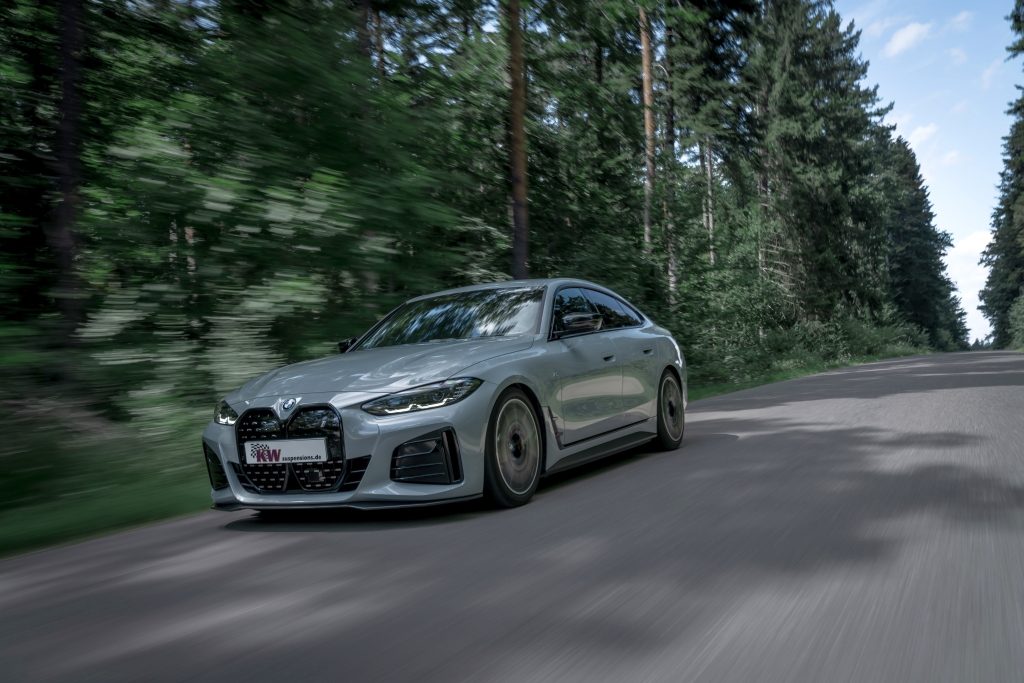
BMW i4 vs Mercedes-Benz EQE: which looks better?
Appearance: BMW i4 or Mercedes EQE?
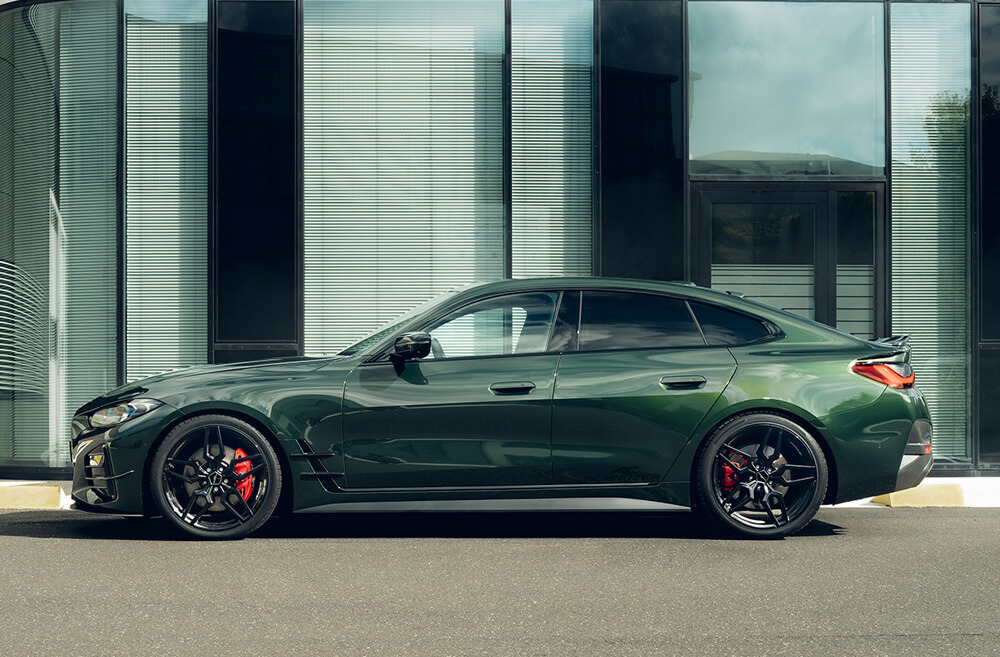
The BMW i4 looks restrained but recognisable at the same time. The classic kidney on the front grille hasn't disappeared, and the silhouette itself is smooth, with a sporty fastback feel. The car looks fast even in a static position. The blue and black details hint that this is an electric BMW, but without the ostentatious futurism. Those who want an electric car but are not ready for a "space" design will appreciate this moderate appearance.
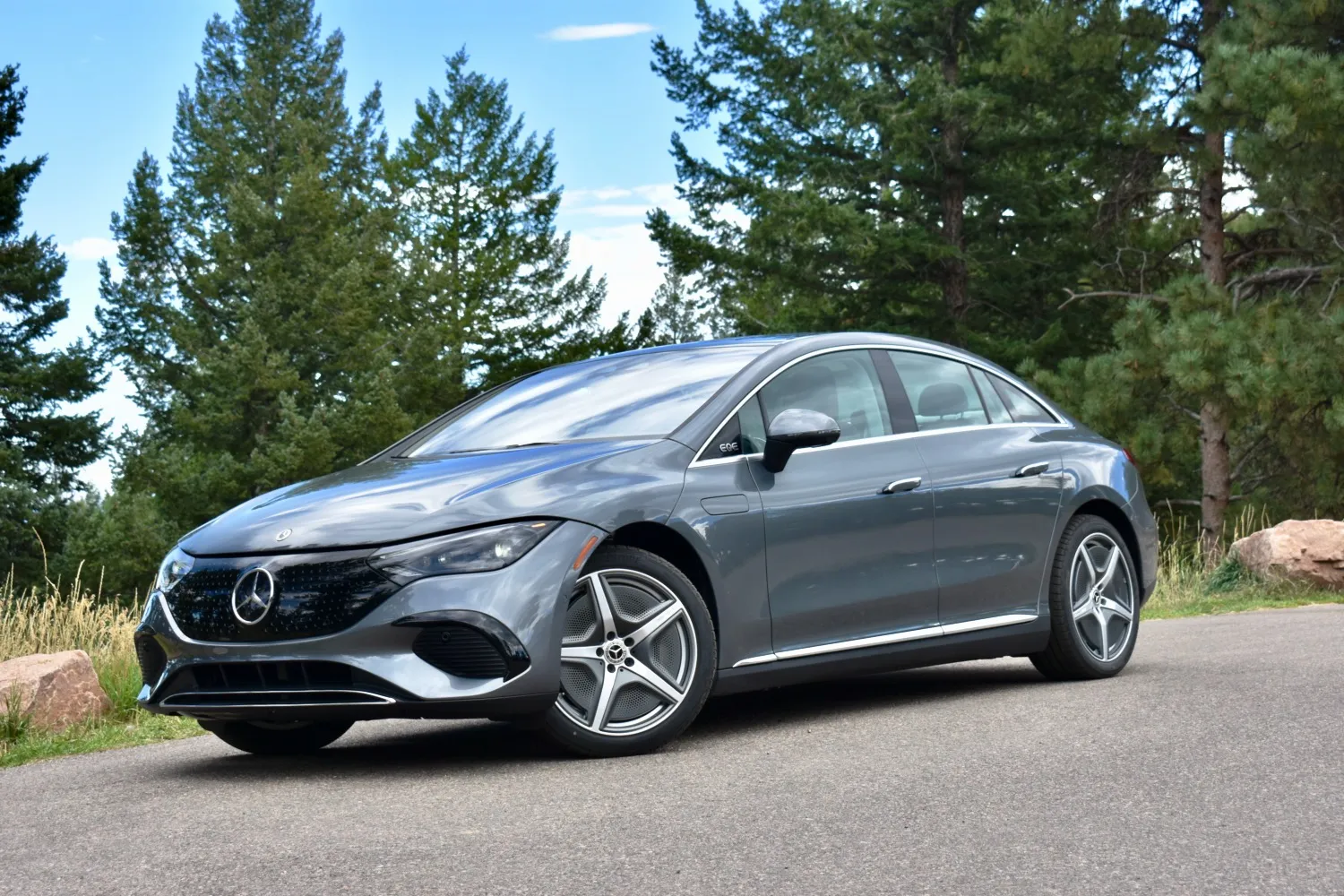
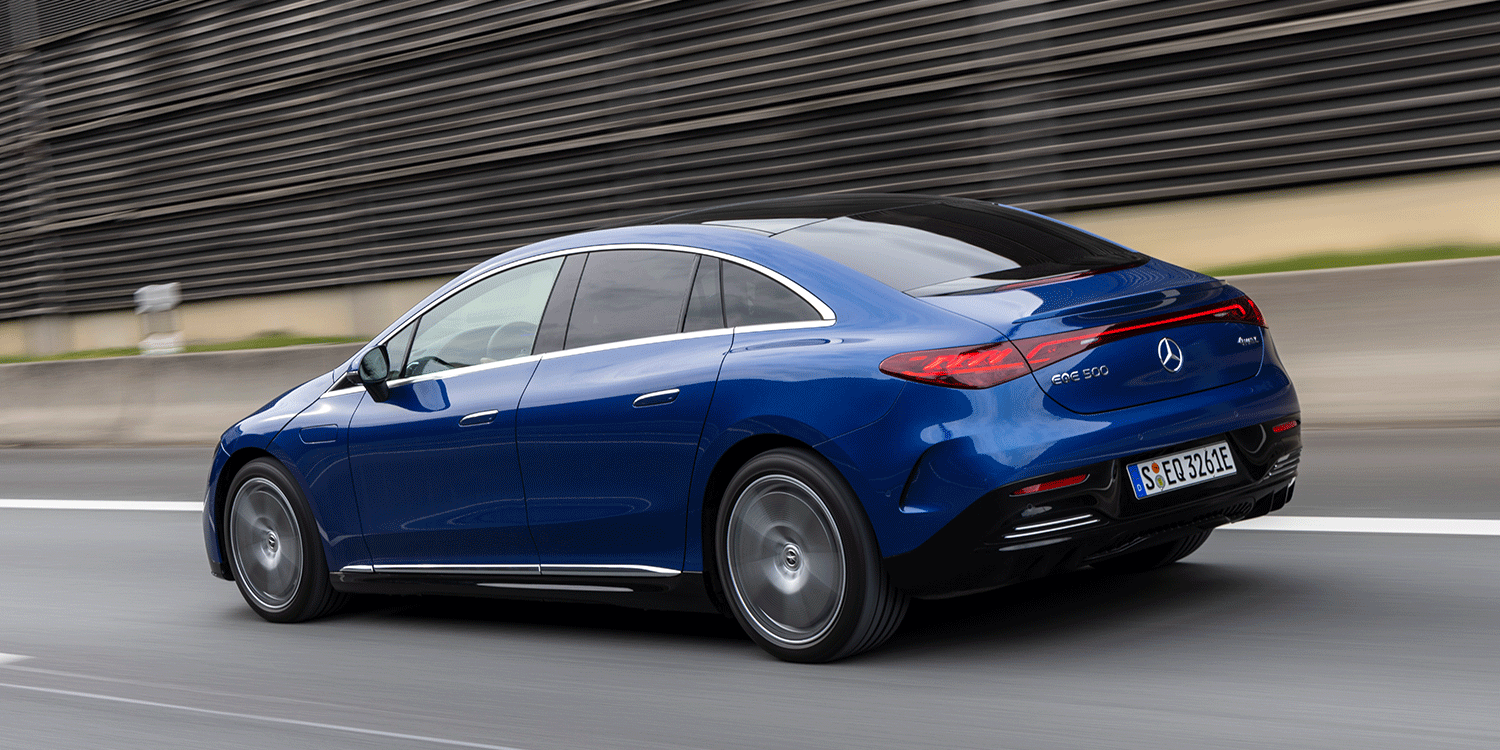
The Mercedes-Benz EQE takes a different approach. Everything here indicates that you're driving a modern electric car: a sleek front end without a traditional grille, elongated lines, darkened glossy inserts and almost no sharp corners. This design looks more like a concept car than a production car and definitely stands out from the crowd. It looks "more expensive" and a little more futuristic, which will appeal to those who love technological aesthetics.
Interior: comfort, style, technology
Inside the BMW i4 is minimalism in the brand's signature style. The driver is in charge here: everything is at hand, the large screens are slightly turned towards the steering wheel, the seat is deep, and you really feel that you are sitting in something dynamic. The central display is combined with the dashboard into one curved unit. The materials are of high quality, with German meticulousness. It's more about functionality than wow effect, but comfort has not been compromised.
The EQE inside is all about wow. A large central screen (and in some configurations, a giant Hyperscreen panel in the full width of the torpedo), soft materials, lighting, space. The seating position is slightly higher than in the BMW, and the impression is more like sitting in business class than in a sports sedan. And while in the BMW you feel like you're driving, in the Mercedes you feel like you're being driven.
Practicality in everyday life
An electric car is not just about the environment, but also about logistics: how much can fit in the trunk, how comfortable it is to drive on the road, how the car will behave on potholes or in winter. The BMW i4 is a pleasant surprise in this regard. Yes, the trunk of 470 litres is not a record, but it is quite normal for a sedan of this class. Moreover, it is deep and has a convenient opening for loading. Large suitcases, a stroller or packages from the epicentre will fit without any problems. There is also a folding backrest in the rear row if you need to transport something longer.
The i4's cabin is a bit cramped in height at the rear, especially if you're tall or often carry passengers over 6'2". This is a design compromise - the sloping roof and sporty body line come at a price. But there's more than enough space in the front, and the quality of materials and ergonomics are on par. An additional advantage is the rather thin floor insulation, which copes well with tyre noise and does not create a "resonator" effect, as in some other electric cars.
The Mercedes-Benz EQE is noticeably larger - and you can tell even before you get behind the wheel. The interior is spacious, especially in the second row. If you often travel with five people or have child seats, the EQE will be more comfortable. The trunk is technically smaller at 430 litres, but it is wider, deeper and easier to load thanks to a more vertical opening. It is easier to use it for everyday tasks - supermarket bags, boxes, tools.
The EQE has a slightly better organised space for small items, with more compartments, deeper cup holders and door pockets that can hold a 1.5-litre bottle without strain. It also has a wider door opening radius, which parents with children will appreciate. If you're looking for something more family-friendly than just a commuter car, the EQE has the goods.
Dynamics: is the BMW really faster?
The BMW i4 eDrive40 is truly dynamic. It's not just numbers on paper - 0 to 60 km/h in 5.7 seconds is impressive, but what's even more impressive is how this dynamism is transmitted to the driver. Thanks to its low centre of gravity (battery in the floor), rear-wheel drive and precise steering, the i4 truly feels like a true BMW. In the Sport Boost mode, the response to the accelerator pedal is instantaneous - just press it and the car literally dives forward. And this is without the roar of the engine, but with a pleasant artificial sound that is not annoying.
On Ukrainian roads, especially in urban areas, such dynamics are useful: to quickly exit a secondary road, overtake on a single-lane highway, or just enjoy driving - the i4 does all this with pleasure. But keep in mind that the suspension is a bit stiff, especially on 19-inch wheels. In Kyiv or Lviv, this is still tolerable, but if you often drive around district centres or villages, you will feel every patch on the road.
The Mercedes EQE 350 is a different story. It's not about "push and go", but about calmness, softness and stability. Acceleration to 100 km/h in 6.2 seconds is not slow, but the power delivery is smooth, without sharp jerks. This car is more suitable for quiet highway trips, far from aggressive style. Its trump card is comfort on broken asphalt, excellent noise insulation and impressive stability even at high speed.
Interestingly, even in corners, the EQE behaves better than it looks - thanks to its low centre of gravity and wide wheelbase. But the steering response is less direct than in the BMW. It's more like an aeroplane than a Porsche. That is, if you are looking for a car that you want to drive just for the sake of driving, the i4 will be more interesting. But if you just want to get from point A to point B with maximum comfort, the EQE is for you.
Power reserve and charging speed
In terms of driving range, both cars perform well, especially in Ukraine, where the charging infrastructure is still being developed. The BMW i4 is equipped with an 83.9 kWh battery and can travel up to 590 km on a single charge according to the European WLTP cycle. In real-world conditions - with the climate control system switched on, mixed-cycle driving and under load - this is closer to 430-460 km in summer and 320-350 km in winter. The car supports alternating current (AC) up to 11 kW and direct current (DC) up to 200 kW. When connected to a fast charger, the 10% to 80% can be charged in about half an hour.
The Mercedes-Benz EQE has a larger battery of 90.6 kWh and an officially declared range of up to 620 km WLTP. In practice, the figures are very similar to the i4: about 440-470 km in the warm season and 330-360 km in winter. The EQE supports charging with AC power up to 22 kW (which is important for those who charge at home or in the office on three phases) and DC power up to 170 kW. The charging time for the 80% is about 35-40 minutes.
In big cities, charging both cars is no longer a problem. The largest networks in Ukraine - TOKA, AutoEnterprise, Ionity, UGV Chargers, YASNO, and others - offer fast DC charging, albeit with varying levels of availability. But on the Kyiv-Odesa or Kyiv-Lviv highway, you still have to plan your stops in advance. It's good that both BMW and Mercedes have built-in navigation services that suggest charging points along the route.
| Charging type / Power (kW) | BMW i4 | Mercedes-Benz EQE |
| Household socket (2.2-3.6 kW) | ~24-27 hours | ~25-28 hours |
| Single-phase charging (7 kW AC) | ~12 hours | ~13 hours |
| Three-phase charging (11 kW AC) | ~7 hours 30 minutes | ~8 hours 45 minutes |
| Three-phase charging (22 kW AC) | not supported, limited to 11 kW | ~4 h 15 min (if 22 kW support is available) |
| Fast charging (50 kW DC) | ~1 h 40 min | ~1 h 50 min |
| High-speed charging (150 kW DC) | ~33 minutes | ~36 minutes |
| Maximum power (DC) | up to 200 kW | up to 170 kW |
Remarks: The BMW i4 does not support 22 kW on AC, even if the station delivers this power. The maximum for AC is 11 kW. The Mercedes-Benz EQE supports 22 kW on AC in some configurations, but not all versions have this option.
Prices in Ukraine: BMW i4 vs Mercedes-Benz EQE
Prices for electric vehicles in Ukraine depend not only on the configuration but also on whether you buy them from an authorised dealer or through imports. The BMW i4 with eDrive40 is currently offered in dealerships for around UAH 2.3-2.5 million. If you want more power, there is the M50 version with all-wheel drive and two electric motors, which already costs from UAH 2.8 to 3.1 million, depending on the options. Used i4s from Europe or the US on the secondary market start at around UAH 1.8 million, but it all depends on mileage, battery condition, and service history.
The Mercedes-Benz EQE is slightly more expensive by default. The base model EQE 350 in the cabin will cost about UAH 2.9 million, but the all-wheel drive versions of the EQE 500 or 4MATIC variants will have a price tag in the region of UAH 3.3-3.8 million. Used cars imported from Europe are available for several hundred thousand less, but you need to be careful about the equipment - not all of them have active air suspension, a panoramic roof, or support for 22 kW of charging.
Overall, the BMW looks like a more affordable option, especially in the basic configuration. It is better suited to those who want a premium electric car but are not ready to spend extra on luxury features. Mercedes is about status, greater comfort, and a slightly different approach to driving. If you want maximum silence, smoothness, and digital features, you'll have to pay a little extra.
What else is there to choose from?
If you're considering the i4 or EQE but aren't sure if it's your car, there are several other worthy alternatives on the Ukrainian market. For example, the Audi Q8 e-tron is a slightly different format because it is an SUV, but it costs about the same money as the EQE. It has comfort, quattro, a large range, and a reliable service network in Ukraine.
Tesla Model 3 or Model S is a classic. The Model 3 can be found new for as little as UAH 1.5 million, but it's a little smaller and closer to the i4. The Model S is more about EQE or even higher, but its new price can reach UAH 4+ million, so it is more common to buy used versions from the US.
For those who want to drive, you should take a look at the Porsche Taycan. A used Taycan can be found in Ukraine for around UAH 2.7-3.2 million, but a new one will cost a lot of money. This car is definitely not for those who count every kilometre, but it's a thrill for driving fans.
Bottom line: what to choose - BMW i4 or Mercedes-Benz EQE?
Both cars are worthy representatives of the business class in the electric era. The BMW i4 is for those who are not ready to compromise on dynamics and want the familiar BMW feel, even in a world without petrol. It's fast, precise in its handling, not overloaded with digital bells and whistles, and quite competitive in price. Especially if this is your first electric car, the i4 makes it easier to adapt to the new format.
The Mercedes EQE is a different philosophy. It is quiet, smooth, and as technologically advanced as possible. You don't want to turn corners at the limit of traction, you want to turn on adaptive cruise and just enjoy the comfort. If driving is not a sport for you, but rather calmness and convenience, EQE will do everything to ensure that you get out of the car not tired, but rested.
The decision - as always - depends not on the numbers in the brochure, but on your needs. Whether you commute across Kyiv every day or drive between cities on motorways. Whether you want to be "sporty" or relaxed. But the good thing is that there is a choice - and both options, despite the nuances, have already been adapted for Ukraine.

ECOFACTOR - charging the BMW i4 and Mercedes EQE without any hassle
At ECOFACTOR, we are well aware that an electric car is not just a vehicle, but a part of everyday life. Whether you drive a BMW i4 or a Mercedes-Benz EQE, it's important that charging is simple, convenient and predictable. This is what we have been working on for over 10 years, creating charging solutions that meet the needs of Ukrainian drivers.
Our ecosystem is not just charging stations. It is a full-fledged infrastructure where everything is combined:
- Charging stations AC and DC ECOFACTOR production (up to 420 kW)
- Cables and adapters, RFID cards, mounts and other accessories
- Mobile application for iOS and Android with support for the Ukrainian language
- Online shop, which contains everything you need for charging
- Map of charging stations with real-time updates
- Operator platform for managing a network of charging stations
Our mobile app allows drivers to find a station, start charging, view session history and manage their user account. It maintains an up-to-date map of charging stations, shows port availability, and allows you to use different networks while roaming. And all of this is available in the Ukrainian language, with support for real Ukrainian tariffs.
We also understand that charging does not end at the station itself. That's why we have a online store you can find everything you need for an electric car: from mobile chargers, cables and adapters to interchangeable connectors and fittings. And whether you're driving the powerful EQE or the dynamic i4, you won't have to look elsewhere for the right equipment - it's all in one place.
We have more than 3,500 active charging ports in Ukraine, more than 215,000 registered drivers in our app, and more than 18,000 stations manufactured under our brand. These are not just numbers for a report, but something that drivers use every day.
We create solutions that help you recharge your electric vehicle every day. So whether you have a BMW i4 with German precision or a Mercedes EQE with comfort and range, we at ECOFACTOR are there to ensure that your journey is not only electric, but also uninterrupted.
Frequently asked questions
Can I charge the BMW i4 or Mercedes EQE from a conventional power outlet?
Yes, you can, but it's slow. The process can take more than a day from a household outlet. For daily use, it is better to have at least a 7 kW wall station.
Which of these two is better suited for winter operation in Ukraine?
Both have heat pumps, pre-heating and a regeneration system that helps keep the battery in the operating range in winter. The EQE has a slightly higher ground clearance and softer suspension, so it can be more comfortable on bad roads.
Are there any problems with servicing these models in Ukraine?
There are already service centres in major cities for both BMW and Mercedes with electric cars. But for specialist repairs, such as battery or electronics, you may be referred to a specialist centre, not necessarily in your city.
What is the real energy consumption in the city and on the highway?
In the city, it consumes about 16-18 kWh per 100 km. On the highway - up to 22 kWh, especially if the speed is 110+ km/h. In severe frosts, these figures can increase even more.
Is 22 kW charging support available for the BMW i4?
No, the maximum power for AC charging in the i4 is 11 kW. That is, even if you connect to a 22 kW station, the car will still take 11 kW.
Which one holds its price better on the secondary market?
So far, the BMW i4 has been selling more actively, so it has more offers and prices are more stable. The EQE is even newer to the aftermarket, and a lot depends on the equipment.


