





CHAdeMO Connector: Fast Charging for Electric Vehicles
CHAdeMO (CHArge de MOve) is one of the most widely used standards for fast charging of electric vehicles. It was developed in Japan in 2010 and has gained popularity among Japanese manufacturers such as Nissan, Mitsubishi, and Toyota. CHAdeMO uses direct current to charge electric vehicles, which significantly reduces charging time compared to standard AC charging stations. [...]
Content:
CHAdeMO (CHArge de MOve) is one of the most widely used standards for fast charging of electric vehicles. It was developed in Japan in 2010 and has gained popularity among Japanese manufacturers such as Nissan, Mitsubishi, and Toyota. CHAdeMO uses direct current to charge electric vehicles, which significantly reduces charging time compared to standard AC charging stations.
We remind you that you can purchase home and commercial charging stations in our online storeand also use the public charging stations ECOFACTORcharging points located throughout Ukraine. For convenient access to charging infrastructure, we recommend using our mobile applicationwhich is available on iOS and Android.
This connector has been designed to quickly replenish the energy in electric vehicle batteries, which is especially important for long journeys when every minute counts. CHAdeMO allows you to charge your electric car quickly and efficiently, providing greater mobility and convenience for electric car drivers.
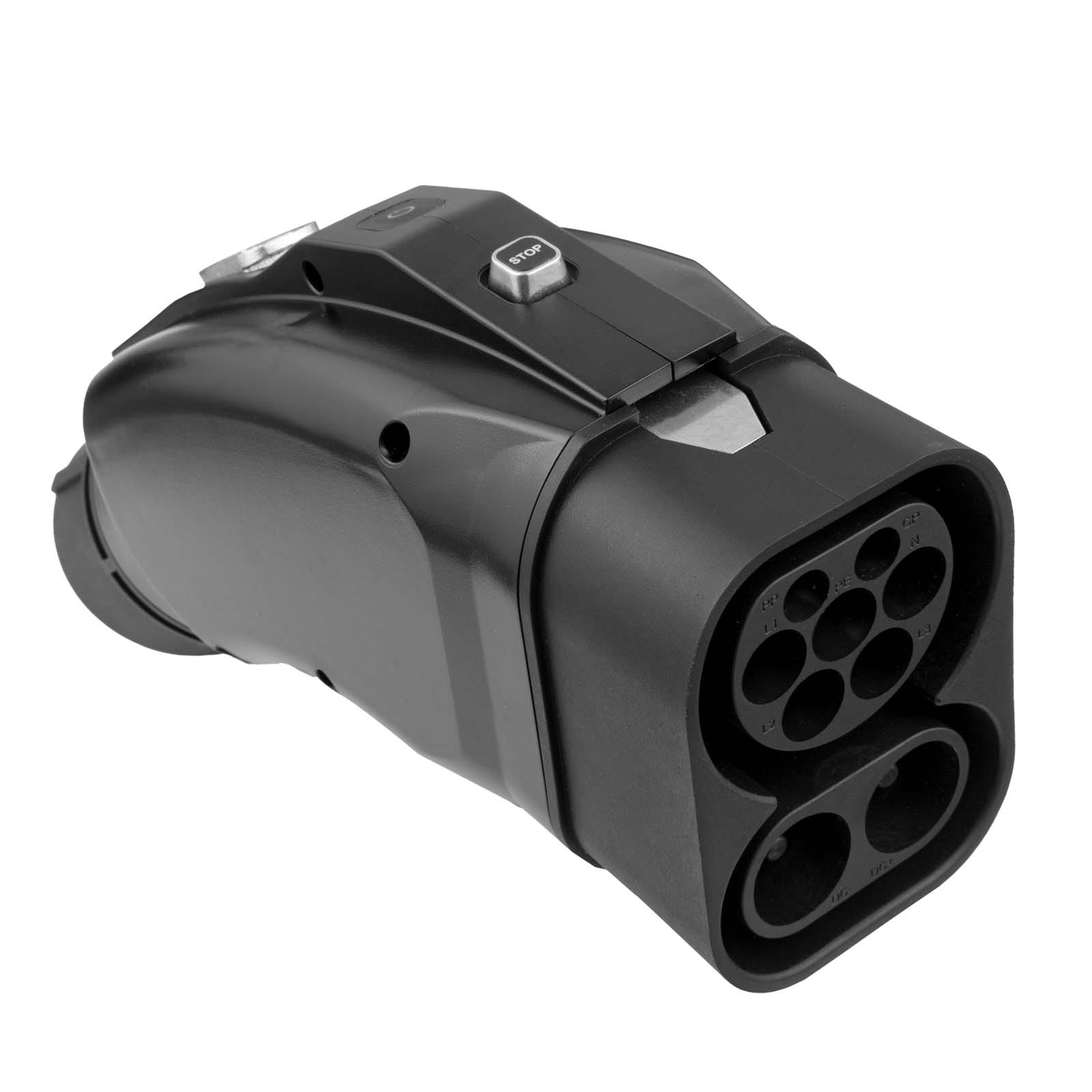
What is the CHAdeMO Connector?
CHAdeMO is a charging standard that provides high speed charging with direct current (DC). It was developed for fast charging of electric vehicles and supports up to 400 kW of power, which allows for rapid replenishment of energy in the battery. This standard was developed to meet the needs of drivers who need to quickly charge their vehicle on long routes, such as when travelling.
One of the main features of CHAdeMO is the possibility of a two-way energy flow. This means that the vehicle can not only receive energy from the grid, but can also return energy back to the grid (so-called Vehicle-to-Grid or V2G). This technology contributes to a more efficient use of renewable energy sources and the stability of energy networks.
How CHAdeMO works
CHAdeMO uses direct current to charge the battery of an electric vehicle. This significantly reduces the charging time, as the AC-to-DC conversion process takes place directly at the charging station, rather than in the car itself, as is the case with home chargers.
The car is connected to the station via the CHAdeMO connector and charging starts automatically, while the charging process is monitored via communication lines to ensure safety.
CHAdeMO technical specifications
CHAdeMO is a fast-charging standard for electric vehicles that provides fast and efficient battery energy replenishment. Developed in Japan, it has gained popularity for its ability to deliver high charging speeds and support two-way energy exchange. Here are the detailed specifications of CHAdeMO:
- Charging voltage: CHAdeMO supports voltages of up to 500 V direct current (DC) in the standard version. However, as technology advances, newer versions of the standard allow charging up to 1000 V DC, which enables even faster charging.
- Maximum current: Depending on the version of the standard, CHAdeMO supports a current of up to 125 A in the standard version. Upgraded versions allow the current to be increased to 400 A, which contributes to a faster recharge of the battery.
- Charging power: The initial versions of CHAdeMO provided a power output of up to 62.5 kW (500 V, 125 A). However, with the evolution of the standard, CHAdeMO 2.0 supports up to 400 kW (1000 V, 400 A), which significantly reduces charging times.
- Two-way energy exchange (V2G): CHAdeMO supports Vehicle-to-Grid (V2G) technology, which allows electric vehicles not only to receive energy from the grid but also to give it back. This contributes to the stability of the power grid and the efficient use of renewable energy sources.
- Types of charging stations: CHAdeMO offers different power levels of charging stations:
- Up to 20 kW: Voltage up to 500 V DC, current up to 50 A.
- Up to 50 kW: Voltage up to 500 V DC, current up to 125 A (the most common configuration).
- Up to 100 kW: Voltage up to 500 V DC, current up to 200/250 A.
- Up to 150 kW: Voltage up to 500 V DC, current up to 350 A.
- Up to 400 kW: Voltage up to 1000 V DC, current up to 400 A (CHAdeMO 2.0).
- Up to 500 kW: Voltage up to 1500 V DC, current up to 600 A (CHAdeMO 3.0).
- Communication between the car and the charging station: CHAdeMO uses the CAN (Controller Area Network) protocol to exchange data between the vehicle battery management and the charging station computer. This ensures a safe and efficient charging process by adapting the charging parameters to the battery's condition.
- Security: CHAdeMO incorporates several safety layers such as electrical isolation, voltage detection and overcurrent protection. These mechanisms ensure safe operation for both users and equipment.
- Physical design of the connector: The CHAdeMO connector consists of several pins, including the main power transfer pins and additional pins for communication and grounding. This ensures a reliable connection and efficient power transfer during charging.
Detailed pinout diagram
The CHAdeMO connector is an essential element of the fast charging system for electric vehicles, ensuring efficient and safe energy transfer. It consists of several contacts, each with its own function to support the safety and efficiency of the charging process.
Key contacts include:
- DC+ and DC-: Positive and negative contacts for transferring direct current to the battery.
- CC+ and CC-: Contacts for communication between the charging station and the vehicle, enabling data exchange.
- PE (Protective Earth): Grounding contact to ensure safety against electrical shock.
- PP (Proximity Pilot): Detects whether a connector is plugged into a socket and prevents power from being supplied if it is not.
- CP (Control Pilot): Controls the charging process by transmitting signals about the charging status.
The pins have different lengths for proper connection. The longest pin (PE) is connected first to provide grounding, followed by the middle pins for communication, and finally the power transmission pins. This sequence ensures safe and efficient charging, guaranteeing stable system operation.
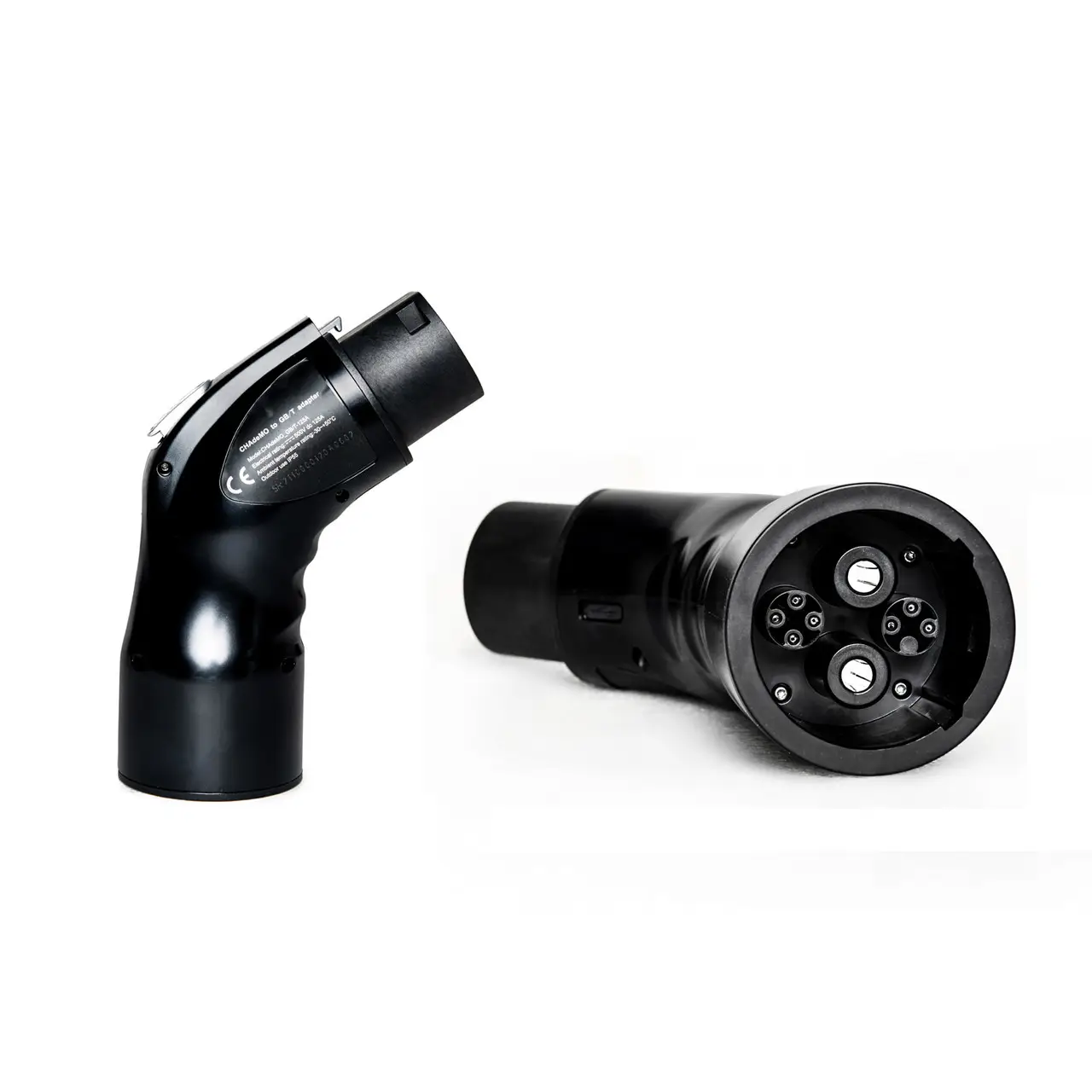
Compatibility and adapters
CHAdeMO is a DC fast charging standard for electric vehicles developed by Japanese companies including Nissan, Mitsubishi and TEPCO. However, with the emergence of other standards such as the Combined Charging System (CCS), compatibility between different connector types has become an important issue for electric vehicle owners.
CHAdeMO adapters
To improve compatibility between different charging standards, CHAdeMO adapters have been developed. For example, Tesla offers a CHAdeMO adapter for its cars that allows the use of the CHAdeMO fast charging station network. This adapter provides up to 43 kW of charging power, which allows you to add approximately 108 km of range per half hour of charging. It is important to note that to use this adapter on a Model S without Supercharging, the appropriate hardware must be activated.
CCS2 to CHAdeMO adapters
Adapters are also available to allow vehicles with a CCS2 connector to charge at CHAdeMO stations. For example, the 600 V 200 A adapter provides a transition from CCS2 to CHAdeMO, allowing CCS2 vehicles to be charged at CHAdeMO charging stations. This adapter supports a nominal voltage of 600 V and a current of up to 200 A, delivering up to 50 kW of power.
Recommendations for using adapters:
- Compatibility: Before using the adapter, make sure it is compatible with your specific vehicle model and charging station.
- Software updates: Some adapters may require a software update to your vehicle or charging station to work correctly.
- Charging power: Please note the maximum charging power supported by the adapter, as it may differ from the standard values.
- Cost and availability: Adapters can be expensive and their availability may vary by region.
The use of CHAdeMO adapters can significantly expand charging options for electric vehicle owners by providing access to a wider network of charging stations. However, it is important to carefully check the compatibility and specifications of the adapter before using it.

ECOFACTOR: Innovative solutions for environmentally friendly and efficient charging of electric vehicles
About the company ECOFACTOR we focus on developing advanced technologies for charging electric vehicles, combining high efficiency with a reduced environmental impact. Our goal is to reduce energy consumption, speed up the charging process and extend battery life. We offer charging stationsThe company's products meet the most advanced safety and efficiency standards, providing comfort and reliability for our users.
In addition to the main charging stations, we also provide cables and adaptersWe offer European-standard charging points that ensure reliable connectivity in all conditions. Tesla Model 3 owners can take advantage of our intelligent solutions to monitor and optimise energy consumption, enabling fast and stable charging.
We are constantly improving our technology by integrating the latest developments to ensure an even more cost-effective and convenient charging experience. Here's how our innovative solutions help:
- Reduce energy costs ECOFACTOR technologies significantly reduce energy consumption, which helps to reduce the cost of charging electric vehicles.
- Improve charging efficiency: We use special algorithms to minimise energy losses, which allows us to fully utilise the power provided for charging.
- Manage charging via a mobile app: Our systems allow drivers to control the entire charging process through mobile application, available for iOS і Android. This makes it possible to monitor the charge level, choose the best time to charge, and get full analytics of energy consumption.
- Contribute to the preservation of the environment: ECOFACTOR charging stations contribute to reducing CO₂ emissions and help to integrate clean energy into our infrastructure.
Choosing solutions from ECOFACTOR - is an investment not only in convenience but also in sustainable development. Our technologies help to save energy and provide maximum comfort for users.
We are actively expanding our network of charging stations, providing access to maps of charging stationsto help drivers find the nearest fast and safe charging points across the country.
Comparison with other connectors
CHAdeMO is a direct current (DC) fast charging standard that has gained popularity among Japanese manufacturers such as Nissan and Mitsubishi. It delivers high charging power, which reduces battery charging time. This connector only works with DC current and its main advantage is fast charging.
Compared to CHAdeMO, CCS (Combined Charging System) has several important differences. First and foremost, CCS supports both alternating current (AC) and direct current (DC) charging through a single connector, making it more versatile. CCS is popular in Europe and North America, and many modern electric vehicles use this standard for charging. The higher charging power of CCS allows for faster energy replenishment, reaching up to 350 kW in newer versions.
Type 1 and Type 2 are the standards for AC charging. Type 1 is used in North America and Japan, and Type 2 is used in Europe. These connectors are typically used for home or slow charging stations where the charging power does not exceed 7-22 kW. They are not suitable for fast charging, which makes them less convenient for long journeys compared to CHAdeMO and CCS.
Tesla Supercharger is another popular standard used for fast charging of Tesla vehicles. However, the Tesla connector is exclusive and only compatible with Tesla vehicles, although adapters allow Tesla charging stations to be used with other car models. The charging power of Supercharger stations can reach 250 kW, which allows you to charge your car faster than most standard charging stations.
GB/T, which is used in China, is another competitor to CHAdeMO. This standard supports both AC and DC and allows for high charging speeds comparable to CCS. In China, this standard is the mainstream standard and is actively used by local electric vehicle manufacturers.
As a result, CHAdeMO is a good option for fast charging of electric vehicles, particularly in Japan, but it is gradually being replaced by other standards such as CCS, which support more versatile charging capabilities, including both AC and DC through a single connector.
Regional use
Since its inception, the CHAdeMO connector has gained popularity mainly in Japan, where it was developed by the Japanese companies Nissan, Mitsubishi and TEPCO. It is the main standard for charging electric vehicles in Japan and is widely used at charging stations across the country.
In other regions, such as Europe and the United States, CHAdeMO also initially enjoyed some popularity, but its market share has declined over time. This is due to the fact that other charging standards have started to dominate in these regions, such as CCS (Combined Charging System), which supports both AC and DC charging through a single connector. In Europe, CCS2 has become the mainstream standard, and most new electric vehicles use this connector.
CHAdeMO is also used in the US, although the main charging standard there is CCS1. Nevertheless, CHAdeMO can still be found at some charging stations, especially in places where there is a demand for charging Japanese electric cars, such as the Nissan Leaf, which is one of the most popular electric cars with this connector.
In China, although other standards such as GB/T are used, CHAdeMO is also available at some stations, mainly for Japanese vehicles exported to China. However, with the development of local standards, CHAdeMO's popularity in China is declining.
Overall, CHAdeMO continues to be an important standard for charging in Japan and certain other regions, although with the development of more universal standards such as CCS, its use in other countries is gradually declining.
Conclusion.
CHAdeMO is an important standard for fast charging of electric vehicles, especially for models from Japanese manufacturers. However, with the development of other standards, such as CCS2, this standard may be less common in the future. Despite this, CHAdeMO still plays an important role in the development of electric mobility in certain regions.
Frequently asked questions (FAQ)
1. How long does it take to charge an electric car via CHAdeMO?
Charging via CHAdeMO typically takes 30 to 60 minutes to top up the 20% to 80% battery, depending on the charging station capacity and vehicle type.
2. Where can I find CHAdeMO charging stations?
CHAdeMO charging stations can be found in Japan, as well as in other countries where there is a high demand for Japanese electric cars. There are also stations in Europe and the US that support this standard, but their number is gradually decreasing due to the transition to CCS.
3. Can CHAdeMO be used with vehicles that support other standards?
For compatibility with other standards such as CCS2, adapters can be used, but not all charging stations support this, so it is important to check compatibility before charging.
4. Do I need an adapter to use CHAdeMO with Tesla cars?
Yes, Tesla requires a special adapter to use CHAdeMO charging stations, as Tesla uses its own fast charging connector standard.
5. What is the charging capacity of CHAdeMO?
CHAdeMO supports charging capacities ranging from 50 kW to 400 kW, depending on the station and version of the standard, which reduces vehicle charging times compared to more traditional methods.


