

Table of contents:
Quick Summary: Fleet management software features include GPS tracking, maintenance scheduling, fuel monitoring, compliance tools, and driver behavior analytics. Modern platforms combine these core capabilities with telematics, real-time reporting, and integrations to help organizations reduce costs, improve safety, and optimize operations across vehicle fleets of all sizes.
Managing a fleet without proper software is like flying blind. Whether overseeing ten delivery vans or thousands of commercial vehicles, fleet managers face daily pressures: fuel costs creeping up, maintenance schedules falling behind, compliance deadlines looming, and drivers taking inefficient routes.
Modern fleet management software solves these problems with features that transform vehicles from operational tools into strategic assets. But not all platforms are created equal.
The right feature set can deliver measurable results. Organizations implementing comprehensive fleet management systems report improvements in productivity and fuel efficiency, with industry data showing up to 55% improved productivity and 10% decreased fuel costs through optimized operations. With NAFA members responsible for specification, acquisition, maintenance, repair, fueling, risk management, and remarketing of more than 4.8 million vehicles that drive an estimated 84 billion miles each year, controlling assets and services well above $122 billion, choosing the right features matters.
Here’s what actually makes a difference in 2026.
We remind you that you can purchase home and commercial charging stations in our online store, as well as use public charging stations ECOFACTOR located throughout Ukraine. For convenient access to charging infrastructure, we recommend using our mobile app, available on iOS and Android.
GPS Tracking and Real-Time Location Visibility
GPS tracking forms the foundation of modern fleet management. Real-time location data provides visibility to answer a fundamental operational question: where are the vehicles right now?
But location alone isn’t enough anymore.
Near real-time visibility enables fleet managers to recover lost or stolen assets quickly, identify excessive idling, boost productivity, and maximize the profitability of previous investments. Route optimization tools layered on top of GPS data help minimize miles driven, improve security, and enhance asset value.
The practical benefits show up immediately. Dispatchers can identify the closest vehicle to a new service call. Customer service teams can provide accurate ETAs instead of vague estimates. Managers can verify that vehicles are where they should be, when they should be there.
Advanced platforms integrate historical location data with current tracking, revealing patterns. Which routes consistently run late? Where do drivers frequently deviate from planned paths? Which service areas generate the most mileage?
Effective platforms deliver location updates at least every 30-60 seconds to maintain near real-time visibility. That granularity matters when you’re trying to optimize tight delivery windows or respond to emergencies.
Maintenance Management and Preventive Scheduling
Unplanned downtime kills productivity and profitability. A vehicle sitting in the shop for emergency repairs isn’t generating revenue or completing routes.
Maintenance management features shift the focus from reactive repairs to preventive care. As defined in Federal Highway Administration guidance, responsive maintenance is the repair or replacement of failed equipment and its restoration to safe normal operation, while preventive maintenance is the activity performed at regularly scheduled intervals for the upkeep of equipment. Modern software automates the preventive side.
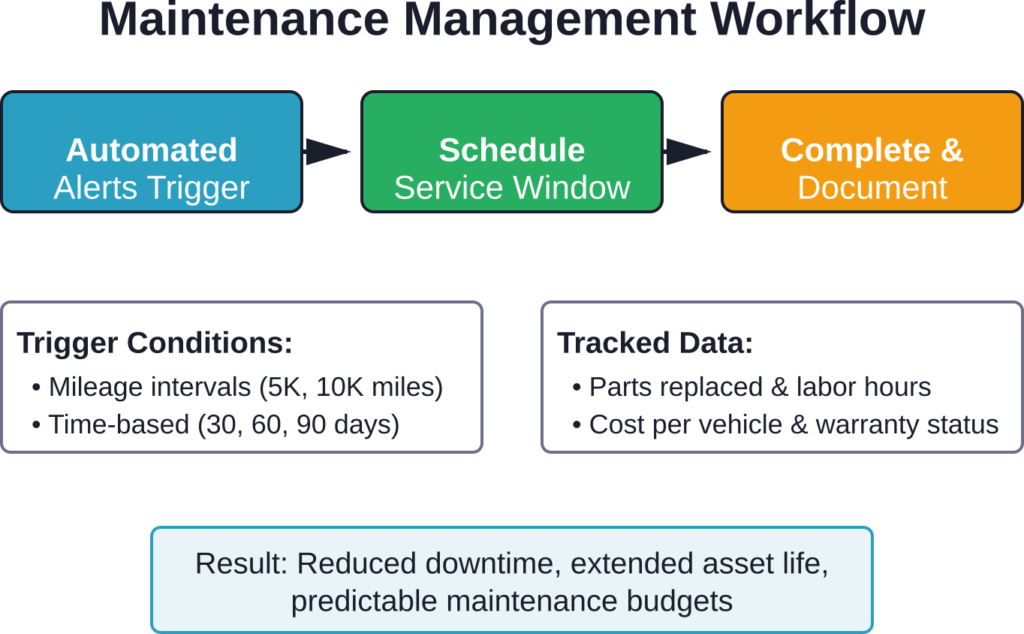
The software tracks mileage, engine hours, and calendar intervals for each vehicle. When a service threshold approaches—say, 5,000 miles until the next oil change—the system generates alerts. Maintenance coordinators can schedule service windows during low-demand periods instead of scrambling when something breaks.
Documentation features create audit trails. Which parts were replaced? What was the labor cost? Is the vehicle still under warranty? These records help identify problem vehicles that consume disproportionate maintenance budgets and inform replacement decisions.
Some platforms integrate directly with service providers, automatically transmitting vehicle data and service histories. That eliminates the clipboard-and-spreadsheet routine that wastes time and introduces errors.
Fuel Monitoring and Cost Control
Fuel represents one of the largest variable costs in fleet operations. Small inefficiencies compound across hundreds of vehicles and thousands of miles.
Fuel monitoring features track consumption patterns at multiple levels. How much fuel does each vehicle burn per mile? Which drivers consistently achieve better fuel economy? Where are fueling transactions occurring, and do the amounts make sense?
Integrations with fuel card systems flag anomalies. A transaction for 40 gallons in a vehicle with a 25-gallon tank? That’s worth investigating. Fueling patterns that don’t match route schedules? Could indicate unauthorized use.
The data reveals optimization opportunities. Vehicles with declining fuel efficiency might need maintenance. Routes with excessive idling time can be restructured. Drivers with poor fuel economy can receive targeted coaching.
Industry data from the 2024 Fleet Technology Report shows decreased fuel costs of 10% through optimized operations. For a fleet burning 100,000 gallons annually, a 10% fuel efficiency improvement generates substantial cost savings from better visibility and management.
Driver Behavior and Safety Analytics
The safest fleets aren’t accidents—they’re built through systematic monitoring and coaching.
Driver behavior features track hard braking, rapid acceleration, excessive speeding, harsh cornering, and distracted driving indicators. Modern telematics systems capture these events automatically, creating objective performance records.
But data without context just creates noise. The best platforms translate raw events into actionable insights. Which drivers consistently exhibit risky behaviors? Are certain routes or times of day associated with more incidents? How do individual drivers compare to fleet averages?
Video telematics adds another layer. Dash cameras with AI analysis can detect cell phone use, following too closely, lane departures, and forward collision warnings. When an incident occurs, the footage provides definitive evidence for insurance claims and driver coaching.
Safety programs built on this data work. Targeted coaching based on specific behaviors—”John, you had 12 hard braking events on Tuesday’s route”—is more effective than generic safety talks.
The Federal Highway Administration notes that maintenance goals like keeping 95% of cameras available matter less than understanding why cameras are needed in the first place. The same logic applies to driver monitoring: the goal isn’t surveillance, it’s preventing accidents and reducing liability.
Compliance Automation and Regulatory Reporting
Regulatory compliance consumes significant administrative time. Hours of Service (HOS) rules, International Fuel Tax Agreement (IFTA) reporting, Driver Vehicle Inspection Reports (DVIR), emissions standards—the list goes on.
Compliance features automate data collection and report generation. Electronic logging devices (ELDs) track driving hours automatically, eliminating paper logbooks and ensuring HOS compliance. The system prevents violations by alerting drivers when they’re approaching limits.
IFTA reporting becomes straightforward when the software automatically tracks miles driven in each jurisdiction and correlates them with fuel purchases. Instead of quarterly nightmares reconstructing mileage logs, the report generates with a few clicks.
DVIR features let drivers complete pre-trip and post-trip inspections on mobile devices. Defects are immediately flagged, and vehicles can be automatically sidelined until repairs are verified complete. The digital trail proves compliance during audits.
Some jurisdictions require specific emissions reporting or idle-time documentation. Software that captures this data automatically eliminates manual tracking and reduces audit risk.
Integration Capabilities and Scalability
Fleet management doesn’t exist in isolation. The software needs to exchange data with accounting systems, fuel card providers, maintenance vendors, dispatch platforms, and customer relationship management tools.
Open integration architecture matters. Platforms with robust APIs and pre-built connectors reduce implementation friction. Data flows automatically instead of requiring manual exports and imports.
Scalability becomes critical as operations grow. A platform that works well for 50 vehicles should handle 500 without requiring a complete reimplementation. Look for cloud-based systems that add capacity transparently.
The NAFA organization emphasizes that fleet managers must understand IT concepts to collaborate effectively with technical teams and optimize system functionality. That doesn’t mean becoming a developer, but it does mean asking the right questions about data standards, API availability, and integration roadmaps during software evaluation.
Reporting and Analytics Dashboards
Data only creates value when it informs decisions. Reporting features transform raw telemetry into business intelligence.
Effective dashboards provide at-a-glance status. How many vehicles are currently active? Which ones are due for service? What’s today’s fuel consumption versus the weekly average? What safety events occurred in the past 24 hours?
Customizable reports let managers focus on metrics that matter to their specific operations. A delivery fleet might prioritize on-time performance and stops per hour. A construction operation might focus on equipment utilization rates and idle time.
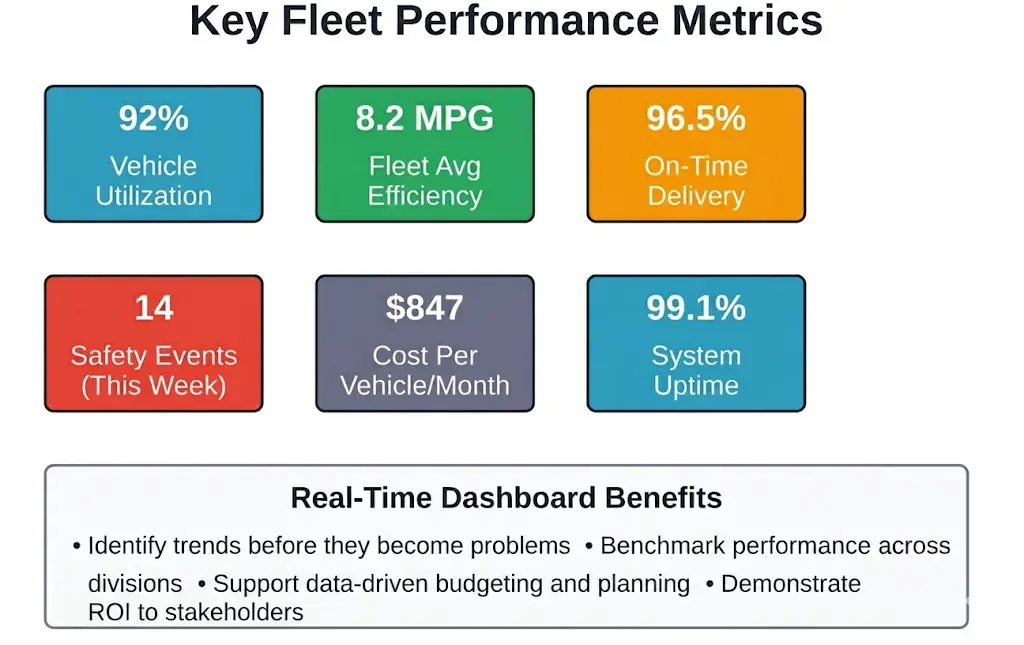
Historical trending reveals whether interventions work. Did that driver coaching program reduce harsh braking incidents? Did the new routing software actually decrease fuel consumption? The numbers tell the story.
Advanced analytics predict future needs. Machine learning models can forecast when a vehicle will likely need major repairs based on usage patterns and maintenance history. That turns reactive management into proactive planning.
The Federal Highway Administration emphasizes that system availability targets like 99.9% database uptime matter for reliability, but the features must serve operational goals rather than existing as technical achievements for their own sake.
Mobile Accessibility for Drivers and Managers
Fleet operations don’t happen at desks. Drivers, technicians, and field managers need access to information wherever work occurs.
Mobile apps extend the system to smartphones and tablets. Drivers can complete vehicle inspections, submit service requests, view assigned routes, and communicate with dispatchers—all from the device in their pocket.
Managers can monitor operations from anywhere. Check vehicle locations while traveling. Approve maintenance requests from the field. Review safety alerts during off-hours.
The best mobile implementations work offline. A driver in a rural area with spotty cell coverage shouldn’t lose functionality. The app caches necessary data and syncs when connectivity returns.
User interface design matters here. An app that requires ten taps to complete a routine task won’t get used consistently. The workflow should match how drivers actually work, not force them to adapt to clunky software.
Turn to ECOFACTOR for Smooth EV Fleet Work
Fleet management software features usually focus on control, visibility, and smoother daily vehicle use. For EV fleets, charging access and station information also matter, and ECOFACTOR supports this area with station management tools, charging stations, and an app for iOS and Android.
Drivers can use the charging station map to find available charging points and check station details. ECOFACTOR also has an online store with chargers, cables and adapters for businesses that need equipment for fleet parking, offices, service locations, or commercial charging points.
ECOFACTOR can help add EV charging support through:
- Station management tools for access and charging activity
- Mobile access to charging station information
- Charging equipment for business locations
- Hardware and accessories for daily EV use
Contact ECOFACTOR to add practical EV charging support to the software and tools your fleet already uses.
Implementation and Adoption Considerations
Features only deliver value when people use them. Implementation strategy matters as much as feature selection.
Successful rollouts typically follow a phased approach. Weeks one and two focus on setup: importing vehicles and users, connecting GPS and fuel systems, defining reporting structure. Weeks three through six emphasize training and pilots with 10-20% of the fleet before full deployment.
Change management can’t be an afterthought. Drivers who think they’re being spied on will resist. Frame the technology around safety improvements and operational support rather than surveillance. Show how it makes their jobs easier—better route planning, less paperwork, faster service approvals.
Technical support during the transition matters. Someone will have questions. Devices will malfunction. Integrations will hiccup. Responsive vendor support prevents small issues from derailing adoption.
Cost Structures and ROI
Fleet management software costs vary by provider and features, with subscription models ranging from $20-100 per vehicle per month depending on feature set and vendor. Enterprise deployments often negotiate custom pricing.
Here’s the thing though—focus on total cost of ownership, not just subscription fees. Implementation costs, training time, hardware requirements (tablets, dash cameras, OBD-II devices), and integration work add up.
But ROI can be substantial. Fuel savings alone often justify the investment. Add reduced insurance premiums from improved safety, lower maintenance costs from preventive scheduling, and productivity gains from route optimization, and the business case strengthens.
Calculate expected returns before committing. If the features enable saving 10% on fuel, reducing accidents by 15%, and extending vehicle life by 20%, what’s that worth in actual dollars? Compare that to implementation and ongoing costs.
| Cost Category | Typical Range | Notes |
|---|---|---|
| Software subscription | $20-100/vehicle/month | Varies by feature set and vendor |
| Hardware (GPS, cameras) | $100-500/vehicle | One-time installation cost |
| Implementation services | $5,000-50,000 | Depends on fleet size and complexity |
| Training | $2,000-10,000 | Initial and ongoing programs |
| Integration development | $3,000-25,000 | For custom system connections |
Evaluating Vendors and Platforms
Not every platform fits every operation. Municipal fleets have different needs than long-haul trucking operations. Delivery services optimize for different metrics than construction equipment pools.
Start with requirements. Which features are must-haves versus nice-to-haves? What integrations are non-negotiable? What’s the technical skill level of the team that will administer the system?
Trial periods reveal what marketing materials don’t. How intuitive is the interface? How responsive is support? Do reports actually answer your questions or just dump data?
Reference checks matter. Talk to organizations with similar fleet profiles. What worked? What didn’t? What surprised them during implementation?
Vendor stability deserves consideration. A platform that gets acquired or goes out of business creates disruption. Look for established providers with solid customer bases and financial backing.
Frequently Asked Questions
What are the most important features in fleet management software?
GPS tracking, maintenance scheduling, fuel monitoring, driver safety analytics, and compliance automation form the core feature set. Real-time visibility into vehicle locations and condition enables operational efficiency, while preventive maintenance and driver coaching reduce costs and liability. Organizations should prioritize features that address their specific pain points rather than chasing comprehensive feature lists.
How much does fleet management software typically cost?
Subscription costs typically range from $20-100 per vehicle per month, depending on features and vendor. Total implementation costs include hardware (GPS devices, cameras), integration services, training, and ongoing support. Smaller fleets might deploy for under $10,000, while enterprise implementations can exceed $100,000. ROI from fuel savings, reduced accidents, and lower maintenance often justifies the investment within 12-18 months.
Can fleet management software integrate with existing business systems?
Modern platforms offer API access and pre-built integrations with common accounting, fuel card, maintenance, and dispatch systems. Integration capabilities vary significantly by vendor—some provide extensive connector libraries while others require custom development. Evaluate integration options during vendor selection, especially for mission-critical data flows. Cloud-based systems generally offer more flexible integration options than legacy on-premise solutions.
How long does implementation typically take?
Basic implementations for small fleets (under 50 vehicles) can complete in 4-6 weeks, including setup, training, and pilot testing. Larger deployments spanning hundreds or thousands of vehicles typically require 3-6 months for full rollout. Phased approaches reduce risk—start with a pilot group, validate the system works as expected, then expand fleet-wide. Complexity increases with custom integrations, legacy system migrations, and multi-location deployments.
What maintenance features should fleet managers prioritize?
Automated service reminders based on mileage and time intervals prevent missed maintenance. Work order tracking creates audit trails for parts, labor, and costs. Vendor management capabilities centralize service provider information and performance. Diagnostic trouble code (DTC) integration flags mechanical issues before they cause breakdowns. Historical records inform replacement decisions by identifying problem vehicles that consume excessive maintenance budgets.
How do driver safety features reduce insurance costs?
Dash cameras and telematics data provide objective evidence for accident claims, often reducing liability. Driver behavior monitoring identifies risky patterns (speeding, harsh braking, rapid acceleration) that predict accidents. Targeted coaching programs based on specific behaviors measurably improve safety performance. Many insurance carriers offer premium discounts for fleets using video telematics and active safety programs—reductions of 5-15% are common.
What compliance requirements can fleet software automate?
Electronic logging devices (ELDs) automatically track hours of service for commercial drivers, ensuring regulatory compliance and reducing paperwork. IFTA reporting generates mileage and fuel tax calculations by jurisdiction. Digital vehicle inspection reports (DVIR) create compliant pre-trip and post-trip documentation. Emissions tracking supports environmental compliance reporting. License and certification management prevents operators from driving without current credentials.
Moving Fleet Management Forward
Fleet management software has evolved far beyond simple GPS tracking. Modern platforms combine location visibility with predictive maintenance, driver safety programs, compliance automation, and operational analytics.
The features that matter most depend on operational priorities. A delivery operation optimizes for route efficiency and customer communication. A construction fleet focuses on equipment utilization and maintenance cost control. A municipal service prioritizes regulatory compliance and public safety.
But certain capabilities benefit every operation: real-time visibility into asset locations, systematic preventive maintenance, fuel consumption monitoring, and data-driven performance management.
Technology continues advancing. Artificial intelligence increasingly powers predictive analytics. Electric vehicle support becomes table stakes. Sustainability reporting gains prominence as organizations track carbon footprints.
The organizations seeing the best results don’t just buy software—they commit to process improvement. They use the data to identify inefficiencies, coach drivers, optimize routes, and make evidence-based decisions. The software provides the information; management provides the action.
Start by identifying the biggest operational pain points. Is fuel consumption out of control? Are unplanned maintenance emergencies disrupting service? Do safety incidents create liability exposure? Match feature priorities to those problems.
Then find a platform that delivers those capabilities with solid vendor support, reasonable total cost of ownership, and proven results in similar operations. The right features, properly implemented and actively used, transform fleet operations from cost centers into competitive advantages.