

Table of contents:
Short Summary: Regenerative braking is a technology that converts kinetic energy during deceleration into electrical energy and returns it to the electric vehicle’s battery. According to IEEE data, traditional braking systems can account for up to 50% of energy losses in the propulsion system, while modern regenerative systems are capable of capturing 60–80% of kinetic energy under ideal conditions. In real-world conditions, the technology adds 10–30% to the driving range, and in urban conditions with frequent stops, it can increase efficiency by up to 30%.
Every time a conventional car brakes, it converts the energy of motion into heat — and simply loses it. Electric vehicles would do the same if not for regenerative braking technology.
Regenerative braking allows part of this energy to be returned to the battery. Sounds like free electricity, right?
Let’s see how it actually works, how much energy can be recovered, and when this technology brings the greatest benefit.
We remind you that you can purchase home and commercial charging stations in our online store, as well as use public charging stations ECOFACTOR located throughout Ukraine. For convenient access to charging infrastructure, we recommend using our mobile app, available on iOS and Android.
What Is Regenerative Braking
Regenerative braking is a type of electric braking in which the traction motor switches to generator mode. Instead of spending battery energy to rotate the wheels, the motor uses the inertia of motion to generate electricity.
When the driver releases the accelerator pedal or presses the brake pedal, the controller switches the motor to generation mode. The wheels, through the transmission, spin the motor rotor, which generates current and sends it back to the high-voltage battery.
At the same time, this action creates resistance that slows down the vehicle — without mechanical friction of the pads.
How the System Works in Practice
The process looks like this:
- The vehicle is moving at a certain speed — the motor consumes energy
- The driver releases the gas pedal — the control unit switches the motor to generator mode
- The rotation of the wheels spins the motor, generating electric current
- The controller directs this current to the battery through the inverter
- The vehicle slows down smoothly, without the involvement of friction brakes
According to IEEE data, traditional braking systems can account for up to 50% of energy losses in the vehicle’s propulsion system. Regeneration partially solves this problem.
How Much Energy Can Be Recovered
Ideal efficiency is one thing, reality is another.
In the process of regenerative braking, modern systems are capable of capturing 60–80% of kinetic energy under ideal conditions. The remaining 20–40% is lost during energy capture, current conversion, and battery internal resistance.
According to information from reputable sources, these figures are supported across a wide range under ideal conditions. But these are laboratory numbers.
In the real world, the typical increase in driving range from regeneration is 10–30%. The greatest benefit is in urban conditions with frequent stops, where efficiency can increase up to 30%.
| Driving Conditions | Regeneration Efficiency | Range Increase |
|---|---|---|
| Urban cycle (frequent stops) | High | 20–30% |
| Suburban highway with flat terrain | Low | 3–5% |
| Mountainous terrain (downhills) | Very High | 25–35% |
| High-speed motorway | Minimal | 2–4% |
When Regeneration Is Most Effective
Not all driving conditions provide the same return from regeneration.
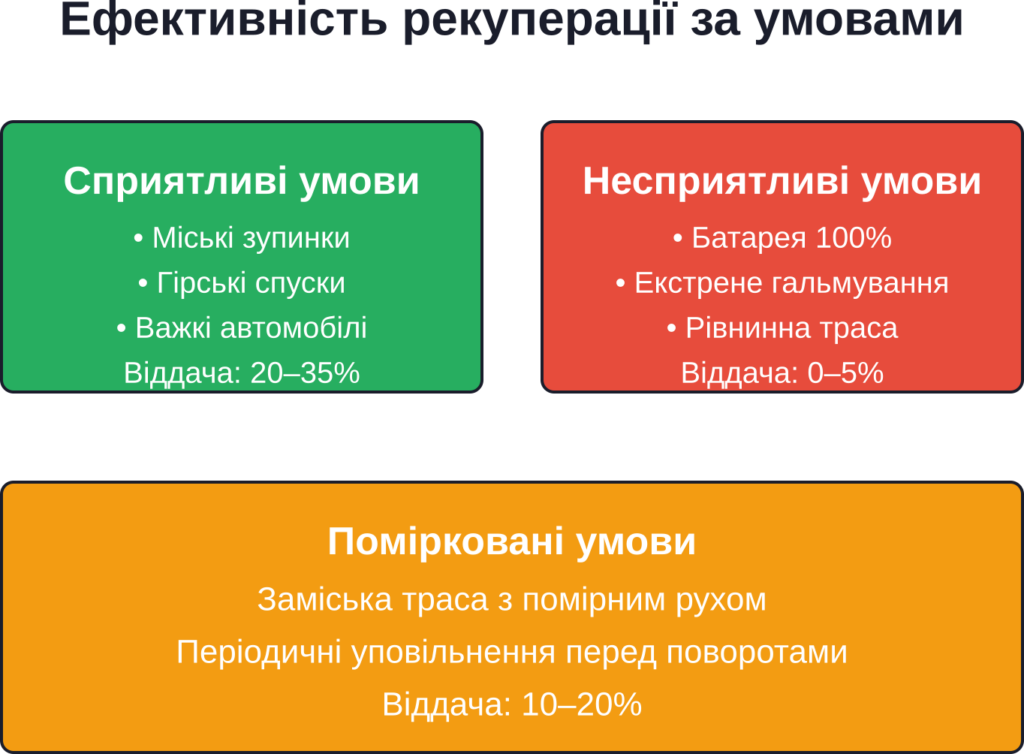
The technology brings the maximum benefit in the following scenarios:
- Urban start-stop mode: numerous traffic lights, intersections, and traffic jams create ideal conditions for constant energy capture
- Mountainous terrain with long descents: during downhill driving, all potential energy is converted into electricity instead of heat in the brake pads
- Suburban roads with moderate traffic: regular deceleration before turns and settlements provides stable regeneration
- Large and heavy vehicles: greater mass means more kinetic energy available for capture
According to IEEE data, energy-optimal deceleration systems demonstrate 33% better regenerative braking efficiency compared to human control.
When Regeneration Does Not Work or Is Ineffective
There are situations when it is impossible or impractical to recover energy:
- Battery charged to 100%: the system blocks regeneration to prevent overcharging and battery damage
- Emergency braking: friction brakes engage instantly because the generator cannot create sufficient force in a short time
- Very low battery temperature: a cold battery accepts charge poorly, so the controller limits regeneration
- Very slow movement or stopping: regenerative braking becomes ineffective at speeds below 3–5 km/h (depending on motor type and controller settings)
- Flat road without stops: if braking is not required, there will be no regeneration
Important point: regenerative braking alone cannot provide an emergency stop. That is why every electric vehicle retains a full mechanical braking system as the primary safety measure.
Why This Matters for Electric Vehicle Owners
Regeneration does three useful things at once.
First, it increases real-world range without adding battery capacity. An extra 10–30% range means fewer stops at charging stations.
Second, it reduces wear on mechanical brakes. Friction pads and discs work less often, which means savings on maintenance. Some EV owners don’t change brake pads for 100–150 thousand kilometers.
Third, it changes driving style to a more predictable one. Smooth deceleration through regeneration becomes a habit — it is safer and more comfortable for passengers.
The only question is whether the driver understands how to use the technology as efficiently as possible.

Control EV Charging the Same Way You Control Energy Consumption
Regeneration returns part of the energy while driving, but this is not enough if charging is chaotic. This is where real efficiency is formed — when there is control over where, when, and how the battery is replenished.
ECOFACTOR allows you not to keep this “in your head”, but to turn it into a system. For trips, the map of charging stations is used to understand available points in advance. In daily use, the mobile app for Android and iOS helps, through which charging is started and the process is monitored. If you need to set up your own connection, through the charging station configurator you can select an AC station for home use or a DC station for intensive scenarios. Separately, in the online store, basic items are collected — accessories, cables, and mobile chargers.
When charging becomes part of a larger system, other tools are added. This is the platform for operators to work with the network and users, as well as white-label solution if you need to launch your own service. Additionally, energy-efficient solutions for home and business are available.
Contact ECOFACTOR and organize charging infrastructure that will work to your advantage.
Frequently Asked Questions
Can You Brake Completely Without Mechanical Brakes?
No. Regenerative braking does not provide sufficient force for an emergency stop. Every electric vehicle has a full hydraulic braking system that activates with a sharp press of the pedal or when regeneration is insufficient.
How Many Kilometers Does Regeneration Add in Practice?
On average 10–30% to the total range. For an electric vehicle with a passport range of 300 km, this can mean an additional 30–90 km depending on driving conditions. The greatest effect is in the city with frequent stops.
Why Doesn’t Regeneration Work When the Battery Is Full?
A battery charged to 100% physically cannot accept more energy without the risk of overcharging and damaging the cells. The control system blocks regeneration to protect the battery, so only friction brakes work at this moment.
Does Cold Affect the Operation of Regeneration?
Yes. At low temperatures, the battery accepts charge poorly due to increased internal resistance. The controller limits regeneration power to avoid damaging the cells, so efficiency decreases in winter.
Does Regeneration Differ Between Different EV Models?
Yes. Some models allow you to adjust the intensity of regeneration (weak, medium, maximum), others have a “one-pedal driving” mode, where releasing the gas pedal slows the car almost to a complete stop. Efficiency also depends on motor power and controller algorithms.
Does the Battery Wear Out Faster from Constant Regeneration?
No. Regeneration currents are significantly lower than fast-charging currents. Modern battery management systems monitor temperature and voltage, preventing harmful modes. Regeneration does not accelerate battery degradation.
Can Regeneration Be Turned Off?
In most electric vehicles, you can select the minimum level of regeneration, but it cannot be completely disabled. The system is integrated into the control logic, and even in “coasting” mode, a small amount of regeneration remains active.
Conclusion
Regenerative braking is not a marketing gimmick, but a real technology that returns up to 70% of kinetic energy back to the battery. According to IEEE data, traditional brakes can account for up to 50% of energy losses in the propulsion system — regeneration partially compensates for this.
In real-world conditions, the technology adds 10–30% to the driving range. The greatest effect is in the city with frequent stops, where savings reach 30%.
This is not just about trip distance. Regeneration reduces mechanical brake wear, makes driving smoother, and changes the approach to vehicle control.
Understand how the technology works — and you get the maximum from your electric vehicle.