

Table of contents:
Quick Summary: Electric vehicles with V2H, V2G, and V2L technologies can power your home during blackouts, turning into powerful backup energy sources. V2L allows you to connect individual appliances, V2H provides power for the entire house, and V2G supports the operation of the power grid. For safe use, special equipment and compliance with connection rules are required.
Prolonged blackouts in Ukraine have forced many to look for alternatives to noisy generators. And here an unexpected solution appears – your electric vehicle can become a powerful backup power source. Sounds like science fiction?
In reality, this is a completely real technology that already works in many electric car models. The battery of a modern electric vehicle contains 40-100 kWh of energy – enough to power an average house for several days.
But there are nuances. Not every electric vehicle supports energy return, and not every connection method is safe.
We remind you that you can purchase home and commercial charging stations in our online store, as well as use public charging stations ECOFACTOR located throughout Ukraine. For convenient access to charging infrastructure, we recommend using our mobile app, available on iOS and Android.
What Are V2L, V2H, and V2G: Three Levels of Capabilities
Bidirectional charging technologies allow an electric vehicle not only to consume but also to give back electrical energy. Depending on the scale of use, three main types are distinguished.
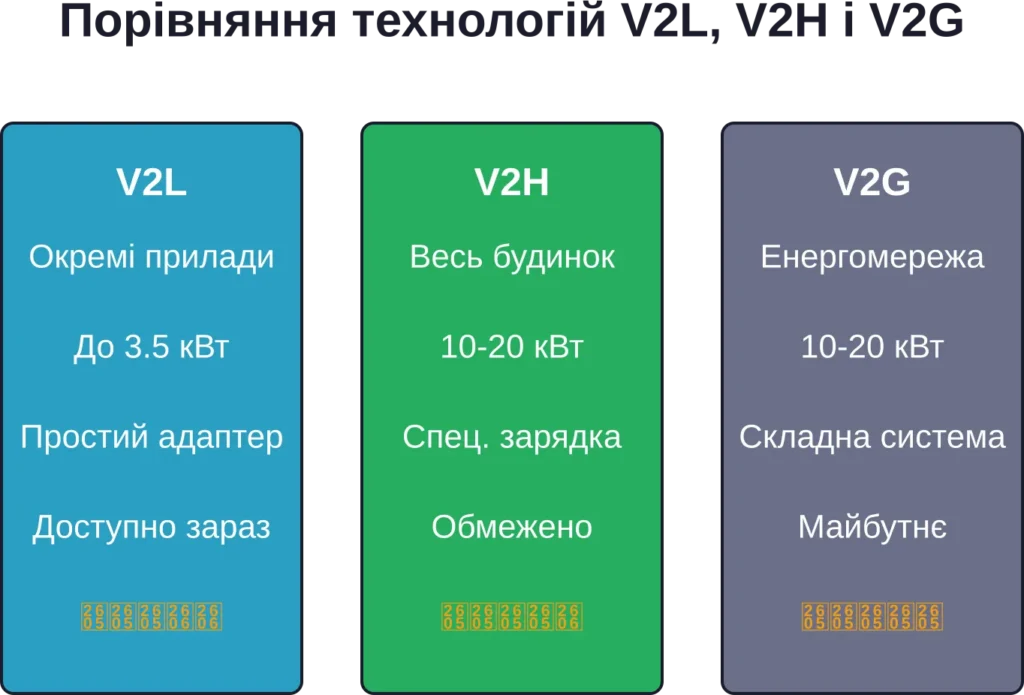
V2L (Vehicle-to-Load) – Powering Individual Appliances
The simplest option. V2L turns your electric car into a huge power bank on wheels.
Through a special connector or adapter, you can connect a laptop, refrigerator, electric stove, or other household appliances. Power is usually limited to 3-3.5 kW – enough for basic needs.
Most modern electric vehicles support V2L. This does not require complex equipment – just a special adapter, which often comes with the car.
V2H (Vehicle-to-Home) – Powering the Entire House
V2H is more serious. The electric vehicle connects to the home electrical network and can power the entire house.
Power can reach 10-20 kW, which is enough for all main systems: heating, lighting, household appliances. Modern V2H systems can provide house autonomy from 2 to 7 days depending on battery capacity and consumption.
But here special equipment is required: a bidirectional charging station and a switching system that isolates the house from the general grid while operating from the electric car.
V2G (Vehicle-to-Grid) – Supporting the Power Grid
The most complex level. V2G allows the electric vehicle not only to power the house but also to interact with the general power grid.
The car can supply energy to the grid during peak hours when demand is high and charge at night when electricity is cheaper. This is beneficial both for the owner (you can earn on tariff differences) and for the power system (helps balance the load).
The U.S. Department of Energy presented a strategy to support the implementation of V2G as part of the integration of electric transport into the power grid (as of January 2025). However, in Ukraine, this technology is still at the pilot project stage due to the lack of necessary infrastructure and regulatory framework.
How the Home Power System from an Electric Vehicle Works
Theoretically, everything is simple: energy from the electric car’s battery is converted by an inverter into 220V alternating current and supplied to the home network. But in practice, safe implementation requires compliance with a number of conditions.
The first and most important thing is an automatic transfer switch (ATS) is needed. It performs a critically important function: it disconnects the house from the general grid when the electric vehicle starts working.
Why You Cannot Connect “Plug-to-Plug”
Some try to save money and simply connect the electric vehicle to the home outlet with two plugs. This is deadly dangerous.
When power is restored, the reverse current can damage the car’s equipment, destroy the inverter, or cause a fire. Moreover, you will supply voltage to the external grid where electricians may be working who consider the line de-energized.
Cheap uncertified ATS may not provide reliable isolation and can also create danger.
Correct V2H Connection Scheme
A modern V2H system consists of several components:
- Bidirectional charging station (bidirectional charger): converts the battery’s DC current into 220V AC
- Automatic transfer switch: instantly disconnects the house from the external grid when switching to power from the car
- Control system: monitors battery charge level, distributes load, protects against full discharge
- Protective devices: prevent overload, short circuit, voltage surges
High-quality equipment costs from $2000 to $8000 depending on power and functionality. This is a significant investment, but it pays off with safety and reliability.
| Connection Method | Safety | Cost | Recommendation |
|---|---|---|---|
| “Plug-to-Plug” | Dangerous | $20-50 | Strictly not recommended |
| Cheap uncertified ATS | Risky | $200-500 | Not recommended |
| Certified V2H System | Safe | $2000-8000 | Optimal option |

Choose a Charging Solution for Home, Business or Network
When it comes to V2H, V2G, and V2L, it is important not only to understand the principle of operation but also to have a solution that can be actually used in everyday life or business.
ECOFACTOR offers comprehensive solutions for EV charging and energy independence. For drivers, there is a mobile app for Android and iOS, a map of charging stations, and an online store where you can select accessories, cables, and mobile chargers. For equipment selection, a charging station configurator is available – through it you can choose an AC or DC station for a specific location, power, and usage scenario.
For business, ECOFACTOR provides separate tools. This is an operator platform for managing the charging network and a white-label solution if you need to launch your own service under your own brand. Energy-efficient solutions for home and commercial facilities are also available – solar panels, hybrid inverters, battery storage, as well as cables and accessories for connection. Contact ECOFACTOR and get a solution that fits exactly your charging and energy infrastructure.
Which Electric Vehicles Support V2H and V2G
Not all electric cars can give energy back. Special electronics and software are required for this.
The number of models with bidirectional charging support is growing, but it is still limited. Here are the most popular options available in Ukraine.
Nissan Leaf – Pioneer of V2H Technology
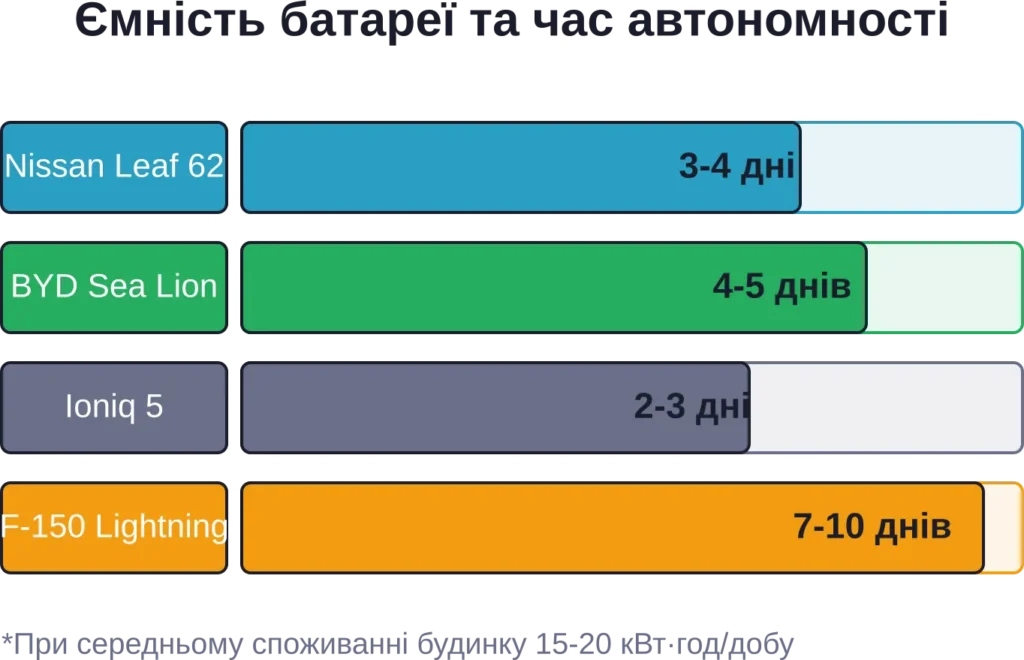
The Nissan Leaf was one of the first mass electric vehicles with V2H support. A 40 or 62 kWh battery can power an average house for 2-4 days.
The technology works through the CHAdeMO standard, which supports bidirectional energy transfer. In Japan, the Leaf is actively used as a backup power source during typhoons and earthquakes.
BYD: Sea Lion, Seal, Dolphin
The Chinese manufacturer BYD actively implements V2L and V2H in its models. BYD Sea Lion, Seal, and Dolphin support energy return with power up to 3.3 kW via V2L.
Some versions are also compatible with V2H systems, although special equipment is required for their implementation in Ukraine.
Hyundai Ioniq 5 and Kia EV6
Both models are built on the E-GMP platform and support V2L “out of the box”. Maximum output power is 3.6 kW.
This is enough to power a refrigerator, laptop, lighting, and charging devices. There is an adapter that connects to the charging port.
Ford F-150 Lightning
The American electric pickup with a huge battery (98-131 kWh) and full V2H support. It can power a house for up to 10 days in economy mode.
Ford supplies a special inverter and control system. True, the pickup itself is rare in Ukraine due to high cost and limited official distribution.
Tesla: Limited Capabilities
Although most models of the brand do not have the ability to power a house, Tesla officially implemented bidirectional charging support (V2H) for the Cybertruck through the Powershare system. The company also announced that soon most new Tesla models will receive bidirectional charging support.
How Much Energy Can Be Obtained from an Electric Vehicle
Battery capacity is one thing, and available usable energy is another. Modern electric cars are protected from full discharge, so they will give only 80-90% of capacity.
An average Ukrainian house consumes 15-25 kWh per day depending on the season and the presence of electric heating. An electric vehicle with a 60 kWh battery can theoretically power such a house for 2-4 days.
But an economical mode is important here. If you leave all usual consumers on – electric kettle, washing machine, boiler, air conditioner – the battery will empty in a matter of hours.
How to Extend Autonomy Time
Practical tips from users who already live with V2H systems:
- Keep at least 20% charge in the battery – this prolongs its life and gives a reserve for an emergency trip
- Turn off powerful consumers: boiler, electric heating, air conditioner
- Use LED lighting instead of regular bulbs
- Keep the refrigerator on but do not open it unnecessarily
- Charge gadgets and power banks in priority order
With a reasonable approach, an electric vehicle with a 60-80 kWh battery will provide a comfortable life for 4-7 days even without access to charging.
V2L as the Simplest Alternative to a Generator
If a full V2H system is not yet available or too expensive, V2L remains an excellent solution for basic needs.
Most modern electric vehicles support V2L through a special adapter. 3-3.5 kW power is enough for:
- Refrigerator (150-300 W)
- Laptop and router (100-150 W)
- LED lighting for several rooms (50-100 W)
- Charging phones and power banks (50-100 W)
- Electric kettle or multicooker (1500-2000 W, but alternately with other appliances)
Unlike a generator, the electric vehicle operates completely silently, does not require fuel, and does not emit exhaust gases. You can leave it under the window and sleep peacefully.
The only downside is limited power. You won’t be able to run several powerful appliances at the same time. You need to plan consumption.
Risks and Limitations of Using V2H
Like any technology, powering a house from an electric vehicle has its pitfalls.
Impact on Battery Life
Each charge-discharge cycle reduces the capacity of a lithium-ion battery. Frequent use of V2H accelerates this process.
On the other hand, modern batteries are designed for 1000-2000 cycles with 80% capacity retention. If you use V2H only during blackouts (10-20 times a year), the impact on resource will be minimal.
The main thing is not to discharge the battery completely and not leave it discharged for a long time. It is optimal to keep the charge in the 20-80% range.
Legal and Warranty Issues
Not all manufacturers officially support using an electric vehicle to power a house. Tesla, for example, directly prohibits this in the warranty terms.
Before installing a V2H system, it is worth clarifying with the dealer whether you will lose the battery warranty. Some brands (Nissan, Ford, BYD) officially support such use, others do not.
Problem of Charging Availability
If you used the battery to power the house and then there is nowhere to charge – a problem arises. This is especially relevant during large-scale blackouts when all charging stations may be unavailable.
Therefore, you always need a Plan B: where you can charge the car in an emergency, what minimum range to leave for a trip to the nearest working charger.
| Risk | Impact | How to Minimize |
|---|---|---|
| Accelerated battery aging | Medium | Do not discharge below 20%, limit the number of cycles |
| Loss of warranty | High | Clarify conditions with the manufacturer, choose a car with official V2H support |
| Lack of charging after use | Medium | Have a plan where to charge, leave at least 20% for a trip |
| Dangerous connection | Critical | Use only certified equipment, entrust installation to professionals |
The Future of V2H and V2G Technologies in Ukraine
Currently, Ukrainians mostly use basic V2L – they simply connect appliances to the electric vehicle through an adapter. It works, but it is far from full integration with the home network.
True V2H and V2G systems in Ukraine are still rare. Several things are missing.
What Prevents Mass Adoption
First, a limited selection of electric vehicles with bidirectional charging support. Tesla, which dominates the EV market, does not yet offer this feature.
Second, the lack of affordable certified equipment. Bidirectional charging stations cost from $3000, which is unacceptable for many.
Third, regulatory uncertainty. V2G requires legislative frameworks that will allow selling electricity back to the grid. Ukraine does not have such a mechanism yet.
What May Change
The global trend is clear: electric vehicles are becoming part of a distributed energy system. The U.S. Department of Energy presented a strategy for integrating electric transport into the power grid (in January 2025), where V2G plays a key role.
Similar programs are developing in the EU, Japan, and China. Ukraine, which strives to integrate into the European energy system, will sooner or later follow the same path.
There are prerequisites for this: a large fleet of electric vehicles, the need to stabilize power grids, and experience working in energy deficit conditions.
Most likely, mass implementation of V2H and V2G in Ukraine will begin after 2027-2028, when more affordable car models and equipment appear, and the state creates the appropriate regulatory framework.
Tips for Choosing and Installing a V2H System
If you are already ready to invest in powering your house from an electric vehicle, here is what you should consider.
Step 1: Check Compatibility of Your Car
Not all electric vehicles support energy return. Check with the official dealer or in the technical documentation whether your model has V2L or V2H function.
Pay attention to the charging connector standard: CHAdeMO has historically best supported V2H, while CCS is gradually catching up.
Step 2: Assess the House’s Needs
Calculate real consumption: which appliances are critically important during a blackout, how much they consume, and how many hours per day they will work.
This will help you choose the power of the equipment (3 kW, 5 kW, 10 kW) and understand how long the electric vehicle’s battery will last.
Step 3: Choose Certified Equipment
Saving on safety is unacceptable. Buy bidirectional charging stations and switching systems only from proven manufacturers with certificates of conformity.
Popular brands: Wallbox (Spain), Fronius (Austria), SMA (Germany), Schneider Electric (France). Yes, it is expensive, but reliable.
Step 4: Entrust Installation to Professionals
Installing a V2H system is not just hanging a charger on the wall. It requires connection to the home distribution panel, automation setup, and safety testing.
Find an electrician with experience working with electric vehicles and backup power systems. Check if he has the necessary permits and licenses.
Frequently Asked Questions About Powering Your Home from an Electric Vehicle
Can Any Electric Vehicle Be Used to Power a House?
No, not every one. Support for V2L, V2H, or V2G technologies is required. Nissan Leaf, BYD Sea Lion, Hyundai Ioniq 5, Kia EV6, Ford F-150 Lightning – yes. Check the technical documentation of your model or ask the dealer.
How Much Does V2H Equipment Cost?
A full certified V2H system (bidirectional charging station, automatic transfer switch, control system) costs from $2,000 to $8,000 depending on power and manufacturer. Installation and setup additionally $500-1,500. A simple V2L solution will cost $50-300 for the adapter.
Does Using V2H Harm the Electric Vehicle Battery?
Each charge-discharge cycle reduces battery life, but the impact is minimal with reasonable use. Modern lithium-ion batteries can withstand 1,000-2,000 cycles while retaining 80% capacity. If V2H is used 10-20 times a year during blackouts and the battery is not discharged below 20%, the impact on resource will be insignificant – about 1-2% additional degradation per year.
How Many Days Will an Electric Vehicle Battery Last to Power a House?
It depends on battery capacity and house consumption. An average Ukrainian house consumes 15-25 kWh per day. An electric vehicle with a 60 kWh battery will provide 2-4 days of autonomy, 80 kWh – 3-5 days, 100+ kWh – up to a week. In economy mode (turning off heating, boiler, powerful appliances), the time doubles.
Can an Electric Vehicle Be Connected to the Home Network Through a Regular Outlet?
Absolutely not. Plug-to-plug connection without an automatic transfer switch is deadly dangerous. When power is restored, reverse current can damage the electric vehicle, cause a fire, or shock electricians working on the line. A certified ATS that isolates the house from the external grid is mandatory.
Will I Lose the Warranty on My Electric Vehicle When Using V2H?
It depends on the manufacturer and implementation method. Nissan, Ford, and BYD officially support V2H use and do not void the warranty with correct installation of certified equipment. Hyundai and Kia support V2L, but their position on V2H may differ depending on the market. Clarify the warranty terms with the official dealer before installing the system.
How Long Can a House Be Continuously Powered from an Electric Vehicle?
Technically – until the battery is discharged or external power is restored. Practically, it is recommended not to discharge below 20% to preserve battery life and the possibility of an emergency trip. At a consumption of 1-2 kW (basic needs: refrigerator, lighting, gadget charging), an electric vehicle with a 60 kWh battery can operate continuously for 24-48 hours. At full load of 5-10 kW – 4-8 hours.
Conclusion: Is It Worth Investing in V2H Now?
Powering your home from an electric vehicle is no longer science fiction, but a working technology. V2L is available right now in most modern electric cars and is excellent for basic needs during blackouts.
A full V2H system is a more serious investment that pays off only with regular long-term power outages. For Ukraine in 2026, this is, unfortunately, relevant.
If you are considering buying an electric vehicle – choose a model with at least V2L support. This does not significantly increase the cost but gives a valuable backup power option.
Installing a V2H system is worth considering if blackouts in your region last more than 10-15 hours regularly and you are ready to invest $3,000-5,000 in reliable equipment. Saving on cheap Chinese solutions can cost lives.
The technology is developing rapidly. Leading automakers are already working on V2G standardization, and governments are developing incentive programs. The next 2-3 years will bring more affordable models, cheaper equipment, and a clearer regulatory framework.
For now – use what is available. Even a simple V2L can save food in the refrigerator, provide communication and lighting during the next blackout. And that is already a lot.
Ready to turn your electric vehicle into a backup power source? Check the compatibility of your car, consult a certified electrician, and invest only in proven equipment. Safety always comes first.