Table of contents:
What’s inside an electric car battery, how long it takes to charge, how quickly it loses capacity, how much it costs, how to replace it, and what to do with the old one. We answer the most frequently asked questions of electric car owners and anyone planning to join the EV club.
Some general information
What it is
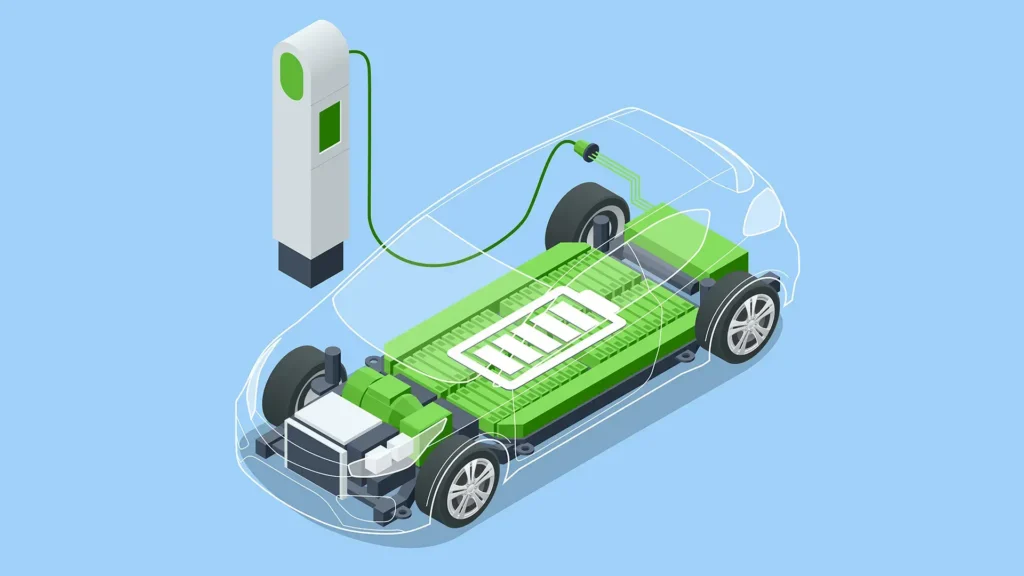
The battery of an electric vehicle is a large battery compartment with dimensions of approximately 200x150x15 cm and a weight of approximately 540 kg. It is located in the bottom of the car and is attached to the body with brackets. If you cut it open, you will see a number of blocks, each of which consists of several thousand compact lithium-ion cells. In Tesla, these cells are similar to ordinary finger batteries, in Nissan Leaf or Chevrolet Bolt they have a pack shape, and in Audi they are prismatic. Such a battery generates as much energy as more than 1,500 laptop batteries. To control the temperature of the battery during operation, it is equipped with a cooling system.
Types
There are different types of batteries: lithium-ion, aluminium-ion, lithium-sulphur, lithium-iron phosphate, and metal-air. Most often, electric vehicles use lithium-ion batteries. They have a high energy density, high power, low self-discharge, no memory effect, and a fairly long service life (8-10 years). However, they are expensive, can overheat and explode.
Despite the high cost of lithium-ion batteries and their questionable safety, almost nothing can compete with them in terms of power and the number of charge-discharge cycles. Developers are constantly searching for the optimal formula for battery production: safe, with low production costs, long service life, easy disposal, fast charging time and maximum efficiency (with a specific energy of 400 Wh/kg or more).
Who produces
Batteries for electric vehicles are produced in Asia: China, South Korea, and Japan. These companies are BYD, Panasonic, LG Chem, Samsung SDI, Farais, AESC Automotive Energy Supply Corp. The leader among all manufacturers is the Chinese company CATL, thanks to active government subsidies. Panasonic produces batteries for Tesla cars, while BYD fills electric buses with batteries. Many manufacturers locate production facilities in Europe and America.
Outlook.
The most promising aregraphene-based batteries. It is used to improve battery properties, for example, by adding it to electrodes and increasing their conductivity. Such batteries are much lighter than lithium-ion batteries and do not explode. The specific capacity is 5 times higher than that of a lithium-ion battery (1000 Wh vs. 200 Wh per 1 kg of weight). Tesla Model S with a graphene batterycan travel 1,013 km on a single charge instead of 334 km, and can be charged in less than 10 minutes.
For all their excellent characteristics, graphene batteries and other modern developments (e.g,batteries based on materials derived from seawater), should have filled the market long ago. However, manufacturers continue to improve lithium-ion batteries created in the 70s, and investors are reluctant to invest in the development of new technologies. After all, this requires millions of dollars, which will not pay off for the reasons that new batteries will be tested for years, then they will go through a long period of adaptation in the market and very slowly increase the interest of the buyer. We can only hope that graphene will be able to change this situation for the better, as a huge amount of capital has already been invested in the development of batteries based on it.
In the meantime, graphene batteries remain a project of the future, so let’s find out what a typical lithium-ion battery looks like using a home assembly as an example. Craftsmen from the Ukrainian YouTube channel KREOSAN assemble lithium-ion batteries for welding machines, electric bicycles, etc. The same principle is used in electric vehicles, but the assembly is not handicraft, but industrial.
Results.
So far, there are no electric vehicles so old that users can find out exactly how long the battery lasts and when it needs to be replaced. Therefore, for a few years, you don’t have to think about recycling the battery and replacing it (in 2020, this will only apply to owners of 2010 Nissan Leaf models). By the time mass battery replacement and recycling is required, more advanced recycling/reuse mechanisms will be available and prices will fall. But even without this, an electric car is becoming more convenient and economical than a car with an internal combustion engine every year.