

Table of contents:
Quick Summary: Enterprise fleet management (EFM) is the comprehensive process of overseeing and optimizing large-scale vehicle operations for companies managing 20 or more vehicles. It encompasses vehicle acquisition, maintenance scheduling, compliance tracking, fuel management, driver safety programs, and data-driven optimization to reduce costs and improve operational efficiency.
Managing a single company vehicle is straightforward. Managing hundreds? That’s where enterprise fleet management becomes essential.
For organizations operating medium-sized fleets of 20 or more vehicles—whether delivery vans, service trucks, or company cars—the complexity escalates quickly. Without a structured approach, costs spiral, vehicles sit idle for maintenance, compliance issues emerge, and efficiency suffers.
Enterprise fleet management tackles these challenges head-on. It’s not just about tracking where vehicles are parked. It’s a holistic system combining technology, processes, and strategic oversight to maximize the value of every vehicle in the fleet.
We remind you that you can purchase home and commercial charging stations in our online store, as well as use public charging stations ECOFACTOR located throughout Ukraine. For convenient access to charging infrastructure, we recommend using our mobile app, available on iOS and Android.
Defining Enterprise Fleet Management
Enterprise fleet management involves overseeing and optimizing a company’s vehicle fleet operations to ensure efficiency, cost-effectiveness, and compliance. According to the Department of Energy, fleet management includes agency-owned, GSA-leased, and commercially-leased motor vehicles such as cars, vans, trucks, and buses.
The Georgia Department of Administrative Services manages fleet operations for the state’s 20,000+ vehicle fleet, from initial acquisition through disposal. Their approach reflects the comprehensive nature of EFM—it’s cradle-to-grave vehicle lifecycle management.
Enterprise Fleet Management, owned by the Taylor family of St. Louis, operates a network of more than 60 fully staffed offices managing a fleet of nearly a million vehicles across the U.S. and Canada. They provide full-service management for companies, government agencies, and organizations operating medium-sized fleets.
The core distinction? Scale and sophistication. Small businesses might track mileage in spreadsheets. Enterprise operations require integrated systems that handle procurement, telematics, predictive maintenance, regulatory compliance, and real-time optimization across hundreds or thousands of assets.
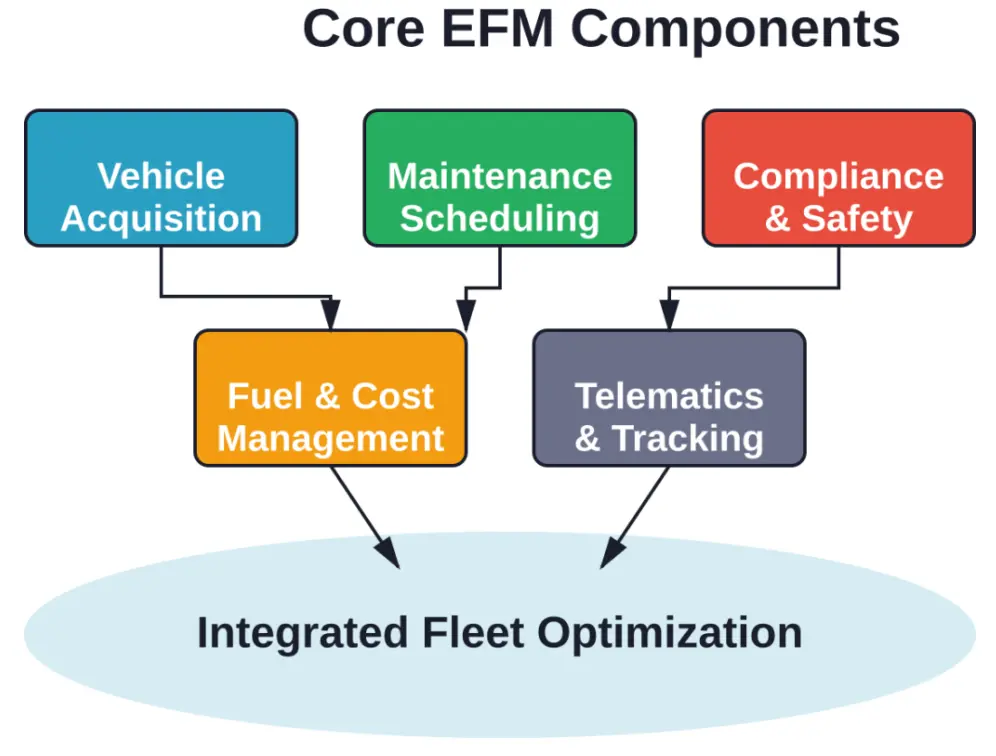
Core Components of Enterprise Fleet Management
Effective EFM rests on several interconnected pillars. Each component addresses specific operational challenges while contributing to overall fleet performance.
Vehicle Acquisition and Lifecycle Management
Fleet managers determine the optimal vehicle types for specific business needs, negotiate purchasing or leasing terms, and plan replacement cycles. This involves analyzing total cost of ownership—not just purchase price, but fuel efficiency, expected maintenance costs, resale value, and operational lifespan.
The Georgia Department of Administrative Services emphasizes ensuring cost-effective management from initial acquisition through disposal, following national industry best practices and state policies.
Maintenance and Repair Scheduling
Preventive maintenance prevents costly breakdowns and extends vehicle life. Enterprise systems schedule routine service based on mileage, engine hours, or time intervals—automatically alerting managers when vehicles need attention.
Analytics can identify underperforming vehicles, potentially reducing fuel costs by up to 15% according to research on fleet management optimization. Catching small issues early prevents major failures that sideline vehicles for days.
Compliance and Safety Management
Regulatory compliance spans multiple domains: vehicle registration and licensing, driver qualification verification, hours-of-service tracking, emissions standards, and industry-specific regulations.
Safety programs monitor driver behavior—speeding, harsh braking, rapid acceleration—and provide targeted training. This reduces accident rates, lowers insurance premiums, and protects both drivers and company reputation.
Fuel Management and Cost Control
Fuel represents one of the largest ongoing fleet expenses. EFM systems track consumption patterns, identify inefficiencies, and implement controls like fuel card programs that prevent unauthorized purchases.
Route optimization reduces unnecessary mileage. Driver behavior coaching improves fuel efficiency. Vehicle right-sizing ensures companies aren’t operating oversized trucks for small deliveries.
Telematics and Real-Time Tracking
Modern Fleet Management Systems provide real-time information about vehicle status and location, allowing management of significant amounts of spatially distributed objects. According to research on enterprise architecture in fleet management, remote monitoring increases operational efficiency by 30% through real-time data analysis.
GPS tracking shows vehicle location, speed, and route history. Diagnostic systems report engine codes, battery voltage, and performance metrics. This data enables proactive decision-making rather than reactive firefighting.
The Importance of Enterprise Fleet Management
Why invest in a comprehensive EFM rather than handling fleet operations piecemeal? The benefits extend across financial, operational, and strategic dimensions.
Cost Reduction and Financial Control
Poorly managed fleets bleed money through unnecessary fuel consumption, excessive maintenance from delayed service, improper vehicle utilization, and premature replacement cycles.
Research shows analytics identifying underperforming vehicles can generate fuel cost savings of up to 15%. When applied across a 200-vehicle fleet consuming 100,000 gallons annually at $3.50 per gallon, that’s $52,500 in annual savings.
Maintenance optimization prevents costly emergency repairs. Compliance programs avoid regulatory fines. Better purchasing decisions reduce total ownership costs. These savings compound year after year.
Operational Efficiency and Productivity
Research on enterprise architecture automation suggests potential reductions in response time through better resource allocation. For service-based businesses, faster response means more jobs completed, higher customer satisfaction, and increased revenue.
Fleet Management Systems can be evaluated using analytical hierarchy process methods to assess operational effectiveness from the perspective of end-user needs. Dispatchers assign the nearest available vehicle. Maintenance schedules minimize downtime. Route optimization reduces wasted travel time.
Risk Mitigation and Safety
Vehicle accidents create multiple risks: driver injury, vehicle damage, liability exposure, insurance claims, and potential legal action. Driver behavior monitoring identifies high-risk patterns before accidents occur.
Maintenance compliance prevents mechanical failures that endanger drivers and other road users. Regular safety training reinforces best practices. The result? Fewer accidents, lower insurance premiums, and protected business continuity.
Environmental Responsibility
Research on urban freight transport indicates significant economic losses due to congestion and pollution in developed economies. Fleet optimization reduces environmental impact through fuel efficiency improvements, emissions monitoring, and strategic route planning that minimizes unnecessary mileage.
Organizations increasingly face pressure to demonstrate environmental stewardship. Documented fleet efficiency improvements provide measurable sustainability metrics for corporate responsibility reporting.
Implementing Enterprise Fleet Management
Moving from ad-hoc fleet operations to comprehensive EFM requires strategic planning and phased execution.
Assessment and Goal Setting
Start by documenting current state: vehicle inventory, maintenance costs, fuel consumption, utilization rates, compliance gaps, and operational pain points. Establish baseline metrics and define specific improvement targets.
System Selection
Not all fleet management platforms suit every organization. Requirements vary based on fleet size, vehicle types, industry regulations, and specific operational challenges. Research on analytical hierarchy process methods can evaluate Fleet Management Systems from the perspective of end-user needs, emphasizing time and economic efficiency.
Evaluate vendors based on functionality, integration capabilities, scalability, support services, and total cost of ownership—not just purchase price.
Phased Deployment
Large-scale implementations often fail when organizations try to change everything simultaneously. Start with a pilot program covering a subset of vehicles. Validate the technology, refine processes, train personnel, and demonstrate ROI before full-scale rollout.
Training and Change Management
Technology alone doesn’t deliver results. Drivers need training on new procedures. Maintenance staff require system access and workflow changes. Managers must learn to interpret data and act on insights.
Resistance is natural when implementing monitoring systems. Clear communication about benefits—improved safety, reduced paperwork, better vehicle quality—helps gain buy-in.
| Implementation Phase | Timeline | Key Activities | Success Metrics |
|---|---|---|---|
| Assessment | 1-2 months | Inventory audit, cost analysis, requirement definition | Baseline metrics established |
| Selection | 1-3 months | Vendor evaluation, RFP process, contract negotiation | System selected and contracted |
| Pilot Program | 3-6 months | Hardware installation, training, process refinement | 10-15% cost reduction in pilot group |
| Full Deployment | 6-12 months | Fleet-wide rollout, integration completion | All vehicles on system, targets met |
| Optimization | Ongoing | Data analysis, process improvement, feature expansion | Continuous efficiency gains |
Build Enterprise EV Charging With ECOFACTOR
Enterprise fleet management usually means coordinating many vehicles across different teams, sites, and business routines. ECOFACTOR helps companies manage the charging part with charging stations, station management software, and a mobile app for iOS and Android.
Drivers can use the charging station map to find suitable charging points, while companies can prepare their own locations with equipment from ECOFACTOR’s online store. The store includes chargers, cables and adapters for workplace parking, depots, commercial sites, and other EV charging needs.
ECOFACTOR can support enterprise fleets with:
- Charging stations for offices, depots, and shared parking areas
- Tools for managing station access and charging activity
- Mobile support for drivers across different locations
- Equipment and accessories for daily EV fleet use
Contact ECOFACTOR to make EV charging easier to manage across your enterprise fleet.
Statistics and Market Growth
The swift adoption of EFM across industries reflects its proven impact. According to MarketsandMarkets research, the global fleet management market is expected to grow from USD 37.71 billion in 2025 to USD 70.26 billion by 2030, at a CAGR of 13.3% from 2025 to 2030, representing significant compound annual growth.
This expansion is driven by several factors: increasing vehicle connectivity, regulatory pressure for compliance documentation, rising fuel costs demanding optimization, and growing adoption of electric and alternative-fuel vehicles requiring specialized management.
Government fleets demonstrate the scale—the Georgia Department of Administrative Services alone manages over 20,000 vehicles. Enterprise Fleet Management operates nearly a million vehicles across North America. These numbers underscore how critical effective fleet management becomes at enterprise scale.
Key Technologies Enabling EFM
Modern enterprise fleet management relies on technological infrastructure that would have been impossible a decade ago. Here’s what powers today’s systems.
GPS and Telematics Hardware
Small devices installed in vehicles capture location, speed, engine diagnostics, fuel consumption, and driver behavior data. This information transmits wirelessly to central management platforms.
Telematic Control Units can capture vital vehicle data through various methods, according to IEEE research on vehicle telematics. This enables retrofit installation across diverse vehicle types and model years.
Cloud-Based Management Platforms
Centralized software processes telematics data, generates reports, triggers maintenance alerts, and provides dashboards for fleet managers. Cloud deployment means accessible from anywhere, automatic updates, and scalability as fleets grow.
IoT Integration
IEEE research on comprehensive IoT-driven fleet management systems demonstrates how interconnected sensors create a unified operational picture. Tire pressure monitors, temperature sensors for refrigerated cargo, cargo weight sensors—all feed into the central management system.
Data Analytics and AI
The real power emerges when systems analyze historical data to predict maintenance needs, identify efficiency opportunities, and optimize operations. Machine learning algorithms detect patterns humans might miss—like specific driving behaviors that correlate with excessive fuel use or vehicle wear.
Challenges and Considerations
Enterprise fleet management delivers substantial benefits, but implementation isn’t without obstacles.
Upfront Investment
Hardware, software licenses, installation, and training require capital expenditure. Building the business case means demonstrating how projected savings and efficiency gains justify initial costs—typically achieved within 12-24 months for well-implemented systems.
Data Privacy and Driver Concerns
Monitoring creates tension. Drivers may feel distrusted or surveilled. Organizations must balance operational needs with privacy considerations, establish clear policies about data use, and ensure compliance with labor laws and union agreements.
Integration Complexity
Fleet management systems must integrate with existing enterprise software—accounting systems, ERP platforms, HR databases, and fuel card providers. Poor integration creates data silos and manual workarounds that undermine efficiency gains.
Technology Obsolescence
Vehicle technology evolves rapidly. Systems must accommodate electric vehicles, autonomous features, and emerging connectivity standards. Vendor roadmaps and platform flexibility matter for long-term viability.
The Future of Enterprise Fleet Management
Several trends are reshaping what enterprise fleet management looks like.
Electric vehicle adoption accelerates as purchase prices decline and charging infrastructure expands. EFM systems must handle range management, charging station location, battery health monitoring, and electricity cost optimization.
Autonomous and semi-autonomous vehicles will fundamentally change fleet operations. Platooning technology allows trucks to draft closely at highway speeds. Autonomous last-mile delivery vehicles eliminate driver costs while requiring new management approaches.
Mobility-as-a-Service models blur traditional fleet boundaries. Companies may shift from owning vehicles to purchasing transportation capacity on-demand, requiring different optimization strategies.
Sustainability reporting requirements increase. Carbon accounting, emissions reduction targets, and environmental impact documentation become standard fleet management functions rather than optional extras.
Frequently Asked Questions
What size fleet requires enterprise fleet management?
Organizations operating 20 or more vehicles typically benefit from formal fleet management systems. Below that threshold, simpler tools may suffice. Above 50 vehicles, comprehensive EFM becomes essential for cost control and operational efficiency.
How much can companies save with enterprise fleet management?
Savings vary by current efficiency levels and implementation quality. Research shows potential fuel cost reductions of up to 15% through analytics, operational efficiency gains of 30% from remote monitoring, and improved response times through automation. Combined with reduced maintenance costs and improved compliance, total savings often reach 10-25% of fleet operating costs.
What’s the difference between fleet management and enterprise fleet management?
The term “enterprise” typically indicates larger scale (50+ vehicles), greater complexity, more sophisticated technology integration, and comprehensive lifecycle management. Basic fleet management might track vehicles and schedule maintenance. Enterprise systems add strategic procurement, advanced analytics, predictive maintenance, compliance automation, and integration with broader business systems.
Do fleet management systems work for mixed vehicle types?
Yes. Modern platforms accommodate cars, trucks, vans, specialized equipment, and increasingly electric vehicles. The key is selecting systems with flexible hardware options and software that handles diverse vehicle specifications, maintenance requirements, and operational patterns.
How long does implementation take?
Pilot programs typically run 3-6 months. Full fleet deployment requires 6-12 months depending on fleet size, geographic distribution, and integration complexity. Organizations should plan 12-18 months from initial assessment to fully optimized operations.
What about companies with leased vehicles?
Enterprise fleet management applies equally to owned, leased, and mixed fleets. According to the Department of Energy, fleet management includes agency-owned, GSA-leased, and commercially-leased vehicles. Leasing may actually simplify aspects like disposal while requiring careful lease term optimization and end-of-lease condition management.
Can small businesses use enterprise fleet management approaches?
Smaller organizations can adopt EFM principles and scaled-down technology solutions. Cloud-based platforms offer tiered pricing that makes sophisticated tools accessible even for 10-20 vehicle fleets. The core concepts—preventive maintenance, data-driven decisions, compliance tracking—apply regardless of fleet size.
Conclusion
Enterprise fleet management transforms vehicle operations from cost centers into strategic assets. Through integrated technology, disciplined processes, and data-driven decision-making, organizations reduce costs, improve efficiency, enhance safety, and meet environmental goals.
The market growth trajectory—rom USD 37.71 billion in 2025 to USD 70.26 billion by 2030—reflects widespread recognition of EFM’s value. As vehicle technology evolves and operational complexity increases, comprehensive fleet management shifts from competitive advantage to operational necessity.
Companies managing 20+ vehicles face a straightforward choice: continue managing fleets reactively with limited visibility and mounting costs, or invest in enterprise fleet management systems that deliver measurable returns through optimized operations.
The data speaks clearly. Organizations implementing modern EFM achieve 30% operational efficiency gains, faster response times, and potential fuel cost reductions of up to 15%. These aren’t aspirational targets—they’re documented results from real-world implementations.
Ready to optimize fleet operations? Start with a comprehensive assessment of current costs and operational pain points, then evaluate how enterprise fleet management addresses specific challenges. The investment pays for itself—and keeps delivering value year after year.