


Table of contents:
Quick Summary: Fleet management in logistics is the process of overseeing and optimizing all vehicles and assets within a company’s supply chain, from acquisition to disposal. It involves vehicle tracking, maintenance scheduling, driver management, route optimization, fuel monitoring, and compliance management to reduce costs, improve delivery efficiency, and enhance operational performance. Modern fleet management relies on telematics systems, GPS tracking, and data analytics to provide real-time insights that streamline operations and strengthen supply chain performance.
Moving goods from point A to point B sounds simple enough. But when you’re managing dozens or hundreds of vehicles across multiple routes, dealing with maintenance schedules, tracking fuel consumption, and ensuring regulatory compliance, things get complicated fast.
That’s where fleet management comes in. It’s not just about keeping trucks on the road—it’s about optimizing every aspect of vehicle operations to cut costs, improve efficiency, and strengthen your entire supply chain.
Research from academic institutions shows that transport costs can account for up to 75% of operating costs in certain regions, particularly in Africa. And with ICT application in fleet management currently at 46%, according to data published on academia.edu, there’s massive room for improvement across the logistics industry.
We remind you that you can purchase home and commercial charging stations in our online store, as well as use public charging stations ECOFACTOR located throughout Ukraine. For convenient access to charging infrastructure, we recommend using our mobile app, available on iOS and Android.
Defining Fleet Management in Logistics
Fleet management in logistics is the supervision of interrelated processes associated with fleet asset movement and organization. These processes include vehicle leasing, financing, licensing, maintenance, remarketing, issue management, and supply chain coordination.
At its core, fleet management is the process within a company aimed at gathering information and controlling all vehicles, from the moment of purchase to the end of their service life. The goal is straightforward: improve operational efficiency, reduce costs, and increase performance across your transportation network.
But what does that actually look like in practice?
Fleet management encompasses everything from selecting which vehicles to acquire, to scheduling preventive maintenance, monitoring driver behavior, optimizing routes, tracking fuel consumption, ensuring compliance with transportation regulations, and eventually remarketing or disposing of vehicles when they reach end-of-life.
The discipline sits at the intersection of logistics and transportation management. While logistics management focuses on the broader flow of goods and information from suppliers to customers, fleet management zeroes in specifically on the vehicle assets that make that flow possible.
The Role Fleet Management Plays in Supply Chain Operations
Fleet management plays a significant role as it manages the flow of goods along the supply chain and therefore helps in controlling supply chain costs. Without effective fleet oversight, even the best supply chain strategy will stumble when it comes to actual delivery.
Research indicates that fleet management significantly enhances supply chain performance by managing transport functions effectively. In studies conducted in Nairobi, 83% of logistics firms agreed that ICT and customer relationship management positively impact supply chain performance.
Here’s the thing though—fleet management doesn’t operate in isolation. It’s deeply integrated with inventory management, warehouse operations, order fulfillment, and customer service. When a vehicle breaks down unexpectedly, that doesn’t just affect transportation; it ripples through inventory levels, customer satisfaction, and revenue.
Efficient fleet management directly impacts:
- Delivery speed and reliability
- Transportation cost control
- Customer satisfaction and retention
- Environmental sustainability efforts
- Competitive positioning in the market
Organizations that excel at fleet management gain tangible advantages in their supply chain performance, from faster order-to-delivery cycles to lower cost-per-shipment ratios.

How Fleet Management Systems Work
Modern fleet management relies heavily on technology. A fleet management system combines hardware, software, and data analytics to provide real-time insights into vehicle operations.
The process typically works like this:
First, telematics devices installed in each vehicle collect data continuously. These devices track GPS location, speed, fuel consumption, engine diagnostics, driver behavior, and more. According to government data from ops.fhwa.dot.gov, typical aggregation levels range from 15 to 60 minutes.
That raw data gets transmitted to central software platforms where it’s aggregated, analyzed, and transformed into actionable insights. Fleet managers can view dashboards showing real-time vehicle locations, maintenance alerts, fuel efficiency metrics, driver safety scores, and route deviations.
The software layer also enables optimization algorithms that recommend more efficient routes, predict maintenance needs before breakdowns occur, and identify opportunities to reduce fuel consumption.
Many systems integrate with other logistics platforms—warehouse management systems, transportation management systems, customer relationship management software—creating a unified view of the entire supply chain.
Key Technologies Powering Modern Fleet Management
Several technologies have transformed fleet management from a manual, reactive discipline into a data-driven, proactive one:
- GPS Tracking: Real-time location monitoring allows dispatchers to know exactly where every vehicle is at any moment, enabling dynamic routing and accurate customer ETAs.
- Telematics Systems: These combine GPS with onboard diagnostics to provide comprehensive vehicle health monitoring, driver behavior analysis, and operational metrics.
- On-Board Computers: These devices give drivers access to route information, delivery instructions, and communication tools while providing management with detailed trip data.
- Dash Cams: Video recording systems enhance safety, provide evidence in accidents, and help train drivers by reviewing actual driving situations.
- Predictive Analytics: Machine learning algorithms analyze historical data to forecast maintenance needs, predict fuel consumption, and identify efficiency opportunities.
- Mobile Applications: Driver-facing apps streamline communication, digital documentation, electronic proof of delivery, and time tracking.
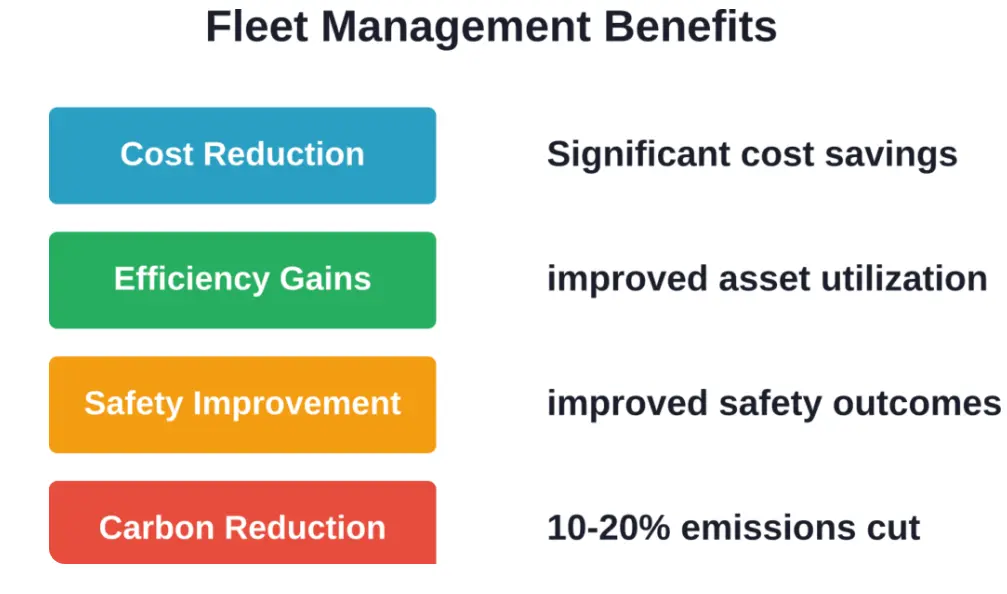
Key Benefits of Effective Fleet Management
Why invest in comprehensive fleet management? The benefits are both substantial and measurable.
Cost Reduction
Fleet operations represent one of the largest expense categories for logistics companies. Effective fleet management attacks costs from multiple angles:
- Reduced fuel consumption through route optimization and driver behavior monitoring
- Lower maintenance costs by shifting from reactive to preventive maintenance
- Decreased vehicle downtime through better scheduling and faster repairs
- Extended vehicle lifespan by following proper maintenance protocols
- Reduced insurance premiums through improved safety records
Given that transport costs can represent up to 75% of operating costs in certain markets, even modest efficiency gains translate to significant bottom-line impact.
Improved Operational Efficiency
Streamlined fleet operations mean faster deliveries, higher asset utilization, and better resource allocation. Fleet management systems provide the visibility needed to identify bottlenecks, eliminate waste, and optimize processes continuously.
Real-time tracking enables dynamic dispatching—rerouting drivers to handle urgent orders or avoid traffic congestion. Automated scheduling reduces the administrative burden on managers while ensuring optimal vehicle and driver assignments.
Enhanced Safety and Compliance
Safety isn’t just about protecting people; it’s about protecting your business from liability, insurance claims, and reputational damage. Fleet management systems monitor driver behavior—hard braking, rapid acceleration, speeding, harsh cornering—and provide coaching opportunities to improve safety.
Compliance management features help ensure adherence to hours-of-service regulations, vehicle inspection requirements, and industry-specific standards. Automated alerts prevent violations before they occur.
Better Customer Service
Customers expect accurate delivery windows and real-time visibility. Fleet management enables both. GPS tracking provides precise ETAs that can be shared with customers automatically. If delays occur, systems can trigger proactive notifications.
Faster, more reliable deliveries improve customer satisfaction and retention. Data from completed deliveries helps identify service issues and opportunities for improvement.
Environmental Benefits
Companies increasingly face pressure to reduce their environmental footprint. Fleet management helps organizations achieve environmental, social, and governance goals through:
- Optimized routing that reduces unnecessary mileage
- Fuel efficiency monitoring that identifies waste
- Idle time tracking that highlights opportunities to reduce emissions
- Data to support electric vehicle adoption and charging infrastructure planning
Essential Components of Fleet Management
Comprehensive fleet management involves multiple interconnected components. Each plays a distinct role in the overall system.
Vehicle Acquisition and Lifecycle Management
Decisions about which vehicles to purchase or lease, when to acquire them, and how long to keep them have long-term financial implications. Fleet managers must balance upfront costs, maintenance expenses, fuel efficiency, resale value, and operational requirements.
Lifecycle management tracks each vehicle from acquisition through disposal, monitoring total cost of ownership and determining optimal replacement timing.
Preventive Maintenance Programs
Reactive maintenance—fixing things when they break—costs more and causes more disruption than preventive maintenance. Modern fleet management systems schedule maintenance based on actual usage patterns, engine hours, mileage, and manufacturer recommendations.
Automated alerts ensure nothing gets missed. Maintenance history tracking helps identify problematic vehicles or recurring issues that need attention.
Fuel Management
Fuel represents one of the largest variable costs in fleet operations. Fuel management involves monitoring consumption, identifying inefficiencies, preventing fraud, and optimizing purchasing.
Telematics systems can identify excessive idling, inefficient routes, or aggressive driving behaviors that waste fuel. Integration with fuel card systems provides complete visibility into fuel purchases and helps detect anomalies.
Driver Management and Training
Drivers are your most valuable asset and your biggest variable. Driver management includes recruitment, training, performance monitoring, safety coaching, and retention efforts.
Fleet management systems provide objective data on driver behavior—speeding incidents, harsh braking, seatbelt usage, idle time—that can inform coaching conversations and recognition programs.
Compliance and Regulatory Management
Transportation is heavily regulated. Fleet managers must ensure compliance with hours-of-service rules, vehicle inspection requirements, licensing, permits, emissions standards, and industry-specific regulations.
Automated compliance tracking reduces the administrative burden while minimizing violation risk. Electronic logging devices have made hours-of-service compliance both easier and more accurate.
Implementing Fleet Management Best Practices
Organizations looking to improve their fleet operations should focus on several key practices.
Start with Clear Objectives
What do you want to achieve? Cost reduction? Better safety? Improved customer service? Environmental goals? Clear objectives guide technology selection, process design, and performance measurement.
Invest in the Right Technology
Not all fleet management systems are created equal. Evaluate options based on your specific needs, fleet size, operational complexity, and budget. Look for systems that integrate well with your existing logistics platforms.
Focus on Data Quality
Garbage in, garbage out. Ensure telematics devices are properly installed and maintained. Establish processes for validating data accuracy. Train staff on proper data entry for manual information.
Develop Driver Buy-In
Drivers sometimes view fleet management technology as surveillance. Communicate how the systems benefit drivers—safer routes, better scheduling, protection in accidents, recognition for good performance. Involve drivers in the rollout and address concerns openly.
Create Preventive Maintenance Schedules
Don’t wait for breakdowns. Use manufacturer guidelines and actual usage data to schedule maintenance proactively. Track maintenance completion rates and hold teams accountable.
Monitor Key Performance Indicators
You can’t improve what you don’t measure. Establish KPIs aligned with your objectives and review them regularly. Common fleet KPIs include cost per mile, fuel efficiency, vehicle utilization rates, maintenance costs, safety incidents, on-time delivery percentage, and vehicle downtime.
Continuously Optimize
Fleet management isn’t a set-it-and-forget-it initiative. Markets change, technologies evolve, and new opportunities emerge. Regular reviews of routes, vehicles, processes, and vendors help identify improvement opportunities.
Add ECOFACTOR Charging to Logistics Fleets
When logistics companies use electric vehicles, charging also becomes part of that routine. ECOFACTOR helps cover this side with charging stations, station management tools, and a mobile app for iOS and Android. Drivers can use the charging station map to find charging points and check station details while working across routes or delivery areas. ECOFACTOR also has an online store with chargers, cables and adapters for companies that need equipment for warehouses, parking areas, depots, or service locations.
ECOFACTOR can help logistics teams with:
- Charging access for electric delivery vehicles
- Equipment for depots, offices, and parking areas
- Mobile tools for finding and using charging stations
- Accessories needed for regular EV charging
Contact ECOFACTOR to make EV charging easier to fit into logistics fleet operations.
Challenges in Fleet Management
Despite the clear benefits, fleet management comes with significant challenges:
- Data Overload: Modern systems generate massive amounts of data. The challenge isn’t collecting data; it’s extracting meaningful insights and acting on them effectively.
- Technology Adoption: With ICT application in fleet management currently at 46%, many organizations still struggle with digital transformation. Legacy systems, resistance to change, and integration complexity slow adoption.
- Driver Shortage: The logistics industry faces persistent driver shortages in many markets. This puts pressure on retention, increases labor costs, and can limit growth.
- Regulatory Complexity: Transportation regulations vary by region and change frequently. Keeping up with requirements across multiple jurisdictions demands constant attention.
- Rising Costs: Fuel prices, vehicle costs, insurance premiums, and labor expenses all trend upward over time. Fleet managers must find efficiency gains that offset these increases.
- Environmental Pressure: Growing expectations around sustainability require fleets to reduce emissions, explore alternative fuels, and invest in cleaner technologies—all while maintaining profitability.
Fleet Management vs. Logistics Management
People often confuse fleet management with logistics management, but they’re distinct disciplines with different scopes.
| Aspect | Fleet Management | Logistics Management |
|---|---|---|
| Primary Focus | Vehicle assets and transportation operations | End-to-end flow of goods and information |
| Scope | Vehicle acquisition, maintenance, driver management, route optimization | Procurement, inventory, warehousing, transportation, order fulfillment |
| Key Metrics | Cost per mile, vehicle utilization, fuel efficiency, maintenance costs | Order cycle time, inventory turnover, perfect order rate, supply chain costs |
| Technology | Telematics, GPS tracking, maintenance management systems | TMS, WMS, ERP, supply chain visibility platforms |
| Stakeholders | Fleet managers, drivers, maintenance teams, dispatchers | Supply chain managers, procurement, warehouse operations, customer service |
Fleet management is essentially a subset of logistics management—one critical component of the larger supply chain puzzle. Logistics strategy determines where goods need to go and when; fleet management determines how the vehicles that move those goods will operate efficiently.
The Future of Fleet Management
Fleet management continues to evolve rapidly. Several trends are reshaping the discipline:
- Electric Vehicle Adoption: As battery technology improves and charging infrastructure expands, electric vehicles are becoming viable for more fleet applications. This shift requires new approaches to route planning, charging management, and vehicle maintenance.
- Autonomous Vehicles: Self-driving technology promises to transform fleet operations, though widespread commercial deployment remains years away. When it arrives, it will dramatically change driver management, safety protocols, and operational models.
- Advanced Analytics and AI: Machine learning algorithms are getting better at predicting maintenance needs, optimizing routes in real-time, and identifying efficiency opportunities that humans might miss.
- Integration and Connectivity: Fleet management systems are becoming more tightly integrated with broader supply chain platforms, creating seamless data flow and unified visibility.
- Sustainability Focus: Environmental considerations are moving from nice-to-have to must-have. Fleet managers will face increasing pressure to demonstrate carbon reduction and embrace sustainable practices.
Frequently Asked Questions
What’s the difference between fleet management and transportation management?
Fleet management focuses specifically on managing vehicle assets—acquisition, maintenance, driver management, and operational optimization. Transportation management has a broader scope, encompassing mode selection, carrier relationships, freight booking, shipment tracking, and freight payment across all transportation modes, including third-party carriers. Organizations often use fleet management systems for their own vehicles and transportation management systems to coordinate broader shipping operations.
How much does fleet management software cost?
Pricing varies widely based on fleet size, features, and vendor. Check providers’ official websites for current pricing, as subscription models, feature tiers, and pricing structures change frequently. Generally speaking, costs are calculated per vehicle per month, with enterprise fleets often negotiating custom pricing.
Do small businesses need fleet management systems?
Even small fleets benefit from basic fleet management capabilities. A business with just five vehicles can achieve measurable fuel savings, prevent breakdowns through scheduled maintenance, and improve customer service with accurate ETAs. Many vendors offer scaled-down solutions appropriate for smaller operations at lower price points.
How does fleet management improve safety?
Fleet management systems monitor driver behavior in real-time, identifying risky actions like speeding, harsh braking, rapid acceleration, and harsh cornering. This data enables targeted safety coaching, recognition of safe drivers, and identification of training needs. Video systems provide evidence in accidents and near-misses that can be used for driver education. Maintenance tracking prevents vehicle-related safety issues by ensuring proper maintenance.
What data does a fleet management system collect?
Typical data points include GPS location, speed, route history, fuel consumption, idle time, engine diagnostics, maintenance records, driver identification, hours of service, harsh braking events, rapid acceleration, cornering behavior, seatbelt usage, and vehicle utilization. Some systems also integrate fuel card data, maintenance invoices, accident reports, and inspection records.
Can fleet management help with environmental goals?
Absolutely. Fleet management drives environmental improvement through route optimization that reduces unnecessary mileage, fuel efficiency monitoring that identifies waste, idle time tracking that highlights emissions opportunities, data that supports electric vehicle transition planning, and measurement of carbon footprint for reporting purposes. Fleet management can support carbon reduction goals through operational improvements.
How long does it take to implement a fleet management system?
Implementation timelines vary based on fleet size and system complexity. Installing telematics hardware across a fleet might take several weeks for larger operations. Software configuration, user training, and process development add additional time. Small to medium fleets can often complete implementation in 1-3 months, while large enterprise deployments might take 6-12 months for full rollout and adoption.
Conclusion
Fleet management has evolved from basic vehicle tracking to a sophisticated discipline that drives competitive advantage in logistics operations. Organizations that invest in comprehensive fleet management see measurable improvements in costs, efficiency, safety, customer satisfaction, and environmental performance.
The technology exists to optimize nearly every aspect of fleet operations. The challenge isn’t capability—it’s execution. With ICT application in fleet management currently at just 46%, there’s substantial opportunity for organizations to gain ground on competitors.
Success requires clear objectives, the right technology, quality data, engaged drivers, preventive maintenance discipline, continuous monitoring, and ongoing optimization. It’s not a one-time project but an ongoing commitment to operational excellence.
The future promises even greater capabilities—electric vehicles, autonomous technology, advanced analytics, deeper integration. Organizations building strong fleet management foundations today will be positioned to capitalize on these advances tomorrow.
Ready to optimize your fleet operations? Start by assessing your current state, defining clear goals, and evaluating technology options that align with your specific needs and constraints.