


Table of contents:
Quick Summary: Fleet management services encompass the coordinated administration of an organization’s vehicle fleet, including acquisition, maintenance, compliance, fuel management, and driver safety. These services optimize operational efficiency, reduce costs, and ensure regulatory compliance through integrated technology platforms and strategic processes. Organizations using comprehensive fleet management systems have achieved measurably better outcomes, with one implementation demonstrating a shift from 75% reactive maintenance to 25% proactive to 80% proactive and 20% reactive, yielding $650,000 in annual savings.
Every delivery truck navigating city streets, every construction van heading to a job site, and every sales vehicle traveling between client meetings represents more than transportation. These vehicles are strategic assets that, when managed properly, drive profitability and competitive advantage.
Fleet management services transform these assets from operational necessities into optimized business tools. But the scope extends far beyond simply keeping vehicles running.
We remind you that you can purchase home and commercial charging stations in our online store, as well as use public charging stations ECOFACTOR located throughout Ukraine. For convenient access to charging infrastructure, we recommend using our mobile app, available on iOS and Android.
Understanding Fleet Management Services
Fleet management services represent the systematic coordination of all activities required to keep a company’s vehicle fleet operating efficiently, safely, and cost-effectively. This encompasses everything from the moment an organization decides to acquire a vehicle through its entire operational lifecycle until disposal or remarketing.
The process involves monitoring fleet activities, making data-driven decisions, and implementing strategies that align vehicle operations with broader business objectives. Organizations handle these services internally through dedicated fleet managers, outsource to specialized fleet management companies, or adopt a hybrid approach.
According to ISO, fleet management turns vehicles from operational tools into strategic assets that keep modern transport moving and supply chains functioning. Whether managing three vans for a family-run business or coordinating thousands of vehicles across a global enterprise, the fundamental principles remain consistent.
Core Components of Fleet Management
Fleet management services are divided into several interconnected domains. Vehicle acquisition establishes the foundation, determining which vehicles enter the fleet based on operational requirements, total cost of ownership, and strategic fit.
Maintenance management keeps vehicles operational and safe. The Federal Highway Administration documented how St. John’s County transformed its maintenance approach, shifting from 75% reactive and 25% proactive maintenance to 80% proactive and 20% reactive maintenance after implementing comprehensive fleet management. That transformation delivered a 13.3% productivity increase and $650,000 in cost savings during the first full year.
Fuel management tracks consumption, identifies inefficiencies, and implements strategies to reduce costs. Academic research on fleet diversification shows potential fuel cost reductions of 36.93% when fleet composition is properly analyzed and adjusted.
Driver management encompasses recruitment, training, performance monitoring, and safety programs. Compliance management ensures adherence to regulatory requirements, from hours-of-service rules to vehicle inspections and environmental standards.
Telematics and tracking technology provide real-time visibility into vehicle location, utilization, driver behavior, and mechanical health. Performance analytics transform this data into actionable insights that drive continuous improvement.
How Fleet Management Services Work
The operational framework begins with strategic planning. Organizations assess their transportation needs, define service requirements, and establish key performance indicators that align with business objectives.
Vehicle selection follows, with fleet managers or service providers analyzing options based on total cost of ownership rather than just purchase price. This includes fuel efficiency, maintenance costs, insurance rates, resale value, and operational suitability.
The Technology Foundation
Modern fleet management relies heavily on integrated software platforms. These systems consolidate data from multiple sources into unified dashboards that provide comprehensive visibility.
GPS tracking devices installed in vehicles transmit real-time location data. Telematics sensors monitor engine diagnostics, fuel consumption, idle time, harsh braking, rapid acceleration, and other operational parameters.
Electronic logging devices automatically record hours-of-service data, ensuring compliance with regulatory requirements while reducing administrative burden. Maintenance management modules track service schedules, generate work orders, and alert managers to upcoming requirements.
According to GSA Fleet, which manages vehicle solutions for federal agencies, the integration of these technologies into end-to-end fleet management solutions helps organizations maintain safe, reliable, and cost-effective operations.
Daily Operations and Decision-Making
Fleet managers use these systems to make informed decisions throughout each day. Route optimization algorithms suggest the most efficient paths, reducing fuel consumption and improving delivery times. Academic research from the University of Georgia indicates that routing optimization software has become essential for efficient fleet management in today’s fast-paced logistics landscape.
When maintenance issues arise, the system alerts managers immediately. Preventive maintenance schedules automatically generate work orders before problems escalate into costly failures or safety hazards.
Driver behavior monitoring identifies training opportunities. Excessive speeding, harsh braking, or extended idle times trigger coaching interventions that improve safety and reduce operational costs.
Who Needs Fleet Management Services
Any organization operating three or more vehicles stands to benefit from structured fleet management. But the specific services required vary significantly by industry and operational model.
Delivery and logistics companies depend on fleet management for route optimization, on-time performance, and cost control. Construction firms need robust maintenance systems to keep specialized equipment operational in demanding environments.
Sales organizations with distributed teams require mileage tracking, expense management, and vehicle allocation systems. Service companies managing technician fleets need dispatch optimization and real-time scheduling capabilities.
Government agencies face unique compliance requirements and public accountability standards. The GSA emphasizes continuous evaluation of federal motor vehicle management programs, examination of new technologies, and analysis of emerging trends in alternative fuels and advanced vehicle systems.
| Industry | Primary Fleet Management Focus | Key Metrics |
|---|---|---|
| Delivery & Logistics | Route optimization, on-time delivery | Cost per mile, delivery time, fuel efficiency |
| Construction | Equipment uptime, maintenance | Utilization rate, maintenance cost, downtime |
| Field Services | Dispatch efficiency, technician productivity | Response time, jobs per day, mileage |
| Sales Organizations | Mileage tracking, expense management | Cost per vehicle, compliance, allocation |
| Government | Compliance, accountability, sustainability | Budget adherence, emissions, utilization |
The Role of Fleet Managers
Fleet managers serve as the strategic and operational center of fleet management services. These professionals oversee vehicle acquisition decisions, negotiate with vendors, and manage relationships with service providers.
They analyze performance data to identify trends, inefficiencies, and improvement opportunities. When fuel costs spike in a particular region, fleet managers investigate whether route changes, driver behavior, or mechanical issues are responsible.
Budget management falls squarely on fleet managers. They forecast costs, track expenditures against budgets, and justify investments in new vehicles or technologies. Regulatory compliance demands constant attention, with fleet managers ensuring that vehicles, drivers, and operations meet all applicable standards.
Safety program development represents another critical responsibility. Fleet managers establish policies, implement training programs, and monitor metrics that indicate safety performance. Organizations such as the Truckload Carriers Association offer specialized certification programs like the Certified Fleet Manager (CFM) designation for fleet managers, recognizing the complexity and importance of these roles.
In-House vs. Outsourced Fleet Management
Organizations face a fundamental choice: build internal fleet management capability or outsource to specialized service providers.
In-house management offers direct control and intimate knowledge of business operations. Companies maintain their own fleet managers, purchase their own software systems, and handle all aspects of vehicle management internally.
This approach works well for organizations with large fleets, specialized requirements, or industries where vehicle operations represent core competencies. But it requires significant investment in personnel, technology, and expertise.
Outsourced fleet management services transfer these responsibilities to companies specializing in vehicle administration. These providers leverage economies of scale, industry expertise, and established vendor relationships to deliver cost savings and operational improvements.
Third-party fleet management companies handle everything from vehicle procurement to remarketing at the end of the lifecycle. They negotiate better rates with fuel vendors, maintenance providers, and insurance companies based on their aggregate fleet size.
Many organizations adopt hybrid models, maintaining strategic oversight internally while outsourcing specific functions like maintenance coordination, fuel card administration, or telematics monitoring.
Measurable Benefits of Fleet Management Services
The value proposition extends across multiple dimensions. Cost reduction typically emerges as the most immediate and visible benefit.
Fuel represents one of the largest fleet expenses. Comprehensive management reduces fuel costs through route optimization, idle time reduction, speed management, and proper vehicle maintenance. Academic research on fleet diversification shows potential fuel cost reductions of 36.93% when fleet composition is properly analyzed and adjusted.
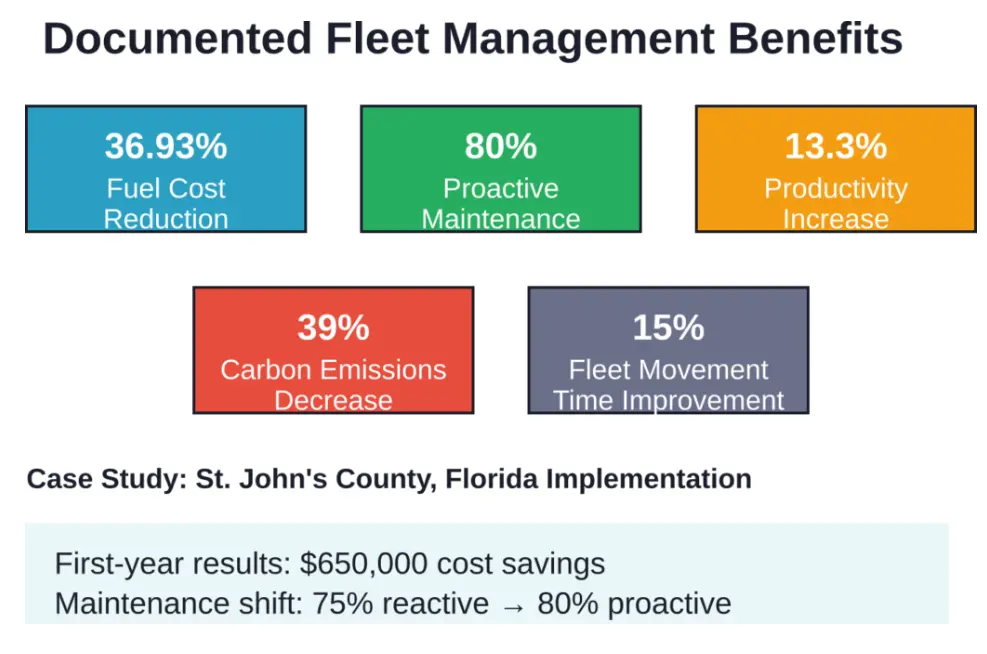
Maintenance costs decline when organizations shift from reactive repairs to preventive maintenance. The Federal Highway Administration documented how St. John’s County transformed its maintenance approach, shifting from 75% reactive and 25% proactive maintenance to 80% proactive and 20% reactive maintenance after implementing comprehensive fleet management.
Vehicle utilization improves when managers have visibility into how assets are actually used. Underutilized vehicles can be redeployed or removed from the fleet entirely, eliminating unnecessary carrying costs.
Safety improvements protect both employees and the organization. Driver behavior monitoring reduces accidents by identifying and correcting risky behaviors. Proper maintenance prevents mechanical failures that could cause crashes.
Environmental benefits have become increasingly important. Fleet management optimization can decrease carbon emissions by 39% through better routing, improved fuel efficiency, and strategic vehicle selection. This supports sustainability goals and environmental objectives.
Compliance assurance reduces risk exposure. Automated systems track license renewals, inspection deadlines, and regulatory requirements, preventing violations that could result in fines, liability, or operational shutdowns.
Key Fleet Management Technologies
Technology serves as the enabler for modern fleet management services. Several categories have become foundational.
Telematics Systems
Telematics combines telecommunications and informatics to transmit vehicle data in real-time. Devices installed in vehicles collect information about location, speed, fuel consumption, engine performance, and driver behavior.
This data flows to centralized platforms where fleet managers access dashboards, generate reports, and configure alerts. ISO standards address telematics applications for regulated commercial freight vehicles, establishing frameworks for collaborative systems.
GPS tracking provides location visibility, enabling dispatchers to identify the nearest vehicle for urgent service calls or reroute around traffic congestion. Historical location data helps verify mileage claims and optimize territory assignments.
Fleet Management Software Platforms
Comprehensive software platforms integrate data from telematics devices, maintenance systems, fuel cards, and other sources into unified interfaces.
These platforms manage the entire vehicle lifecycle. They track acquisition costs, schedule maintenance, monitor fuel consumption, generate compliance reports, and calculate total cost of ownership.
Advanced platforms incorporate predictive analytics, using historical data and machine learning algorithms to forecast maintenance needs, predict when vehicles should be replaced, and identify optimization opportunities.
Mobile Applications
Mobile apps extend fleet management capabilities to drivers and field personnel. Drivers use apps to complete pre-trip inspections, report issues, review assignments, and communicate with dispatchers.
Electronic logging devices integrated with mobile apps automatically record hours-of-service data, ensuring compliance while eliminating paper logbooks. Digital workflows reduce administrative burden and improve data accuracy.
Selecting Fleet Management Services
Organizations evaluating fleet management options should start by assessing their current state. How many vehicles? What types? What are the primary operational challenges? What metrics matter most?
Define specific objectives. Some organizations prioritize cost reduction. Others focus on safety improvement, compliance assurance, or sustainability goals. Clear objectives guide provider selection and implementation priorities.
When evaluating fleet management companies, examine their experience in your industry. A provider specializing in long-haul trucking may not understand the requirements of urban delivery fleets or construction equipment.
| Evaluation Criteria | Why It Matters | Questions to Ask |
|---|---|---|
| Industry Experience | Different fleet types have unique requirements | How many clients in our industry? Can you provide references? |
| Technology Platform | Determines capabilities and user experience | What systems integrate? How is data accessed? Mobile capabilities? |
| Service Scope | Defines what’s included vs. additional cost | Which services are bundled? What costs extra? Customization options? |
| Pricing Model | Impacts total cost and budget predictability | Per-vehicle fees? Transaction costs? Hidden charges? Contract terms? |
| Support Quality | Critical when issues arise | Support hours? Response times? Account management structure? |
Technology capabilities matter significantly. The platform should integrate with existing systems, provide mobile access for drivers and managers, and offer reporting that aligns with your key performance indicators.
Pricing structures vary widely. Some providers charge per-vehicle monthly fees. Others use transaction-based models. Understanding the total cost, including implementation fees, training, and ongoing support, prevents surprises.
Request demonstrations with realistic scenarios from your operations. Generic demos look impressive but may not address your specific requirements. Test the platform with your actual data and workflows.
Set Up EV Charging Support With ECOFACTOR
Fleet management services often cover vehicle use, maintenance, driver support, and daily coordination. For businesses that operate electric vehicles, charging also needs to be handled as part of that service structure. ECOFACTOR helps with charging stations, station management tools, and a mobile app for iOS and Android.
Drivers can use the charging station map to find charging points and check station details before they charge. ECOFACTOR also has an online store with chargers, cables and adapters for company parking areas, offices, service locations, or private EV charging needs.
ECOFACTOR can support EV fleet services with:
- Charging equipment for business and commercial locations
- Station tools for access and activity management
- Mobile support for drivers using public or company charging points
- Hardware and accessories for everyday EV operation
Contact ECOFACTOR to add practical EV charging support to your fleet management services.
Common Challenges in Fleet Management
Despite proven benefits, organizations implementing fleet management services encounter obstacles:
- Cost pressures remain constant: Fuel prices fluctuate unpredictably. Maintenance costs rise as vehicles age. Insurance rates increase. Organizations must continuously optimize to maintain profitability amid these headwinds.
- Driver recruitment and retention present ongoing challenges: The transportation industry faces persistent driver shortages. High turnover increases training costs and disrupts operations. Fleet managers must develop retention strategies that go beyond compensation.
- Regulatory compliance grows more complex: Hours-of-service rules, electronic logging requirements, emissions standards, and safety regulations all demand attention. Keeping pace with changing requirements across multiple jurisdictions strains resources.
- Technology integration can be difficult: Organizations often operate legacy systems that don’t communicate with modern fleet management platforms. Data silos prevent comprehensive analysis. Successful implementations require careful planning and sometimes painful system replacements.
- Resistance to change affects both managers and drivers: Telematics monitoring can feel invasive. New processes disrupt established routines. Change management becomes as important as the technical implementation itself.
The Future of Fleet Management Services
Fleet management continues evolving rapidly. Several trends are reshaping the landscape:
- Electric vehicle adoption is accelerating: Fleet managers must understand charging infrastructure requirements, range limitations, total cost of ownership calculations that differ from traditional vehicles, and maintenance procedures for electric powertrains.
- Autonomous vehicle technology promises to transform fleet operations fundamentally: ISO is developing standards for operation status monitoring for fleets using automated driving, with ISO/CD 15638-27 currently under development. While fully autonomous commercial fleets remain years away for most applications, driver assistance technologies are advancing quickly.
- Artificial intelligence and machine learning enhance predictive capabilities: Systems analyze patterns in maintenance data to predict failures before they occur. Route optimization algorithms consider real-time traffic, weather, and delivery windows to suggest optimal paths that adjust throughout the day.
- Sustainability metrics have moved from nice-to-have to mandatory: Organizations track carbon footprints, set emissions reduction targets, and report environmental performance to stakeholders. Fleet management systems increasingly incorporate sustainability dashboards alongside traditional operational and financial metrics.
- Connected vehicle technology enables richer data collection and new service models: Vehicles communicate with infrastructure, with each other, and with backend systems. This connectivity enables more sophisticated optimization and preventive interventions.
Implementing Fleet Management Services Successfully
Successful implementations follow structured approaches rather than attempting big-bang transformations:
- Start with assessment: Document current costs, processes, pain points, and performance metrics. This baseline enables measuring improvement and justifying continued investment.
- Prioritize initiatives based on impact and feasibility: Quick wins build momentum and demonstrate value. Tackle the most painful problems first, even if they aren’t the most glamorous.
- Invest in change management: Technology alone doesn’t deliver benefits. People must understand why changes are happening, how their roles will evolve, and what support they’ll receive. Driver buy-in is particularly critical since they directly interact with many fleet management systems.
- Plan for integration carefully: Fleet management platforms must exchange data with accounting systems, dispatch software, and other enterprise applications. Define integration requirements early and allocate sufficient time for testing.
- Establish clear governance: Who makes decisions about vehicle acquisition? Who reviews driver performance data? Who responds to compliance alerts? Undefined responsibilities create gaps where important issues fall through cracks.
- Monitor results continuously: Track the metrics that matter to your organization. Review dashboards regularly. Investigate anomalies. Successful fleet management is not a project with an end date but an ongoing operational discipline.
Frequently Asked Questions
What is the difference between fleet management and vehicle management?
Fleet management encompasses the coordinated administration of multiple vehicles as an integrated system, including strategic planning, optimization, and performance management across the entire fleet. Vehicle management typically refers to the maintenance and operational management of individual vehicles. Fleet management takes a holistic view of how vehicles work together to support business objectives, while vehicle management focuses on keeping specific units operational.
How much do fleet management services cost?
Pricing varies based on fleet size, service scope, and provider. Typical models include per-vehicle monthly fees, transaction-based charges, or percentage-of-spend arrangements. Pricing varies based on fleet size, service scope, and provider. Check provider websites for current pricing since rates change frequently and often include volume discounts.
Can small businesses benefit from fleet management services?
Absolutely. Organizations with as few as three to five vehicles can achieve measurable benefits from structured fleet management. Many providers offer scaled-down services appropriate for smaller operations. Cloud-based platforms have reduced technology costs, making fleet management accessible to businesses that previously couldn’t justify the investment. The key is selecting services that address your specific challenges rather than paying for capabilities you won’t use.
What qualifications should a fleet manager have?
Effective fleet managers combine operational knowledge, analytical skills, and business acumen. Many have backgrounds in logistics, transportation, or operations management. Industry certifications like the Certified Fleet Manager (CFM) designation or Motor Carrier Risk Specialist (MCRS) designation offered by organizations such as the Truckload Carriers Association demonstrate specialized expertise. Technical proficiency with fleet management software, understanding of compliance requirements, and strong vendor negotiation skills are essential. Experience managing people and budgets matters as much as technical knowledge.
How does fleet management improve safety?
Fleet management systems improve safety through multiple mechanisms. Telematics monitoring identifies risky driving behaviors like speeding, harsh braking, and rapid acceleration, enabling targeted coaching interventions. Preventive maintenance reduces mechanical failures that could cause accidents. Hours-of-service tracking prevents fatigued driving. Driver qualification management ensures personnel have appropriate licenses and training. Accident data analysis identifies patterns and informs policy improvements. Organizations with comprehensive fleet management programs typically see measurable reductions in accident rates and associated costs.
What is the typical ROI timeline for fleet management services?
Organizations typically see measurable returns within six to twelve months of implementation. Quick wins like fuel card savings and reduced administrative time appear almost immediately. Maintenance optimization benefits accumulate over several months as preventive programs take effect. The St. John’s County implementation documented by the Federal Highway Administration achieved $650,000 in savings during the first full year. Larger strategic benefits from optimized vehicle lifecycles and fleet right-sizing may take two to three years to fully materialize.
How do fleet management services handle compliance across different jurisdictions?
Comprehensive fleet management platforms incorporate regulatory databases that track requirements across jurisdictions. The systems alert managers to upcoming inspection deadlines, license renewals, and regulatory changes. Electronic logging devices automatically ensure hours-of-service compliance. Document management modules store required records and generate audit reports. For organizations operating nationally or internationally, this automated compliance management prevents violations that could result in fines, out-of-service orders, or liability exposure. Providers with experience in your operating regions bring valuable knowledge of local requirements.
Conclusion
Fleet management services transform vehicle operations from cost centers into strategic assets that drive competitive advantage. Through systematic coordination of acquisition, maintenance, compliance, safety, and optimization, organizations achieve measurable improvements in efficiency, cost control, and performance.
The documented results speak clearly. Organizations have shifted maintenance from primarily reactive to predominantly proactive, achieved substantial cost savings, reduced fuel consumption by double-digit percentages, and decreased environmental impact while improving productivity.
Whether managing three delivery vans or three thousand tractor-trailers, the fundamental principles remain consistent. Know your vehicles, monitor their performance, maintain them proactively, optimize their utilization, and continuously improve based on data-driven insights.
Technology serves as the enabler, but success ultimately depends on people, processes, and commitment to operational excellence. Organizations that treat fleet management as a strategic discipline rather than an administrative task consistently outperform competitors that view vehicles as mere transportation tools.
The question isn’t whether fleet management services deliver value. The evidence confirms they do. The real question is whether your organization is capturing that value or leaving it unrealized through fragmented processes, inadequate visibility, and missed optimization opportunities.
Ready to optimize your fleet operations? Start by assessing your current state, defining clear objectives, and exploring providers that align with your industry requirements and operational priorities. The return on that investment begins accumulating from day one.