

Table of contents:
Quick Summary: Vehicle fleet management is the systematic process of overseeing, coordinating, and optimizing a company’s collection of vehicles to maximize efficiency, reduce costs, and ensure safety throughout the entire vehicle lifecycle—from acquisition through disposal.
Managing a commercial fleet isn’t just about keeping vehicles on the road. It’s about transforming a collection of vehicles into a strategic asset that drives profitability, safety, and operational excellence.
Whether it’s a delivery company with five vans or a municipality with hundreds of vehicles, fleet management touches every aspect of vehicle operations. And the stakes are high—poor management leads to inflated costs, safety incidents, and operational chaos.
This guide breaks down what vehicle fleet management actually means, why it matters, and how organizations are using modern tools to stay competitive.
We remind you that you can purchase home and commercial charging stations in our online store, as well as use public charging stations ECOFACTOR located throughout Ukraine. For convenient access to charging infrastructure, we recommend using our mobile app, available on iOS and Android.
Defining Vehicle Fleet Management
Vehicle fleet management encompasses the systems, processes, and tools needed to maintain and optimize an organization’s business vehicles throughout their entire lifecycle. But it goes deeper than maintenance schedules.
At its core, fleet management coordinates several interconnected functions. Vehicle acquisition and disposal. Maintenance and repairs. Driver management and safety. Fuel management. Compliance with regulations. Asset tracking and utilization.
According to NAFA Fleet Management Association, the practice has evolved from simple record-keeping to sophisticated data-driven operations that span global markets. More than 3,500 fleet professionals rely on NAFA for resources and education to strengthen their vehicular fleet programs.
The process isn’t one-size-fits-all. A construction company managing excavators faces different challenges than a package delivery service coordinating last-mile routes. Yet the fundamental principle remains: maximize value while minimizing risk and cost.
How Vehicle Fleet Management Works
Fleet management operates through interconnected processes that create a continuous cycle of improvement. Here’s how it functions in practice.
Vehicle Acquisition and Lifecycle Planning
The process starts before a vehicle enters service. Fleet managers analyze operational needs, evaluate purchase versus lease options, and determine optimal replacement cycles based on total cost of ownership.
Lifecycle cost analysis examines every expense—from initial purchase through fuel, maintenance, insurance, and eventual resale value. NAFA produces specialized guidebooks on this topic to help fleet professionals master these calculations.
Smart acquisition decisions compound over years. A vehicle that costs $3,000 less upfront but requires $5,000 more in maintenance over five years represents a net loss.
Maintenance Management
Preventive maintenance forms the backbone of fleet longevity. Scheduled inspections, oil changes, tire rotations, and component replacements prevent costly breakdowns and extend vehicle life.
Modern systems track maintenance schedules automatically, triggering alerts based on mileage, engine hours, or calendar intervals. This eliminates the guesswork and prevents vehicles from slipping through the cracks.
Centralized maintenance under a professional manager, as recommended by MTAS (Municipal Technical Advisory Service), consolidates ownership and maintenance under a stand-alone department for maximum efficiency.
Driver Management and Safety
Vehicles don’t operate themselves. Driver behavior directly impacts costs, safety, and vehicle longevity.
Data from NAFA shows that driver behavior accounts for 15% to 40% variance in fuel consumption between identical vehicles. The gap between the most aggressive and most conservative drivers can reach $9,000 annually per vehicle.
Fleet managers implement driver training programs, monitor performance metrics, and establish safety protocols. New York City’s data-driven approach reduced excessive speeding in city vehicles by 70% through monitoring systems, according to research from Harvard’s Data-Smart City Solutions project.
The same NYC program achieved a 28% reduction in crashes after implementing telematics and safety modifications, cutting annual claims costs from a staggering $200 million baseline.
Fuel Management and Cost Control
Fuel represents one of the largest variable costs in fleet operations. Managing it requires multiple strategies working in concert.
Fuel cards track purchases, prevent fraud, and provide detailed consumption data. Route optimization reduces unnecessary mileage. Vehicle right-sizing ensures the appropriate vehicle handles each task—no sense sending a heavy-duty truck when a van suffices.
Real talk: fuel prices surged nearly $2 per gallon in early 2026, according to NAFA’s supplier webinar series, and structural refining constraints mean volatility isn’t disappearing. Fleet managers can’t control market prices, but they can control consumption patterns.
Compliance and Regulatory Management
Fleets must navigate a complex web of regulations. Department of Transportation (DOT) compliance, emissions standards, driver hours-of-service rules, vehicle inspections, and safety certifications.
NAFA offers ongoing webinars on compliance topics, including their “2026 DOT Compliance Mid-Year Outlook” to help fleet managers prepare for evolving requirements.
Non-compliance carries steep penalties. But beyond avoiding fines, proper compliance management protects drivers, reduces liability, and maintains operational continuity.
The Role of Telematics and Technology
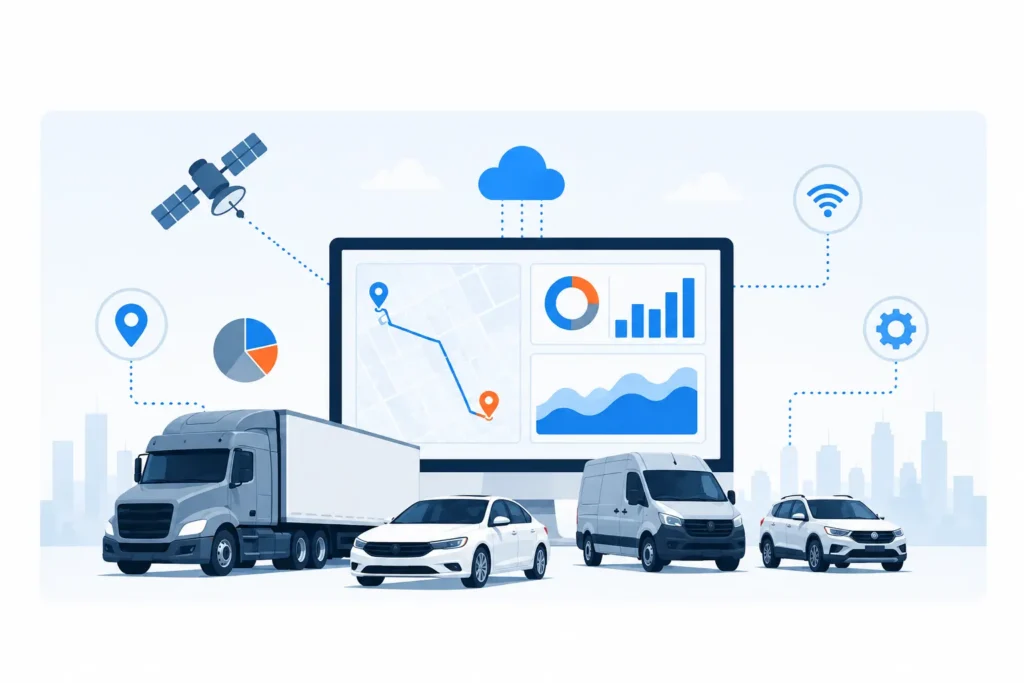
Modern fleet management leans heavily on telematics—the integration of telecommunications and informatics to monitor and manage vehicles remotely.
Telematics systems collect real-time data on vehicle location, speed, fuel consumption, engine diagnostics, harsh braking, rapid acceleration, and dozens of other parameters. This data flows into fleet management software platforms that transform raw information into actionable insights.
GPS tracking enables precise location monitoring. Geofencing creates virtual boundaries that trigger alerts when vehicles enter or exit designated areas. Engine diagnostics detect mechanical issues before they cause breakdowns.
SAE International, a global association of engineers and technical experts, has developed standards for telematics systems and automotive connectivity that enable interoperability across platforms.
Mining operations provide a compelling case study. Research published on Academia.edu documented how fleet monitoring systems reduced bucket mining out-of-polygon events from 34% to 15%, improved dispatch accuracy from 10% mismatches to 8%, and decreased mining costs to $10.30 per bank cubic meter while improving high-grade material delivery from 65% to 75%.
Core Responsibilities of Fleet Managers
Fleet managers wear many hats. Their responsibilities span strategic planning, daily operations, financial management, and personnel oversight.
| Responsibility Area | Key Tasks |
|---|---|
| Strategic Planning | Fleet size optimization, vehicle selection, replacement cycles, budget forecasting |
| Operations Management | Dispatching, route planning, utilization tracking, asset allocation |
| Maintenance Oversight | Preventive schedules, repair coordination, vendor management, downtime reduction |
| Cost Control | Fuel management, expense tracking, lifecycle analysis, cost-per-mile metrics |
| Safety & Compliance | Driver training, accident investigation, regulatory compliance, policy enforcement |
| Data Analysis | Performance reporting, KPI monitoring, trend identification, improvement initiatives |
NAFA’s resources highlight the parallels between fleet management and high-performance fields. Keynote speaker Jack Becker, a combat-decorated fighter pilot, draws connections between military aviation protocols and fleet optimization—both require precise execution under pressure and continuous performance improvement.
The best fleet managers combine analytical skills with operational expertise. They interpret data, negotiate contracts, manage people, troubleshoot problems, and continually seek efficiency gains.
Key Benefits of Effective Fleet Management
Organizations that invest in proper fleet management see measurable returns across multiple dimensions.
Cost Reduction
Systematic management cuts expenses throughout the vehicle lifecycle. Preventive maintenance costs less than emergency repairs. Optimized routes consume less fuel. Better driver behavior reduces wear and tear. Proper disposal timing maximizes resale value.
Effective fleet management programs can help reduce insurance costs through improved safety metrics and claims history.
Enhanced Safety
Safety improvements protect both human lives and financial assets. Driver monitoring systems identify risky behaviors before they cause accidents. Maintenance programs catch mechanical issues before failures occur on the road.
The NYC fleet safety case demonstrates measurable impact—a 70% reduction in excessive speeding and 28% fewer crashes through data-driven interventions.
Improved Operational Efficiency
Fleet management eliminates operational friction. Dispatchers assign the right vehicle to each job. Maintenance happens on schedule without disrupting operations. Accurate data enables informed decisions rather than gut-feel guesses.
Vehicle utilization metrics reveal underused assets that can be redeployed or eliminated, trimming unnecessary capital expenditures.
Better Compliance and Risk Management
Systematic tracking ensures inspections happen on time, licenses stay current, and documentation remains audit-ready. This reduces legal exposure and regulatory penalties.
NAFA has even introduced Fleet Safety Awards recognizing operations that exemplify safety-first culture, with winners announced at the Fleet Safety Symposium—part of the organization’s 100 Best recognition programs.
Data-Driven Decision Making
Fleet management software aggregates data that would be impossible to track manually. Patterns emerge. Trends become visible. Decisions shift from reactive to proactive.
But here’s the thing—data only helps if someone acts on it. The insights matter less than the operational changes they inspire.

Fleet Management Software Solutions
Technology platforms consolidate fleet management functions into integrated systems. These solutions typically include several core modules.
Vehicle tracking provides real-time location data via GPS. Maintenance management schedules preventive service and tracks repair history. Fuel management monitors consumption and identifies anomalies. Driver management records performance metrics and training completion.
Reporting and analytics transform raw data into dashboards, alerts, and trend visualizations. Integration capabilities connect with fuel card systems, telematics devices, and enterprise resource planning platforms.
Check official software providers for current pricing and feature availability, as these change frequently. Most platforms offer tiered subscriptions based on fleet size and required functionality.
| Software Feature | Business Value |
|---|---|
| Real-Time GPS Tracking | Location visibility, route verification, theft recovery, geofencing alerts |
| Automated Maintenance Scheduling | Prevents missed services, extends vehicle life, reduces breakdowns |
| Fuel Monitoring | Detects waste, identifies inefficient routes, tracks consumption trends |
| Driver Behavior Scoring | Improves safety, reduces fuel use, lowers insurance premiums |
| Compliance Management | Tracks inspections, certifications, licenses, audit documentation |
| Analytics Dashboards | Visualizes KPIs, identifies trends, supports data-driven decisions |
The right platform depends on fleet size, vehicle types, operational complexity, and specific pain points. Small fleets may need basic tracking and maintenance tools, while large organizations require enterprise-grade platforms with advanced analytics.
Best Practices for Fleet Management Success
Certain principles consistently separate high-performing fleets from struggling ones.
Establish Clear Policies and Procedures
Document expectations for vehicle use, maintenance reporting, fuel card usage, and driver conduct. Ambiguity leads to inconsistency. Clear policies create accountability.
Invest in Preventive Maintenance
Scheduled maintenance costs a fraction of emergency repairs. Oil changes, filter replacements, and inspections prevent catastrophic failures that sideline vehicles for days or weeks.
Monitor Key Performance Indicators
Track metrics that matter: cost per mile, fuel efficiency, maintenance cost per vehicle, vehicle utilization rates, safety incidents, on-time performance. Measure consistently and review regularly.
Leverage Data for Continuous Improvement
Collect data with purpose. Analyze it systematically. Implement changes based on findings. Test results. Refine approaches. Repeat.
Data without action wastes resources. Action without data risks misguided efforts.
Prioritize Driver Training and Safety
Drivers represent the human element in fleet operations. Their skills, attitudes, and behaviors directly impact outcomes. Regular training, constructive feedback, and recognition programs improve performance.
Right-Size the Fleet
Resist the temptation to maintain excess capacity “just in case.” Unused vehicles depreciate, require insurance, and tie up capital. Match fleet size to actual operational needs with modest buffer capacity.
Build Strong Vendor Relationships
Reliable maintenance providers, fuel suppliers, and technology vendors become strategic partners. Good relationships often yield better pricing, priority service, and collaborative problem-solving.
Stay Current with Industry Developments
Fleet management evolves constantly. New technologies emerge. Regulations change. Best practices advance. Professional associations like NAFA provide education, networking, and resources to keep fleet managers informed.
NAFA’s Information Management Online Certificate Course, running June 1-3 virtually, offers tools and insights for operational efficiency—one example of continuous learning opportunities available to professionals.
Manage EV Vehicle Charging With ECOFACTOR
Vehicle fleet management is about keeping company vehicles ready, available, and easier to coordinate during daily work. ECOFACTOR supports the EV charging side with charging stations, station management tools, and a mobile app for iOS and Android. Drivers can use the charging station map to find charging points and check station details before they charge. ECOFACTOR also has an online store with chargers, cables and adapters for businesses that need EV equipment for parking areas, offices, service points, or fleet locations.
ECOFACTOR can help vehicle fleet teams with:
- Charging access for electric company vehicles
- Equipment for workplace and commercial charging
- Station tools for shared charging points
- Practical accessories for everyday EV use
Contact ECOFACTOR to keep EV charging organized around the vehicles your business uses every day.
Types of Fleets and Sector-Specific Considerations
Fleet management principles apply universally, but implementation varies across sectors.
Commercial Delivery Fleets
Package and freight delivery operations prioritize route optimization, last-mile efficiency, and delivery time windows. High daily mileage accelerates maintenance cycles. Driver shortages impact service capacity.
Service and Utility Fleets
Plumbers, electricians, HVAC technicians, and utility companies need mobile inventory management and dispatching systems that match technician skills with job requirements. Specialized equipment increases vehicle costs.
Government and Municipal Fleets
Public sector fleets face unique constraints—budget cycles, procurement regulations, public accountability. NAFA’s Fleet Safety Awards specifically recognize both government and commercial operations that exemplify safety culture.
Municipal fleets often include diverse vehicle types: police cars, fire trucks, sanitation vehicles, administrative sedans. This variety complicates standardization.
Construction and Heavy Equipment
Construction fleets deal with specialized machinery, off-road equipment, and harsh operating conditions. Asset tracking becomes critical across multiple job sites. Theft prevention and utilization tracking justify significant investments.
Rental and Leasing Fleets
Car rental companies and equipment leasing operations manage high vehicle turnover, frequent inspections, and detailed condition documentation. Customer satisfaction depends on vehicle cleanliness and reliability.
Common Challenges Fleet Managers Face
Fleet management isn’t without obstacles. Understanding common challenges helps organizations prepare effective responses.
Rising Operating Costs
Fuel prices fluctuate wildly. Insurance rates have increased significantly in the fleet market in recent years. Parts cost climbing. Labor rates rise. These factors squeeze margins relentlessly.
Fleet managers must find efficiency gains that offset external cost pressures—a constant balancing act.
Driver Recruitment and Retention
Community discussions highlight that driver shortages plague the trucking industry. One survey found approximately 57% of truck drivers leave their carriers after only six months.
Creating better workplace conditions, competitive compensation, and supportive management helps retain talent. But competition for qualified drivers remains fierce.
Technology Integration
Fleet management software offers powerful capabilities, but implementation challenges exist. Legacy systems may not integrate easily. Staff need training. Data migration takes time. Change management requires careful planning.
Organizations must balance the urgency of modernization with the practical realities of transition.
Regulatory Complexity
Rules change. New emissions standards take effect. Safety requirements evolve. Multi-jurisdictional operations face varying regulations across different regions.
Staying current requires continuous education. NAFA’s certification courses and webinars help fleet professionals keep pace with regulatory developments.
Asset Utilization Optimization
Many fleets struggle to match vehicle capacity with actual demand. Some vehicles sit idle while others run constantly. Right-sizing the fleet requires accurate data and willingness to make tough decisions.
Underutilized assets tie up capital that could be deployed more productively elsewhere in the organization.
The Future of Fleet Management
Fleet management continues evolving rapidly. Several trends shape the near-term future.
Electric vehicle adoption accelerates, requiring new maintenance expertise and charging infrastructure. Autonomous vehicles move from testing to limited deployment. Artificial intelligence enhances predictive maintenance and route optimization.
Connectivity expands as 5G networks enable richer data streams and real-time processing. Sustainability metrics gain prominence as organizations pursue carbon reduction goals.
The core mission remains constant—maximize asset value while minimizing costs and risks. But the tools, technologies, and techniques available to fleet managers expand year after year.
Organizations that embrace innovation while maintaining operational fundamentals position themselves for long-term success. Those that resist change risk falling behind more agile competitors.
Getting Started with Fleet Management
For organizations new to formal fleet management, the prospect can seem overwhelming. Start with these practical steps.
First, inventory current assets. Know exactly what vehicles exist, their condition, age, and assignment. Second, establish baseline metrics. Measure current costs, utilization, and performance even if the numbers look bad—you can’t improve what you don’t measure.
Third, identify the biggest pain point. Is it excessive fuel costs? Frequent breakdowns? Safety incidents? Compliance gaps? Focus initial efforts where they’ll deliver maximum impact.
Fourth, research solutions appropriate to fleet size and budget. Small fleets may start with basic GPS tracking and spreadsheet tracking. Larger operations justify comprehensive software platforms.
Fifth, develop policies and communicate expectations. Drivers and maintenance staff need clear guidance on procedures and standards.
Sixth, implement gradually. Trying to transform everything simultaneously often leads to chaos. Phase in changes systematically, refine processes, then expand.
Finally, commit to continuous improvement. Fleet management isn’t a project with an end date—it’s an ongoing discipline that requires sustained attention.
Frequently Asked Questions
What size fleet needs professional fleet management?
Any organization operating five or more vehicles benefits from systematic fleet management practices. Even smaller fleets gain value from basic tracking and maintenance scheduling. The complexity and investment scale with fleet size, but the fundamental principles apply universally.
How much does fleet management software typically cost?
Pricing varies significantly based on features, fleet size, and provider. Entry-level GPS tracking and comprehensive enterprise platforms are available at various price points. Check official software providers for current pricing.
Can fleet management really reduce fuel costs significantly?
Absolutely. Driver behavior alone accounts for 15% to 40% variance in fuel consumption between identical vehicles, according to NAFA data. Route optimization, vehicle right-sizing, preventive maintenance, and behavior monitoring collectively deliver measurable fuel savings. The exact percentage depends on baseline efficiency and how aggressively improvements are pursued.
What’s the difference between fleet management and fleet tracking?
Fleet tracking specifically refers to GPS-based location monitoring—knowing where vehicles are in real time. Fleet management encompasses tracking plus maintenance, driver management, fuel control, compliance, lifecycle planning, and cost optimization. Tracking is one component of comprehensive fleet management.
How does fleet management improve safety?
Fleet management improves safety through multiple mechanisms: driver behavior monitoring identifies risky habits like speeding and harsh braking; preventive maintenance catches mechanical issues before failures; compliance tracking ensures inspections and certifications stay current; training programs improve driver skills; and data analysis reveals patterns that enable targeted interventions. New York City’s program demonstrated a 28% crash reduction through these approaches.
Is fleet management only for large companies?
No. Small businesses with just a few vehicles benefit from fleet management principles—scheduled maintenance, fuel tracking, basic GPS monitoring, and simple policies deliver value regardless of scale. The sophistication of tools and processes should match fleet size and operational complexity, but the core concepts apply universally.
What qualifications should a fleet manager have?
Effective fleet managers combine analytical skills, operational knowledge, and people management abilities. Many hold professional certifications like NAFA’s Certified Automotive Fleet Manager (CAFM) credential. Relevant experience in logistics, operations, or automotive fields provides valuable context. Critical thinking, problem-solving, and communication skills matter as much as technical expertise.
What qualifications should a fleet manager have?
Effective fleet managers combine analytical skills, operational knowledge, and people management abilities. Many hold professional certifications like NAFA’s Certified Automotive Fleet Manager (CAFM) credential. Relevant experience in logistics, operations, or automotive fields provides valuable context. Critical thinking, problem-solving, and communication skills matter as much as technical expertise.
Conclusion
Vehicle fleet management transforms collections of vehicles into strategic assets. Through systematic processes, modern technology, and disciplined execution, organizations reduce costs, improve safety, enhance efficiency, and make better decisions.
The field continues evolving with technological advances and changing business requirements. But the fundamental mission endures: maximize the value of vehicle assets while minimizing risks and costs throughout their lifecycle.
Whether managing five vans or five hundred trucks, the principles remain consistent. Measure what matters. Maintain vehicles proactively. Monitor driver behavior. Optimize operations continuously. Leverage data systematically.
Organizations that commit to professional fleet management—supported by appropriate tools, training, and leadership—position themselves for operational excellence and competitive advantage. Those that treat fleet management as an afterthought leave money on the table and expose themselves to unnecessary risks.
Ready to optimize fleet operations? Start by assessing current performance, identifying improvement opportunities, and implementing proven best practices. The return on investment justifies the effort.