

Table of contents:
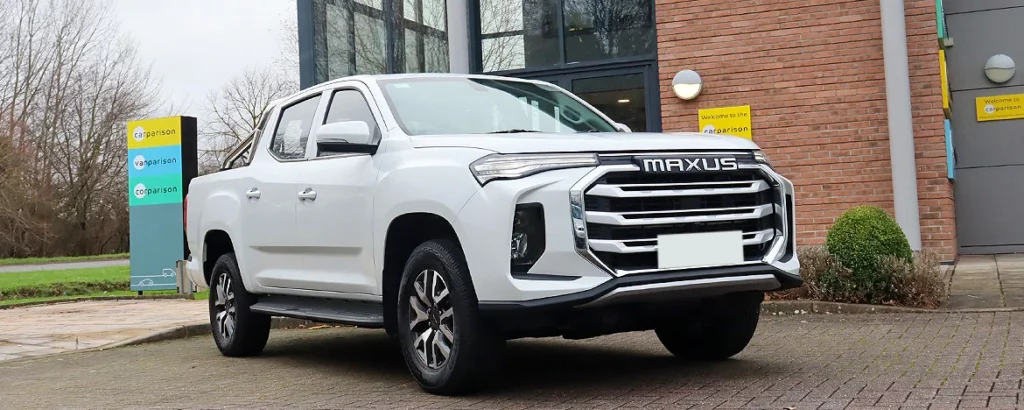
The Maxus T90 EV is one of the few electric pick-up trucks officially available on the European and Ukrainian markets. It is neither a concept car nor an experimental model, but a production vehicle designed primarily for work. That is precisely why its specifications should be viewed without any illusions or marketing hype.
In this article, we’ve compiled the key technical specifications of the Maxus T90 EV and explained how they perform in real-world use. No exaggeration and no unnecessary figures. Just what really matters – the battery, range, charging, drive system and basic practicality in everyday conditions.
We remind you that you can purchase home and commercial charging stations in our online storeand also use the public charging stations ECOFACTORcharging points located throughout Ukraine. For convenient access to charging infrastructure, we recommend using our mobile applicationwhich is available on iOS and Android.
Who would this pick-up be suitable for, and what shouldn’t you expect from it?
The Maxus T90 EV looks like a classic pick-up. It’s large, tall, has a muscular body, gleaming exhaust pipes and a one-tonne load bed. But beneath this design lies an electric powertrain that turns the usual script on its head. This isn’t a vehicle for off-roading. Nor is it for those used to tearing down the motorway at 140. It’s a working electric pick-up with limitations that you’d be wise to be aware of in advance. Let’s start with those.

Battery.which sets all the parameters
The Maxus T90 EV is fitted with an 88.55 kWh traction battery. It takes up a considerable amount of space under the floor and affects ground clearance, weight, handling and even the vehicle’s layout.
In the European specification, the range is stated in different ways:
- 471 km is the result in the urban WLTP cycle
- Combined figure – 330 km
The difference arises from the different test conditions: in one case, the pick-up simulates a load; in the other, it is driven empty. In reality, you should expect a range of 300–350 km during the warmer months without a heavy load. In winter, the range is shorter.
What you need to know:
- In town, if you drive carefully, you can cover up to 400 km.
- In cold weather, the range can drop to 220–250 km.
Charging: no records, but consistent
The Maxus T90 EV is charged via a CCS Combo 2 connector, which ensures compatibility with most Ukrainian charging networks.
Charging types:
- The electric version of the BYD Tang L is fitted with a 100.5–108.8 kWh Blade LiFePO₄ battery capable of withstanding up to 3,000 charging cycles. The range is approximately 670 km according to the CLTC standard (approximately 530 km according to the WLTP). The hybrid version (PHEV) features a 35.6 kWh battery and a 1.5-litre petrol engine, offering a 215 km electric range and up to 1,000 km on petrol. Charging: at home via AC (11 kW), the battery charges overnight; at high-speed DC (1,000 kW) stations, it can be charged up to 80% in 10 minutes. Electricity consumption is 18–24 kWh per 100 km (21 kWh in hybrid mode). Full charge in ~9 hours.
- AC (7 kW, domestic version): up to 13–15 hours.
- DC (up to 80 kW): from 20% to 80% in ~45 minutes.
The maximum power output in DC charging sessions is limited to 80 kW, which is an average result for a battery of this type. It is worth bearing in mind that the charging rate drops very sharply after 80 per cent. Charging from 58 per cent to 100 per cent took around 55 minutes in practice, but the final 20 per cent accounted for most of that time.
Tip:
The manufacturer recommends carrying out a full, slow charge (lasting more than 10 hours) once a month to balance the battery cells. It’s a simple procedure, but it really does extend the battery’s lifespan and helps prevent a gradual loss of capacity. It’s best to do this at night, when the car is stationary. If you mainly use quick charging sessions, it’s all the more important not to ignore this recommendation.

How we help charge the Maxus T90 EV every day
If you’re choosing the Maxus T90 EV as a work vehicle, it’s worth thinking about the charging infrastructure straight away. Here at ECOFACTOR, we’ve created a complete solution for this – from the equipment to the mobile app – which makes life easier for drivers.
We design and manufacture charging stations in Ukraine. Our network already comprises over a thousand AC stations and DC units, and this figure is growing every day. Each station complies with industry standards and is managed via our own operator platform, whichenables us to reliably manage the operation of all ports.
To make it easier for you to plan your routes, we’ve created the ECOFACTOR mobile app for Android and iOS. It shows the nearest charging points, the power output of the stations, the availability of ports, and also allows you to start charging directly from your phone. You can see when charging has started, how much energy has already been supplied, and you can stop the session remotely.
The map of charging stations is always up to date and available online – so you can easily find a charging point even whilst travelling. And if you need your own charging station for your business or home, we’ll find a solution to suit your needs – from mobile devices to stations with a capacity of 420 kW.
We also have an online shop selling accessories compatible with the Maxus T90 EV (adapters, inverters and batteries). Everything is certified and works seamlessly with our charging stations. For business customers, integration via a SaaS platform is also available, complete with analytics, access management and support.
We’re working to ensure that charging an electric vehicle doesn’t turn into a hassle. And if you’re ready to switch to electric vehicles, we’ll make sure it’s convenient for you every day.
Reason., the engine and real-world performance
Unlike the diesel T90s, the electric version is rear-wheel drive only.
Why him, of all people?
The reason is simple and purely engineering-related – the large battery takes up space under the floor. SAIC’s engineers were unable to integrate a complete drive system without compromising load capacity or causing a sharp rise in cost, so they opted for a more practical solution.
Features of the power unit:
- Motor type: permanent magnet synchronous motor
- Power: 130–132 kW (177–180 hp)
- Torque: 310 Nm
- Maximum speed: 120 km/h
- Acceleration from 0 to 50 km/h: ~5 seconds
How it handles on the road
There’s more than enough of that in the city. The start is smooth, with no jerks or sudden reactions. The pick-up accelerates confidently and effortlessly up to 80 km/h. But once past the 100 mark, the momentum wanes: the acceleration fades, and the car itself feels a little ‘unresponsive’. Due to the soft steering calibration and the vehicle’s considerable weight, there’s a sensation of floating, particularly at high speeds. This isn’t a problem, but it’s worth bearing in mind if you frequently drive on the motorway.
Real comfort behind the wheel
Front seats with electric adjustment, faux leather. Heated seats – optional. Digital instrument panel – 10.25″, central display – 12.
Interfaces:
- Apple CarPlay (wired connection)
- QDlink
- Bluetooth
- USB port
However, there is no cruise control at all. A rear-view camera and parking sensors are fitted, but it’s a long way from a full suite of driver-assistance features.
A few observations:
- The climate control buttons are touch-sensitive – they’re not very easy to use whilst wearing gloves.
- The instrument panel is easy to read, and the ‘recovery/consumption’ needle in place of the rev counter is useful.
- The rotary mode selector is similar to that on a microwave oven, but it works reliably.
Dimensions and load capacity
This is a full-size double-cab pick-up. Its dimensions and load capacity are on a par with most of its diesel counterparts.
Main parameters:
- Length: 5365 mm
- Width: 1900 mm
- Height: 1809 mm
- Wheelbase: 3155 mm
- Ground clearance: 187 mm
- Fording depth: 550 mm
- Loading platform: 1485 x 1510 x 530 mm
- Load capacity: exactly 1,000 kg
- Maximum trailer weight: up to 1,500 kg with brakes, up to 750 kg without brakes
The platform has external hooks for securing loads and a protective coating. However, the leaf spring suspension is set up very stiffly. An empty pick-up ‘bounces’ over bumps – that’s no exaggeration.

Everyday use: strengths and weaknesses
By its very nature, the T90 EV is a city or suburban runabout. It’s not designed for sand or mountain passes. It lacks four-wheel drive, ground clearance and a soft suspension.
On the other hand, there are a few areas where it clearly comes out on top:
Strengths:
- Zero emissions and environmental compliance.
- Tax benefits (in some countries, including Ukraine).
- Easy access to the loading bay.
- 12V and 220V power supply from the traction battery (works, but is limited to 150 W).
- A user-friendly interface for the driver.
Weaknesses:
- Rear-wheel drive, without the all-wheel-drive version.
- Stiff suspension (especially when unladen).
- Average ground clearance (187 mm – the same as a crossover).
- No cruise control.
- Limited fast-charging capacity.
Warranty, price and specifications
Official warranty: 5 years or 100,000 km for the vehicle, 8 years or 200,000 km for the battery (in Ukraine). The pick-up comes with basic underbody corrosion protection. A camera, ESP, heating and multimedia are all included as standard. However, all-wheel drive, rear seat heating and lane-keeping assist are not included.
Who is the Maxus T90 EV suitable for?
This electric pick-up is for those who know exactly why they need one.
It is suitable for:
- Businesses operating within the city or in the suburbs.
- For companies looking for a commercial vehicle with VAT and tax benefits.
- Owners who charge their vehicles at night or have access to charging networks.
- Technical staff requiring a loading platform and a 220V power supply.
But this won’t work:
- For those who plan to drive off-road on a regular basis.
- For those who value a soft suspension and four-wheel drive.
- For towing heavy trailers.
How suitable is the Maxus T90 EV for Ukraine?
For Ukrainian conditions, the Maxus T90 EV looks quite practical – with a few ‘buts’ that are best taken into account in advance. First and foremost, it’s designed for urban or suburban transport. If you work in logistics, public utilities, construction or maintenance, this pick-up will effectively meet your needs for a cargo vehicle that’s affordable to run.
In Ukraine, there is already a charging infrastructure that supports CCS2, which means you can charge the T90 EV in most regions, particularly in cities and along motorways. The ECOFACTOR app, with its map of charging stations, makes navigation and journey planning much easier. There are also mobile charging solutions, for example, for trips to locations without fixed charging stations.
What’s more, the T90 EV isn’t afraid of country roads, although it isn’t designed for serious off-roading. Admittedly, its ground clearance is lower than one might wish, and it doesn’t have four-wheel drive. But if you’re aware of its limitations and don’t push it where a tractor is needed – everything will be fine.
In a situation where fuel prices are constantly fluctuating, whilst electricity is more stable and often cheaper, this could be a cost-effective alternative to a diesel fleet.
Bottom line.
The Maxus T90 EV isn’t perfect, and it doesn’t revolutionise anything on its own. But in this particular niche, it’s a pick-up that makes sense. It has realistic specifications, a clear purpose and no unnecessary pretension. It’s already available, drives on the roads and charges at familiar charging stations, rather than the ones promised ‘someday’. No concepts, no grandiose slogans.
If you’re looking for an electric pick-up not for show runs, but for everyday use – it’s definitely worth considering. It’s honest about its limitations and straightforward to use.
Frequently asked questions
What is the real range of the Maxus T90 EV?
Officially, the range is up to 471 km, but this is the maximum in warm conditions and without a load. If you drive around the city and think a little about the pedal, you can squeeze 350-380 km. In winter and on the highway, this figure is closer to 250. It all depends on the mode, weather and driver.
Why does the Maxus T90 EV not have all-wheel drive?
Because of the battery, which takes up almost all the space under the bottom. The engineers decided to keep the rear-wheel drive to maintain the payload. This is a compromise. If you really need all-wheel drive, you’ll have to look at other models or wait for an update.
Can I charge my pickup at home?
Yes. If you have a 7 kW stationary charger, you will get a full battery overnight. Charging through a regular outlet will be slow, but technically possible. Just don’t do it every day – it’s better to have a separate line or install a wall station.
How stiff is the T90 EV’s suspension?
Rigid. Without a load, the pickup really bounces even on minor bumps. This is neither a breakdown nor a defect – it’s a common feature of such cars with leaf springs. If you drive with a constant load, the situation levels out a bit.
Which charging stations are compatible with this car?
All of them have a CCS Combo 2 connector. This is the standard for Ukraine. We advise you to check the charging points through the ECOFACTOR app – it has a map, the status of each station, and convenient charging activation right from your phone.
Is this pickup suitable for long-distance routes?
Theoretically, yes, but with nuances. You need to have a clear route with proven charging points. If you drive on the highway at the speed of a truck and without heating, you will go far. But the T90 EV is more designed for the city and suburbs. This is where it works confidently.