


Table of contents:
Fast direct current (DC) charging stations
In this article, we’ll look at the situations in which fast charging works best, how to use it properly, and what to bear in mind before plugging in.
We remind you that you can purchase home and commercial charging stations in our online storeand also use the public charging stations ECOFACTORcharging points located throughout Ukraine. For convenient access to charging infrastructure, we recommend using our mobile applicationwhich is available on iOS and Android.
What is a DC fast charger and why does it charge so quickly?
To understand how fast charging works, it’s worth starting with the basics. A battery electric vehicle stores energy in the form of direct current (DC). The electricity grid, on the other hand, supplies alternating current (AC).
During slow or standard charging (Level 1 or Level 2), the vehicle’s on-board charger converts AC to DC. It is this charger that limits the charging rate, as it has its own maximum power rating.
A DC fast charger works differently:
- converts the current to DC inside the stations
- supplies power directly to the battery
- bypasses the limitations of on-board charging devices
As a result, the power output can be tens of times higher.
Typical capacities:
- 50 kW – basic fast-charging stations
- 100–150 kW – a common standard on motorways
- 250–480 kW – ultra-fast HPC stations
In theory, this allows the battery to be charged to 80 per cent in 20–60 minutes, depending on the car.
Key differences from AC charges
Many drivers see fast charging as simply a ‘faster plug’, but in reality the difference is much more significant. A DC fast charger operates at a much higher power output, has a different charging architecture and a more sophisticated temperature control system. As a result, the equipment and electricity are more expensive, and the impact on the battery is more pronounced.
AC charging, on the other hand, is best suited for regular use at home or at work. It is slower, but gentler on the battery. A DC fast charger should be seen as a tool for situations where speed is the key factor, rather than economy or the long-term impact on the battery.
When should you use a DC fast charger, and when is it better to avoid it?
The easiest way to think of a DC fast charger is as a tool for emergency or high-demand situations. It helps to quickly top up the range when you can’t afford to wait several hours, but it is not intended for regular daily use.
Typical situations where fast charging is really needed:
- Long-distance travel. On the track, a long wait is simply impractical. A short stop of 20–40 minutes allows you to continue your journey without losing much time.
- Limited to a short time. When you need to leave urgently and the battery is almost flat.
- No domestic charges. Residents of high-rise blocks or tenants are often forced to rely on public infrastructure.
- Commercial use. Taxis , delivery services or corporate fleets cannot afford long periods of downtime due to slow charging.
Why you shouldn’t use fast charging all the time
Despite its obvious convenience, regular use of a DC fast charger has its drawbacks, so it is best regarded as a supplementary option rather than the primary method of charging. Fast charging is usually more expensive, places an additional thermal load on the battery and can contribute to its faster wear and tear if used constantly.
In addition, it depends on the availability of public charging points, which are not always conveniently located in everyday life. That is why most manufacturers recommend using slow AC charging as the standard option, and fast charging only in situations where saving time is truly important.
ECOFACTOR – fast charging, no fuss
At ECOFACTOR, we are building a charging infrastructure for electric vehicles in Ukraine, taking into account how drivers actually use DC fast chargers on a daily basis. Fast charging is needed precisely when it’s needed – on the road, between errands or whilst travelling. That is why we prioritise predictability: the station must be accessible, the process simple, and the result quick. To achieve this, we combine our own charging stations with digital services that make it easy to find a charging point and start a charging session without any unnecessary steps.
Our range includes AC and DC charging stations of various power ratings, suitable both for daily slow charging and for quick stops whilst on the road. This allows you to combine home charging with the use of DC stations on your journeys without compromising on convenience. For electric vehicle owners, it is important to have a choice, as fast charging works best as part of a system, rather than as the sole option.
Our online shop plays a key role, offering a range of chargers for home and business use, cables, adaptors and accessories required for various charging scenarios. This enables you to prepare for your journeys in advance and be confident that your car is compatible with the available infrastructure. Instead of making random purchases, drivers can find tried-and-tested solutions all in one place.
To help you navigate and manage your charging, we’ve developed a mobile app for iOS and Android. Through it, you can access a map of charging stations, check the status of charging points in real time, find fast DC charging points along your route, and start a charging session without any unnecessary steps. This approach allows you to plan routes based on your actual range and makes using a DC fast charger as straightforward as possible. We aim to make fast charging a routine part of your journey, rather than a source of uncertainty.
Optimal charge level for a DC fast charger: the 20–80 per cent rule
One of the key concepts when using a DC fast charger is the charging curve. The charging speed does not remain constant, but varies depending on the state of charge (SOC) of the battery.
The typical process is as follows:
- Initial stage – speed limited
- average range – maximum power
- after approximately 80% – a sharp drop in speed
- The final few per cent – charging is very slow
That is precisely why the most efficient range for fast charging is approximately 20%–80% SOC.
The advantage of this approach is that charging takes place at the fastest possible rate whilst minimising the strain on the battery. This allows for more efficient use of time and means you do not have to stay at charging stations any longer than necessary, whilst also freeing up the station more quickly for other drivers.
In addition, power output drops sharply in the upper charging range, so the final 20% can often take almost as long as the first 60%.
Why you shouldn’t charge to 100% at fast-charging stations
Technically, it is possible to charge the battery to full capacity using a DC fast charger, but there is little practical benefit to doing so. Once the charge reaches around 80 per cent, the charging rate drops sharply, which significantly increases the time spent at charging stations. Additionally, this leads to increased battery heating and a greater load on the battery. In most cases, it makes more sense to charge to around 70–80 per cent, carry on driving and, if necessary, make another short stop later on. This approach allows you to reach your destination more quickly whilst reducing the strain on the battery.
What determines the speed of a DC fast charger and the compatibility of the connection?
The rated power output of charging stations does not guarantee that the car will charge at exactly that rate. The actual result depends on several factors at the same time.
- Charging station capacity. The higher the power output, the greater the potential for fast charging, but this is merely the upper limit of what is possible.
- The vehicle’s maximum charging power. Each electric vehicle model has its own limit. If a vehicle can accept a maximum of 70 kW, it will not charge any faster, even at 350 kW charging stations.
- Temperature. Batteries. A cold battery charges more slowly, whilst an overheated one may limit power output to protect the system.
- Battery charge level at the start of the session. The highest speed is usually achieved in the mid-charge range.
- State of the infrastructure. In popular locations, bandwidth may be shared between several vehicles, which reduces the speed of each individual session.
Types of fast-charging connectors
Equally important is the vehicle’s compatibility with the charging station, as different regions and manufacturers use different connector standards.
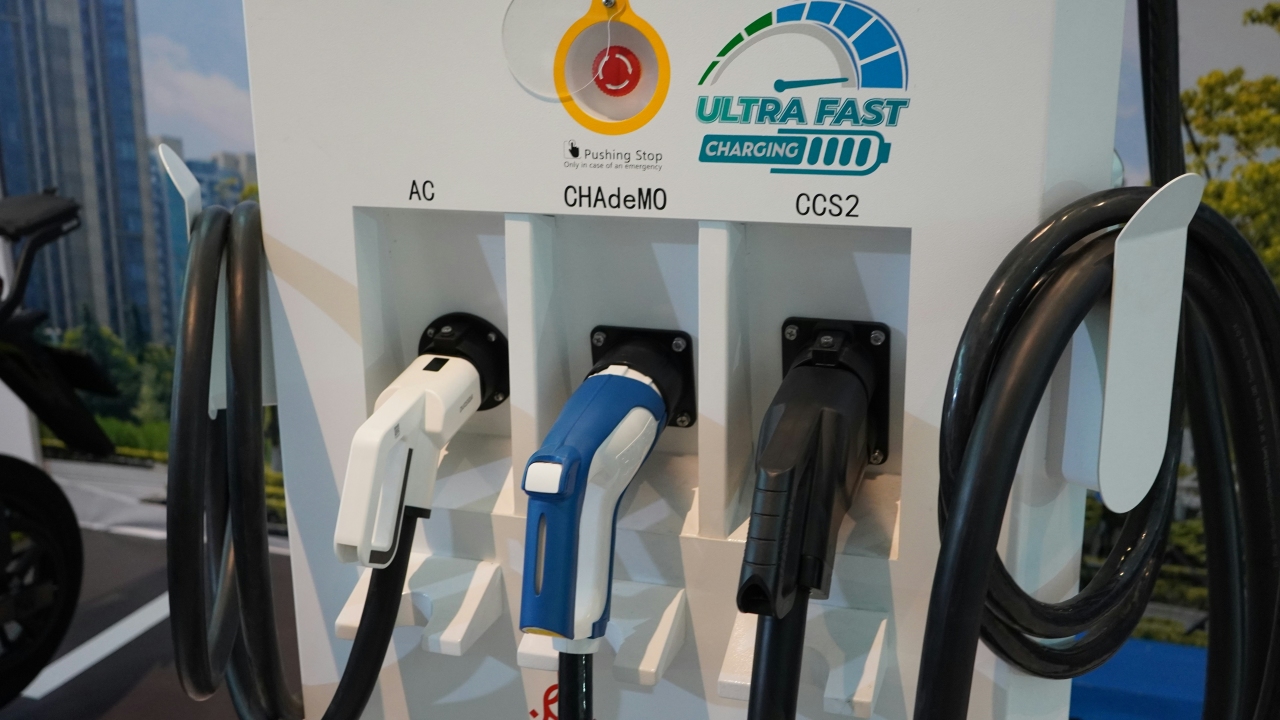
In North America, the CCS1 connector was the standard for a long time, but it is now gradually being replaced by the NACS standard (SAE J3400), which is used by Tesla and which most other manufacturers, including Ford, GM and Rivian, are switching to.
CCS2 is widely used in Europe; CHAdeMO is common on many Japanese models; the GB/T standard is used in China; and Tesla cars can be charged via the company’s own network or using adaptors.
Before setting off, you should check that the chosen charging station supports the required connector type; otherwise, it will not be possible to connect, regardless of the station’s power output.
The impact of a DC fast charger on the battery and charging costs
The issue of battery life is a concern for most electric vehicle owners, particularly when it comes to DC fast chargers, as high power output also means increased strain on the battery. During fast charging, the battery is subjected to high current, thermal stress, rapid changes in charge level and the active operation of cooling systems.
At the same time, modern electric vehicles are equipped with battery management systems (BMS) that constantly monitor temperature, permissible power, voltage and charging rate. This is precisely why moderate use of fast charging poses no danger, whilst a noticeable negative impact is likely to occur mainly in the event of continuous use without alternative charging methods.
DC fast chargers are also almost always more expensive than slow AC charging, due to the specific characteristics of the infrastructure and the operation of public charging stations. High-power equipment costs considerably more, requires complex connection to the mains, consumes large amounts of electricity and demands regular maintenance.
Furthermore, the price is influenced by the operators’ business model. That is why, for everyday use, the most economical option remains slow charging at home or at work, whilst fast charging is mainly used when you need to save time.
How to use a DC fast charger correctly
The process itself is fairly straightforward, but there are a few things to bear in mind that will help you avoid any problems.
Typical sequence:
- Parking correctly near stations
- Switch off the car
- Open the charging port
- Select the appropriate connector
- Connect the cable to the car
- Log in via the app, card or terminal
- Monitor the charges process
- End the session and disconnect the cable
Many modern stations allow you to monitor the process via a mobile app in real time.
Practical tips for maximum effectiveness
A few simple tips can significantly improve your user experience.
- Plan your stops in advance
- Please arrive at the station with a battery charge of 15–30 per cent
- Don’t wait for 100% unless you really need to
- Use trusted networks
- Keep an eye on the temperature of your radiator in winter
- Check that the connectors are compatible
Conclusion
DC fast chargers have made electric vehicles truly suitable for travel and active everyday use. Without fast charging, any long-distance journey would turn into a lengthy logistical challenge, whereas with it, an electric car becomes a normal mode of transport that simply requires a slightly different approach to planning. The key is to understand that this is a tool for saving time, not a replacement for all other charging methods.
The best strategy seems quite simple: use slow charging for everyday use, and fast charging when you need to top up your range quickly. If you maintain this balance, taking into account the charge level, battery temperature and the vehicle’s specific characteristics, the DC fast charger works exactly as intended – quickly, predictably and without unnecessary risks to the battery.
Frequently asked questions
1. Can you use a DC fast charger every day?
Technically, you can, but it’s not the best approach. Constant fast charging is more expensive and puts more strain on the battery, so manufacturers recommend using it only when necessary and carrying out most charging at a slower rate.
2. How long does it take to fast-charge an electric vehicle?
In most cases, it takes between 20 and 60 minutes to reach approximately 80 per cent charge. The exact time depends on the power of the charging stations, the car model, the battery temperature and the initial charge level.
3. Why does charging slow down significantly after 80 per cent?
This is normal battery behaviour. When the charge level is high, the system reduces the power output to prevent overheating and minimise cell wear. This is why the last few per cent take considerably longer to charge.
4. Is fast charging harmful to the battery?
Moderate use is not a problem, as the car regulates the process itself via the battery management system. The risks only increase when fast charging is used constantly without any alternatives.
5. Do you need to charge an electric car to 100% before setting off?
In most cases, no. For everyday journeys, 70–90 per cent is sufficient, whilst on high-speed lines it is usually better to stop at around 80 per cent and carry on.
6. What should you do if the charging speed is lower than expected?
This may be caused by a cold or overheated battery, a high charge level, a limitation of the vehicle itself, or the distribution of power amongst several vehicles at the charging station. This does not necessarily indicate a fault.