

Table of contents:
Hyundai Kona Electric is one of the most popular electric vehicles in Ukraine. And this is not surprising: a reasonable price, a normal range, and compact dimensions. But the first question that potential owners have is how and where to charge it?
After analysing the real-life experience of owners and official data, I have prepared the most practical guide possible. There will be no water here – only specifics about the types of charging, battery charge time, and where to find charging stations throughout Ukraine.
We remind you that you can purchase home and commercial charging stations in our online storeand also use the public charging stations ECOFACTORcharging points located throughout Ukraine. For convenient access to charging infrastructure, we recommend using our mobile applicationwhich is available on iOS and Android.
Hyundai Kona Electric charging types: what the car supports
Kona Electric supports two main types of charging: alternating current (AC) and direct current (DC). Depending on the version – 39 kWh or 64 kWh – the characteristics are slightly different, but the principle is the same.
Type 1 is used for alternating current (AC) charging and CHAdeMO is used for fast direct current (DC) charging. Before purchasing a mobile charging station, you should check compatibility with these standards.
For fast charging with direct current (DC), Kona uses the CCS Combo 2, which is the same Type 2 but with additional contacts on the bottom for high power transfer.
| Charging type | Connector | Power | Time up to 100% (64 kWh) |
|---|---|---|---|
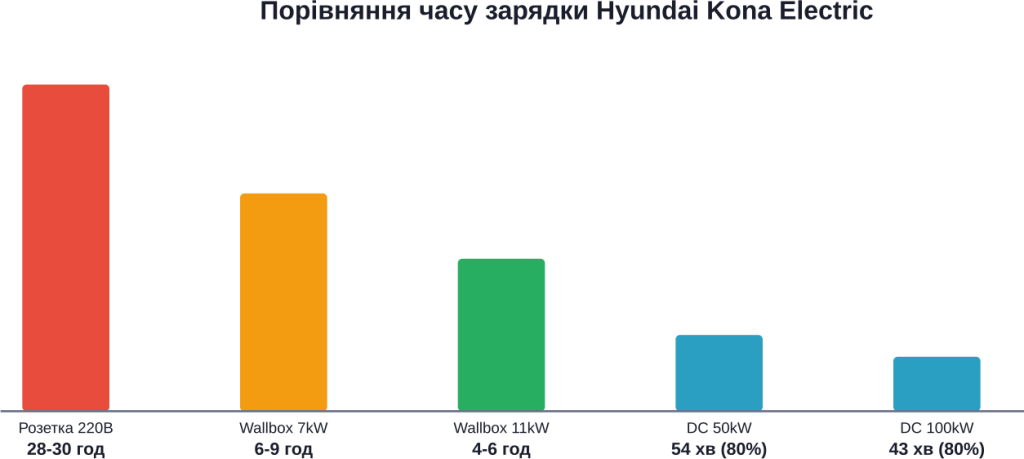
| Home socket (Level 1) | Conventional 220V | 2.3 kW | 28-30 hours |
| Wallbox (Level 2) | Type 2 | 7.2-11 kW | 6-9 hours |
| Fast charging (Level 3) | CCS Combo 2 | 50-100 kW | 54 min (up to 80%) |
Charging from a 220V home socket
The easiest option is to plug the standard ICCB cable (included) into a regular wall socket. The power output is limited to 2.3 kW, so the 64 kWh version will take more than a day to fully charge.
But there is a nuance here. If you drive around the city 30-50 km a day, you can easily replenish the spent charge overnight at a regular outlet. The real-life experience of owners shows that this is enough for most users for their daily needs.
Wallbox – the optimal solution for your home
The 7.2 or 11 kW wall charger is the golden mean. It connects to a 380V (three-phase) or 220V (single-phase) network and charges the Kona in 6-9 hours to full.
The cost of installation together with the equipment varies depending on the capacity and functionality.
Fast charging: DC stations in Ukraine
When you need to recharge quickly – on the road or when you’re actively using your car – fast DC charging stations come to the rescue. The Hyundai Kona Electric (2018-2023) supports up to 77 kW on the 64 kWh version. The 39.2-kWh version also supports up to 50 kW (actually up to 44-50 kW), but the 10-80% charging time is the same when using a 100 kW station – approximately 47 minutes.
Most DC stations in Ukraine deliver 50 kW. At the 50 kW Kona Electric station (64 kWh), the battery is charged from 10% to 80% in 64 minutes. Why up to 80% and not 100%? Because after 80%, the charging rate drops sharply – this is the battery’s protective mechanism.
At fast 100 kW stations, charging from 10% to 80% takes 47 minutes for first-generation models and 41-43 minutes for second-generation models (2024+). But there is a caveat here: the car itself limits the current intake to 77 kW, so the difference between a 100 kW station and a 350 kW station for Kona will be insignificant.
How ECOFACTOR Helps You Charge Your Car
When you charge your Hyundai Kona Electric, three things are usually important: finding a suitable station (Type 2 or CCS Combo 2) quickly, understanding the conditions on site, and starting the session without nerves. That’s why we built ECOFACTOR as an ecosystem – we produce AC and DC
For Kona owners, it’s convenient at home and on the road: open the app, find a nearby point, connect and control the charging without any extra steps. We also have our own infrastructure base – 18,000+ AC/DC stations of our own production, 215,000+ drivers in the app community, and 3,500+ charging ports on the platform. You can find them on the interactive
In addition, our online store ECOFACTOR you will find all the necessary accessories, inverters and mobile chargers.
How much does it cost to charge a Hyundai Kona
The cost depends on where you charge:
| Charging type | Cost per kWh (approximate) | Full charge 64 kWh |
|---|---|---|
| At home (day rate) | 4.32 UAH | ~276 UAH |
| At home (night rate) | 2.16 UAH | ~138 UAH |
| Public AC station | 6-10 UAH | 384-640 UAH |
| Fast DC station | 12-18 UAH | 768-1152 UAH |
It is most profitable to charge at home on a nightly tariff. If you install a Wallbox and connect differentiated electricity metering, it will cost significantly less to refuel your Kona compared to fuel-efficient cars with the same range.
Practical advice from the owners
After analysing the experience of Hyundai Kona Electric owners, he highlighted the key points that are rarely written about in official instructions.
Problem with the 12V battery
The automatic 12V battery recharging system (Aux. Battery Saver+) in Hyundai Kona Electric stops working if the charge level of the high-voltage battery drops below 20% (in some firmware, the limit may be higher, but the threshold of 20% is critical).
Solution: keep the main battery above 40%, or install a high-quality 12V battery after 2-3 years of operation.
Optimal charging range
Do not continuously charge up to 100% and discharge below 10-15%. The optimal range for daily use is 20-80%. This extends the battery life.
Only charge to 100% before long journeys. And even then, it’s better to charge to 90% and top up at a fast charging station on the road than to wait for hours for the slow last 10%.
Vehicle-to-Load (V2L) function
The second-generation Kona Electric (model year 2024 and later) supports V2L, which means that the car’s battery can be used as a power source. Through a special adapter, you can connect household appliances with a power of up to 3 kW. Useful for camping, emergencies or working on the road.

Charging in winter: features of the cold season
Charging efficiency decreases in winter. The battery needs to be preheated to receive full power. If you arrive for a fast charge with a cold battery, the power will be limited for the first 10-15 minutes.
The owners recommend: before fast charging in cold weather, drive 15-20 km in active acceleration mode. This will warm up the battery and charge faster.
Also, keep in mind that the driving range may be reduced in winter due to the heating of the cabin and reduced battery efficiency at low temperatures.
Do you need a separate meter for charging at home
Technically, no, it is not necessary. But economically, it is highly desirable. By installing a separate meter with differentiated metering (day/night), you will pay less for nighttime charging.
The installation procedure is standard: applying to the regional power company, approving the project, and installing the meter. It pays off in a few years of active use of the electric vehicle.
Summary: what you need to know about Kona charging in Ukraine
Hyundai Kona Electric is a great choice for Ukraine. Charging station infrastructure is developing, especially in large cities and along major highways. The number of electric vehicles and charging infrastructure continues to grow.
For comfortable use, it is optimal to be able to charge at home – from the Wallbox or at least from a regular power outlet. This covers most of your charging needs. Use the fast DC stations for long journeys or when you need to top up quickly.
Switching to an electric vehicle has its own nuances, but the fuel savings, low maintenance and environmental benefits will have a positive impact on your experience.
Ready to switch to an electric car? Hyundai Kona Electric is a great start in the world of electric transport. Explore the map of charging stations in your area, calculate the cost of installing a home charger, and join the community of electric car owners in Ukraine.
Frequently asked questions
Can I charge the Hyundai Kona from a regular outlet?
Yes, you can. Kona is supplied with an ICCB cable for charging from a 220V household outlet. The power is limited to 2.3 kW, so a full charge will take 28-30 hours for the 64 kWh version. This is enough for daily recharging after 30-50 km of driving.
How long does fast charging take at a DC station?
At a 50 kW station, the Kona charges from 10% to 80% in approximately 54 minutes. On more powerful 100 kW stations, the time can be shorter. Charging the latest 20% (from 80% to 100%) takes significantly longer, so it is more cost-effective to charge to 80% and then continue on your way.
Do I need to install the Wallbox at home?
Not necessary, but very convenient. The 7-11 kW Wallbox charges Kona in 6-9 hours, which is comfortable for overnight charging. Without it, you’d have to use slow charging from a power outlet or go to public stations more often. The installation pays for itself in a few years of savings.
Why is the 12V battery in the Hyundai Kona discharging?
This is a problem reported by some owners of 2019-2021 models. The auxiliary 12V battery may discharge if the traction battery is below 40% and the car is not used for a long time. The solution: keep the main battery above 40%, or replace the standard 12V battery with a better one after 2-3 years of use.
What is the optimal charging range for the battery?
For daily use, keep the charge between 20% and 80%. This extends the battery life. Charge to 100% only before long journeys. Avoid a full discharge below 10% – this is the most damaging to the battery.
Does Kona support Vehicle-to-Load?
For example, second-generation models from 2024 and later support V2L. Using a special adapter, you can power household appliances with a capacity of up to 3 kW from the car battery. Useful for camping, emergencies, or as a backup power source.