


Table of contents:
Electric trucks are no longer a futuristic dream – they are here and now. In 2026, the Ukrainian commercial vehicle market is undergoing a real revolution, with businesses increasingly turning to electric solutions. Fuel savings, reduced emissions and new charging technologies make electric trucks a real alternative to diesel models.
But which models are best suited for our roads? Which manufacturers offer the most reliable solutions? And what do you need to know before buying? Let’s find out.
We remind you that you can purchase home and commercial charging stations in our online storeand also use the public charging stations ECOFACTORcharging points located throughout Ukraine. For convenient access to charging infrastructure, we recommend using our mobile applicationwhich is available on iOS and Android.
Why electric trucks are becoming popular in Ukraine
The transition to electric traction in commercial transport is not just a trend, but an economic necessity. The cost of operating an electric truck is significantly lower than that of a diesel truck, especially when it comes to urban and regional transport.
According to some manufacturers, operating costs are significantly reduced and maintenance requires less time and money. The absence of emissions makes electric trucks ideal for use in cities where environmental regulations are becoming increasingly stringent.
In addition, the European Commission proposed a new Euro 7 standard in November 2022, which tightens emission requirements for all types of vehicles. The new Euro 7 standard will only come into force for trucks and buses from 28 May 2028 (for new types) and 28 May 2029 (for all new vehicles).
Top 5 electric trucks for the Ukrainian market
Scania with MCS megawatt charging technology
Scania introduced MCS-enabled trucks and opened orders for them in early 2026, but the first successful real-world tests and prototype demonstrations took place in 2024-2025. This is a real breakthrough for long-haul transport.
According to Scania, the new battery-electric trucks are capable of delivering a significant range on a single charge. The MCS system significantly reduces charging times, which is critical for logistics companies.
These trucks are suitable for a wide range of applications, from city deliveries to regional routes. Scania offers a complete solution, including advice on charging infrastructure.
Volvo FL Electric – the city leader
Volvo FL Electric is positioned as the ideal solution for urban transport. This model is built on the principles of quality, safety and environmental care that have always been Volvo’s hallmark.
The 100% offers emission-free operation, making it a great choice for businesses with an environmentally conscious approach. For companies that operate in city centres with emission restrictions, it is the best choice.
Volvo also offers the VNR Electric model for heavier duty and regional routes, expanding the options for different business segments.
Mercedes-Benz eActros 600
The Mercedes-Benz eActros 600 sets a new standard for long-haul electric transport. With its impressive range, this model is able to compete with conventional diesel trucks over medium distances.
The German manufacturer has invested in the development of efficient batteries and energy management systems. The result is a truck that combines power, reliability and environmental friendliness.
Tesla Semi – an American innovation
The Tesla Semi remains one of the most anticipated models on the market. Although the company’s main focus is on the US market, Tesla’s technology is having an impact on the entire industry.
The truck promises a high range, which makes it competitive even for long routes. The charging time is one of the fastest in the class, which is one of the best indicators.
Renault Master Z.E. – a compact solution
Renault Master Z.E. continues to be a popular choice for small and medium-sized businesses. It is a compact electric truck ideal for urban deliveries and courier services.
The new Renault Master E-Tech (model 2024-2026) has a range of up to 460 km (WLTP) thanks to an 87 kWh battery, while the Master Z.E. compensates with its agility, affordable price and low running costs.

Charging infrastructure: challenges and solutions
Charging infrastructure remains the biggest obstacle to the mass adoption of electric trucks. Unlike passenger electric vehicles, commercial vehicles require more powerful charging stations.
The MCS system that Scania is introducing in 2026 promises to revolutionise charging speeds. But this requires the right infrastructure along key logistics routes.
For example, major manufacturers, including Scania and Volvo, offer comprehensive solutions. They help companies develop an optimal charging strategy and select the right equipment.
| Model. | Charging time up to 80% | Charging type |
|---|---|---|
| Tesla Semi | 40 minutes | Own network |
| Nikola Tre BEV | 90 minutes | 350 kW system |
| Volvo FL Electric | 140 minutes | Station 150 kW |
| Scania MCS | Less than 45 minutes | Megawatt system |

Charging an electric truck under control with ECOFACTOR
When businesses switch to electric trucks, we almost always see the same reality: the equipment is ready, but the charging needs to be predictable on a daily basis. That’s why at ECOFACTOR, we don’t just build a single station, but a complete system – we design, manufacture and service charging stations, connect them to the operator platforms and provide tools for drivers. We select the equipment format to suit the different tasks of the fleet: mobile chargers for flexible scenarios, AC stations up to 44 kW for base, warehouse, urban locations, and DC stations up to 420 kW where quick stopping and high vehicle turnover are required.
For drivers and dispatchers, one simple question is key: where to charge and whether there’s a free charging point available right now. Our mobile app for Android and iOS features a charging map showing locations, connector types, power output, real-time charging point status and tariffs. This takes the pressure off during journeys, especially when routes are busy and stop times are limited. And if you’re building your own infrastructure, the platform helps you manage your network, rates and station operations without the hassle of juggling different services.
We also have online shop, where you can choose charging equipment, accessories and inverters tailored to a specific fleet and usage scenario. In practice, this is convenient: there’s no need to piece together solutions bit by bit when you urgently need a cable, an adapter or an additional kit for a new vehicle. We view charging as part of the fleet management system, rather than as a one-off purchase. And yes, it sounds pragmatic, but that’s exactly how it works in commercial transport.
The economic viability of electric forklift trucks
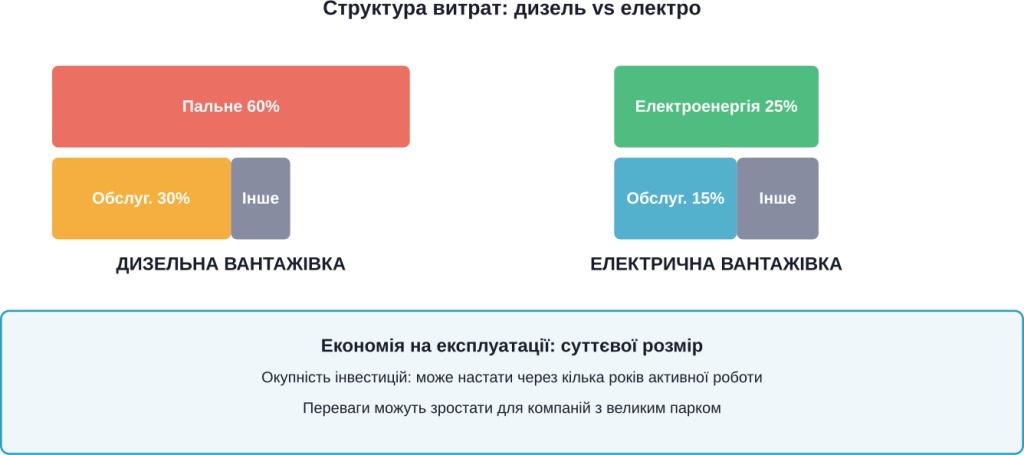
The initial cost of an electric lorry is higher than that of a diesel one. But that’s only part of the picture. Let’s be honest: running costs change the whole economic picture.
Electricity costs considerably less than diesel fuel. Maintenance is simpler — there are fewer parts that wear out. No oil, filters or complex exhaust systems.
According to estimates by some manufacturers, the break-even point can be reached after several years of active use. For companies with a large fleet and regular routes, this makes the switch economically viable.
Technical characteristics: What to look for when choosing
Choosing an electric lorry is not just about buying a vehicle. It is an investment in infrastructure and a change to operational processes.
Firstly, take a look at your usual routes. If most of your journeys are under 300 km, virtually any modern model will do. For longer distances, you’ll need models with a greater range.
Secondly, assess the availability of charging infrastructure. Where will you be charging — at your own premises or at public charging points? This has a significant impact on operational efficiency.
Thirdly, take the payload capacity into account. Some models, such as the Nikola Tre BEV, have a substantial payload capacity, making them suitable for heavy loads.
Conclusion
Electric lorries in 2026 are no longer an experiment, but a viable solution for Ukrainian businesses. From the compact Renault Master Z.E. for courier services to the powerful Scania with MCS technology for long-haul routes — there is a choice for every segment.
The key benefits are clear: lower running costs, environmental friendliness and less maintenance. Yes, the initial investment is higher, but the payback period is shorter than many people think.
Ready to take the leap into an electric future? Start by analysing your routes and needs. Consult your local Scania, Volvo or Mercedes-Benz dealers about the models available and the terms and conditions. The future of commercial transport is already here — and it runs on electricity.