


Table of contents:
The Nissan Leaf remains one of the most popular electric vehicles in the world, but many owners and prospective buyers have questions about charging. What type of charging connector does the Leaf use? How long does it take to charge? Can I charge it at home?
These issues aren’t just technical details — they directly affect your day-to-day experience of using an electric vehicle. Understanding the different types of chargers will help you plan your journeys, save time and extend the life of your battery.
In this guide, we’ll look at all aspects of charging the Nissan Leaf: from the basic connectors to the best charging strategies.
We remind you that you can purchase home and commercial charging stations in our online storeand also use the public charging stations ECOFACTORcharging points located throughout Ukraine. For convenient access to charging infrastructure, we recommend using our mobile applicationwhich is available on iOS and Android.
Charging connectors for the Nissan Leaf: J1772 and CHAdeMO
The Nissan Leaf is fitted with two types of connectors for different charging methods. This is no coincidence — each connector is designed for specific tasks and charging speeds.
J1772 connector for AC charging
J1772 is a standard connector for alternating current (AC) charging, used by virtually all electric vehicles in North America and many other regions. In accordance with the IEC 62196-2:2022 standard, this type of connector ensures compatibility between different manufacturers and charging stations.
The J1772 connector is located behind the charging port on your Leaf and is used for:
- Charging at home from a standard 220V socket (Level 1)
- Charging from domestic or public 240V charging points (Level 2)
- A slower but gentler charging process for the battery
AC charging of the Nissan Leaf via the AC socket is usually limited by the on-board charger to 3.3 kW or 6.6 kW (depending on the model year and specification).
But there’s a caveat: if you don’t charge the 100%, the actual mileage between charges will be shorter. Below are the approximate figures for each of the models if you follow the “smart” charging mode: The charging power depends not only on the car, but also on the capabilities of the charging station.
CHAdeMO connector for fast charging
CHAdeMO is a connector for fast direct current (DC) charging, developed by Japanese car manufacturers. The Nissan Leaf is fitted with a CHAdeMO connector as standard or as an option, depending on the model and year of manufacture.
In accordance with the IEC 62196-6:2022 and IEC TS 62196-4:2022 standards, the CHAdeMO connector provides high-power fast charging whilst complying with electrical insulation and safety requirements.
CHAdeMO is used at special fast-charging stations and can:
- Charge the battery to 80% in 40–60 minutes
- To supply power of up to 50 kW (older stations) or 100+ kW (newer stations)
- Significantly reduce journey times
It is important to note that the CHAdeMO connector is separate from the J1772 connector and is located next to it under the same charging port cover.

Charging options: from a domestic socket to fast-charging stations
Now that you understand the different types of connectors, let’s take a look at the different charging levels. This classification will help you choose the best charging method depending on the situation.
Level 1: charging from a standard socket (220V)
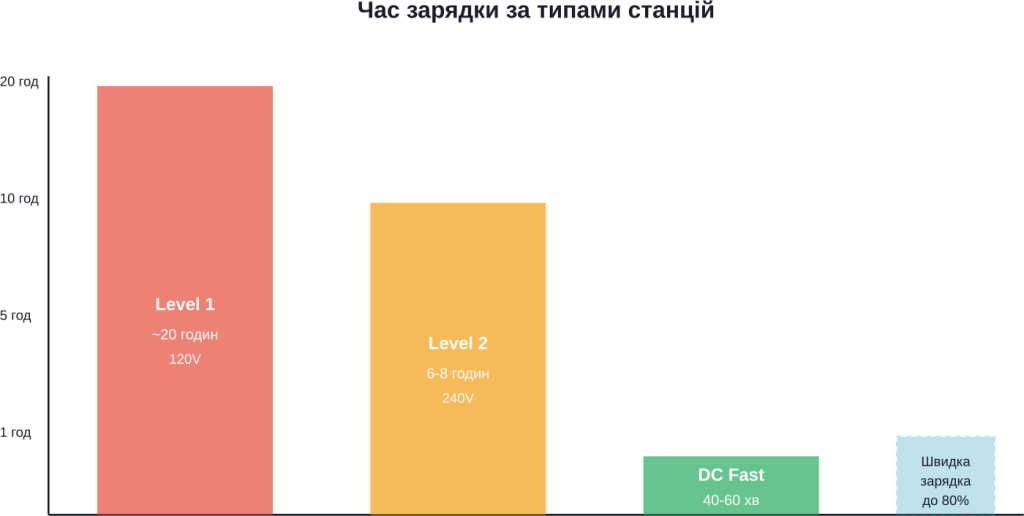
Level 1 is the slowest but most accessible way to charge. You simply plug the Leaf into a standard 220V domestic socket using the charging cable supplied with the car.
The charging time from zero to 100 per cent is around 30 hours. Sounds like a long time? It is. But if you drive 30–40 km every day and charge your car overnight, that’s quite enough.
Level 1 is ideal for:
- Owners with the lowest daily mileage
- Top-ups, not full charges
- Situations where there is no access to more powerful chargers
Level 2: domestic and public charging points (240V)
Level 2 offers the ideal balance between speed and accessibility. These charging points operate on 240V and provide a power output of between 3.3 and 6.6 kW.
According to leading sources, a Level 2 charge takes 6–8 hours to fully charge the battery. This makes such stations ideal for installation at home or at work.
Here’s what you need to know: Level 2 charging points are widely available in cities across Ukraine and in the car parks of shopping centres, hotels and office buildings.
DC fast charging: CHAdeMO stations
Fast DC charging via the CHAdeMO connector is the quickest way to charge the Nissan Leaf. 50 kW charging points can charge the battery to 80% in 40–60 minutes.
Why only up to 80 per cent? This is down to the physics of batteries. The final 20 per cent of the charge always takes longer to complete, as the battery is protected against overheating and degradation.
According to sources, these stations are available in Ukraine’s major cities and along key transport routes, making them ideal for long journeys.
Fast charging is best for:
- Intercity travel
- Emergencies when you need to charge your device quickly
- Recharging during short stops
However, you shouldn’t overuse fast charging for everyday use — it accelerates battery degradation compared to Level 2 charging.
Installing a home charging station
If you’re planning to use the Nissan Leaf as your main car, a Level 2 home charging station is practically a must-have investment.
Choice charging equipment
For a Level 2 home charging point, you will need a charging station (EVSE — Electric Vehicle Supply Equipment) with a J1772 connector. The power output can range from 3.3 to 6.6 kW.
What to consider when choosing:
- The capacity of your electricity supply (will the wiring be able to cope with the load?)
- Budget for equipment and installation
- The required speed of the charges
- The length of the cable (usually 5–7 metres is sufficient)
Most owners choose the 6.6 kW stations as the best option for home use.
Installation process
Installation must be carried out by a qualified electrician.
The process usually involves:
- Assessment of your electricity supply and meter
- The electrical distribution board may need upgrading
- Installation of a separate 240V circuit
- Installation charging station
- Testing and configuration
Installation usually takes one day, but the preparatory work may take longer.
Optimising charging for maximum battery life
The right charging strategy can significantly extend the battery life of your Nissan Leaf. Here’s what you need to know.
Support for the optimum charge level
Lithium-ion batteries perform best when their charge level is between 20% and 80%. Regularly discharging them completely or keeping them constantly at 100% accelerates degradation.
Practical tip: charge to 80% for everyday journeys and to 100% only before long journeys.
Frequency of rapid charges
CHAdeMO fast charging is convenient, but it generates more heat and puts more strain on the battery. General recommendation: no more than 20–30 per cent of all charging sessions should be fast charges.
For everyday use, always opt for Level 2 charging.
Where to charge a Nissan Leaf: home vs public charging points
Each type of charge has its own advantages, depending on your situation.
Advantages of domestic charges
Charging at home offers maximum convenience. You arrive in the evening, plug in your car, and wake up to a fully charged battery.
Pros:
- The lowest electricity price (domestic tariff)
- Charging at a time that suits you
- There’s no need to look for a free station
- A gentler charging mode for the battery
When to use public stations
Public charging points are indispensable for travelling and in situations where home charging isn’t sufficient.
Public charging is useful for:
- Long journeys between cities
- Charging whilst out and about in town
- Situations where you haven’t had time to charge your phone at home
- Owners unable to pay their household bills
In Ukraine, the network of public charging stations is expanding rapidly, making the use of electric vehicles increasingly convenient.
| Station type | Cost | Convenience. | Speed | Best for |
|---|---|---|---|---|
| Home Level 1 | ★★★★★ | ★★★★★ | ★☆☆☆☆ | Minimal mileage |
| Home Level 2 | ★★★★☆ | ★★★★★ | ★★★☆☆ | Daily use |
| Public Level 2 | ★★★☆☆ | ★★★☆☆ | ★★★☆☆ | City, car parks |
| CHAdeMO fast | ★★☆☆☆ | ★★★★☆ | ★★★★★ | Travel, motorway |
Charging infrastructure for Nissan Leaf from ECOFACTOR
For Nissan Leaf owners, convenient access to charging points is a basic necessity. This electric car is often used both for daily trips around the city and for journeys between cities, so it is important to have a reliable charging infrastructure at home and along the route. ECOFACTOR is developing a charging ecosystem that allows the Nissan Leaf to be used hassle-free across Ukraine.
The company installs and maintains state-of-the-art charging stations for a range of usage scenarios. Its network includes AC solutions for homes and offices, as well as fast DC stations for motorways and public locations. This enables Nissan Leaf drivers to plan their journeys with ease and find convenient charging points nearby.
The ECOFACTOR mobile app for iOS and Android is designed for everyday use. The app includes a map of charging stations, where you can check the status of charging points, select the nearest location, plan a route and pay online. This is particularly handy when you need to quickly find a charging point in an unfamiliar area or whilst travelling.
Operates separately online shop ECOFACTOR, in which it was presented chargers for different operating conditions, as well as cables and adapters and related accessories. This allows Nissan Leaf owners to find the best solution for both private garages and business premises or car parks.
ECOFACTOR therefore brings together charging stations, digital services and equipment into a comprehensive system, ensuring that using the Nissan Leaf remains simple, predictable and convenient every day.
Practical tips for effective charging
Now let’s look at a few practical tips to help optimise the charges process.
Charging schedules for long journeys
Before setting off on a long journey, plan your route taking into account the locations of CHAdeMO stations. Use apps such as PlugShare or other maps of charging stations.
Travel strategy:
- Start your journey with a 100% charge
- Plan your stops when the battery is at 15–20 per cent
- Charge up to 80% at fast-charging stations (not to 100% — this saves time)
- The last 20 per cent takes the longest to charge, so it’s best to drive a bit further
Savings. whilst charging
The cost of charging depends on the time of day and the type of charging station.
How to save money:
- Charge at home at night at a lower rate
- Use the free charging points in shopping centres
- Avoid fast-charging stations for routine charging (they’re more expensive)
- Take a look at the loyalty schemes offered by charging network operators
Things to do in winter
Cold weather reduces battery capacity and increases charging time. This is normal for all electric vehicles.
Winter tips:
- Heat the cabin whilst charging (when connected to the mains)
- Park in the garage if possible
- Allow for 20–30 per cent less range
- Charge more frequently and avoid letting the battery run completely flat

Conclusion
Understanding the different types of Nissan Leaf chargers is key to enjoying your electric vehicle. The J1772 connector for everyday AC charging and the CHAdeMO connector for fast charging whilst on the move offer flexibility for any situation.
The best strategy for most owners: install a Level 2 home charging station, charge to 80% for daily journeys, and use CHAdeMO fast charging only for long journeys. This approach strikes a balance between convenience and maximising battery life.
The network of charging stations in Ukraine continues to expand, making the Nissan Leaf an increasingly practical choice for everyday use and travel. A proper understanding of the charging options allows you to fully realise the benefits of an electric vehicle without compromise.
Ready to make the switch to an electric car? Start by analysing your daily mileage and home charging options — this is the foundation for a comfortable experience with the Nissan Leaf.
Frequently asked questions about charging the Nissan Leaf
Can you charge a Nissan Leaf at Tesla charging stations?
In Europe and Ukraine, most Tesla Supercharger and Destination Charger stations are equipped with a standard Type 2 or CCS2 connector. The Nissan Leaf can use Destination Chargers (via Type 2), but cannot charge at Superchargers, as these operate on the CCS2 protocol rather than CHAdeMO.
How much does it cost to fully charge a Nissan Leaf?
The total cost of charging depends on the battery capacity and the local electricity tariff. At public charging points, the price may be higher, particularly at fast CHAdeMO charging points.
Can you leave your Nissan Leaf plugged in to charge overnight?
Yes, it is completely safe. Once fully charged, the system automatically stops the charging process. Furthermore, connecting to the mains allows you to use electricity to cool the passenger compartment without draining the battery.
How often does the Nissan Leaf need to be charged?
It depends on your daily mileage. Most owners charge their car every night at home, even if the battery isn’t completely flat. This approach ensures maximum range every morning and is more convenient than waiting for the battery to run completely flat.
Does the charging speed decrease when the battery is low?
On the contrary, charging is fastest when the battery level is low (20–50 per cent) and slows down as it approaches 80–100 per cent. This is a protective mechanism designed to preserve the battery’s health. That is why it is recommended to charge to no more than 80% at fast-charging stations.
Do you need special equipment to charge a Nissan Leaf at home?
For Level 1 charging (220V), no additional equipment is required — the cable is included. For Level 2 (240V), a separate charging station needs to be installed, which requires the work of an electrician but significantly reduces charging time.
What should you do if a CHAdeMO socket is occupied at a charging station?
Most fast-charging stations have several sockets, but if the CHAdeMO socket is in use, you’ll either have to wait (fast charging takes 40–60 minutes) or find another station nearby. Plan your routes to include a few alternative stations.