


Table of contents:
If you own an electric car or are considering it, the cost of charging becomes a critical issue. ChargePoint operates one of the largest networks of charging stations in North America and Europe, but how much does it really cost to use their services? The answer is not as simple as we would like. Unlike Tesla’s Supercharger network, which has uniform pricing, ChargePoint operates as an open platform. It is […]
The answer is not as simple as we would like. Unlike Tesla’s Supercharger network, which has uniform pricing, ChargePoint operates as an open platform. This means that station owners – be they hotels, shopping malls, businesses or municipalities – set their own rates.
We’ll look at all aspects of ChargePoint pricing, from public charging fees to home station installation costs and commercial business solutions.
We remind you that you can purchase home and commercial
How the price is formed at public ChargePoint stations
According to ChargePoint, stations managed through the ChargePoint platform are independent entities. Each station owner or roaming partner independently determines the cost of using its stations. ChargePoint processes payments for paid charging sessions on behalf of the station owner or partner.
This is a key point. ChargePoint does not set a single tariff for the entire network.
Types of charging at ChargePoint stations
Station owners can choose different charging models:
- Per kilowatt-hour (kWh) – you pay for the actual amount of energy that has entered the battery of your car
- Hourly pay – fixed fee for each hour or part of an hour of connection
- Fixed fee – one-time charge per charging session
- Minimum or maximum fee – additional restrictions on the cost of the session
- Combined tariff – combining several models (e.g., a charge per kWh plus an hourly parking fee after charging is complete)
Some stations remain free – their owners have decided not to charge for charging. In the ChargePoint app, you can filter stations by whether they are free.
Real prices for ChargePoint in 2026
In the context of the Ukrainian market (ECOFACTOR references), Level 1 (230V) provides about 2.3 kW. The average cost of electricity for households in Ukraine is

Dynamic pricing and payment for downtime
Prices at a particular ChargePoint station are subject to change at any time. If you have enabled notifications in your ChargePoint account, you will be notified of upcoming rate changes.
Some station owners are introducing additional idle fees, which are charges for continuing to park after charging is complete. This incentivises drivers to free up spaces for other users.
The cost of ChargePoint home charging equipment
More than 80% of all electric vehicle charging takes place at home. This is the most convenient and cheapest way to keep your electric vehicle ready to go.
ChargePoint offers home charging solutions under the ChargePoint Home brand.
Price range of home charging stations
According to the Alternative Fuels Data Center (AFDC), the cost of Level 2 resident chargers varies from $380 to $690. This is the price for the equipment itself, excluding installation costs.
The Level 1 chargers, which plug into a standard 110V outlet, may not require any additional cost if no additional equipment is required. But Level 1 charges slowly – only 3-5 miles of range per hour of charging.
Level 2 chargers require a 240V outlet (like an electric stove or dryer) and can add between 12 and 60 miles of range per hour, depending on the power output.
| The required machine (A) | Charging power (A) | Range per hour (miles) | Range per hour (km) |
|---|---|---|---|
| 20A | 16A | 12 | 19 |
| 30A | 24A | 18 | 29 |
| 40A | 32A | 25 | 40 |
| 50A | 40A | 30 | 48 |
| 60A | 48A | 36 | 58 |
| 70A/80A | 50A | 37 | 60 |
Additional installation costs
In addition to the cost of the equipment, you need to consider the cost of installation. If your garage already has a suitable electrical panel and a 240V socket close to the parking space, installation can cost between $200 and $500.
If new wiring needs to be installed, the electrical panel needs to be updated, or the cable needs to be run over a significant distance, the cost can increase to $1,000-$3,000 or more.
The good news is that tax credits can offset some of these costs. According to the Alternative Fuels Data Center, the charging infrastructure tax credit can cover up to 30% of the cost of purchasing and installing electric vehicle charging equipment for qualified locations (for equipment placed in service by 30 June 2026).
Benefits of ChargePoint Home
ChargePoint Home integrates with the ChargePoint app, allowing you to:
- Track charging costs based on your utility tariff
- Schedule charging for the cheapest hours (if you have a dynamic tariff)
- Receive notifications when charging is complete.
- View session history and energy consumption
In the app, you can manually configure your electricity tariff to get accurate calculations of the cost of home charging.
ChargePoint commercial solutions for business
Whether you’re a small business, multi-family housing or corporate fleet, ChargePoint offers different levels of service for commercial customers.
ChargePoint Essential Cloud Plan
On 30 October 2024, ChargePoint announced the launch of its new Essential Cloud Plan, an alternative to traditional cloud subscriptions.
Key features of the Essential Cloud Plan:
- Software fees are covered by drivers’ charging fees
- All income above this fee is returned to the station owner on a monthly basis
- Activation of stations is included in the plan at no extra charge
- Provides small businesses and apartment buildings with a level of service that meets corporate standards
This makes ChargePoint more affordable for small owners who don’t want to pay a fixed monthly subscription for station management.
Complete enterprise solutions
For larger organisations, ChargePoint offers full-featured management platforms with analytics, integration with building management systems, white-labeled applications and dedicated support.
Prices for enterprise solutions are not publicly available – they depend on the scale of the project, the number of stations, and the level of customisation. For specific prices, please contact ChargePoint sales directly.
Government contracts and the public sector
According to Civic IQ, a public sector procurement intelligence platform, ChargePoint dominates the public sector EV charging market with over 193 government contracts and 847 active projects. The total value of the monitored contracts exceeds $2.8 million.
This confirms that ChargePoint is a trusted provider for municipalities, school districts and government agencies.
Operating and maintenance costs
In addition to the initial capital expenditure, station owners must consider operating costs.
The cost of electricity
The main operating cost is electricity. If you offer free charging, you cover this cost yourself. If you charge a fee, you need to set tariffs that cover your electricity cost plus a margin.
Commercial electricity tariffs usually include demand charges, which are additional charges for peak power consumption. This can significantly increase the cost of operating fast charging stations.
Maintenance
According to the Alternative Fuels Data Centre, station owners should budget for an average maintenance cost of around $400 per charger per year.
Service contracts should include response times, repair times, and overall uptime requirements. ChargePoint network stations allow remote diagnostics, which can reduce the cost of on-site repairs.
ChargePoint and Eaton partnership
In 2025, ChargePoint announced a partnership with Eaton to integrate energy storage systems with charging infrastructure.
This solution can reduce operating costs by 30% due to:
- Energy storage during periods of low demand (when electricity is cheaper)
- Use of stored energy during peak hours (avoiding high tariffs)
- Reduced demand charges due to peak load smoothing
- Higher energy conversion efficiency (direct DC charging from the battery without AC/DC conversion losses)
This is especially true for operators of large charging stations or corporate fleets.

ECOFACTOR charging infrastructure: modern solutions for electric car owners in 2026
When it comes to the cost of charging an electric vehicle, we look beyond the price of individual equipment. We create a complete ecosystem where the charging infrastructure from ECOFACTOR covers everything drivers need for convenient daily use. It is important for us that charging is accessible, understandable and logically organised throughout Ukraine.
We install and maintain charging stations for different formats of use. Our network includes AC solutions for home and office, as well as fast DC stations for highways and public locations. This allows drivers to quickly find a convenient location nearby and plan their trips without stress.
For daily monitoring, we offer a mobile app for
In addition to the network, we are developing online shop, which presents chargers for home and business. There are also available cables and adapters, additional accessories and solutions for different technical conditions. We help you choose the right equipment for your specific needs, regardless of the size of the facility or the car model.
We combine charging stations, digital services and equipment into a single system. This is how we provide a comprehensive approach to make using an electric vehicle simple, straightforward and financially predictable.
How to save on charging with ChargePoint
Even if ChargePoint prices are set by third parties, there are ways to reduce costs.
Use the free stations filter
The ChargePoint app has a function to filter stations by free access. Many hotels, shopping centres and workplaces offer free charging as an additional service.
Charge at home whenever possible
Home charging is significantly cheaper than public Level 2 and DC Fast Charging due to lower electricity tariffs.
If you have a dynamic time-of-use electricity tariff, charge at night or during other off-peak hours for additional savings.
Plan your routes and charge
Use the ChargePoint app to view prices at stations along your route. Sometimes driving 5 minutes off the road to a lower-priced station can save you $5-$10 per charging session.
Use roaming partners
ChargePoint has roaming agreements with other networks. Your ChargePoint card may work at other carriers’ stations, sometimes at better rates. Check the app for roaming availability.
Financial outlook for ChargePoint Holdings
When considering investing in charging infrastructure or in ChargePoint Holdings (CHPT) stock, understanding the company’s financial outlook is important.
As of February 2026, analyst ratings for CHPT stock tend to be “Hold/Downgrade”, with 7 analysts recommending a Hold, 3 recommending a Sell, and only 1 recommending a Buy.
The Relative Strength Index (RSI) of CHPT stock is fluctuating in the range of 32-35, which indicates that it is approaching an oversold zone, but does not guarantee a trend reversal.
The company continues to expand its network and introduce new solutions (such as the Essential Cloud Plan), but competition in the charging infrastructure market is growing and achieving profitability remains a challenge.
Conclusion: are ChargePoint stations worth the money?
ChargePoint offers the most extensive network of charging stations in North America. But because of its decentralised pricing model, the cost of use can vary widely.
For EV drivers, ChargePoint is an essential tool in your charging solution arsenal. But it doesn’t have to be the only one. Combine home charging (the cheapest option) with selective use of public charging stations for your journeys.
For businesses, ChargePoint offers flexible solutions ranging from the new Essential Cloud Plan for small owners to full-fledged enterprise platforms. Integration with energy storage systems (through a partnership with Eaton) can significantly reduce operating costs.
Most importantly, always check the prices in the app before charging. ChargePoint provides transparent information about each station’s rates, allowing you to make informed decisions about where and when to charge your electric vehicle.
Planning to switch to an electric car or already own one? Download the ChargePoint app to find nearby stations and compare prices. And if you do most of your charging at home, consider investing in a Level 2 home charging station – it will pay for itself in 1-2 years thanks to the savings you’ll make on public charging.
Frequently asked questions about the cost of ChargePoint
How much does it cost to charge an electric car at a ChargePoint station?
The cost varies from station to station, as owners set their own rates. Typical prices are: $0.20-$0.25 per kWh for Level 2 and $0.35-$0.60 per kWh for DC Fast Charging. Some stations are free of charge.
Does ChargePoint charge a flat fee for using the network?
There is no monthly subscription fee for drivers. You only pay for charging sessions at paid stations. Creating a ChargePoint account is free.
How much does a ChargePoint home charging station cost?
ChargePoint Home Level 2 equipment costs between $380 and $690. Add $200-$3,000 for installation depending on the complexity of the electrical work. Tax credits can offset up to 30% of the total cost for qualified locations.
What is the ChargePoint Essential Cloud Plan?
This is a plan for small businesses and apartment buildings, where the software fee is covered by driver payments, and all additional revenue is returned to the station owner. Activation is included for free. Announced in October 2024.
Is it cheaper to charge an electric car at home or at ChargePoint?
Home charging is almost always cheaper. The average cost of home electricity is about $0.17/kWh compared to $0.20-$0.60/kWh at public stations. Home charging is also more convenient for daily use.
Can I use ChargePoint for free?
Yes, many ChargePoint stations are free – their owners have decided not to charge. In the ChargePoint app, you can filter stations by whether they are free. These are often shopping centres, hotels or workplaces that offer charging as a service.
How much does it cost to install a commercial ChargePoint station?
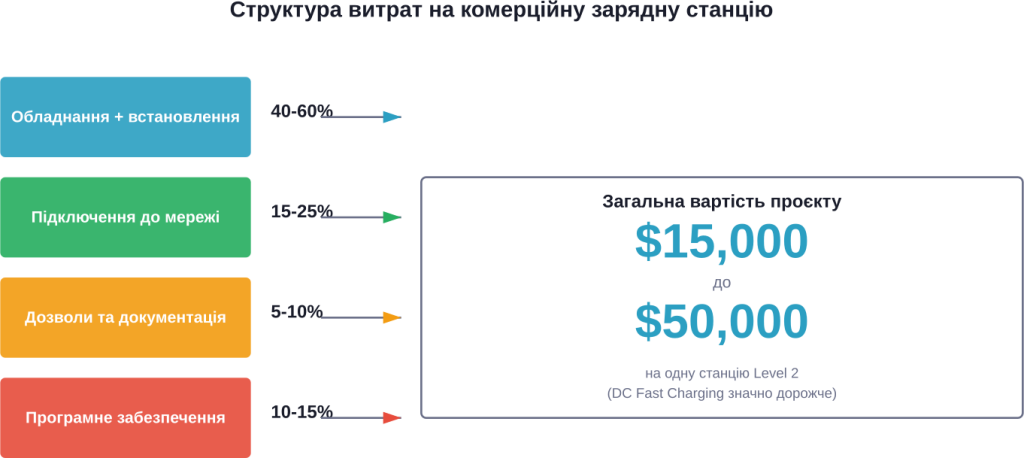
The cost of installing a single Level 2 station is typically $15,000 to $50,000, including equipment, installation, network connection, permits and software. DC Fast Charging stations are significantly more expensive, ranging from $100,000 to $500,000 or more.