


Table of contents:
Short Summary: The BMW i3 is a compact premium-class electric vehicle with a range of up to 300 km (depending on the year of manufacture and battery configuration). Charging from a home 7 kW network takes about 6 hours, while fast charging at 50 kW takes only 45 minutes to 80%. The model is notable for its innovative design with extensive use of recycled materials and a unique aesthetic.
The BMW i3 was a real breakthrough in the premium electric vehicle segment when it first appeared on the market. This compact hatchback remains a popular choice for those looking for a reliable urban electric vehicle with BMW character.
But what are the real range figures? How long does charging take? And what makes this model special among other electric cars?
Let’s break it all down step by step.
We remind you that you can purchase home and commercial charging stations in our online store, as well as use public charging stations ECOFACTOR located throughout Ukraine. For convenient access to charging infrastructure, we recommend using our mobile app, available on iOS and Android.
Range of the BMW i3: Battery Evolution
During its production, the BMW i3 received several battery updates that significantly affected driving range. The first models from 2013-2016 were equipped with a 22 kWh battery, providing a real-world range of about 130 km (according to reliable sources).
Later, a version with a 33 kWh battery appeared (2017-2018), increasing the range to 200 km. The newest versions with a 120 Ah battery (42.2 kWh) offer up to 310 km under the WLTP cycle, but in real mixed-cycle conditions it is approximately 260 km.
Real-world range depends on several factors:
- Driving style and use of regenerative braking
- Ambient temperature (in winter, range drops by 20-30%)
- Use of climate control and heating
- Driving speed (energy consumption increases above 110 km/h)
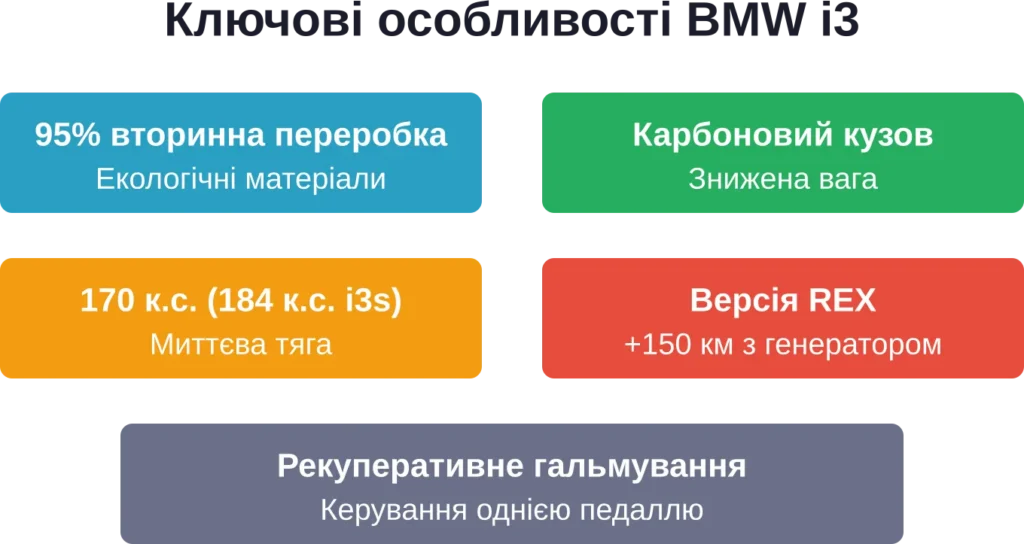
Interestingly, the BMW i3 was also produced in the REX (Range Extender) version — with a two-cylinder petrol engine of 647 cm³ that extended the range by another 150 km. This version became a unique offer for those not ready to completely give up the possibility of refueling with petrol.
Charging the BMW i3: Time and Options
One of the most important aspects of owning an electric vehicle is charging convenience. The BMW i3 supports several charging types, each with its own features.
Home Charging
The most common option for daily use. Charging from a 7 kW home wallbox takes about 6 hours for a full charge of the 42 kWh battery. This is ideal for overnight charging — park the car in the evening, and it’s ready for a new trip in the morning.
Some owners use a regular 220V household socket (2.3 kW), but in that case a full charge can take more than 15 hours. This is less convenient but suitable as a backup option.
Fast Charging at Stations
The BMW i3 is equipped with a CCS Combo connector for fast DC charging. At 50 kW stations, the battery charges from 10% to 80% in approximately 45 minutes at 50 kW power.
Why only up to 80%? Because the last 20% charges much more slowly due to the characteristics of lithium-ion batteries. To preserve battery life, it is recommended to keep the charge between 20% and 80% for everyday use.
| Charging Type | Power | Time to 100% | Time to 80% |
|---|---|---|---|
| Household Socket | 2.3 kW | ~18 h | ~14 h |
| Wallbox | 7 kW | ~6 h | ~5 h |
| Wallbox (3-phase) | 11 kW | ~4 h | ~3 h |
| Fast DC Charging | 50 kW | ~60 min | ~45 min |
It is worth noting that regular use of fast charging can accelerate battery degradation. Studies show that maintaining the charge between 20% and 80% optimizes the battery management system and extends its service life.

Choose Charging for Your BMW i3 According to Your Usage Format
In the case of the BMW i3, the question is not only how long charging takes, but how it fits into your day and night, short city trips or occasional trips outside the city.
ECOFACTOR helps assemble this into one clear system. Through the charging station configurator you can select an AC station for home charging or a DC station if fast top-up is needed. For daily use there is a mobile app for Android and iOS, and the map of charging stations lets you see available points in advance. If you need to supplement the connection, the online store makes it easy to choose accessories, cables, and mobile chargers for the BMW i3.
If the scenario changes over time, additional solutions are available. This includes the operator platform for managing the network and users, as well as white-label solutions for launching your own service. Separately available are energy-efficient solutions for home and business. Contact ECOFACTOR and select a charging option that will be convenient for everyday use.
Unique Features of the BMW i3
What sets the BMW i3 apart from other electric vehicles on the market? Quite a few interesting solutions.
Innovative Design and Materials
The BMW i3 was the first production electric vehicle in which 95% of parts can be recycled. The body is made of lightweight but strong carbon fiber (CFRP), which compensates for the battery weight and improves dynamics.
The interior is finished with eco-friendly materials: recycled plastic, natural fabrics made from eucalyptus fiber, and wood from responsibly managed forests.
Dynamics and Power
The 170 hp electric motor (184 hp in the i3s version) provides instant torque from the first revolutions. Acceleration 0-100 km/h takes just 7.3 seconds (i3s — 6.9 s), making this compact hatchback quite lively in city traffic.
Top speed is limited to 150 km/h to preserve range.
Energy Recuperation
The BMW i3 is equipped with an efficient regenerative braking system. When you release the accelerator pedal, the car actively slows down, returning energy back to the battery. This allows driving almost without using mechanical brakes — the so-called “one-pedal driving”.
Efficient recuperation can add up to 15-20% extra range in urban conditions with frequent stops.
Tips for Operating the BMW i3
To make the most of the electric vehicle’s capabilities, several points should be considered.
The ideal charge level for long-term parking is between 30% and 50%. This is a recommendation that helps preserve battery health. If you plan to leave the car for several weeks, set exactly this charge level.
Do not leave the electric car plugged in during prolonged downtime — this can negatively affect the battery.
In winter, warm up the interior while charging. Most of the energy for heating is spent at the initial stage, so it is better to do this while the car is still plugged in.
Use eco mode to increase range. It limits power and optimizes the climate system, which can add up to 10% range.
Frequently Asked Questions (FAQ)
What Is the Real-World Range of the BMW i3 in Winter?
In winter, range decreases by 20-30% compared to summer due to energy spent on interior heating and reduced battery efficiency at low temperatures. For the 42 kWh battery version, this means about 200-220 km of real-world range.
How Much Does It Cost to Charge a BMW i3 at Home?
At a hypothetical electricity rate of about 2-3 UAH/kWh, a full charge of a 42 kWh battery will cost approximately 85-125 UAH. This is equivalent to the cost of 1-1.5 liters of petrol but provides up to 300 km of range.
Can the BMW i3 Be Charged from a Regular Socket?
Yes, it can. The BMW i3 comes with a charging cable for a 220V household socket. A full charge takes about 18 hours, but to replenish 100-150 km of range, 6-8 hours of overnight charging is sufficient.
What Is the BMW i3 REX Version?
REX (Range Extender) is a version with a small two-cylinder petrol engine of 650 cm³ that works as a generator to recharge the battery. It does not drive the wheels directly but only generates electricity, extending the range by 150 km.
How Long Does the BMW i3 Battery Last?
BMW gives an 8-year or 160,000 km warranty on the battery (minimum 70% capacity retention). Several owners report that batteries retain 85-90% capacity after 5-6 years of operation with proper maintenance.
Does the BMW i3 Support Fast Charging?
Yes, all BMW i3 versions are equipped with a CCS Combo connector for fast DC charging up to 50 kW. This allows charging the battery from 10% to 80% in approximately 45 minutes.
What Is the Difference Between the BMW i3 and i3s?
The i3s version has a more powerful engine (184 hp vs 170 hp), sportier suspension, wider wheels, and a slightly more aggressive design. Acceleration 0-100 km/h is 0.4 seconds faster. The range is almost identical.
Conclusion
The BMW i3 remains one of the most interesting options on the used electric vehicle market. A range of up to 260 km is quite sufficient for city trips and regional travel, especially considering the REX version for those who need extra flexibility.
Charging causes no problems — a home wallbox will provide a full charge overnight, and the network of fast stations allows you to top up the battery during a coffee break.
The unique construction, eco-friendly materials, and true premium character make this electric vehicle an attractive choice even in 2026. If you are considering buying a used electric car, the BMW i3 is worth including in your shortlist of candidates.