


Table of contents:
The number of electric vehicles on Ukrainian roads is growing every year. And this isn’t just a trend — it’s a reality that is driving demand for infrastructure.
Charging stations are becoming not just a necessity, but a fully-fledged business opportunity. But how do you build a model that actually works? How do you calculate the investment and payback period? And, most importantly, how do you minimise the risks that may arise during the implementation phase?
This guide breaks down the charging station business model from A to Z. It cuts through the jargon, provides practical steps and takes current market conditions into account.
We remind you that you can purchase home and commercial charging stations in our online storeand also use the public charging stations ECOFACTORcharging points located throughout Ukraine. For convenient access to charging infrastructure, we recommend using our mobile applicationwhich is available on iOS and Android.
The electric vehicle market in Ukraine: why now is the time
The development of infrastructure for electric vehicles in Ukraine is gaining momentum thanks to government initiatives and international support. Less noise and exhaust fumes, cheaper charging and simpler maintenance — all of this makes electric vehicles attractive to Ukrainian drivers.
But there is a problem. The infrastructure is not keeping pace with demand.
This is where an opportunity arises for entrepreneurs. The development of charging infrastructure is a key area of growth.
Types of charging stations: which one to choose
The first decision, which determines the entire business model, is the type of station. And there is no one-size-fits-all solution here.
AC charging stations (slow)
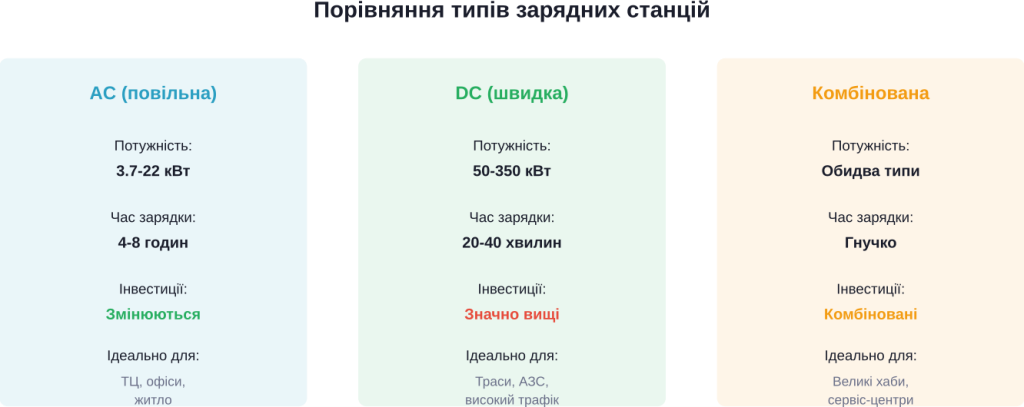
Power: from 3.7 to 22 kW (for most modern locations and vehicles). Charging time: 4–8 hours for a full charge of an average electric vehicle.
These stations are suitable for locations where cars are parked for long periods: shopping centres, office car parks, residential complexes and hotels. The estimated investment is lower, but the revenue per session is also lower.
DC charging stations (fast)
Power: from 50 to 350 kW. Charging time: 20–40 minutes for an 80 per cent charge.
This is the option for motorways, petrol stations and high-traffic locations. The initial investment is significantly higher, but customer turnover is faster. More sessions per day = higher revenue.
Combined stations
Some operators install several types of charging stations at a single location. This offers flexibility: some people want to charge quickly, whilst others are happy to wait in exchange for a lower price.

How ECOFACTOR helps turn charging into a manageable business
When an entrepreneur gets into the charging infrastructure sector, the hardest part is usually not buying the station itself. The hardest part is ensuring that it operates reliably, is visible to drivers and generates a predictable income. That is precisely why we at ECOFACTOR take a holistic approach: we design and manufacture charging stations in Ukraine, provide a platform for operators and integrate everything into a seamless experience for the driver. Depending on the business scenario, we offer various types of equipment – mobile chargers, AC stations up to 44 kW for locations with longer parking times, and DC stations up to 420 kW for motorways and high-traffic areas.
From the customer’s perspective, it’s all about simplicity, and this is where our mobile app for iOS and Android comes in handy. In it, drivers can see a map of charging points, connector types, power output, port status in real time and current rates, whilst the operator gains effective control and a clear overview of usage. This has a direct impact on the business model: when a charging station is easy to find and straightforward to use, there are more sessions and fewer complaints.
A particular bonus for businesses is our online shop. There, you can select charging stations for a specific location, as well as buy accessories, inverters and consumables – the sort of things people usually only remember at the last minute. In practice, this saves time on both set-up and maintenance, as there’s no need to piece together a solution bit by bit. If you’re building a business model from scratch, this approach is simpler: the equipment, the infrastructure on the map, the driver app and the management platform all exist within a single ecosystem, rather than as a collection of disparate services.
Calculating investments: what you need to know
Now, let’s look at the practical side of things. What is the actual cost of installing a charging station in Ukraine?
Let’s break this down by main expense categories:
The exact cost depends on a number of factors: whether an additional power line needs to be laid, the condition of the car park, and the terms and conditions set by the equipment supplier. For up-to-date prices, we recommend contacting the equipment and service suppliers directly.
An important point: some international programmes provide support for the development of infrastructure for electric vehicles. It is worth checking what grants and preferential financing are available.
Choosing a location: where to set up the stage
Even a high-quality station won’t generate revenue without the right location. The choice of location is a critical factor for success.
Criteria for the ideal location:
- Traffic involving electric vehicles: obvious, but crucial. It is worth researching the routes taken by EV owners. Useful data can be obtained from existing charging networks and social media communities.
- Time spent: AC stations require locations where people spend hours: shopping centres, cinemas, fitness centres. DC stations require places for short stops: motorways, petrol stations, roadside cafés.
- Power grid availability: can the local grid cope with the additional load? High-power DC stations require a high-capacity transmission line. Upgrading networks can sometimes be very costly.
- Visibility and access: the station must be visible from the road and easily accessible 24/7. Lighting, security and ease of parking all influence how often it is used.
- Competition: the presence of other stations nearby can be both a disadvantage and an advantage. If competitors are constantly busy, this is a sign of high demand. If they are empty, this requires a detailed analysis.
Promising locations for charging stations:
- Intercity routes.
- Shopping centres in major cities.
- Car parks near office complexes.
- Hotels and restaurants on the outskirts of towns.
- Petrol stations and roadside service stations.
- Residential complexes.
Monetisation models: how to make money
Now for the most important thing — how can you turn your investments into a steady income?
Model. 1: Payment per kWh
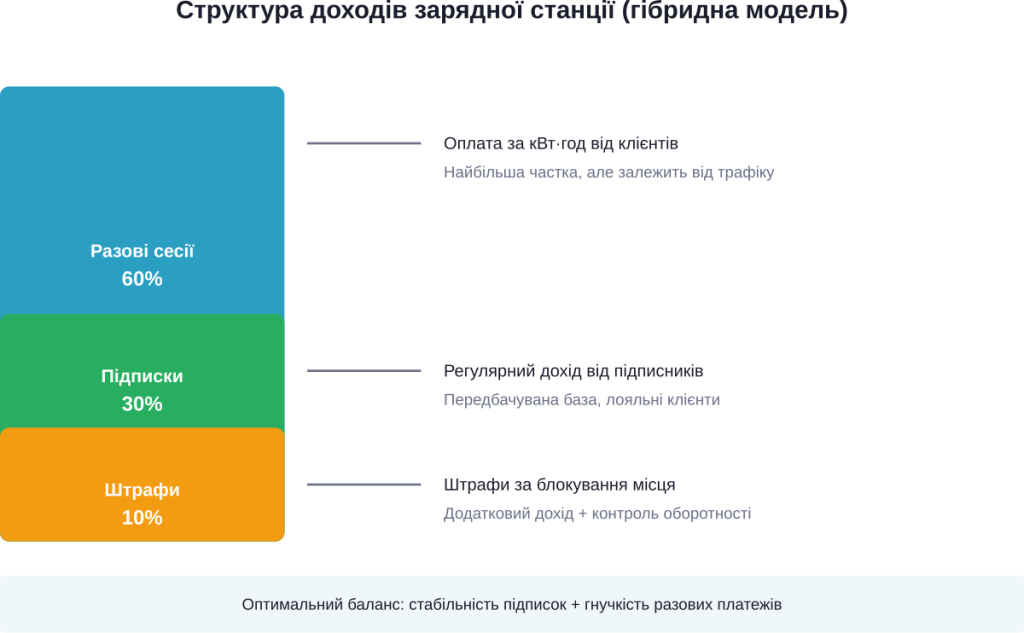
The most common model. A tariff is set for each kilowatt-hour of energy consumed.
Typical tariffs in Ukraine vary depending on market conditions and suppliers. The margin consists of the difference between the purchase price of electricity and the selling price to customers.
Pros: simple, easy for customers to understand, predictable income. Cons: dependence on electricity prices, the need for accurate meters.
Model 2: Payment per hour
Fixed-fee charges per minute or per hour. Less commonly used, but still has its place.
Rates vary depending on the type of station. It works best at DC stations, where charging times are more predictable.
Pros: easier administration. Cons: different charging rates may create a perception of unfairness and can lead to queues.
Model 3: Subscription + discounted rates
Customers purchase a recurring subscription for a fixed fee, receiving discounts on data usage or unlimited data up to a certain limit.
This approach builds a loyal customer base and generates a predictable, regular income.
Model 4: Hybrid (recommended)
Combination of models: a basic charge per kWh + optional subscriptions for frequent users + penalties for blocking a space after the charging session has ended.
This is the most flexible approach. It allows you to monetise different customer segments.
Operating costs: what requires funding
Income is one thing. But what about expenditure? The biggest expenses require attention:
- Electricity: Main article. The purchase price depends on the contract with the supplier, the time of day and consumption levels. Businesses can negotiate special terms.
- Service and equipment: routine inspections, replacement of components, software updates. It is advisable to set aside a percentage of the equipment’s value each year for repairs and maintenance.
- Venue hire: if the land or car park isn’t yours, factor in the hire cost. Rates vary depending on the location and the terms agreed.
- Internet and communications: stations require an internet connection for payment processing, monitoring and management. A monthly fee is payable, depending on the region.
- Insurance: Equipment is expensive. Insurance against damage, theft and force majeure is a sensible investment. The cost depends on the level of cover.
- Marketing: to ensure customers are aware of the station, it is worth investing in promotion: listing on maps, advertising, signage and partnerships with EV communities.
Payback period calculation: influencing factors
An important question for investors: when will the project pay for itself?
Calculation example for air-conditioning units in a shopping centre:
Assumption:
- Number of sessions: the forecast depends on the specific location.
- Charging volume per session: depends on the number of EV owners in the area.
- Tariff for the client: market research is required.
- The purchase price of electricity depends on the supplier and the time of year.
The payback period depends on many variables: traffic, location and market conditions. A conservative approach is to allow for 2–4 years for a well-chosen location, taking into account fluctuations in electricity prices and market capacity.
For DC stations, the payback period is longer due to higher investment, but the revenue potential is also higher because of higher customer turnover.
Technical section: connection and integration
Now, let’s talk about implementing the project. Without this part, the station simply won’t work.
Connection to the mains
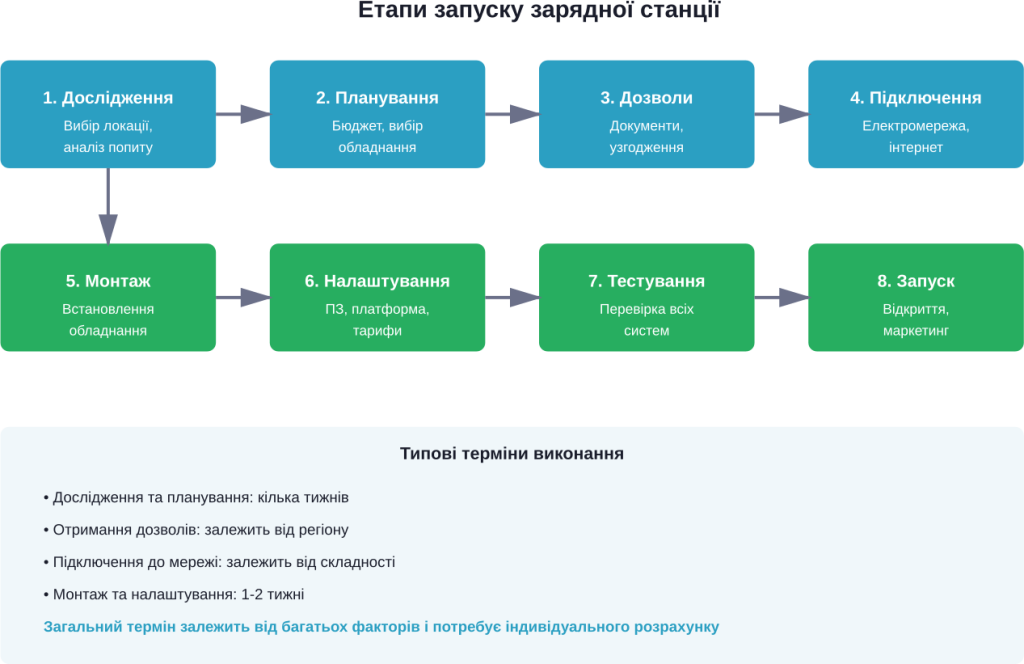
This is the most critical stage. AC stations require a three-phase network with sufficient capacity. For DC stations, the process is more complex; it is necessary to obtain technical specifications (TU) and secure approval from the distribution system operator (DSO).
Process: submit a connection application, receive the technical specifications, carry out the work, undergo an inspection, sign the contract. The time taken varies depending on the region.
Management platform
Modern charging stations are not just power sockets. They are IoT devices that require centralised management.
What the platform should be capable of:
- Accept payments via various methods.
- Monitor the condition of the equipment in real time.
- Generate usage reports.
- Manage tariffs.
- To provide support to customers.
- Integrate with maps and sat-navs.
There are various solutions available on the market for managing charging stations, both international and local.
Legal aspects
To work legally, you need:
- Register the business in accordance with the prescribed procedure.
- Obtain the necessary permits to use the location.
- To enter into a contract for the supply of electricity.
- Have the electrical installation inspected.
- Use specialised billing platforms that are integrated with bank acquiring services, or register a payment acceptance system, depending on the chosen payment acceptance model.
Most equipment suppliers offer advice and assistance with completing the necessary paperwork.
Scaling: how to grow a project
Once you’ve launched a successful station, you can add new locations. The experience gained from your first project will help you launch subsequent ones. Add different types of stations (AC+DC), expand the facilities at existing locations, and consider offering additional services.
Work with companies that are developing corporate electric transport. Taxi companies and delivery services are reliable customers. Once the model proves successful, you can consider scaling it up through partnership programmes.
Some operators are expanding into additional areas: energy storage and integration with alternative energy sources. This is transforming the station into an energy hub.
Risks and their management
Every business faces risks. It is worth anticipating and minimising them:
- Technical issues: equipment may malfunction. Solution: choose reliable manufacturers, take out service contracts, and set aside a contingency budget.
- Insufficient demand: low utilisation rates at stations are affecting profitability. Solution: thorough analysis of the location, active marketing at launch, flexible pricing.
- Fluctuations in electricity prices: changes in tariffs affect profit margins. Solution: contracts with suppliers, flexible pricing models, a buffer in the budget.
- Regulatory changes: the government may change the rules. Solution: monitoring legislation, participating in trade associations, and being flexible in planning.
- Competition: other players may enter the market. Solution: focus on service quality, customer loyalty and the selection of niche locations.
Practical examples and experience
In practice, companies operating in the charging infrastructure sector in Ukraine are demonstrating that the model has potential.
Infrastructure development is supported by international programmes, which creates opportunities for entrepreneurs.
Communities of electric vehicle owners are actively discussing the quality of different charging networks. It is important that the equipment is reliable and the payment systems are user-friendly.
The key lesson from operators already in the business: don’t skimp on quality. An unreliable charging station is worse than no charging stations at all. Word spreads quickly within the EV community.
Future trends (2026–2027)
Here’s what to expect:
- Growth of the EV market: forecasts indicate that the number of electric vehicles on the road will continue to rise. Demand for infrastructure is set to increase accordingly.
- Developments in fast charging: new EV models support more powerful charging modes. This segment is set to grow.
- Integration with renewable energy: the combination of charging stations with alternative energy sources will be a key focus.
- Two-way charging (V2G): a technology whereby electric vehicles can feed energy back into the grid, is set to develop.
- Automation: the development of autonomous vehicles will influence the configuration of the charging infrastructure.
Conclusion: Opportunities for development
The charging station business in Ukraine presents a real opportunity. The market is growing, demand is rising, and the infrastructure is developing.
Now is the time to enter the market, as competition has not yet peaked and demand is growing. International support programmes are creating further opportunities.
To flesh out your plan, it is advisable to consult industry associations, equipment suppliers and companies already operating in this market. The practical experience of other market participants will be invaluable when planning your project.
Ready to get started? Begin by drawing up a detailed business plan and researching potential locations. Every successful business starts with a well-considered first step.
Frequently asked questions
How much money is needed to set up the stations?
Initial investment costs depend heavily on the type of charging station and local conditions. AC charging stations require a lower initial investment than DC charging stations. For current prices, it is recommended that you contact equipment suppliers.
How long will it take for the project to pay for itself?
Payback depends on traffic, tariffs, operating costs and location. It is worth allowing for a period of several years, taking into account fluctuations in market conditions.
Which locations are best suited?
For AC stations: locations where people spend a long time (shopping centres, offices, hotels). For DC: high-traffic locations (motorways, petrol stations). Key factors: visibility, accessibility, network coverage.
Which monetisation model should I choose?
The hybrid model combines payment per kWh, subscriptions and penalties. This is the most flexible approach, which allows you to cater to different customer segments.
Are permits required?
Yes, you’ll need to register your business, obtain location permits, sign an electricity supply contract, have the installation inspected and set up a cash register system. Equipment suppliers usually offer advice.
How do you attract your first customers?
Listing on maps and in apps, promotional rates during the initial period, engagement with EV communities, clear signage, and equipment that works flawlessly.
What are the main risks?
Technical issues, low traffic, changes in electricity prices, regulatory changes, competition. It is advisable to set aside a contingency budget and carefully analyse the location before investing.