


Table of contents:
Short Summary: Charging an electric vehicle in a private home is available through three main options: a regular household socket (slow but without additional costs), an enhanced Type 2 Mode 2 socket (medium speed, minimal investment), or a home wallbox charging station (fastest, most convenient). The choice depends on the power of the electrical network, the type of vehicle connector, and the installation budget.
Electric vehicles in Ukraine are no longer a rarity. Owners of private homes are luckier than residents of apartment buildings — organizing home charging is much simpler when you have your own garage or parking space in the yard.
But even in such conditions, many questions arise. Is a regular socket enough? How much does installing a full station cost? What are the technical requirements for the electrical network? We analyze all options in detail.
We remind you that you can purchase home and commercial charging stations in our online store, as well as use public charging stations ECOFACTOR located throughout Ukraine. For convenient access to charging infrastructure, we recommend using our mobile app, available on iOS and Android.
Three Main Ways to Charge an Electric Vehicle at Home
Owners of private homes have three realistic options for organizing home charging. Each has its own advantages, limitations, and cost.
Option 1: Regular Household 220V Socket
The simplest way is to connect the electric vehicle to a regular household socket using the standard charging cable that comes with the car. Charging power is limited to 2-3 kW, which means very slow battery replenishment.
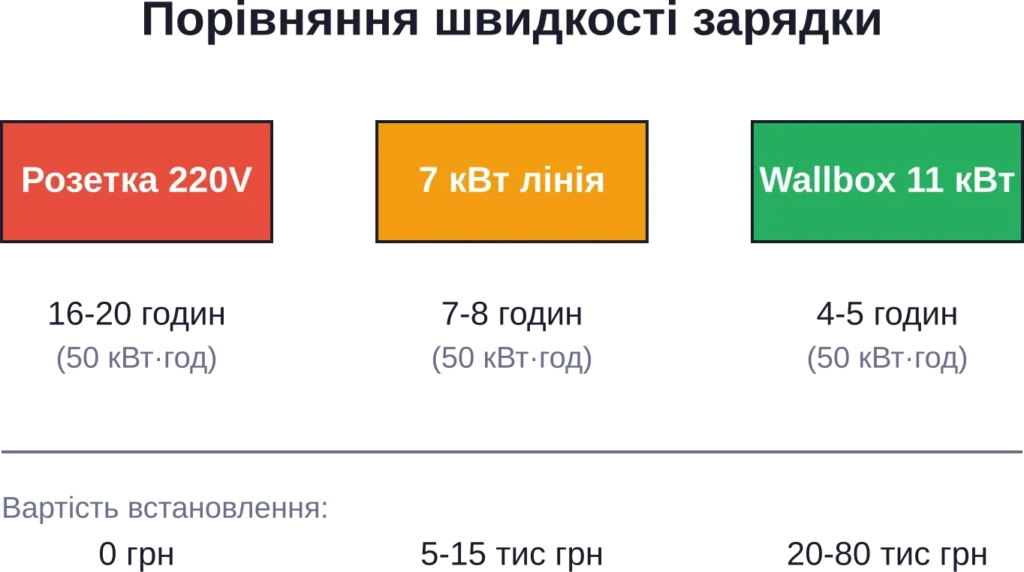
For a 50 kWh battery, a full charge from a regular socket will take 16-20 hours. This actually works if the car stays at home all night and drives a short distance every day.
The main advantage is zero installation costs if the socket is already in the garage or near the parking space. The disadvantage is the risk of wiring overheating if it is not designed for prolonged loads of 10-16 amps.
Before regularly using a household socket for charging, check the condition of the wiring and circuit breakers. It is advisable to install a separate 16-20A circuit breaker and an RCD for additional safety.
Option 2: Enhanced Line with Type 2 Mode 2 Socket
A compromise option is to run a separate dedicated line from the electrical panel to the charging location and install an industrial socket or Type 2 socket. This approach allows safe charging at 7 kW (single-phase connection) or 11-22 kW (three-phase).
Charging devices from Europe are often rated for 7 kW or 11 kW, while Chinese electric vehicles are mostly single-phase — the optimal solution for them is exactly 7 kW via a GBT connector or Type 2 adapter. American Teslas use their own connector but also support single-phase 7 kW charging.
At 7 kW power, a 50 kWh battery will fill in approximately 7-8 hours. This is enough for overnight charging even after an active day.
The installation cost includes cable laying, socket, circuit breaker, and electrician work. Depending on the distance and complexity of installation, this can cost from several thousand to tens of thousands of hryvnias.
Option 3: Home Wallbox Charging Station
The most convenient solution is to install a specialized wall-mounted charging station (wallbox). These devices are designed specifically for regular electric vehicle charging and have a number of advantages.
A wallbox allows you to adjust charging power, integrates with a mobile app for control and scheduling, and has protection against overvoltage and overheating. Some models support integration with home solar panels or energy storage systems (BESS).
The power of home stations is usually 7, 11, or 22 kW. For most private homes with single-phase connection, the realistic option is 7 kW. If there is three-phase power, you can consider 11 kW or even 22 kW, but this makes sense only if the car supports such speed.
The cost of a wallbox starts from 10,000 hryvnias for basic models and can reach 50-80 thousand for premium versions with additional functions. Add to this the installation cost — cable laying, mounting, and setup.
Technical Requirements for the Electrical Network of a Private Home
Before installing a charging station, you need to make sure that the home electrical network can handle the additional load.
Connection Power and Automation
Most private homes in Ukraine have a single-phase 220V connection with an allowed power of 10-15 kW. If 7 kW charging is planned, this will take up a significant part of the available limit.
When the electric vehicle is charging at night, other consumers are usually off, so there is no conflict. But if you turn on charging simultaneously with electric heating, a boiler, and an electric stove, the circuit breaker may trip.
For comfortable use of a 7-11 kW wallbox, it is desirable to have a total allowed power of 15 kW or more. Three-phase connection opens the possibility of using 11-22 kW stations without overloading one phase.
Be sure to install a separate circuit breaker for the charging line (rating depends on power — usually 32-40A for 7 kW) and a residual current device (RCD) at 30 mA to protect against current leakage.
Cable Cross-Section and Laying Distance
For a 7 kW line, the minimum copper cable cross-section is 4 mm², but it is better to use 6 mm² for reserve and reduced losses. For 11 kW, a 6-10 mm² cable is needed depending on the route length.
If the distance from the electrical panel to the charging location exceeds 30-40 meters, voltage losses become noticeable. In such cases, it is worth increasing the cable cross-section or considering the installation of an intermediate distribution panel.
The cable can be laid along the wall in a cable channel, underground in a protective pipe, or overhead. Underground laying is the most aesthetic but more expensive due to excavation work.
Which Connectors and Charging Standards Are Important for a Private Home
Electric vehicles from different regions use different connectors. This is important to consider when choosing charging equipment.
Type 2 — European Standard
The Type 2 (Mennekes) connector is the most common standard in Europe and Ukraine. Most electric vehicles from European brands (Volkswagen, BMW, Renault) use it.
A wallbox with a Type 2 connector is a universal solution for European electric cars. It supports both single-phase 7 kW charging and three-phase up to 22 kW.
GBT — Chinese Standard
Electric vehicles from China (BYD, Chery, Geely, and others) are often equipped with a GBT (GB/T) connector. Most Chinese cars are single-phase, so the optimal power for them is 7 kW.
Some wallboxes support both standards or come with adapters. Check compatibility before purchasing.
Tesla — Proprietary Connector
American Teslas use a proprietary connector, but in Europe Teslas come with a Type 2 adapter. For home charging, a regular Type 2 wallbox or even an enhanced socket is quite suitable for Tesla.
| Connector | Region | Typical AC Power | Car Examples |
|---|---|---|---|
| Type 2 | Europe | 7-22 kW | VW ID.4, BMW iX, Renault Zoe |
| GBT (GB/T) | China | 7 kW | BYD Atto 3, Chery Omoda E5 |
| Tesla (NA) | USA | 7-11 kW | Tesla Model 3, Model Y (with adapter) |
| CHAdeMO | Japan | — (DC only) | Nissan Leaf (older), Mitsubishi |

Choose Home Charging According to Your Usage
Home charging only seems simple at the start. In practice, it is important not only to install the station but also to understand how it works every day and what to do in other scenarios.
ECOFACTOR covers this as a set of specific tools, not just separate equipment:
- Charging station configurator allows you to select an AC station according to the capabilities of your home network or select a DC station for fast charging
- Mobile app for Android and iOS is used to start, control, and track charging
- Map of charging stations shows available points if you need to charge outside the home
- Online store gives the opportunity to select accessories, cables, and mobile chargers for specific connection conditions
If charging goes beyond one house, other solutions are available. This includes the operator platform for managing the network and users, as well as white-label solutions for launching your own service. Additionally, energy-efficient solutions for home and business are available.
Contact ECOFACTOR and select a charging option that works in your conditions without any restrictions.
How to Charge an Electric Vehicle Correctly: Practical Tips
Even with the best home station, it is important to follow a few rules to extend battery life.
Optimal Battery Charge Level
For lithium-ion batteries, it is recommended not to allow deep discharge and to avoid regular charging to 100%. It is best to keep the charge in the 20-80% range for daily use.
Full charging to 100% should be done only before long trips. Modern wallboxes allow you to set a charging limit via the app — for example, stop charging at 80%.
Night Charging and Electricity Tariffs
In a private home, it is beneficial to charge the electric vehicle at night, especially if a two-zone or three-zone tariff is connected. At the night tariff (2.16 UAH/kWh), a full charge of a 50 kWh battery will cost 108 UAH. This is 3-4 times cheaper than the petrol equivalent for the same distance.
The daytime tariff (4.32 UAH/kWh) is twice as expensive as the night tariff (2.16 UAH/kWh). Most wallboxes support charging scheduling — you can set an automatic start at 23:00 when the cheap zone begins.
Integration with Solar Panels
If solar panels are installed in the house, smart charging stations can automatically use excess generation to charge the electric vehicle. This is the most environmentally friendly and economically beneficial option.
Some systems (for example, with BESS — home batteries) allow accumulating solar energy during the day and using it to charge the car in the evening.
Fast Charging: When It Is Needed at Home
Public fast stations (DC fast charging) allow charging up to 80% of the battery in just 30-40 minutes thanks to 50-150 kW power and higher. But is such speed needed at home?
In reality — no. Installing a DC charger in a private home is not economically justified. The cost of equipment and connection reaches hundreds of thousands of hryvnias, and the power of the private sector electrical network usually does not allow using 50+ kW.
For home use, 7-11 kW AC charging is quite sufficient. The car stays at home for hours, so there is no need to charge in 30 minutes — it is comfortable to fill the battery overnight.
Fast stations are useful on the road, on highways, and in public locations. For home, this is excessive.
Legal and Technical Norms in Ukraine (2026)
Since January 1, 2020, a law on creating access to electric vehicle charging station infrastructure has been in force in Ukraine. This document regulates the installation of chargers in public places, but owners of private homes have more freedom.
Installing a charging station on your own territory does not require special permits if the connection power does not exceed the limits approved by the electricity supply contract. If you need to increase the allowed power, you must contact the electricity supplier with the appropriate application.
International standards IEC 62196 regulate the design of connectors and the safety of charging equipment. The latest editions of the standards include IEC 62196-1:2022 (fourth edition) and IEC 62196-1:2025 (fifth edition), and IEC 62196-3:2026 establish requirements for compatibility and protection.
When choosing a wallbox, check compliance with IEC standards and the availability of safety certificates. This guarantees reliability and compatibility with most electric vehicles.
Comparative Table of Charging Options
| Parameter | Household Socket | Enhanced 7 kW Line | 11 kW Wallbox |
|---|---|---|---|
| Power | 2-3 kW | 7 kW | 11 kW |
| Charging Time (50 kWh) | 16-20 h | 7-8 h | 4-5 h |
| Equipment Cost | 0 UAH (standard cable) | 3-8 thousand UAH | 15-50 thousand UAH |
| Installation Cost | 0 UAH | 5-15 thousand UAH | 10-30 thousand UAH |
| Network Requirements | Standard 220V socket | Separate line, 32A breaker | Three-phase connection preferred |
| Convenience | Low | Medium | High |
| Additional Functions | None | None | Wi-Fi, scheduling, statistics |
Frequently Asked Questions About Home Electric Vehicle Charging
Can an Electric Vehicle Be Charged from a Regular Socket Permanently?
Technically possible, but not recommended without checking the wiring. Prolonged load of 10-16 amps can lead to contact overheating, especially if the socket is old or the wiring is aluminum. For regular charging, it is better to install a separate line with the appropriate breaker and RCD.
How Much Does It Cost to Charge an Electric Vehicle at Home in Ukraine?
At the night tariff (2.16 UAH/kWh), a full charge of a 50 kWh battery will cost 108 UAH. This is 3-4 times cheaper than the petrol equivalent for the same distance. The daytime tariff (4.32 UAH/kWh) is twice as expensive as the night tariff (2.16 UAH/kWh).
Is a Separate Meter Needed for Electric Vehicle Charging?
A separate meter is not mandatory, but it can be useful for monitoring consumption and connecting a special tariff. Some suppliers offer preferential conditions for electric vehicle owners if confirmation is available.
How Long Does Wallbox Installation Take?
With a ready electrical network with sufficient power, wallbox installation takes 4-8 hours of work by a qualified electrician. If a new line needs to be laid from the panel or the allowed power increased, the process may take several days.
Do All Electric Vehicles Support 11 kW or 22 kW Charging?
No. Many electric vehicles, especially Chinese-made ones, support only single-phase charging with a maximum of 7 kW. European models more often have a three-phase 11 kW charger. 22 kW power is rare even among premium models. Check the technical specifications of your car before choosing a wallbox.
Is It Safe to Leave an Electric Vehicle on Charge All Night?
Yes, it is completely safe. Modern electric vehicles and charging stations have built-in control systems that automatically stop charging when the set level is reached. There is no overheating or overcharging. On the contrary, night charging is the most convenient and economical mode.
What Are Mode 2 and Mode 3 Charging?
Mode 2 is charging via a mobile cable with a built-in controller that connects to a regular or industrial socket. Mode 3 is charging via a stationary station (wallbox) with built-in safety and control systems. Mode 3 is more reliable and safer for regular use, Mode 2 is suitable for occasional charging or in places without stationary infrastructure.
Conclusion
Owners of private homes have all the opportunities for comfortable home charging of an electric vehicle. The choice between a socket, an enhanced line, and a wallbox depends on the budget, technical capabilities of the electrical network, and the intensity of car use.
For daily trips to work within 50-100 km, even a regular socket is quite sufficient if the wiring is in good condition. But for full comfort and battery longevity, it is worth investing in a wallbox — it is convenient, safe, and pays for itself with fuel savings within 2-3 years.
Before installation, be sure to check the connection power, wiring condition, and equipment compatibility with your car’s connector. Contact certified electricians for installation — safety is more important than saving money.
Ready to make electric vehicle charging as convenient as possible? Choose the approach that meets your needs and enjoy the benefits of electric mobility without unnecessary worries.