

Table of contents:
Short Summary: Installing a charging station for an electric vehicle requires careful planning: choosing a location, assessing the electrical network, obtaining permits, and selecting the appropriate equipment. The cost of a home Level 2 station ranges from $380 to $690, while public fast chargers cost significantly more depending on local infrastructure. Proper infrastructure preparation can reduce installation costs by up to 75% compared to upgrading existing facilities.
The number of electric vehicles on Ukrainian roads is growing every year. And if you have already become an EV owner or are just planning a purchase, the issue of charging infrastructure becomes critically important.
Charging your car at public stations is convenient for trips, but home charging remains the most economical and practical solution. But how do you properly install a charging station? What technical requirements and permits are needed?
Let’s break down all the key aspects — from choosing the type of equipment to the final installation.
We remind you that you can purchase home and commercial charging stations in our online store, as well as use public charging stations ECOFACTOR located throughout Ukraine. For convenient access to charging infrastructure, we recommend using our mobile app, available on iOS and Android.
Types of Charging Stations: What to Choose for Home
The first question that arises is what type of charging you need. There are three main levels of charging stations for electric vehicles.
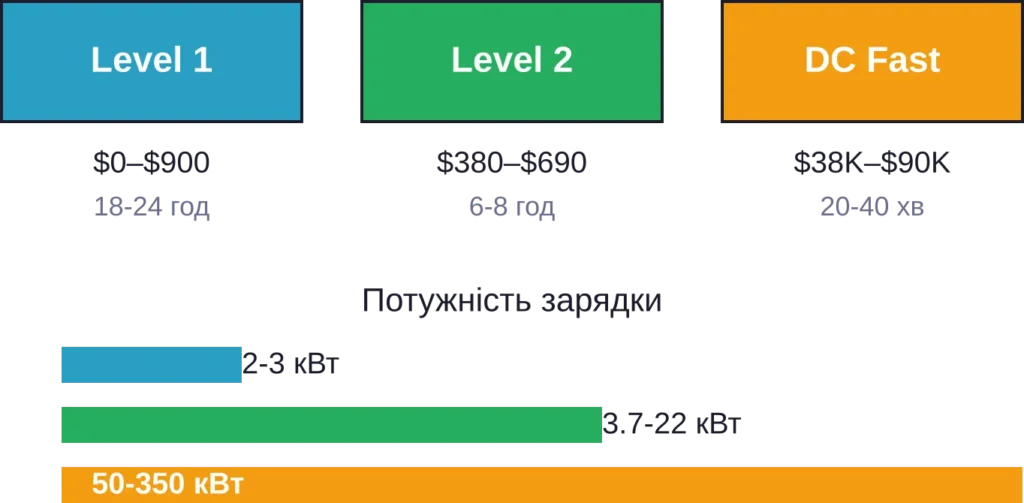
Level 1: Basic Charging from a Regular Outlet
This is the simplest option. You connect the car to a standard 220V household outlet using the factory charging cable that comes with the electric vehicle.
Charging power is about 2-3 kW. A full charge of a 54 kWh battery will take 18-24 hours. For daily short trips this may be enough, but for regular use it is too slow.
According to Rocky Mountain Institute Report data, the cost of additional equipment for Level 1 charging ranges from $0 to $900 — depending on whether you need extra safety components.
Level 2: The Optimal Home Solution
Level 2 charging stations operate at 220-240V and provide power from 3.7 to 22 kW. This is the gold standard for private households.
For a car with a 54 kWh battery, a full home charge will cost about 233 UAH (~$5.3) at a daytime rate of 4.32 UAH/kWh. If charging at night on a two-zone tariff (2.16 UAH/kWh), the cost is reduced by about half — to 117 UAH (~$2.65). Taking into account charging losses, the real amount will be 8–12% higher.
The cost of Level 2 equipment is $380-$690 according to the Rocky Mountain Institute Report (residential equipment). This does not include installation work, but the investment pays off due to convenience and time savings.
DC Fast Charging: For Business and Public Locations
DC Fast Charging stations are a solution for commercial use. Power from 50 to 350 kW allows charging the battery to 80% in 20-40 minutes.
But the cost of such equipment is high — from $38,000 to $90,000 per connector. For a private home, this is not justified either technically or financially.
Electrical Network Preparation: Will Your Wiring Handle It
Before purchasing equipment, you need to assess the state of the electrical network. A Level 2 charging station consumes from 16 to 32 amps — this is a significant load.
Checking Network Capacity
A typical private house in Ukraine has an input capacity of 10-15 kW. For a 7 kW charging station this is sufficient, but a separate circuit breaker is required.
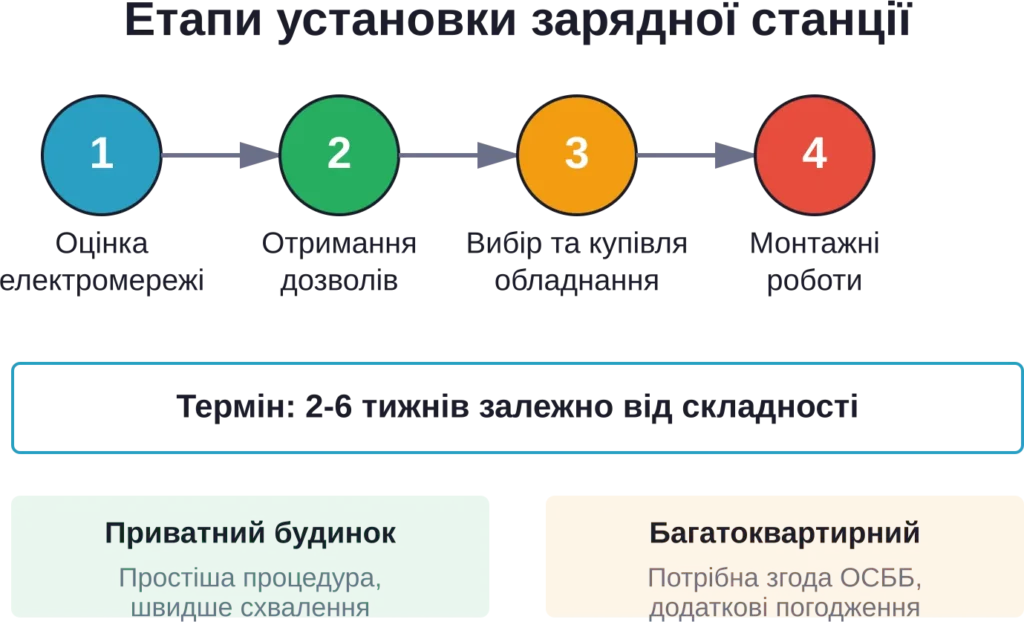
If you have electric heating, a boiler and other powerful consumers, you may need to increase the input capacity. Contact your local power supply company — the process usually takes 2-4 weeks.
Important point: installing equipment at the construction or major renovation stage can reduce installation costs by up to 75% compared to later upgrades.
Dedicated Line and Protective Automation
A charging station requires a separate dedicated line from the electrical panel. This means:
- A separate circuit breaker of the appropriate rating (25-40A)
- RCD (residual current device) for safety
- Cable with a cross-section of at least 6 mm² for power up to 10 kW
- Grounding according to PUE standards
Electrical installation work must be performed by a certified electrician. Self-installation without proper qualifications is dangerous and may lead to denial of insurance compensation in case of fire.
Two-Zone Tariff: Savings up to 50%
Install a two-zone electricity meter. The night tariff (from 23:00 to 7:00) is usually 50% cheaper than the daytime one.
For an electric vehicle with consumption of about 17 kWh per 100 km (approximately 27 kWh per 100 miles), the charging cost is approximately 0.58 UAH per mile (or 0.36 UAH per km) at a night tariff of 2.16 UAH/kWh.
Choosing the Installation Location for the Charging Station
The location of the charging station affects usability and installation cost.
Private Yard or Garage
The simplest option. The station is mounted on the garage wall or on a separate stand near the parking space.
Main requirements:
- Distance from the electrical panel — the shorter, the cheaper the cable laying
- Protection from atmospheric precipitation (for outdoor installation, a housing with IP54 or higher protection rating is required)
- Connection convenience — the charging cable is usually 5-7 meters, take this into account when planning
- Lighting of the parking space for night connection
Outdoor installation is completely safe. Modern charging stations are certified for use in rain and snow.
Apartment Building or Parking Lot
The situation here is more complicated. Consent from the HOA or management company is required, as well as the technical possibility of allocating a separate meter.
Solution options:
- Installation of a personal meter at your parking space
- Agreement on compensation for electricity according to the readings of the charging station with a built-in meter
- Collective installation of several stations for building residents with cost sharing
In underground parking lots, ventilation and mobile communication access are important (some stations require an internet connection for monitoring).
Equipment Selection: What to Pay Attention To
The charging station market offers dozens of models. How to choose the right one?
Charging Power
The optimal power for a home station is 7-11 kW. This ensures a full charge overnight without excessive load on the network.
3.7 kW stations are suitable for PHEVs (plug-in hybrids) or if you drive less than 50 km per day. For a full electric vehicle this is too slow.
Power over 11 kW for home use is usually excessive and requires three-phase connection, which not all houses have.
Connector Type and Compatibility
In Ukraine, the most common standards are Type 2 (Mennekes) for AC charging and CCS Combo 2 for fast DC charging.
Most modern electric vehicles support Type 2. Make sure the station is compatible with your car, or choose universal models with interchangeable cables.
According to the IEC 61851-1:2017 standard, EV supply equipment must be applied to supply voltages up to 1000 V AC or 1500 V DC and output voltages up to 1000 V AC or 1500 V DC.
Additional Features
Useful options worth considering:
- Wi-Fi connection: remote control and monitoring via mobile app
- Charging scheduling: automatic start during cheap tariff hours
- Built-in meter: accurate accounting of consumed energy
- Power regulation: ability to limit consumption if needed
- Access protection: RFID card or PIN code to prevent unauthorized use
These features increase the cost by 15-30%, but significantly improve ease of use.
Certification and Warranty
Choose equipment with certificates of compliance with international safety standards. For the American market this is UL Listed, for Europe — CE marking.
Reliable manufacturers provide a minimum warranty of 2-3 years. Check for service support in Ukraine — this is critically important for quick troubleshooting.
| Characteristic | Budget Model | Mid-Range | Premium |
|---|---|---|---|
| Power | 3.7-7 kW | 7-11 kW | 11-22 kW |
| Cost | $380-$450 | $450-$550 | $550-$690+ |
| Wi-Fi/App | Rarely | Often | Always |
| Built-in Meter | No | Optional | Yes |
| Access Protection | No | Optional | Yes |
| Warranty | 1-2 years | 2-3 years | 3-5 years |
Permits and Regulatory Framework
Installing a charging station is work with electrical equipment that requires compliance with safety standards.
Private House
For the private sector the procedure is relatively simple. You need:
- Coordination of increased allocated power with the power supply company (if needed)
- Electrical installation project from a certified specialist
- Certificate of completed works after installation
Formally, there is no need to notify the regional power company about installing a charging station if you do not exceed the allocated power. But it is better to get a consultation from the local energy company.
Apartment Building
The process is more complicated here:
- Written consent of the HOA or management company
- Technical conditions for connection from the regional power company
- Agreed equipment placement project
- Electricity supply contract (separate meter or sub-metering)
According to IBC 2021 Section 406.2.7 requirements, when installing charging stations there must be at least 5% of available spaces for them (minimum not less than 1 space). This facilitates the modernization of modern parking lots.
Safety Requirements
Installation must comply with NFPA 70 (National Electrical Code) or local equivalents — in Ukraine these are the PUE (Rules for Electrical Installations).
Key requirements:
- Mandatory grounding
- Leakage current protection (RCD)
- Overload protection (circuit breaker of appropriate rating)
- Use of cables and components rated for the appropriate power
Cost and Payback of Installation
How much does a full charging station installation cost?
Cost Structure
Typical budget for a private house (Level 2, 7 kW):
- Charging station: $450-$550
- Electrical installation works: $300-$600 (depends on distance to the panel)
- Additional automation (RCD, breaker): $50-$100
- Cable and materials: $100-$200
- Two-zone meter installation (optional): $80-$150
Total cost: $980-$1600 for a standard installation.
For more complex cases (long distance to the panel, need to increase input power) the amount can rise to $2000-$2500.
Operating Savings
With an average annual mileage of 15,000 km and consumption of 18 kWh per 100 km, an electric vehicle consumes about 2,700 kWh of electricity per year.
At a night tariff of 2.16 UAH/kWh (two-zone meter), this amounts to approximately 5,830 – 6,500 UAH (~$132–148) per year, taking into account charging losses.
A petrol car with consumption of 7 l/100 km at an average price of 55 UAH/liter will cost about 57,750 UAH (~$1,310) per year.
Savings: over 50,000 UAH (~$1,150) per year. Thanks to this, the investment in the charging station and installation usually pays off in 8–14 months.
Reliability and Maintenance
According to a 2024 Harvard Business School study, the average reliability of charging stations in the USA is 78% — meaning approximately every fifth station has operational problems.
But this mainly concerns public stations. Private home chargers are much more reliable due to controlled operating conditions and regular maintenance.
Typical Problems and Their Prevention
The most common faults:
- Internet connection problems (for Smart stations): check Wi-Fi stability at the installation site
- Mechanical cable damage: use cable holders and avoid kinks
- Condensation in the connector: regularly check the condition of seals
- Protection tripping due to network overload: check total consumer power
It is recommended to have an annual inspection by a certified electrician to check connections, grounding, and the functionality of protective automation.
Commercial Use: Charging Stations for Business
If you are considering installing charging stations as a business, the requirements and costs differ dramatically.
Public Level 2 Stations
The cost of equipment for public Level 2 stations is significantly higher than home solutions. Additionally required:
- Powerful electrical network (often a separate transformer substation is needed)
- Management and payment system
- Certification and permits
- Regular maintenance and monitoring
The total cost of one charging point is $8,000-$15,000 including infrastructure.
Fast DC Stations
Equipment costs from tens of thousands of dollars per connector. Installation requires an industrial power network, powerful connection, and complex approvals.
A full project for one fast charging location can cost significantly more depending on local infrastructure.
The payback of public stations depends on traffic, tariffs, and business model (own network, franchise, partnership with networks like ChargePoint or EVgo).

Choose the Right EV Charging Solution for Your Needs
Installation itself is only part of the task. Next, it is important how you will use the charger every day and how it fits into your routes and electricity costs.
ECOFACTOR is not limited to equipment only. For charging management, the mobile app for Android and iOS is used, and the map of charging stations helps find available options outside the home. If you need to supplement the system, in the online store you can select accessories, cables, and mobile chargers. For equipment selection according to specific conditions, use the charging station configurator — through it you can select an AC or DC station.
If charging is needed not only for one car, the operator platform is available for managing the network and users. There are also white-label solutions for launching your own service and energy-efficient solutions for home and business. Contact ECOFACTOR and select a charging system that will work in your real conditions.
Common Installation Mistakes
Avoid these typical mistakes that can cost time and money.
Underestimating Network Capacity
The most common mistake is buying an 11 kW powerful station without checking the capabilities of the electrical network. The result is constant tripping of the circuit breaker.
Always start with an electrical network audit, and then choose equipment according to the available capabilities.
Saving on Cable and Automation
Using too thin a cable leads to heating, energy losses, and fire risk. Low-quality automation may not work in an emergency.
Do not save on safety components — this is the most important part of the installation.
Poor Station Placement
A station installed too far from the usual parking spot creates inconvenience. A short cable does not reach the car’s connector, a long one gets in the way and wears out faster.
Think about ergonomics: the optimal distance from the station to the car’s connector is 3-5 meters.
Lack of Weather Protection
Even stations certified for outdoor use are better protected by a canopy from direct rain and snow. This extends the equipment’s service life.
The Future of Home Charging
Technologies are developing, and home charging is evolving too.
Bidirectional Charging (V2G and V2H)
Vehicle-to-Grid and Vehicle-to-Home are technologies that allow using the electric vehicle’s battery as an energy storage for the home or selling electricity back to the grid.
This is especially relevant for owners of solar panels: excess energy is accumulated in the car and used in the evening.
Integration with Smart Home
Modern charging stations integrate with smart home systems, automatically balancing the load between different consumers.
If the washing machine and oven turn on, the station temporarily reduces charging power, preventing overload.
Faster Home Charging
Stations with power up to 22 kW for home use are appearing. With three-phase connection, they charge a 60 kWh battery in 3-4 hours.
But so far this is exotic — most private houses do not have the technical capability for such power.
Frequently Asked Questions
Can a Charging Station Be Installed in a Rented House?
Theoretically yes, but written consent from the property owner is required. Keep in mind that when moving, the charging station is difficult to dismantle without loss of value, so for rented housing it is better to use portable Level 1 solutions or public chargers.
Is It Safe to Charge an Electric Vehicle in Rain or Snow?
Absolutely safe. Charging stations and EV connectors are certified for use in any weather conditions. Connectors have an IP54 or higher protection rating, which prevents moisture ingress during connection. Charging is automatically blocked if a leakage current is detected.
What Is the Difference Between Home Charging and Public Station Charging?
Home charging will cost approximately 0.036–0.04 UAH per km (or 0.058–0.065 UAH per mile) at a night tariff of 2.16 UAH/kWh. Public Level 2 charging is usually 2–4 times more expensive, and fast DC is even more expensive.
Is Special Maintenance Required for a Charging Station?
Minimal. It is recommended to check the condition of the cable, connectors, and mounts once a year. A professional electrician inspection every 2-3 years to check grounding and automation. After severe frosts or thunderstorms, check the functionality of protective devices. Software updates for Smart stations usually occur automatically via Wi-Fi.
Does an Installed Charging Station Increase Property Value?
Yes, according to real estate market analysts, the presence of a charging station increases the attractiveness of the house for buyers and can add 1-3% to the value. With the growing popularity of electric vehicles, this trend is strengthening. Houses with ready charging infrastructure sell faster, especially in regions with high EV adoption.
How to Choose Between Wall-Mounted and Floor-Mounted Station?
A wall-mounted station is more compact, cheaper, and suitable for most private garages. A floor-mounted (pedestal) one is necessary when there is no suitable wall near the parking space — for example, in open parking lots or in the yard. Pedestal models are more resistant to vandalism and better suited for commercial use, but cost 20-40% more.
Conclusion
Installing a charging station for an electric vehicle is not as complicated a task as it seems at first. Proper planning, choosing the right equipment, and professional installation ensure convenient and safe operation for many years.
Key points to remember:
- A Level 2 station with 7-11 kW power is the optimal choice for home use
- Check the condition of the electrical network before purchasing equipment
- A two-zone tariff reduces charging costs by 50%
- The investment pays off in 8-14 months due to fuel savings
- Do not save on the quality of the cable and protective automation
- For apartment buildings, HOA consent and separate metering are required
Electric vehicles are becoming more affordable, and charging infrastructure is developing. Investing in a home charging station is an investment in convenience, savings, and an ecological future.
Ready to install a charging station? Start with an audit of your electrical network and consultation with a certified electrician. The right first step is the key to a successful project.