


Table of contents:
Quick Summary: A fleet management system combines hardware (GPS trackers, sensors), software platforms, and telematics to monitor, control, and optimize vehicle operations in real time. It collects data from vehicles, transmits it to a central platform, and provides actionable insights on location, fuel consumption, maintenance needs, and driver behavior to improve efficiency and reduce costs.
Managing a fleet of vehicles without modern technology is like flying blind. Fleet managers face constant pressure to reduce costs, improve driver safety, and keep vehicles running smoothly—all while juggling spreadsheets and scattered data.
That’s where fleet management systems come in. These integrated platforms transform how organizations track, maintain, and optimize their vehicles. But how exactly do they work under the hood?
This guide breaks down the technology, processes, and components that power fleet management systems in 2026. Whether overseeing five delivery vans or five hundred trucks, understanding these systems helps organizations make smarter operational decisions.
We remind you that you can purchase home and commercial charging stations in our online store, as well as use public charging stations ECOFACTOR located throughout Ukraine. For convenient access to charging infrastructure, we recommend using our mobile app, available on iOS and Android.
What Is a Fleet Management System?
A fleet management system is an integrated solution that combines hardware, software, and connectivity to oversee all aspects of vehicle operations throughout their lifecycle. It encompasses everything from real-time vehicle tracking and fuel monitoring to maintenance scheduling and driver performance analysis.
At its core, fleet management is the process of overseeing and optimizing a fleet of vehicles to improve operational efficiency, reduce costs, and increase performance. Modern systems leverage telematics—the convergence of telecommunications and informatics—to collect and transmit vehicle data wirelessly.
These systems don’t just track where vehicles are. They provide insights into fuel consumption patterns, engine diagnostics, driver behavior, route efficiency, and asset utilization. This comprehensive visibility enables data-driven decisions that impact the bottom line.
The Evolution of Fleet Technology
Fleet management has evolved dramatically from paper logbooks and manual inspections. Early GPS tracking systems simply showed vehicle locations. Today’s platforms integrate IoT sensors, artificial intelligence, and predictive analytics to anticipate maintenance needs before breakdowns occur.
Vehicle telematics has become a key enabler in this transformation, particularly as organizations work toward smarter, more connected operations. The shift from reactive to proactive management represents a fundamental change in how businesses approach fleet operations.
Core Components of Fleet Management Systems
Understanding how fleet management systems work requires breaking down their fundamental building blocks. These components work together to create a comprehensive monitoring and optimization ecosystem.
Hardware: The Data Collection Layer
The hardware component consists of physical devices installed in or on vehicles. GPS tracking units represent the foundation, using satellite signals to determine precise vehicle location coordinates continuously.
Telematics devices plug into a vehicle’s onboard diagnostics port (OBD-II) to access engine data directly. These devices capture information like speed, fuel consumption, engine temperature, error codes, and hundreds of other parameters the vehicle’s computer monitors.
Additional sensors can track door openings, cargo temperature, tire pressure, or driver behavior metrics like harsh braking and rapid acceleration. Some systems incorporate dashcams that record video footage triggered by specific events.
Modern devices use cellular networks (4G/5G) or satellite connections to transmit collected data back to central servers in real time or at regular intervals.
Software Platform: The Intelligence Center
The software platform receives, stores, and processes the massive amounts of data streaming from vehicles. Cloud-based architectures have become standard, allowing authorized users to access information from any device with internet connectivity.
These platforms transform raw data into actionable insights through dashboards, reports, and alerts. Fleet managers can view live maps showing all vehicle locations, review historical route patterns, analyze fuel efficiency trends, and receive automated notifications about maintenance requirements or policy violations.
Integration capabilities allow fleet management software to connect with other business systems—ERP platforms, accounting software, dispatch tools, and customer relationship management systems. This creates a unified ecosystem rather than isolated data silos.
Connectivity: The Communication Bridge
Reliable connectivity ties hardware and software together. Cellular networks provide the primary communication channel for most fleet management systems, with devices transmitting data packets at intervals ranging from seconds to minutes depending on configuration.
When vehicles enter areas with poor cellular coverage, devices typically store data locally and upload it once connectivity resumes. Satellite connectivity serves as a backup option for remote operations where cellular networks don’t reach.
The quality and reliability of this connectivity layer directly impacts system performance and data freshness.
How Data Flows Through the System
The magic of fleet management systems lies in how they collect, transmit, process, and present data. Understanding this flow clarifies how raw vehicle signals become business intelligence.
Step 1: Data Collection
The process begins inside each vehicle. Telematics devices continuously monitor the vehicle’s systems through the OBD-II port, while GPS modules calculate position coordinates using satellite signals. Additional sensors track environmental conditions, driver inputs, and cargo status.
This happens constantly while the vehicle operates, with devices typically sampling data points every few seconds to several minutes depending on configuration and movement status. Idle vehicles may report less frequently to conserve power and bandwidth.
Step 2: Data Transmission
Collected data gets packaged and transmitted to remote servers via cellular or satellite networks. Transmission frequency varies based on system settings, data type, and connectivity availability.
Critical alerts—like sudden impacts, unauthorized movement, or engine error codes—typically trigger immediate transmission. Routine location updates might transmit every 30-60 seconds during movement, while detailed trip summaries upload after journeys complete.
Data compression techniques minimize bandwidth usage, an important consideration given that organizations may pay per megabyte for cellular connectivity across large fleets.
Step 3: Data Processing and Analysis
Once data reaches cloud servers, processing engines go to work. Raw GPS coordinates get matched to road networks to determine actual routes traveled. Fuel consumption readings combine with route data to calculate efficiency metrics. Engine diagnostics get compared against manufacturer specifications to identify potential maintenance needs.
Machine learning algorithms analyze patterns across the fleet to identify anomalies, predict failures, and benchmark performance. Historical data enables trend analysis showing whether metrics are improving or declining over time.
This processing happens continuously in the background, updating dashboards and triggering alerts based on predefined rules.
Step 4: Information Presentation
Processed data becomes accessible through user interfaces—web dashboards for fleet managers, mobile apps for drivers, and API endpoints for integration with other business systems.
Visualizations transform numbers into understandable formats: maps showing vehicle locations, charts comparing fuel efficiency across vehicles, calendars highlighting upcoming maintenance deadlines, and scorecards rating driver performance.
Automated reports get generated and distributed on schedules—daily summaries, weekly performance reviews, monthly cost analyses. Customizable alerts notify relevant personnel when specific conditions occur.
Key Functions Fleet Management Systems Enable
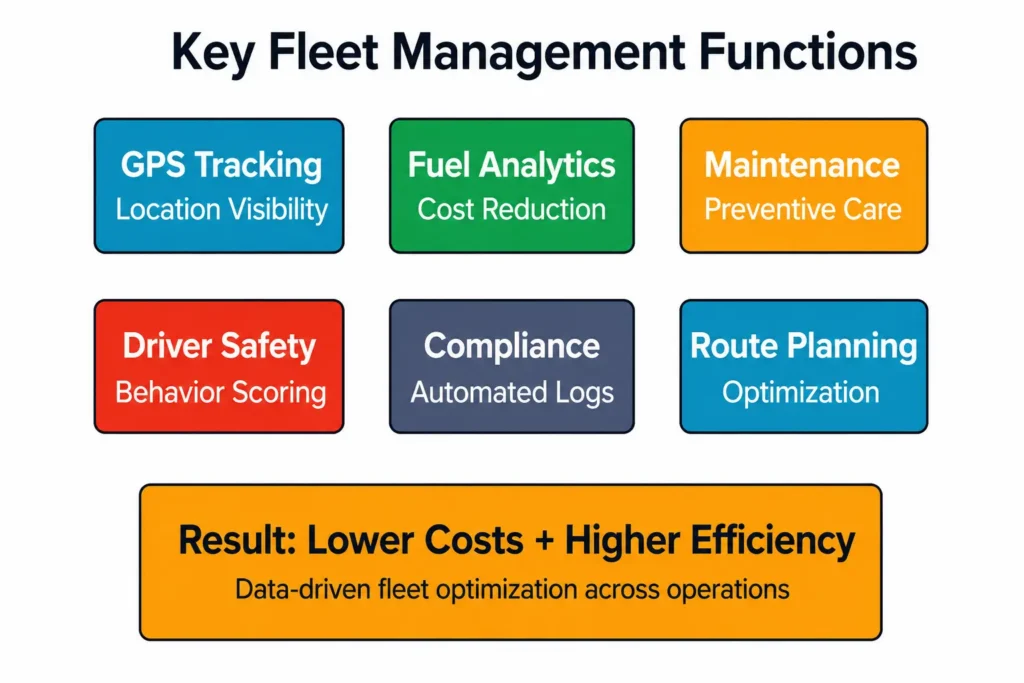
Fleet management systems support numerous operational functions that improve efficiency and reduce costs. These capabilities explain why organizations invest in these platforms.
Real-Time Vehicle Tracking
GPS tracking provides continuous visibility into vehicle locations. Fleet managers can see where every vehicle is at any moment on live maps, review historical routes, and calculate accurate ETAs for customer deliveries.
This visibility eliminates guesswork when dispatching the nearest available vehicle to urgent jobs, verifying that vehicles are being used for authorized purposes, and quickly locating assets if theft occurs.
Geofencing features trigger alerts when vehicles enter or exit designated areas, useful for verifying customer visits, monitoring unauthorized use, and tracking progress along planned routes.
Fuel Management and Optimization
Fuel represents a major operating expense, with transport costs representing a significant portion of operating costs. Fleet management systems monitor fuel consumption in real time, comparing actual usage against expected rates based on vehicle type, load, and route.
Excessive idling gets flagged automatically—a significant waste given that idling burns fuel while generating zero productive miles. Route optimization features suggest more efficient paths that reduce total distance traveled.
Driver behavior monitoring identifies fuel-wasting habits like rapid acceleration and hard braking. Coaching drivers to improve these behaviors can reduce fuel consumption by measurable percentages across the fleet.
Maintenance Management
Preventive maintenance prevents expensive breakdowns and extends vehicle lifespan. Fleet management systems track maintenance schedules based on time, mileage, engine hours, or other parameters.
Automated reminders notify managers when services come due—oil changes, tire rotations, inspections, and major component overhauls. Integration with engine diagnostics enables predictive maintenance, where systems identify developing problems before they cause failures.
Digital maintenance records create comprehensive service histories for each vehicle, valuable for resale purposes and warranty claims. Some systems connect directly with service providers to schedule appointments automatically.
Driver Behavior and Safety Monitoring
Telematics devices detect driving behaviors that impact safety and costs: harsh braking, rapid acceleration, excessive speed, aggressive cornering, and unbuckled seatbelts. These events get logged with timestamps and locations.
Driver scorecards summarize performance metrics, enabling targeted coaching for individuals who need improvement. Positive reinforcement programs reward safe drivers, creating cultural incentives for better habits.
Some systems incorporate video telematics with forward-facing and driver-facing cameras. AI algorithms analyze footage to identify distracted driving, lane departures, and collision risks, triggering real-time in-cab alerts to prevent accidents.
Compliance and Reporting
Regulatory compliance requirements vary by industry and region. Fleet management systems help organizations meet these obligations through automated documentation and reporting.
Electronic logging devices (ELDs) automatically record driver hours of service to comply with regulations limiting driving time. Digital vehicle inspection reports replace paper checklists, creating auditable records that regulators can review.
Mileage tracking supports tax reporting requirements, while detailed trip logs provide documentation for customer billing or reimbursement claims.
Add EV Charging Support With ECOFACTOR
A fleet management system works by helping companies organize vehicle use, driver tasks, maintenance, routes, and daily operations. ECOFACTOR supports the charging side for EV fleets with charging stations, station management tools, and a mobile app for iOS and Android. Drivers can use the charging station map to find charging points and check station details before starting a session. Companies can also use ECOFACTOR’s online store to buy chargers, cables and adapters for offices, parking areas, depots, or other charging locations.
ECOFACTOR can help connect charging to fleet operations through:
- Station access and charging activity tools
- Charging equipment for company and commercial sites
- Mobile support for drivers using charging points
- Hardware and accessories for everyday EV use
Contact ECOFACTOR to make charging a more organized part of how your fleet management system works.
The Role of Telematics Technology
Telematics serves as the technological foundation that makes modern fleet management possible. Understanding this technology clarifies how systems achieve their capabilities.
Vehicle telematics combines telecommunications, vehicular technologies, road transportation, and computer science to transmit and receive vehicle data. The term emerged from merging “telecommunications” and “informatics.”
In practical terms, telematics devices installed in vehicles collect data from multiple sources—GPS satellites for location, the vehicle’s computer for mechanical data, accelerometers for motion sensing, and various connected sensors. This data gets transmitted wirelessly to remote servers for processing and storage.
Telematics has become a key enabler in developing smarter, more connected operations. Organizations leverage telematics data not just for tracking vehicles, but for optimizing entire supply chains and improving customer service.
Types of Telematics Data
Modern telematics systems capture dozens or hundreds of data points. Location and speed represent the basics. Engine diagnostics include RPM, coolant temperature, battery voltage, and diagnostic trouble codes that indicate mechanical issues.
Fuel data tracks consumption rates, tank levels, and efficiency metrics. Driver behavior data captures acceleration patterns, braking force, cornering speeds, and seatbelt usage. Environmental sensors monitor cargo temperature, humidity, door status, and loading dock time.
This comprehensive data collection enables holistic fleet optimization rather than addressing isolated problems.
Benefits Organizations Gain From Fleet Management Systems
The question isn’t whether fleet management systems provide value, but how much. Organizations implementing these systems report measurable improvements across multiple operational areas.
Cost Reduction
Fuel savings alone often justify system investments. Identifying inefficient routes, reducing idle time, and improving driver behavior directly decrease fuel expenses. Preventive maintenance costs less than emergency repairs, while extending vehicle life defers expensive capital replacements.
Optimized routing reduces total miles driven, decreasing wear and tear across the fleet. Insurance premiums may decrease when organizations demonstrate safety improvements through telematics data.
Productivity Improvements
Real-time visibility enables better resource allocation. Dispatchers assign the nearest available vehicle to new jobs rather than guessing which driver has capacity. Route optimization ensures drivers complete more stops per day without working longer hours.
Automated reporting eliminates manual data entry and reconciliation tasks. Integration with other business systems creates seamless workflows that reduce administrative overhead.
Enhanced Safety
Driver behavior monitoring identifies risky habits before they cause accidents. Coaching programs improve driving standards across the fleet. Video telematics provides evidence for exonerating drivers in not-at-fault incidents, reducing fraudulent claims.
Maintenance monitoring ensures vehicles remain in safe operating condition. Tire pressure monitoring prevents blowouts, while brake system diagnostics identify worn components before they fail.
Better Customer Service
Accurate ETAs keep customers informed about delivery windows. Proof-of-service documentation confirms job completion with timestamps and locations. Historical data enables realistic scheduling commitments.
When service issues arise, complete vehicle and driver records help organizations investigate and respond quickly to customer concerns.
Environmental Sustainability
Reducing fuel consumption directly decreases carbon emissions. Route optimization minimizes total miles driven. Idling reduction cuts unnecessary emissions from stationary vehicles.
These improvements help organizations meet environmental, social, and governance goals while reducing operating costs—a rare win-win scenario.
| Benefit Category | Typical Impact | How Systems Enable It |
|---|---|---|
| Fuel Costs | 10-25% reduction | Behavior monitoring, route optimization, idle reduction |
| Maintenance Costs | 15-30% reduction | Preventive scheduling, predictive diagnostics |
| Administrative Time | 20-40% reduction | Automated reporting, digital documentation |
| Accident Rates | 10-20% reduction | Driver coaching, safety alerts, video evidence |
| Vehicle Utilization | 15-30% improvement | Real-time visibility, optimized dispatching |
Challenges in Fleet Management Systems
While benefits are substantial, implementing and operating fleet management systems presents challenges organizations should anticipate.
Initial Investment and ROI Timeline
Hardware costs multiply across large fleets. Software subscriptions represent ongoing expenses. Installation requires time and technical expertise. Organizations need realistic expectations about ROI timelines—typically 12-24 months depending on fleet size and operational inefficiencies addressed.
Driver Acceptance and Privacy Concerns
Drivers sometimes resist monitoring systems, viewing them as invasive surveillance. Successful implementations require clear communication about system purposes, transparent policies about data usage, and emphasis on safety and coaching rather than punishment.
Privacy regulations in some jurisdictions limit what data can be collected and how it can be used. Organizations must ensure their fleet management practices comply with applicable laws.
Data Overload and Analysis Paralysis
Modern systems generate enormous data volumes. Without clear processes for reviewing data and acting on insights, organizations risk drowning in information while failing to improve operations.
Effective implementations focus on key metrics aligned with business goals rather than trying to monitor everything equally.
Integration Complexity
Connecting fleet management systems with existing business software can be technically challenging. API compatibility, data format standards, and IT resource availability all impact integration success.
Organizations should evaluate integration capabilities during vendor selection rather than discovering limitations after purchase.
Connectivity Reliability
Fleet management systems depend on reliable wireless connectivity. Vehicles operating in remote areas or underground facilities may experience data gaps. While devices typically buffer data during outages, real-time monitoring capabilities are lost until connectivity resumes.
Choosing and Implementing a Fleet Management System
Selecting the right system requires matching organizational needs with vendor capabilities. Not all fleet management platforms offer identical features or serve the same industries equally well.
Assess Organizational Requirements
Start by identifying the most pressing fleet challenges. Organizations struggling with fuel costs should prioritize systems with strong fuel management features. Those facing safety issues need robust driver behavior monitoring and video telematics.
Fleet size matters—solutions designed for small businesses may lack capabilities needed by enterprise operations, while enterprise platforms may be overkill for small fleets.
Industry-specific requirements also factor in. Construction fleets need equipment tracking capabilities. Refrigerated transport requires temperature monitoring. Passenger transport demands different features than freight hauling.
Evaluate Vendor Options
Research vendors serving the relevant industry and fleet size. Request demonstrations focused on specific use cases rather than generic overviews. Ask about implementation timelines, training requirements, and ongoing support quality.
Check vendor pricing structures carefully—pricing varies significantly by vendor and feature set. Organizations should check vendors’ official websites for current pricing since subscription tiers and feature availability change frequently. Integration capabilities matter if connecting with existing business systems is required. Verify API availability and data format compatibility before committing.
Plan the Implementation
Successful implementations follow structured approaches. Establish clear goals with measurable metrics for evaluating success. Develop realistic timelines accounting for device installation, software configuration, staff training, and process changes.
Pilot programs testing systems with a subset of the fleet help identify issues before full-scale deployment. Lessons learned during pilots inform broader rollout strategies.
Driver training ensures proper system use and acceptance. Explaining benefits and addressing concerns upfront prevents resistance later.
Monitor and Optimize
Implementation isn’t the end—it’s the beginning. Regular review of system-generated reports identifies improvement opportunities and verifies that expected benefits materialize.
Adjust alert thresholds and reporting frequencies based on operational experience. What seems important initially may prove less relevant in practice, while overlooked metrics sometimes become critical.
Continuous improvement processes leverage system data to refine operations over time, compounding initial benefits.
Future Trends in Fleet Management Technology
Fleet management systems continue evolving as new technologies emerge. Several trends are reshaping the industry.
Artificial Intelligence and Machine Learning
AI algorithms analyze historical data to predict maintenance needs with increasing accuracy. Machine learning models identify patterns humans might miss, optimizing routes based on traffic patterns, weather conditions, and historical delivery times.
Predictive analytics forecast future fuel prices, helping organizations time refueling strategically. Driver coaching becomes more targeted as AI identifies which specific behaviors individual drivers should improve for maximum impact.
Electric Vehicle Integration
As fleets transition to electric vehicles, management systems must adapt. Battery charge monitoring, charging station availability, range calculations under various load and weather conditions, and electrical grid demand management all require new capabilities.
Systems are evolving to help fleet managers plan charging schedules that minimize electricity costs while ensuring vehicles have sufficient range for assigned routes.
Autonomous Vehicle Readiness
Though widespread autonomous commercial vehicle deployment remains years away, fleet management platforms are preparing. Future systems will need to monitor autonomous systems, manage mixed fleets of human-driven and autonomous vehicles, and handle new regulatory reporting requirements.
Enhanced Connectivity
5G networks promise faster data transmission, lower latency, and support for more connected devices. This enables richer data collection—high-resolution video streaming, real-time sensor networks, and instant bidirectional communication with vehicles.
Vehicle-to-everything (V2X) communication protocols allow vehicles to exchange information with each other, infrastructure, and central systems, enabling coordinated fleet movements and enhanced safety systems.
Frequently Asked Questions
What is the main purpose of a fleet management system?
The main purpose is to optimize vehicle operations throughout their entire lifecycle—from acquisition through disposal. This encompasses tracking vehicle locations, monitoring fuel consumption, scheduling maintenance, analyzing driver behavior, ensuring regulatory compliance, and providing data-driven insights that reduce costs while improving safety and efficiency. Organizations use these systems to gain visibility into fleet operations and make informed decisions based on real-time and historical data.
How much does a fleet management system typically cost?
Pricing varies significantly by vendor and feature set. Organizations should check vendors’ official websites for current pricing since subscription tiers and feature availability change frequently.
Can fleet management systems work without internet connectivity?
Fleet management systems require connectivity to transmit data from vehicles to central servers. However, most telematics devices include local storage that buffers data during connectivity outages. When vehicles return to areas with cellular or satellite coverage, buffered data uploads automatically. Real-time tracking and alerts aren’t available during outages, but historical data remains intact. Some systems offer offline mobile apps that allow drivers to complete certain tasks without connectivity, syncing later when connection resumes.
How do fleet management systems improve driver safety?
These systems monitor driving behaviors including speeding, harsh braking, rapid acceleration, aggressive cornering, and distracted driving. Drivers receive scorecards showing their performance compared to safety standards and fleet averages. Managers use this data for targeted coaching to improve risky habits. In-cab alerts warn drivers about unsafe behaviors in real time. Video telematics provides evidence for exonerating drivers in not-at-fault accidents. Maintenance monitoring ensures vehicles remain in safe operating condition. These combined capabilities reduce accident rates by identifying and correcting unsafe practices before incidents occur.
What data do fleet management systems collect?
Modern systems collect extensive data including GPS location coordinates, speed, acceleration patterns, braking force, engine RPM, fuel consumption rates, coolant temperature, battery voltage, diagnostic trouble codes, mileage, idle time, door status, cargo temperature, driver identification, seatbelt usage, and video footage. The specific data collected depends on hardware capabilities and system configuration. Organizations typically configure systems to focus on data relevant to their operational goals and compliance requirements rather than monitoring every possible parameter equally.
Are fleet management systems only for large organizations?
No. While large enterprises with hundreds or thousands of vehicles were early adopters, fleet management systems now serve organizations of all sizes. Small businesses with just five to ten vehicles can benefit from basic tracking and fuel management capabilities. Vendors offer solutions scaled for different fleet sizes with pricing and feature sets appropriate to each market segment. Smaller fleets often see faster ROI percentages since addressing even a few inefficient vehicles creates meaningful cost savings relative to total fleet operating expenses.
How long does it take to implement a fleet management system?
Implementation timelines vary based on fleet size and system complexity. Small fleets with basic systems may complete installation and initial setup within 1-2 weeks. Large enterprises deploying comprehensive platforms across hundreds of vehicles may require 2-6 months for phased rollouts. Key phases include vendor selection, hardware procurement, device installation, software configuration, staff training, process documentation, and optimization. Pilot programs testing systems with subset fleets before full deployment add time but reduce risk. Organizations should plan for 30-90 days for typical mid-sized fleet implementations.
Conclusion
Fleet management systems represent sophisticated ecosystems combining GPS hardware, cellular connectivity, cloud software, and data analytics to transform vehicle operations. These platforms collect real-time data from vehicles, transmit it wirelessly to central servers, process massive information streams into actionable insights, and present results through dashboards and automated reports.
The operational benefits are substantial and measurable—fuel cost reductions, maintenance savings, productivity improvements, enhanced safety, better customer service, and environmental sustainability gains. Organizations implementing these systems report ROI within 12-24 months through quantifiable cost decreases and efficiency improvements.
Success requires matching organizational needs with appropriate system capabilities, planning structured implementations, training staff effectively, and continuously optimizing operations based on system-generated insights. The technology continues advancing with artificial intelligence, electric vehicle integration, and enhanced connectivity promising even greater capabilities ahead.
For organizations managing vehicle fleets of any size, the question isn’t whether to implement fleet management systems—it’s how quickly implementation can begin delivering benefits. The data-driven optimization these platforms enable has become essential for competitive operations in 2026.
Ready to transform fleet operations? Research vendors serving the specific industry and fleet size, request targeted demonstrations, and develop a phased implementation plan that delivers quick wins while building toward comprehensive optimization.