


Table of contents:
Quick Summary: Fleet management helps construction companies reduce operating costs by 15-25%, improve equipment utilization, enhance job site safety, and ensure regulatory compliance. Modern fleet management tools provide real-time tracking, predictive maintenance, automated scheduling, and data analytics that optimize resource allocation across multiple projects while reducing downtime and fuel expenses.
Managing construction fleets isn’t what it used to be. Between rising fuel costs, stricter safety regulations, and projects scattered across multiple sites, construction companies face constant pressure to do more with less.
The stakes are high. Industry analyses indicate that construction projects are over budget 50% of the time and behind schedule 60% of the time. A significant portion of those overruns traces back to poor equipment management.
Here’s the thing though—fleet management isn’t just about knowing where trucks are parked. It’s a comprehensive approach that touches every part of construction operations, from reducing idle time to preventing costly breakdowns to keeping workers safe.
So what exactly does modern fleet management do for construction companies? Let’s break down the real benefits.
We remind you that you can purchase home and commercial charging stations in our online store, as well as use public charging stations ECOFACTOR located throughout Ukraine. For convenient access to charging infrastructure, we recommend using our mobile app, available on iOS and Android.
What Construction Fleet Management Actually Means
Construction fleet management is the process of effectively managing all equipment and vehicle assets for construction and building projects. That includes everything from excavators and bulldozers to pickup trucks and delivery vans.
But it goes deeper than just tracking assets.
Fleet management can be defined by three basic components: equipment assignment and optimization, production monitoring, and position and material monitoring. Equipment assignment and optimization is the primary reason many construction companies implement these systems in the first place.
The construction industry faces unique challenges that make fleet management particularly complex. Heavy equipment doesn’t just drive on roads—it operates in challenging terrain, moves between job sites, and requires specialized maintenance schedules. Construction projects also have variable timelines, making resource planning tricky.
Real talk: without a systematic approach, construction companies end up with equipment sitting idle on one site while another project falls behind waiting for the same type of machine.
Massive Cost Reduction Across Operations
The financial impact of proper fleet management is substantial. Companies implementing comprehensive fleet solutions typically see 15-25% cost reduction.
Where do those savings come from?
Fuel Efficiency and Route Optimization
Fuel represents one of the largest ongoing expenses for construction fleets. Fleet management systems deliver 10-15% fuel savings through route optimization and behavior monitoring.
GPS tracking shows the most efficient routes for material deliveries and equipment transport. Telematics data reveals which operators are idling excessively or using inefficient driving patterns. These insights translate directly into lower fuel bills.
Material cost volatility is a persistent challenge in construction pricing. When costs spike unexpectedly, controlling the expenses within reach becomes critical.
Maintenance Cost Control
Reactive maintenance—waiting for equipment to break down—is expensive. Fleet management enables predictive maintenance that catches problems before they cause failures.
Modern systems track engine hours, monitor diagnostic codes, and schedule preventive service automatically. The result? Reduced equipment downtime through predictive maintenance and lower repair costs overall.
Think about the cost of a breakdown on an active job site. Beyond the repair bill itself, there’s the project delay, the crew standing idle, and potentially penalty fees. For a small project, delays might cost $10,000 per day. For large-scale infrastructure work, losses can exceed $50,000 daily.
Preventive maintenance isn’t glamorous, but it keeps projects moving.
Administrative Efficiency
Manual fleet management means spreadsheets, phone calls, and constant status checks. Digital fleet management streamlines administrative processes and frees up managers to focus on high-value work.
Automated reporting, digital inspection forms, and centralized data eliminate hours of administrative work each week. That time savings adds up quickly across a company with multiple projects.
Improved Equipment Utilization and Resource Allocation
Construction companies often discover they own more equipment than they thought—and use less of it than they should.
Fleet management provides visibility into utilization rates across all assets. Which excavators are running at capacity? Which trucks spend most of their time parked? These insights drive smarter purchasing and allocation decisions.
Optimized equipment allocation across job sites becomes straightforward when managers can see real-time availability and usage. Instead of renting additional equipment, companies can redeploy underutilized assets from one site to another.
Academic research on construction equipment productivity shows that job size impacts efficiency. For building construction, a project requiring 500,000 labor hours is considered standard for determining baseline labor productivity. Jobs in the 300,000 to 700,000 labor hour range maintain a linear productivity relationship.
The point? Resource planning matters at scale. Fleet management ensures equipment arrives where and when projects need it, maintaining productivity targets.
Better Project Scheduling
When fleet managers know exactly which equipment will be available and when, project scheduling becomes more accurate. Improved project scheduling and resource planning reduces the guesswork that leads to delays.
Construction schedules are complex puzzles. Equipment availability is just one piece, but it’s a critical one. Modern fleet management integrates with project management systems to provide a unified view.
Enhanced Safety and Compliance Management
Construction safety isn’t just a moral imperative—it’s a regulatory requirement and a business necessity.
According to OSHA, the majority of fatalities that occur in road construction work zones involve a worker being struck by a piece of construction equipment or other vehicle. Workers are just as likely to be struck by construction equipment inside the work zone as by passing traffic.
That’s sobering data. Fleet management addresses these risks directly.
Driver Behavior Monitoring
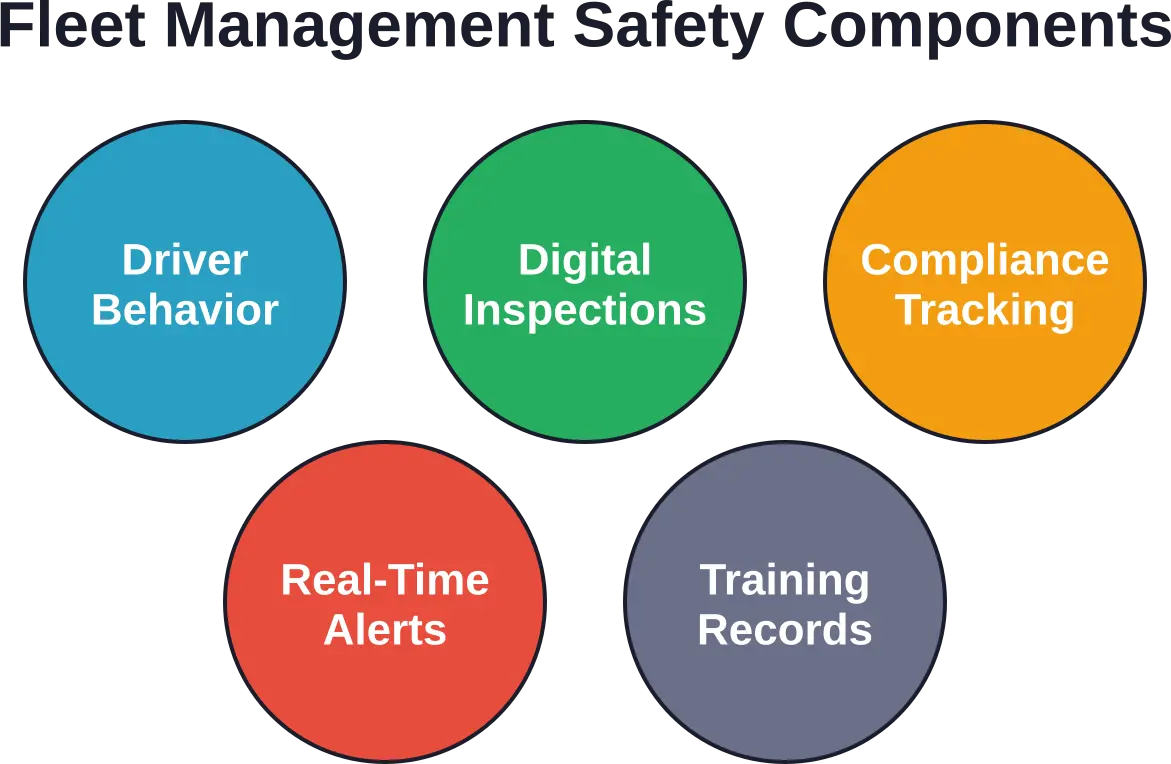
Telematics systems track speeding, harsh braking, rapid acceleration, and other risky behaviors. Fleet managers receive alerts about unsafe operation and can address issues through training before accidents occur.
Some systems include driver scorecards that gamify safety, encouraging operators to maintain high safety ratings. The combination of monitoring and positive reinforcement drives behavioral change.
Compliance Documentation
OSHA regulations for construction equipment are detailed and specific. Requirements cover everything from equipment inspections to operator qualifications to maintenance records.
Fleet management software automatically logs inspections, stores certifications, tracks expiration dates, and generates compliance reports. When inspectors arrive, documentation is ready.
Digital inspection forms ensure nothing gets skipped. Operators complete pre-trip and post-trip inspections on mobile devices, with systems flagging any reported issues for immediate attention.
Geofencing and Site Security
Geofencing creates virtual boundaries around job sites. When equipment enters or leaves a designated area outside authorized hours, managers receive instant alerts.
This capability prevents theft, catches unauthorized equipment use, and ensures machines stay where they belong. Given the value of construction equipment, theft prevention alone justifies the investment for many companies.
Real-Time Visibility Across Multiple Job Sites
Construction companies juggling multiple projects need centralized visibility. Fleet management provides a single dashboard showing equipment location, status, and availability across all sites.
GPS tracking updates continuously, so dispatchers know exactly where assets are. Need to move an excavator from the highway project to the commercial build? The system shows which unit is available and how long transport will take.
This visibility enables collaboration across different job sites, business locations, and departments. Project managers, fleet managers, and equipment operators all access the same real-time data.
Modern fleet management tools cut the time and cost required to manage a construction vehicle fleet. The coordination challenges that once consumed hours of phone tag now resolve with a few clicks.
Data-Driven Decision Making
Fleet management systems generate tremendous amounts of data. The value comes from turning that data into actionable insights.
Performance Metrics and KPIs
Key performance indicators provide objective measures of fleet performance. Common construction fleet KPIs include:
- Equipment utilization rates (hours used vs. hours available)
- Fuel consumption per project or per machine
- Maintenance costs per asset over time
- Downtime frequency and duration
- Safety incidents and near-misses
- Compliance audit results
According to research on construction project performance, clear measurements determine how a project is progressing and allow for cost-saving efficiency improvements along the way.
The same principle applies to fleet management. Measurement drives improvement.
Lifecycle Cost Analysis
When is the right time to replace aging equipment? Fleet management systems track total cost of ownership across each asset’s lifecycle.
Managers can compare maintenance costs, downtime, and fuel efficiency for older machines versus newer models. When an aging excavator requires frequent repairs and operates inefficiently, the data supports replacement decisions.
This analytical approach beats gut-feel decisions and prevents both premature replacement (wasting remaining useful life) and excessive retention (throwing good money after bad).
| Fleet Management Feature | Primary Benefit | Typical Impact |
|---|---|---|
| GPS Tracking | Real-time asset location | Reduced search time, theft prevention |
| Telematics | Equipment health monitoring | 15-25% reduction in breakdowns |
| Automated Scheduling | Optimized maintenance timing | 20-30% less unplanned downtime |
| Fuel Monitoring | Consumption tracking and alerts | 10-15% fuel cost savings |
| Digital Inspections | Compliance documentation | Faster audits, reduced violations |
| Utilization Reports | Asset allocation optimization | 15-20% improvement in utilization |
Integration with Construction Technology Ecosystems
Fleet management doesn’t exist in isolation. The most value comes from integrating fleet systems with other construction technology.
Modern construction companies use project management software, accounting systems, safety platforms, and more. Fleet management integrates with these tools to create a unified technology ecosystem.
For example, connecting fleet management with project scheduling software allows automatic equipment allocation based on project timelines. Integration with accounting systems ensures accurate cost tracking and billing.
The construction industry has seen tremendous technological evolution. The shift from Computer Aided Design to Building Information Modeling transformed design workflows. Fleet management represents a similar transformation in operations.
In 2021, 97% of large firms (50 or more employees) adopted or utilized BIM for billable projects, while only 52% of small firms (under 10 employees) utilized BIM software. Fleet management adoption shows similar patterns—larger construction companies lead adoption, but technology is becoming increasingly accessible to smaller firms.
Choosing the Right Fleet Management Solution
Not all fleet management systems are created equal. Construction companies need solutions designed for their specific requirements.
Key Features for Construction Fleets
Construction-specific fleet management should include:
- Heavy equipment tracking (not just light vehicles)
- Multi-site project management
- Off-road GPS capabilities
- Customizable inspection forms for different equipment types
- Integration with construction project management tools
- Robust reporting for project cost allocation
Systems designed for delivery fleets or service vehicles won’t meet construction needs. The operating environment is different, the equipment is different, and the business requirements are different.
Implementation Considerations
Successful fleet management implementation requires planning. Companies should consider:
- Current fleet size and composition: How many assets need tracking? What types of equipment are included?
- Geographic spread: Are projects concentrated locally or spread across regions?
- Integration requirements: Which existing systems need to connect with fleet management?
- User adoption: How will operators and managers be trained on new systems?
- Scalability: Will the system grow with the business?
Check the official documentation for current feature availability when evaluating specific platforms—capabilities evolve rapidly in this space.
Support Construction Fleets With ECOFACTOR EV Charging
Construction vehicles move between offices, yards, warehouses, suppliers, and job sites, so reliable charging matters when electric vans or cars are used in daily operations. ECOFACTOR helps construction businesses build EV charging into that routine with charging stations, management software, and access to charging points through its iOS and Android app.
For teams that manage several vehicles, this can make charging easier to plan around site schedules and crew movement. The company’s online store also offers chargers, cables and adapters that can be used for business parking areas, temporary bases, or regular company locations, while their charging station map helps to find a charging solution.
For construction companies, ECOFACTOR can help with:
- Preparing charging access near offices, yards, or service areas
- Supporting electric vehicles used by managers, crews, and field teams
- Making station access easier for several users
- Supplying practical equipment for daily EV charging needs
Contact ECOFACTOR to set up charging support that fits the way construction fleets actually move during the day.
The ROI of Fleet Management Investment
Construction companies naturally want to understand return on investment before committing to fleet management systems.
The numbers are compelling. With cost reductions of 15-25% achievable within the first year, most companies see payback periods of 12-18 months.
But wait. The benefits extend beyond direct cost savings.
Improved project delivery—meeting deadlines and staying within budget—enhances client satisfaction and drives repeat business. Better safety records reduce insurance premiums and protect against liability. Enhanced asset utilization means fewer equipment purchases and rentals.
Technology investments in construction consistently deliver measurable returns when implemented thoughtfully.
Common Implementation Challenges and Solutions
Fleet management implementation isn’t without challenges. Understanding common obstacles helps companies prepare.
Operator Resistance
Equipment operators sometimes resist telematics and tracking systems, viewing them as surveillance rather than safety tools.
The solution? Clear communication about how the data will be used. Frame fleet management as a tool that makes operators’ jobs easier—automated logs, simplified inspections, better equipment maintenance. Involve operators early in the selection and implementation process.
Data Overload
Fleet management systems generate extensive data. Without proper configuration, managers face information overload rather than actionable insights.
Focus on the metrics that matter most for specific business goals. Start with 3-5 key KPIs rather than trying to track everything. Expand gradually as the team develops data literacy.
Integration Complexity
Connecting fleet management with existing construction systems can be technically challenging.
Prioritize vendors with proven integration capabilities and robust APIs. Consider implementation support and training as part of the purchase decision, not just the software features.
Future Trends in Construction Fleet Management
Fleet management technology continues to evolve rapidly. Several trends are shaping the future:
- Artificial intelligence and machine learning are enhancing predictive capabilities: AI analyzes historical data to forecast maintenance needs, predict equipment failures, and optimize scheduling with increasing accuracy.
- Electric construction equipment is gaining traction: Fleet management systems are adapting to track battery charge levels, plan around charging times, and analyze total cost of ownership for electric vs. diesel equipment.
- Autonomous equipment will eventually transform construction sites: Fleet management will play a critical role in coordinating autonomous vehicles and machinery.
- Enhanced analytics will provide deeper insights: Advanced reporting will connect fleet performance directly to project profitability, enabling more sophisticated financial modeling.
The construction industry has historically been slower to adopt technology compared to other sectors. That’s changing. Companies that embrace fleet management and other digital tools gain competitive advantages in efficiency, safety, and profitability.
Frequently Asked Questions
What is construction fleet management?
Construction fleet management is the systematic process of managing all vehicles and equipment assets used in construction projects. It includes tracking location and usage, scheduling maintenance, monitoring operator behavior, ensuring regulatory compliance, and optimizing resource allocation across multiple job sites.
How much does fleet management software cost for construction companies?
Pricing varies significantly based on fleet size, features, and vendor. Check official vendor websites for current pricing, as costs and subscription tiers change frequently. Most providers offer tiered pricing models with monthly or annual subscriptions based on the number of assets tracked.
Can small construction companies benefit from fleet management?
Absolutely. Even fleets with 5-10 assets can achieve meaningful cost savings and efficiency improvements.
How long does it take to implement a fleet management system?
Implementation timelines vary by fleet size and system complexity. Small fleets can be operational within 2-4 weeks. Larger implementations with extensive integrations may require 2-3 months. Hardware installation, user training, and system configuration are the primary time factors.
Does fleet management really improve safety?
Yes, measurably. Fleet management improves safety through driver behavior monitoring, automated inspection compliance, real-time alerts for unsafe conditions, and comprehensive documentation. OSHA data shows that equipment-related incidents are a leading cause of construction fatalities, making systematic safety management critical.
What’s the difference between GPS tracking and full fleet management?
GPS tracking provides asset location data. Full fleet management includes GPS tracking plus telematics (equipment health monitoring), maintenance scheduling, fuel tracking, compliance documentation, digital inspections, utilization reporting, and integration with project management systems. It’s a comprehensive operational approach, not just location awareness.
How do fleet management systems handle equipment without engines?
Non-powered equipment like trailers, containers, and attachments can be tracked using battery-powered GPS devices or RFID tags. These solutions provide location tracking and movement alerts without requiring vehicle power, ensuring comprehensive asset visibility across all fleet components.
Conclusion
Fleet management delivers tangible benefits for construction companies operating in an increasingly competitive and regulated environment. Cost reductions of 15-25%, improved equipment utilization, enhanced safety, and better compliance aren’t theoretical—they’re documented outcomes from systematic fleet management implementation.
Construction projects face enough variables and uncertainties. Equipment management doesn’t have to be one of them.
Modern fleet management provides the visibility, control, and data needed to run efficient operations. From fuel savings to preventive maintenance to real-time asset tracking, the benefits touch every aspect of construction fleet operations.
The question isn’t whether fleet management helps construction companies. The evidence is clear—it does. The real question is how quickly companies can implement these systems to capture the competitive advantages they provide.
Ready to optimize fleet operations? Start by assessing current fleet costs, identifying the biggest pain points, and researching solutions designed specifically for construction industry requirements. The technology exists. The ROI is proven. The timing is now.