

Table of contents:
Quick Summary: The Tesla Model 3 Long Range is an electric sedan with a range of up to 346 miles (EPA), power up to 498 hp (for the Dual Motor version), and 0-100 km/h acceleration in 4.4 seconds. The model offers fast charging to 80% in 27 minutes on Supercharger V3 (maximum power 250 kW), advanced Autopilot features, and high safety ratings from NHTSA (five stars).
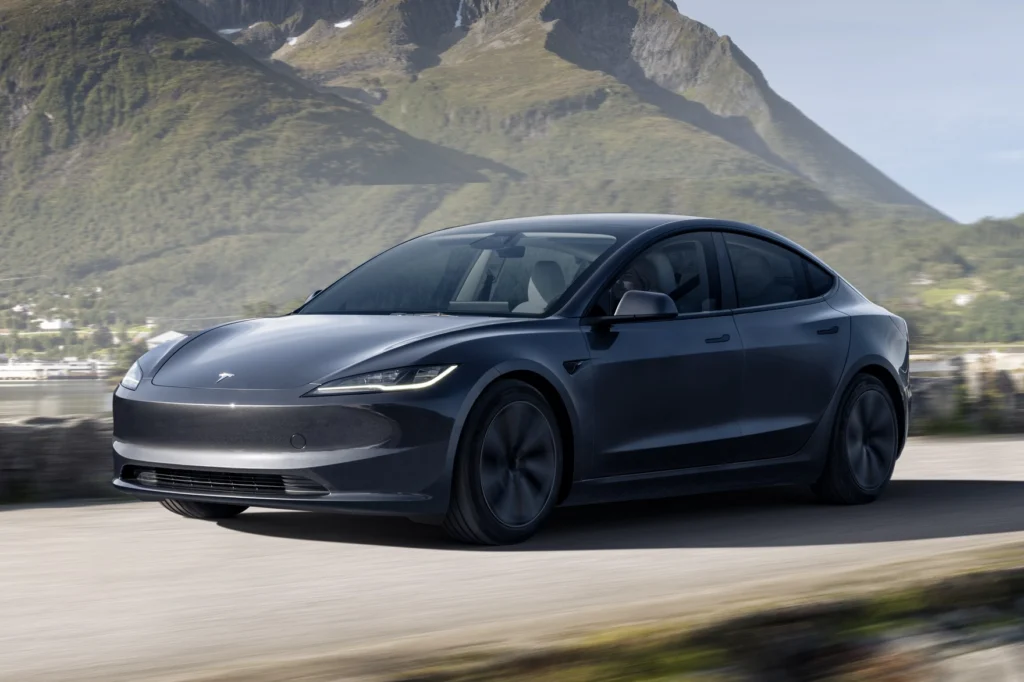
The Tesla Model 3 Long Range remains one of the most popular electric vehicles on the market due to its combination of practicality, technology, and performance. This model demonstrates that an electric car can be not only an eco-friendly solution but also a true alternative to traditional luxury vehicles.
Many drivers choose the Long Range version specifically because of its balanced characteristics. Sufficient range for daily trips and travel, fast charging, and a high level of comfort make this electric car a universal choice.
Let’s examine in detail what makes the Tesla Model 3 Long Range special and whether it meets owners’ expectations.
We remind you that you can purchase home and commercial charging stations in our online store, as well as use public charging stations ECOFACTOR located throughout Ukraine. For convenient access to charging infrastructure, we recommend using our mobile app, available on iOS and Android.
Main Technical Specifications
The Tesla Model 3 Long Range is equipped with a powerful electric powertrain that delivers impressive dynamics and smooth ride. The model is available in configurations with rear-wheel drive (RWD) and all-wheel drive (Dual Motor AWD).
The rear-wheel-drive version develops around 280-300 hp, while the Dual Motor version delivers up to 498 hp. Acceleration from 0-100 km/h takes approximately 4.4 seconds for the all-wheel-drive version, matching the level of sports cars.
| Characteristic | RWD | Dual Motor AWD |
|---|---|---|
| Power | 280-300 hp | 498 hp |
| 0-100 km/h Acceleration | 6.1 s | 4.4 s |
| Maximum Speed | 225 km/h | 233 km/h |
| Drivetrain | Rear | All-Wheel |
Every press of the accelerator pedal turns into an instant response with no delay. The electric motors provide linear acceleration across the entire speed range, creating a unique driving sensation.
The suspension is tuned for a balance between comfort and handling. On smooth roads, the car glides softly, and in corners it shows minimal body roll and precise steering response.
Range: Theory and Practice
Range is one of the most important parameters for any electric vehicle. The Tesla Model 3 Long Range got its name precisely because of the extended battery and optimized energy efficiency.
According to Consumer Reports, testing showed results of about 310 miles against the original EPA rating. In Consumer Reports testing, the car achieved 350 miles with aggressive regenerative braking enabled.
What does this mean in practice? For most drivers, the range is enough for a week of city driving without charging. Even long trips become quite feasible thanks to the network of fast charging stations.
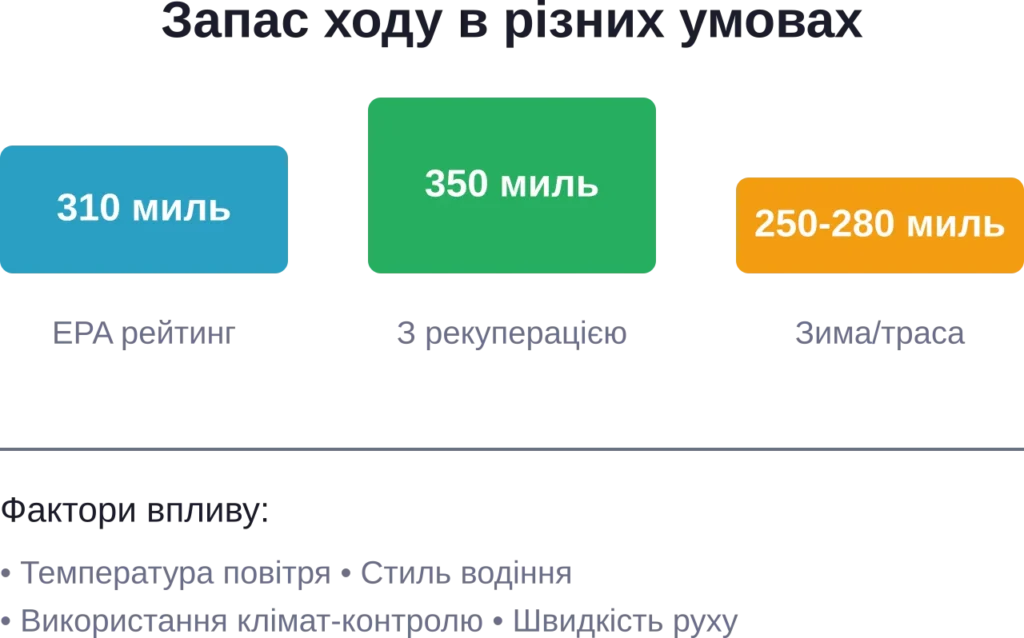
It is worth noting that range significantly depends on temperature. In winter, at temperatures below 0°C, range can decrease by 20-30% due to the need for cabin heating and reduced battery efficiency.
In summer at moderate temperatures, the car shows results close to the stated EPA figures. Aggressive driving style with frequent accelerations also reduces range, but regenerative braking partially compensates for these losses.
Battery and Energy Efficiency
The Tesla Model 3 Long Range is equipped with a lithium-ion battery with a capacity of approximately 75-82 kWh depending on the year of manufacture. The battery is located in the floor of the car, which lowers the center of gravity and improves handling.
The battery has a thermal management system that maintains the optimal temperature of the cells in any conditions. This extends battery life and ensures stable performance.
Tesla provides an 8-year or 192,000 km battery warranty with at least 70% of original capacity retained. In practice, most batteries retain over 85-90% capacity after five years of operation.
Charging: Speed and Convenience
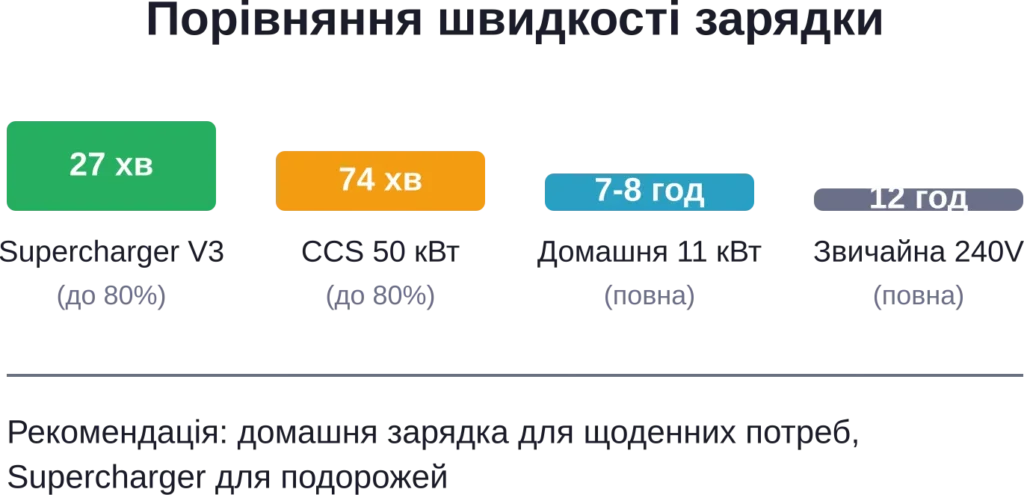
One of the biggest advantages of owning a Tesla is access to the Supercharger network — the most developed fast-charging infrastructure in the world. At Supercharger V3 stations (maximum power 250 kW), the electric car can be charged to 80% in just 27 minutes, restoring approximately 270-280 km of range.
The maximum charging power at Supercharger V3 stations reaches 250 kW. Charging from 10% to 80% takes about 27 minutes under optimal conditions and battery temperature.
| Charging Type | Power | Time (10-80%) | Speed |
|---|---|---|---|
| Supercharger V3 | 250 kW DC | 27 min | 840 km/h |
| Home Charging (Type 2, 11 kW) | 11 kW AC | 8 h 15 min (0-100%) | 60 km/h |
| Standard Outlet (240V, 32A) | 7.7 kW AC | 12 h (full) | 40 km/h |
| CCS (50 kW DC) | 50 kW DC | 74 min | 290 km/h |
For daily use, most owners install an 11 kW home charging station. According to Consumer Reports, charging at a 40A/240V station takes about 7 hours.
A standard 240-volt outlet with 32 amps charges the car fully in 12 hours. This is convenient for overnight home charging when the car is not in use.

Optimize Charging Infrastructure for Your Car
If you use the Tesla Model 3 Long Range daily, charging should match your trips and not create extra steps. ECOFACTOR combines the necessary tools in one approach. There is a mobile app for Android and iOS for charging management, a separate map of charging stations for route planning, and an online store where you can select accessories, cables, and mobile chargers for specific tasks without a long search.
For equipment selection, the charging station configurator is available — through it you can choose an AC station for home or a DC station for commercial use. For networks or scaling, the operator platform is available. Energy-efficient and white-label solutions for adaptation to your own projects are also available.
Contact ECOFACTOR and get a charging solution that matches your current needs and expectations.
Safety Systems and Ratings
Safety is one of Tesla’s main priorities. The Model 3 has repeatedly received high scores in crash tests from leading organizations, particularly NHTSA (U.S. National Highway Traffic Safety Administration).
NHTSA awarded the Tesla Model 3 five stars in the overall rating and in each individual test category. This includes frontal impact, side impact, and rollover test.
The car’s design with a low center of gravity due to the floor-mounted battery reduces the risk of rollover. The reinforced body frame and deformation zones provide maximum passenger protection.
Standard equipment includes:
- Eight airbags
- Automatic emergency braking
- Forward collision warning
- Blind spot monitoring
- Automatic lane keeping
- Adaptive cruise control
EPA confirms that the Model 3 is among the 20% of vehicles with the lowest emissions for its model year. Considering it is an electric vehicle, greenhouse gas emissions during operation are completely absent.
Autopilot and Driving Technologies
The Tesla Model 3 Long Range comes with the basic Autopilot system, which includes adaptive cruise control and lane-keeping assistance. The system works reliably on highways and well-marked roads.
For an additional fee, the Enhanced Autopilot or Full Self-Driving (FSD) package is available, adding automatic lane changing, parking, car summoning, and autopilot navigation from highway entry to exit.
It is important to understand: even with the most advanced packages, the car requires constant driver attention. These are driver assistance systems, not fully autonomous ones.
Cameras and sensors constantly monitor the environment. The system reacts to road signs, traffic lights, pedestrians, and other vehicles with high accuracy.
Interior and Comfort
The Tesla Model 3 interior is executed in a minimalist style. The central element is a 15-inch horizontal touchscreen through which all vehicle functions are controlled.
The absence of physical buttons may initially seem unusual, but after a few days the interface becomes intuitive. Navigation, media, climate settings, cameras — everything is available in a few taps.
The front seats provide good support and wide adjustment ranges. Seat heating is standard equipment; ventilation is available in some configurations.
The rear row offers enough space for adult passengers thanks to the completely flat floor.
The trunk has a volume of 425 liters, plus a front trunk (frunk) of 88 liters. The rear seats fold in a 60/40 ratio, expanding the possibilities for transporting bulky items.
Maintenance Cost
Operating costs for the Tesla Model 3 Long Range are significantly lower compared to gasoline cars of a similar class. According to fueleconomy.gov, annual electricity costs for the 2024 Model 3 Long Range RWD are $550.
Electric motors do not require oil changes, filters, spark plugs, or timing belts. The main maintenance costs include cabin filter replacement, washer fluid, and tire rotation.
Brake pads wear out much more slowly thanks to regenerative braking. Many owners drive over 100,000 km without replacing brake pads.
However, tire cost should be considered. Due to the high torque of the electric motors and battery weight, tires may wear faster than on conventional cars.
Real-World Usage Experience
Discussions in automotive communities show that owners of the Tesla Model 3 Long Range highly appreciate the car’s everyday practicality. Instant acceleration, cabin silence, and the convenience of home charging are named among the main advantages.
Some users note the suspension stiffness on bad roads. Low-profile tires transmit small irregularities into the cabin, which can be uncomfortable on long trips.
Build quality has improved in recent years. Early models sometimes had issues with body panel gaps and interior squeaks, but 2024-2026 cars demonstrate a significantly higher level of quality.
The Supercharger infrastructure receives high marks. Stations are located along major highways, making travel convenient even over long distances.
Advantages and Disadvantages
| Advantages | Disadvantages |
|---|---|
| Significant range up to 346 miles (EPA) | Suspension stiffness on bad roads |
| Fast charging on Supercharger V3 (27 min to 80%) | Range reduction in cold weather |
| Impressive dynamics and smooth ride | Minimalist interior may not suit everyone |
| Low operating costs | Battery replacement cost outside warranty |
| High safety ratings from NHTSA (five stars) | Faster tire wear due to weight and torque |
| Advanced technologies and over-the-air updates | Dependence on the touchscreen for all functions |
Will the Model 3 Long Range suit you? It depends on your usage style. For daily trips up to 200 km per day and the ability to charge at home, this car turns out to be an ideal solution.
If you regularly have to cover 400+ km without access to fast charging, it is worth carefully planning routes taking into account the location of charging stations.
Frequently Asked Questions (FAQ)
What Is the Real Range of the Tesla Model 3 Long Range in Winter?
In winter, at temperatures from -10°C to 0°C, the real range is usually 250-280 miles (400-450 km), which is 20-30% less than the summer figure. The use of cabin heating and reduced battery efficiency in the cold are the main factors in reducing range.
How Much Does a Full Charge of the Tesla Model 3 Long Range Cost at Home?
At an average electricity rate of approximately $0.12-0.15 per kWh, a full charge of a 75-82 kWh battery will cost $9-12. According to official data, annual electricity costs are about $550 with regular use.
Is Regular Maintenance Required for the Tesla Model 3?
Tesla does not have a strict schedule for regular maintenance. It is recommended to check brake fluid every 2 years, replace the cabin filter annually, and rotate tires every 10,000-12,000 km. Other components are checked as needed through the Tesla app.
How Long Does the Battery Last in the Tesla Model 3 Long Range?
The battery warranty is 8 years or 192,000 km with retention of at least 70% of original capacity. Real data shows that most batteries retain 85-90% capacity after five years of operation. The battery life often exceeds the life of the car itself.
Can You Charge a Tesla at Regular Charging Stations (Not Supercharger)?
Yes, the Tesla Model 3 supports charging at stations with CCS (Combined Charging System) connectors, which are common in Europe and are gradually appearing in other regions. Charging speed depends on the power of the specific station — from 50 kW to 350 kW.
What Is the Difference Between RWD and Dual Motor AWD Versions?
The RWD version has rear-wheel drive, one electric motor, power of about 280-300 hp, and 0-100 km/h acceleration in 6.1 seconds. Dual Motor AWD is equipped with two motors (one on each axle), 498 hp, acceleration in 4.4 seconds, and better traction on slippery roads.
Does the Tesla Model 3 Lose Range Over the Years?
Yes, the battery gradually loses capacity due to natural degradation. The loss is usually 5-10% in the first five years and stabilizes at 10-15% after eight to ten years. This is a normal process for all lithium-ion batteries.
Conclusion
The Tesla Model 3 Long Range continues to set standards in the electric sedan segment. The combination of significant range up to 346 miles (EPA), impressive dynamics, and advanced technologies makes this car an attractive choice for a wide range of drivers.
High safety ratings from NHTSA (five stars), low operating costs, and access to the Supercharger network further strengthen the model’s position in the market. Yes, there are some compromises such as a stiffer suspension and reduced range in winter.
However, for most usage scenarios — daily commutes, family trips, environmental awareness — the advantages significantly outweigh the disadvantages. If charging infrastructure is developed in your region, the Model 3 Long Range can become not just a vehicle, but a real alternative to traditional cars.
Make sure you can charge the car at home or have stable access to charging stations. Book a test drive to feel the unique dynamics of the electric car and evaluate whether the minimalist Tesla approach to interior design suits you.