


Table of contents:
Quick Summary: Tesla Model Y is a compact electric crossover that combines practicality, dynamics, and advanced technology. Depending on the version (RWD, Long Range, Performance), the range is from 430 to 455 km under the WLTP cycle, acceleration to 100 km/h takes from 3.7 to 6.9 seconds, and Supercharger fast charging restores 80% of the battery in 25 minutes. Real-world operating experience confirms high battery reliability, minimal maintenance costs, and excellent Euro NCAP safety ratings.
Tesla Model Y has become one of the most popular electric vehicles in the world thanks to the optimal combination of space, performance, and technology. This compact crossover offers three powertrain versions, a spacious interior for five or seven seats, and characteristics that meet different needs — from economical city trips to dynamic sports driving.
Let’s take a detailed look at the technical specifications, real range in various conditions, charging features, and practical operating experience of this electric crossover.
We remind you that you can purchase home and commercial charging stations in our online store, as well as use public charging stations ECOFACTOR located throughout Ukraine. For convenient access to charging infrastructure, we recommend using our mobile app, available on iOS and Android.
General Information About Tesla Model Y
The Tesla Model Y is built on the Model 3 platform but received increased ground clearance, a larger trunk volume, and the option to install a third row of seats. Series production began in March 2020. The vehicle is manufactured at Tesla factories in the USA, China, Germany, and Texas.
Today, the Model Y is produced at four factories — in the USA, China (Shanghai), Germany (Berlin), and Texas (Austin). This allows Tesla to ensure fast delivery of vehicles worldwide and adapt configurations to local markets.
The vehicle class is a compact crossover (SUV) with five doors. The layout depends on the version: rear-motor in RWD or all-wheel drive in Long Range and Performance.
Versions and Powertrain Configurations
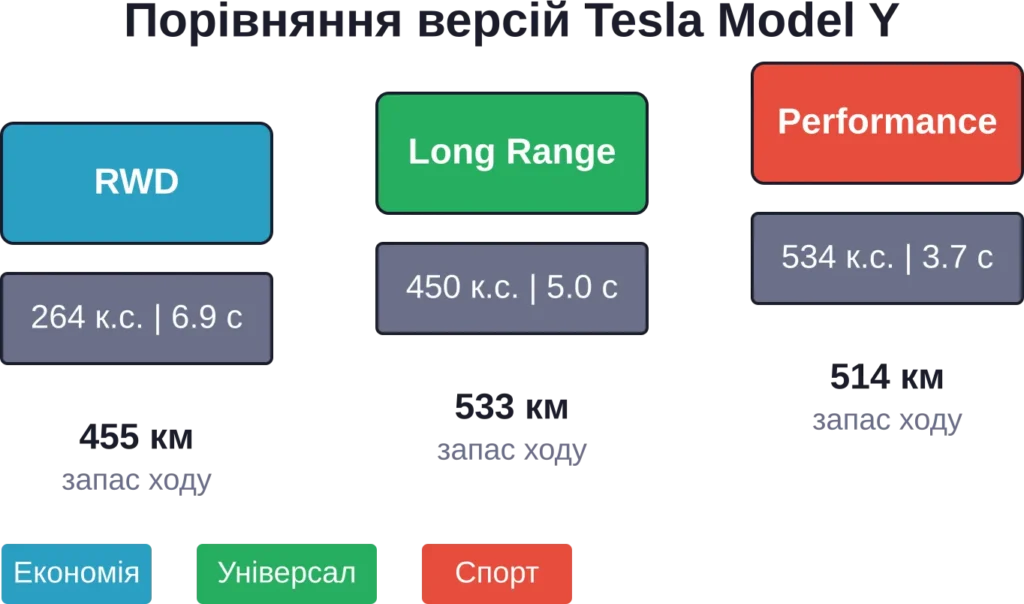
Tesla offers three main versions of the Model Y, each differing in power, drive type, and dynamic characteristics.
Rear-Wheel Drive (RWD)
Base version with a single rear electric motor:
- Power: 194 kW (264 hp)
- Torque: 340 Nm
- 0-100 km/h Acceleration: 6.9 seconds
- Top Speed: 201 km/h
- Drive: Rear-wheel drive
- WLTP Range: up to 430-455 km
This version is aimed at drivers who need efficiency and sufficient dynamics for everyday use. Rear-wheel drive provides balanced handling and predictable road behavior.
Long Range (Dual Motor AWD)
The most popular version with two motors and all-wheel drive:
- Power: 331 kW (450 hp)
- Torque: 493 Nm
- 0-100 km/h Acceleration: 5.0 seconds
- Top Speed: 201 km/h
- Drive: All-wheel drive (AWD)
- WLTP Range: up to 533 km
Long Range offers the optimal balance between dynamics, range, and all-weather confidence thanks to all-wheel drive. This is the best choice for those who often travel long distances.
Performance (Dual Motor AWD)
The sports version with maximum performance:
- Power: 393 kW (534 hp)
- Torque: 660 Nm
- 0-100 km/h Acceleration: 3.7 seconds
- Top Speed: 250 km/h
- Drive: All-wheel drive (AWD)
- WLTP Range: up to 514 km
Performance receives an improved suspension, larger brakes, 21-inch Überturbine wheels, and Track Mode for track driving. This version demonstrates supercar dynamics in the body of a practical crossover.
Battery and Real-World Range
The Tesla Model Y is equipped with lithium-ion batteries of different capacities depending on the version and market. Vehicles produced in China for base versions use LFP chemistry (lithium-iron-phosphate), while Long Range and Performance versions use NCA or NMC chemistry.
Battery Specifications
The base RWD version receives a battery with a capacity of about 57.5-60 kWh depending on the market (LFP), while Long Range and Performance are equipped with a battery of about 75-82 kWh (nominal) depending on the year of manufacture.
The nominal battery voltage is about 340-400 V. LFP batteries are known for their safety, longevity, and the ability to regularly charge to 100% without significant resource loss.
Tesla provides an 8-year or 160,000 km (for RWD) and 8-year or 192,000 km (for Long Range and Performance) battery warranty with a minimum of 70% of the original capacity retained.
Real-World Range in Different Conditions
Official WLTP data shows optimistic figures, but real range depends on temperature, driving style, speed, and climate control usage.
| Version | WLTP (Official) | Summer, Highway | Winter, City | Highway 120+ km/h |
|---|---|---|---|---|
| RWD | 455 km | 380-410 km | 300-330 km | 280-310 km |
| Long Range | 533 km | 450-480 km | 370-400 km | 350-380 km |
| Performance | 514 km | 430-460 km | 350-380 km | 330-360 km |
In winter, at temperatures below 0°C, the range can decrease by 25-35% due to the need to heat the cabin and battery. In summer, during high-speed highway driving, the reduction is also noticeable due to aerodynamic drag.
According to EPA data, electric vehicles use 87-91% of battery energy for motion thanks to regenerative braking, while gasoline cars convert only 16-25% of fuel energy into motion.
Tesla Model Y Charging
Tesla offers several charging options — from a household outlet to fast Supercharger stations.
Home Charging (AC)
The maximum AC charging power is 11 kW via a wall charger. Using the 11 kW Wall Connector, a full battery charge (0-100%) takes about 6 hours 15 minutes.
The charging speed is approximately 57 km of range per hour. This is the ideal option for daily use — plug in at night and have a full charge in the morning.
Supercharger Fast Charging (DC)
The Supercharger network allows charging the Model Y with direct current with a peak of up to 250 kW. Charging time from 10% to 80% is about 25 minutes under optimal conditions on a Supercharger V3.
The charging curve looks like this:
- 0-20%: up to 250 kW (peak speed)
- 20-50%: 150-200 kW (stable high-speed phase)
- 50-80%: 75-150 kW (gradual reduction)
- 80-100%: 25-75 kW (slow top-up to preserve the battery)
The optimal range for fast charging is from 20% to 50%, when the speed is maximum. Charging from 80% to 100% is not recommended during trips due to the sharp drop in power.

Connect Charging Infrastructure for Your Tesla Model Y Now
If you actually use your Tesla Model Y every day, charging and cost management becomes a practical rather than theoretical issue. ECOFACTOR works with charging infrastructure, energy, and services for drivers and businesses, solving these tasks without empty promises. They also have an online store where you can get accessories, cables, and mobile chargers for your specific usage scenarios.
Get Full Control Over Charging Without Extra Effort
ECOFACTOR offers practical tools for those who want to easily manage the process and costs:
- Mobile App for Android and iOS with network access and map of charging stations
- Online store with equipment: accessories, cables, mobile chargers
- Charging Station Configurator to select an AC station or DC station for your needs
- Platform for Operators for managing the charging network
- Energy-Efficient Solutions for consumption optimization
- White-Label Solution for launching your own charging services
If you need a working solution for your Tesla Model Y, discuss it with ECOFACTOR and select the right solution for your real usage.
Dimensions and Interior Space
The Tesla Model Y offers a spacious interior and large trunk thanks to compact electric motors and the absence of a transmission tunnel.
Exterior Dimensions
- Length: 4751 mm
- Width: 1921 mm (with mirrors — 2129 mm)
- Height: 1624 mm
- Wheelbase: 2890 mm
- Ground Clearance: 167 mm
- Weight: from 1909 kg (RWD) to 2003 kg (Performance)
A ground clearance of 167 mm allows you to confidently drive over speed bumps, gravel roads, and park near high curbs.
Interior and Trunk
The interior is designed for five adult passengers with comfortable legroom and headroom. A third row of seats for two children or teenagers is optionally available.
Trunk volume:
- Rear trunk: 854 L (with second-row seats folded — up to 2158 L)
- Front trunk (frunk): 117 L
The flat floor without a tunnel creates extra legroom for rear passengers. The panoramic glass roof visually expands the interior space.
Interior and Technologies
The Tesla Model Y interior features a minimalist design. The central 15-inch touchscreen controls all vehicle functions — from climate control to suspension settings.
Infotainment System
Tesla’s operating system is constantly updated over the internet (OTA updates), adding new features and improving existing ones without visiting a service center.
Available entertainment includes:
- Music streaming (Spotify, Apple Music, YouTube Music)
- Video services (Netflix, YouTube, Disney+ when connected to Wi-Fi or LTE)
- Games with gamepad support
- Web browser
- Navigation with visualization of available Superchargers
Autopilot and Full Self-Driving
The basic Autopilot function is included in all Model Y configurations. It includes adaptive cruise control and automatic lane keeping on highways.
The optional Full Self-Driving (FSD) package adds:
- Automatic lane changes on the highway
- Automatic parking (parallel and perpendicular)
- Summon the car from a parking spot via the app
- Recognition and reaction to traffic lights and stop signs
- Autopilot navigation (automatic lane changes and exits)
It is important to understand that FSD requires constant driver attention — it is a driver assistance system, not fully autonomous driving.
Safety and Crash Tests
The Tesla Model Y received the highest ratings in Euro NCAP tests, confirming its reputation as one of the safest vehicles in its class.
Euro NCAP Ratings
- Adult Occupant Protection: around 97% — one of the best results
- Child Occupant Protection: 87% — high level of safety for children
- Vulnerable Road Users Protection: 79% — good safety performance
- Safety Assist: 98% — advanced driver assistance systems
The low center of gravity thanks to the battery in the floor reduces the risk of rollover. The rigid body and deformation zones effectively absorb impact energy.
Active Safety Systems
Standard equipment includes:
- Automatic Emergency Braking (AEB)
- Collision warning with automatic intervention
- Blind spot monitoring
- Rear cross-traffic warning
- 360° cameras for surround view
- Lane keeping system
Tesla Model Y Real-World Experience
Real owner reviews of the Tesla Model Y help understand the advantages and disadvantages of this electric crossover in everyday use.
Advantages According to Owners
- Low Operating Costs: The cost of electricity for 100 km is approximately 56-81 UAH depending on the tariff, which is 4-6 times cheaper than gasoline. No oil, filters, spark plugs, or complex transmission significantly reduces maintenance costs.
- Dynamics and Handling: Instant torque from the electric motor provides sharp acceleration from any speed. The low center of gravity makes handling sharp and predictable.
- Quiet and Comfort: The absence of internal combustion engine noise creates a calm atmosphere in the cabin even at high speeds. The climate control system works without starting the engine.
- Supercharger Network: Tesla’s extensive network of fast charging stations makes long trips convenient. Navigation automatically plans the route with charging stops.
Disadvantages and Issues
- Build Quality: Early Model Y units had build quality issues — uneven panel gaps, interior trim squeaks. Later production years show improved quality.
- Stiff Suspension: The Performance version is particularly stiff on uneven roads, which can be uncomfortable for rear passengers. Long Range and RWD offer softer settings.
- Range Loss in Winter: At temperatures below -10°C, real range can drop by 25-35% due to cabin and battery heating. Pre-heating via the app partially solves the problem.
- Post-Accident Repair Cost: Tesla parts and specialized repairs are more expensive compared to traditional cars. Insurance may be higher due to design complexity.
Battery Reliability
According to research and Tesla’s warranty, batteries retain at least 70% of original capacity for 8 years or 160,000-192,000 km. Battery degradation is usage-dependent — driving style affects aging speed more than total mileage.
Recommendations for battery preservation:
- Avoid regular charging to 100% (optimally 80-90% for daily use)
- Do not leave the car with a very low charge (below 10%) for long periods
- Minimize the number of fast DC charges (if possible)
- Use the battery preconditioning function before charging in cold weather
Tesla Model Y Comparison with Competitors
The Tesla Model Y competes with other premium electric crossovers on the market.
| Model | Power | WLTP Range | 0-100 km/h | Price (approx.) |
|---|---|---|---|---|
| Tesla Model Y LR | 450 hp | 533 km | 5.0 s | from €52,000 |
| BMW iX3 | 286 hp | 460 km | 6.8 s | from €68,000 |
| Audi Q4 e-tron | 299 hp | 520 km | 6.2 s | from €55,000 |
| Mercedes EQB | 292 hp | 423 km | 6.9 s | from €56,000 |
The Tesla Model Y offers the best dynamics and the largest range among competitors at a lower or comparable price. Tesla’s advantage is its own Supercharger network and regular OTA updates that add new features without visiting a dealer.
Competitors offer better interior material quality, a more traditional cabin design with physical buttons, and the reputation of established premium brands.
Maintenance Cost and Total Cost of Ownership
Electric vehicles have significantly lower maintenance costs compared to internal combustion engine vehicles.
Regular Maintenance
Tesla recommends minimal scheduled maintenance:
- Cabin Filter Replacement: every 2 years
- Brake Fluid Check: every 2 years (replacement every 4 years)
- Air Conditioning System Check: every 2 years (desiccant replacement every 4 years)
- Wheel Rotation: every 10,000 km
There are no costs for:
- Engine oil and oil filters
- Fuel filters
- Spark plugs
- Timing belts and chains
- Clutch and transmission fluid
Brake pads last much longer thanks to regenerative braking, which uses the electric motor to slow the vehicle and return energy to the battery.
Energy Cost
The cost of driving 100 km (at 18 kWh consumption) ranges from 77.76 UAH (at the standard rate of 4.32 UAH/kWh) to 38.88 UAH (at the night rate of 2.16 UAH/kWh).
For comparison, an internal combustion engine car with 7 l/100 km consumption and gasoline at 50 UAH/l spends 350 UAH per 100 km — 4-6 times more.
FAQ — Frequently Asked Questions About Tesla Model Y
What Is the Real Range of Tesla Model Y in Winter?
In winter, at temperatures of -5…-15°C, the real range of the Long Range version is 370-400 km (compared to 480-500 km in summer). The RWD version shows about 300-330 km in winter. The reduction occurs due to the need to heat the cabin and maintain the optimal battery temperature. Using the pre-heating function via the Tesla app during charging helps reduce losses.
Can the Tesla Model Y Be Charged from a Regular Outlet?
Yes, the Model Y can be charged from a standard 220V household outlet using the mobile charger included in the kit. However, the charging speed will be only 8-12 km of range per hour (about 2 kW), making this method impractical for regular use. It is recommended to install a Wall Connector at 11 kW (57 km/h speed).
How Much Does Supercharger Charging Cost in Ukraine?
The cost of charging at a Supercharger, depending on location and network load, can vary. Home charging on a night tariff is significantly cheaper — about 2.16 UAH per kWh.
Is Special Battery Maintenance Required for Tesla?
No, the Tesla battery does not require regular maintenance. The battery management system automatically controls temperature, cell balancing, and charge level. Tesla provides an 8-year or 160,000-192,000 km battery warranty (depending on version) with a minimum of 70% of the original capacity retained. For longevity, it is recommended to avoid regular charging to 100% and long-term storage with a very low charge.
How Does Autopilot Work in the Tesla Model Y?
The basic Autopilot includes adaptive cruise control (maintains distance to the vehicle ahead) and automatic lane keeping. The system uses cameras and sensors to recognize road markings, vehicles, and obstacles. Autopilot works on highways and clearly marked roads. The driver must keep hands on the steering wheel and monitor the situation — the system requires periodic touches of the wheel to confirm attention.
Is It Worth Buying a Tesla Model Y in 2026?
The Tesla Model Y remains one of the best options among electric crossovers in 2026. Advantages: the largest range in its class, excellent dynamics, Supercharger network, regular free software updates, and low operating costs. Disadvantages: build quality still lags behind traditional premium brands, stiff suspension in the Performance version, and high repair costs after accidents. If the priority is range, technology, and fuel savings, the Model Y is an excellent choice.
Which Tesla Model Y Variant Should I Choose: RWD, Long Range, or Performance?
RWD — for those who prioritize savings and mainly drive in the city with occasional trips to the countryside (up to 400 km). Long Range — the universal choice for most buyers: maximum range, all-wheel drive for winter confidence, and balanced suspension. Performance — for those who value dynamics above all and are willing to accept a stiffer suspension and slightly lower range. The most popular version is Long Range.
Conclusion
The Tesla Model Y confirms its status as one of the best electric crossovers on the market thanks to the combination of space, performance, and advanced technology. A range of up to 533 km provides freedom of movement both in the city and on long trips.
Low operating costs, no need for complex maintenance, and fuel savings make the Model Y an attractive choice from an economic point of view. Over 8-10 years of operation, savings on fuel and maintenance can offset the higher initial cost compared to gasoline counterparts.
The Supercharger network solves the problem of long trips, and regular OTA updates constantly improve the vehicle’s functionality without visiting a service center.
Of course, the Model Y is not perfect — the build quality of early examples drew criticism, the Performance suspension is too stiff for bad roads, and the range noticeably decreases in winter. But for most owners, these disadvantages do not outweigh the numerous advantages of Tesla’s electric crossover.
If you are looking for a spacious, dynamic, and technologically advanced electric vehicle for the family, the Tesla Model Y Long Range deserves your primary attention. It is not just a vehicle, but a transition to a new level of mobility with minimal environmental impact and maximum comfort.