


Table of contents:
The electrification of commercial transport has been a game-changer for fleet operators. And when ChargePoint announced the acquisition of ViriCiti in August 2021, the industry gained a powerful combination: a leading network of charging stations plus the best platform for managing electric transport.
But what does this mean for you? How does the integration work? And, most importantly, how can you make the most of this tool?
This guide will tell you everything you need to know about the ViriCiti ChargePoint platform — from the basics to advanced fleet management strategies.
We remind you that you can purchase home and commercial charging stations in our online storeand also use the public charging stations ECOFACTORcharging points located throughout Ukraine. For convenient access to charging infrastructure, we recommend using our mobile applicationwhich is available on iOS and Android.
What is ViriCiti and Why Did ChargePoint Acquire It?
Founded in 2012, ViriCiti specialises in software for managing electric buses and commercial vehicles. Their platform gave fleet operators real control: battery monitoring, charge optimisation and predictive analytics.
ChargePoint realised that charging infrastructure is only half the story.
According to ChargePoint’s official blog, ChargePoint has been working to power the movement of people and goods with electricity since 2007. ViriCiti provides solutions for around 150 fleet operators and original equipment manufacturers worldwide, including major transport authorities, making it a logical step to expand its capabilities in the commercial fleet segment, particularly for electric buses.
Key Features of the Unified Platform
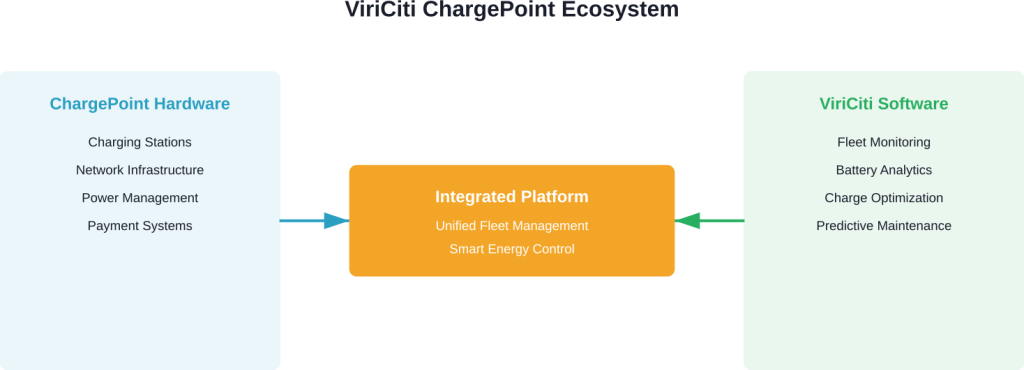
Integration has created an ecosystem where hardware meets smart software:
- Charging management: Monitoring when and how vehicles are charged
- Fleet monitoring: Tracking battery status, mileage and efficiency
- Predictive analytics: Planning maintenance before problems arise
- Energy optimisation: Reducing costs through smart planning of charges
- Reporting: Detailed data to support decision-making
How to Log In to the ViriCiti System via ChargePoint
The first question most users ask is: ‘Where do I actually log in?’ The good news is that the process is quite simple.
| Login Method | When to Use | URL |
|---|---|---|
| ViriCiti Legacy Portal | Existing ViriCiti customers prior to acquisition | accounts.viriciti.com |
Most users receive their login details from their fleet administrator or during the initial setup of the equipment.
Settings. Account
Here’s the reality: the first time you log in, it might seem a bit unusual. The interface contains a lot of information, and it takes a bit of getting used to navigating it.
Start with the basics:
- Check your profile and access rights
- Add vehicles to the system (if they haven’t already been added)
- Set up notifications for critical events
- Create basic reports to understand usage patterns
Don’t try to set everything up in a single day. Platform is powerful precisely because it’s complex — but that means a steeper learning curve.
Key Features for Fleet Operators
The real value becomes apparent when you start using the advanced features. Here’s what you should focus on:
Battery Status Monitoring
Batteries are the heart of an electric fleet. And just as you don’t want your engine to break down unexpectedly, you don’t want any surprises with your batteries.
ViriCiti monitors battery health in real time: temperature, charge cycles and degradation. The system can predict when a battery will start to lose performance, giving you time to plan for replacement or servicing.
Charging Optimisation
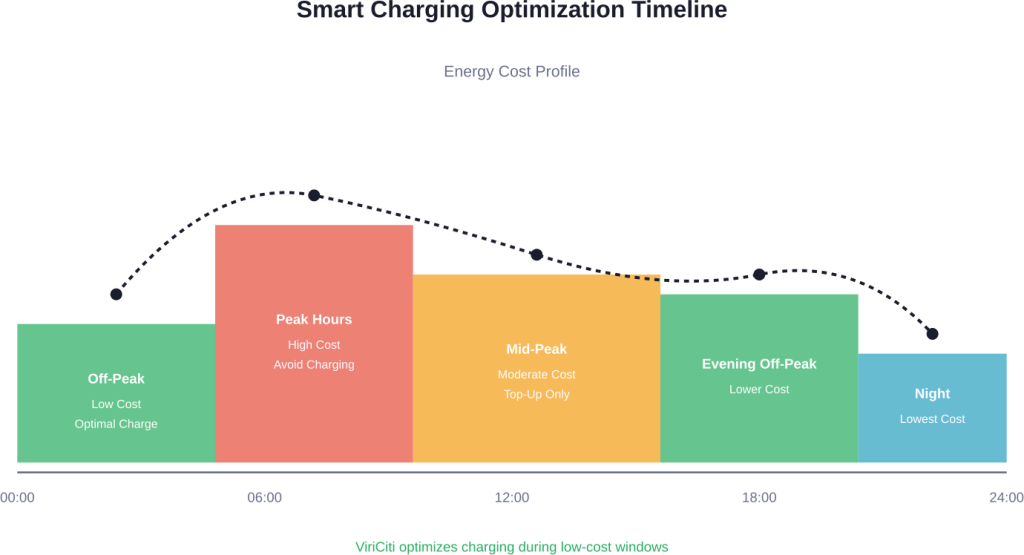
Not all charging sessions are created equal. Charging during peak tariff periods costs more. Fast charging reduces the battery’s lifespan.
The platform allows you to set priorities:
- Charge during the cheapest tariff periods
- Balancing charging speed with battery life
- Ensure that transport is ready for the morning departures
- Distribute the load across several charging stations
Forecast Service.
This is where analytics really comes into its own. Instead of waiting for something to go wrong, the system alerts you to potential problems.
The sensors monitor hundreds of parameters. When something falls outside the normal range — even slightly — you’ll receive a notification. Perhaps the battery is losing its charge faster than it should. Or the charging port is showing unusual temperature fluctuations.
Early detection means cheaper repairs and less downtime.
Integration with Existing Systems
None. A fleet does not operate in isolation. You probably already have systems in place for route planning, vehicle tracking and stock management.
The good news is that the ChargePoint-ViriCiti platform supports integration via API. The bad news is that setting it up can take some time.
General Points of Integration
| System | Advantages. Integration | Complexity |
|---|---|---|
| Route Planning | Automatic consideration of battery charge level during planning | Medium |
| Service.m Management | Automatic repair requests based on diagnostics | Low |
| ERP systems | Tracking energy and maintenance costs | High |
| Telematics | Integrated data on mileage and performance | Medium |
Most organisations start with one or two integrations, then expand over time.
Best Practices for Maximising ROI
Buying software is one thing. Actually deriving value from it is quite another.
Set Your Key Performance Indicators Early
The first thing to do is to assess current performance. What are the current charging costs? What is the average downtime? How often does the fleet require unscheduled maintenance?
Without baseline figures, you won’t be able to demonstrate any improvements later on.
Train Drivers and Dispatchers
Even the best system in the world won’t work if people don’t understand how to make use of it. Invest time in learning:
- Drivers need to know how to connect to charging stations correctly
- Dispatchers must understand the battery status indicators
- Service managers need access to maintenance alerts
Create quick reference guides, rather than just long manuals that nobody will read.
Monitor Key Performance Indicators Continuously
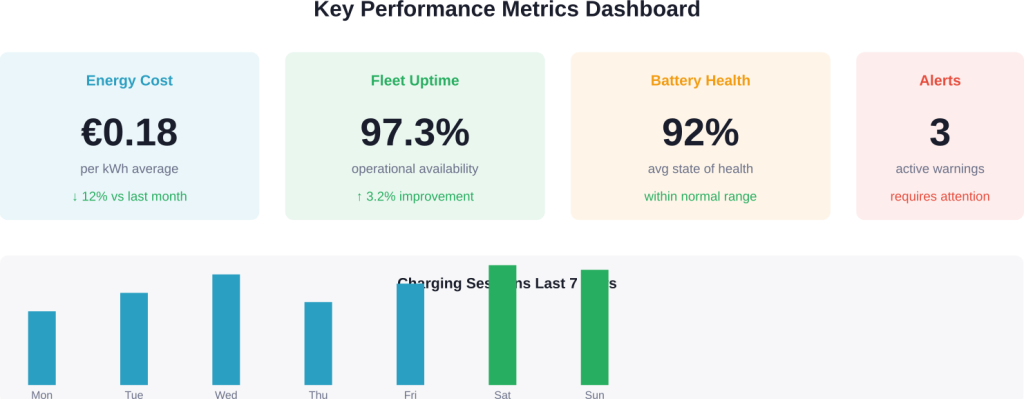
Data is only useful if you actually look at it. Set up a weekly overview to keep track of:
- Energy costs (overall and for transport)
- Battery status trends
- Charges on efficiency
- Transport readiness indicators
Look out for anomalies. Is one vehicle using significantly more energy? Why? Is one charging station slower than the others? What’s going on?
Common Problems and Solutions
Even the best technology has its challenges. Here are some real-life problems users face, and how to solve them.
Slow Charging or Failed Sessions
Symptoms: The vehicle is charging more slowly than expected, or charging does not start at all.
Possible causes:
- Load management limits power output
- Problems with the electrical connection
- The transport software needs updating
- Battery overheating (the system throttles performance for safety reasons)
Check the ViriCiti data for the actual charging speed compared to the expected speed. If the difference is consistent, the problem is likely to be hardware-related. If it is sporadic, check the battery temperature and the time of day (load management may be active).
Discrepancies in the Data
There are times when the platform shows one charge level, whilst the vehicle’s instrument panel shows another.
This is more the rule than the exception. BMS (Battery Management System) and vehicle and platform monitoring systems use different calculation methods. A slight difference (1–3 per cent) is normal.
If the difference is greater than or increases over time, calibrate the battery: charge it fully to 100 per cent, then discharge it to the recommended minimum (usually 10–20 per cent).
Notification: Overloading
By default, the system can be… let’s say, very attentive. You receive notifications about everything.
Take the time to configure your alert thresholds. Not every minor anomaly requires immediate attention.
Set your priorities:
- Critical: Battery faults, charging failures, safety issues
- Warning: Unusual patterns, signs of deterioration
- Information: Completed tasks, scheduled events
Send critical alerts in real time. Warnings can be included in the daily report. Informational messages do not require alerts at all.

Charging infrastructure from ECOFACTOR – a comprehensive solution for electric vehicles
At ECOFACTOR, we are developing charging infrastructure to ensure that using an electric vehicle is simple and predictable in any region of Ukraine. For us, it is not just about installing charging stations, but about creating a comprehensive ecosystem that meets the day-to-day needs of drivers and businesses.
We design, install and maintain charging stations for a range of scenarios. Our network includes AC solutions for homes and offices, as well as high-power DC stations for fast charging on motorways and in public locations. Thanks to this, we help drivers easily find a convenient charging point nearby – both in the city and on long-distance journeys.
For ease of use, we offer a mobile app, available on iOS and Android. Using the app, you can view a map of charging stations, check the availability of charging points in real time, plan a route and pay for your charging session online. We have designed this tool to be as user-friendly as possible, so that the charging process takes as little time and effort as possible.
Separately, we are developing an online shop featuring chargers for various operating conditions, as well as cables, adaptors and other essential accessories. We help find solutions both for private owners of electric vehicles and for companies setting up their own charging infrastructure at commercial premises.
By integrating charging stations, digital services and equipment into a single system, we are creating a convenient and scalable model for electric transport. ECOFACTOR offers a comprehensive approach in which everything works together – from finding charging stations to purchasing equipment – to ensure that charging is simple, transparent and accessible every day.
Practical Tips for New Users
Starting from scratch? Here’s a realistic plan for the first 90 days:
The First Moon: The Basics
Focus on ensuring that the system is working and that all vehicles are reporting correctly. Don’t worry about advanced optimisation — just make sure the data is accurate.
Set some basic charging rules. Perhaps simply ‘charge to 90% overnight’. Nothing too complicated for now.
Month Two: Optimisation
Now that you have a month’s worth of data, start looking for patterns. Which routes use the most energy? When are electricity rates at their lowest? Can you shift any charges to cheaper time slots?
Experiment with different pricing strategies for different vehicles. What works for urban routes may not be suitable for inter-city routes.
Month Three: Forecasting Work
By now, you should have identified enough trends to inform your forecasting work. Which batteries degrade more quickly? Which vehicles consistently require more charges than expected?
Start planning proactive maintenance based on actual data, rather than just on the clock and mileage.
Comparison with Alternatives
ChargePoint-ViriCiti isn’t the only option in the field of electric fleet management. How does it compare?
| Platform. | Strengths | Restrictions. |
|---|---|---|
| ChargePoint-ViriCiti | An integrated hardware and software ecosystem, particularly strong in commercial fleets | Steeper learning curve, higher cost |
| Standalone Telematics | Potentially cheaper, flexible integration | Requires manual integration of charging systems |
| OEM Solutions | Deep integration with specific vehicles | Limited to inter-manufacturer fleets |
For most medium-sized and large commercial fleet operations, the ChargePoint-ViriCiti integration makes sense. The initial investment pays for itself through improved energy optimisation and reduced downtime.
For smaller fleets (fewer than 10 vehicles), basic telematics combined with ChargePoint charging stations – without the full ViriCiti platform – may be sufficient.
What’s Next for Platforms
ChargePoint continues to invest in the ViriCiti integration. Although specific future features have not been officially announced, industry trends point the way:
Deeper integration with Vehicle-to-Grid (V2G) technologies is gaining momentum. The ability not only to charge vehicles but also to feed energy back into the grid during periods of peak demand is creating new revenue streams for fleet operators.
Machine learning for even better forecasting. Current algorithms are already impressive, but with larger datasets, systems will become more accurate at predicting service needs and optimising charging models.
Extended support for different types of transport. Although ViriCiti started with buses, the platform is expanding to support lorries, vans and even heavy machinery.
Frequently Asked Questions (FAQ)
Do I need ChargePoint charging stations to use ViriCiti?
It is not essential for basic fleet monitoring, but for full integration and optimisation of charging, it is recommended to use ChargePoint equipment. The platform can work with third-party charging stations, but functionality will be limited.
What types of electric vehicles does the platform support?
The platform was originally developed for electric buses, but now supports a wide range of commercial electric vehicles: delivery lorries, city vans, refuse collection lorries, school buses and other commercial vehicles. Support for passenger electric vehicles is also available via the main ChargePoint platform.
How does the platform integrate with existing fleet management systems?
ViriCiti offers a RESTful API for integration with third-party systems. Most major FMS (Fleet Management Systems) have ready-made integrations or can be connected via bespoke development. ChargePoint also offers consultancy services for more complex integrations.