


Table of contents:
Quick Summary: Fleet management is the process of overseeing and optimizing a company’s vehicles throughout their entire lifecycle—from acquisition to disposal. It encompasses vehicle maintenance, driver supervision, fuel management, compliance tracking, and operational efficiency improvements to reduce costs and maximize asset utilization.
Running a business with vehicles isn’t just about keeping keys in ignition switches and fuel in tanks. Behind every delivery truck, service van, or company car sits a complex operation that can make or break operational efficiency.
Fleet management has evolved from simple vehicle tracking into a sophisticated discipline that touches every corner of business operations. The stakes? Higher fuel costs, stricter regulations, and customers who expect precision timing on every delivery.
This guide breaks down everything organizations need to know about managing vehicle fleets—from basic definitions to advanced optimization strategies that real companies are using right now.
We remind you that you can purchase home and commercial charging stations in our online store, as well as use public charging stations ECOFACTOR located throughout Ukraine. For convenient access to charging infrastructure, we recommend using our mobile app, available on iOS and Android.
Understanding Fleet Management: The Fundamentals
Fleet management encompasses the systems, processes, and tools needed to ensure an organization’s fleet of business vehicles are maintained throughout their entire lifecycle. But that’s just scratching the surface.
The process involves coordinating all aspects of vehicle operations—maintenance schedules, driver assignments, route planning, fuel consumption, and regulatory compliance. It’s the process used by fleet managers to monitor fleet activities and make decisions that keep fleets running efficiently, on time, and within budget.
Think of it as the central nervous system for any business that relies on vehicles. Whether managing two delivery vans or two hundred long-haul trucks, the core principles remain consistent: optimize asset utilization, reduce operational costs, and maintain safety standards.
What Qualifies as a Fleet?
Any organization operating multiple vehicles for business purposes technically operates a fleet. Construction companies with pickup trucks and excavators. Delivery services with cargo vans. Sales teams with company cars.
The defining characteristic isn’t fleet size—it’s systematic management of mobile assets to achieve business objectives. Even small operations with just a handful of vehicles benefit from structured fleet management practices.
Core Components of Fleet Management
Fleet management breaks down into several interconnected responsibilities. Each component plays a distinct role, but they all work together toward the same goal: operational efficiency.
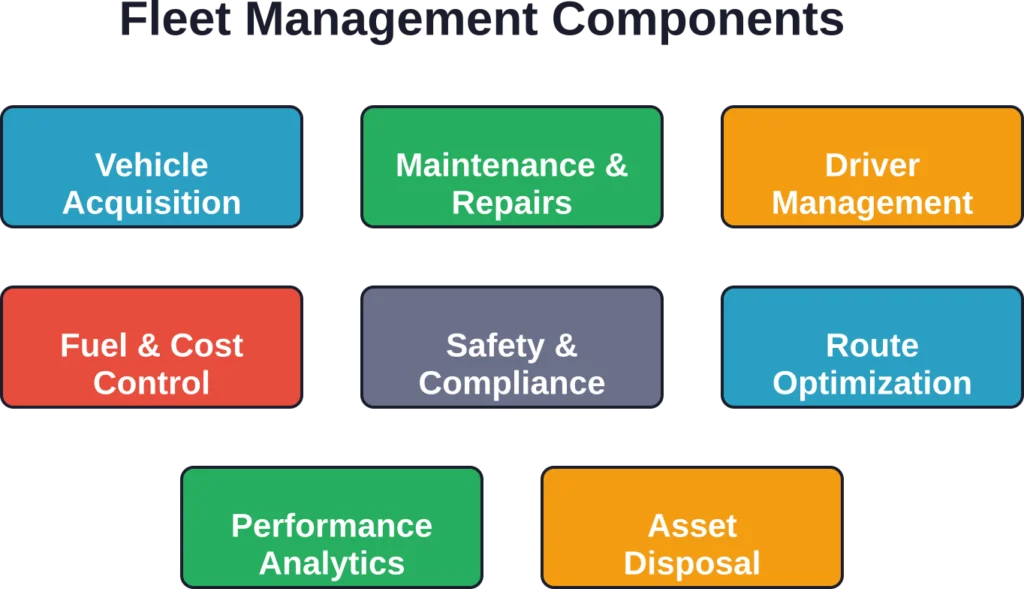
Vehicle Acquisition and Lifecycle Management
Fleet management starts before vehicles hit the road. Vehicle acquisition involves selecting the right vehicles for specific business needs, negotiating purchase or lease terms, and planning replacement cycles.
Smart organizations track total cost of ownership—not just sticker price. Fuel efficiency, maintenance costs, insurance rates, and resale value all factor into acquisition decisions.
Maintenance and Repair Coordination
Preventive maintenance schedules keep vehicles operational and extend asset lifespan. Fleet managers coordinate oil changes, tire rotations, brake inspections, and countless other service activities.
The goal? Catch small issues before they become expensive breakdowns. Downtime costs money—both in repair bills and lost productivity.
Fuel Management and Cost Control
Fuel typically represents one of the largest ongoing fleet expenses. Effective fuel management tracks consumption patterns, identifies inefficiencies, and implements strategies to reduce waste.
Industry data from academic research shows that optimization can deliver significant results. Academic research on fleet optimization documented a case study achieving a 36.93% fuel cost reduction, a 39% decrease in carbon emissions, and a 15% improvement in fleet movement time through fleet diversification strategies, demonstrating the tangible impact of systematic fuel management.
How Fleet Management Works in Practice
Modern fleet management relies on integrated technology systems that collect data, generate insights, and enable informed decision-making. Here’s where theory meets reality.
Telematics systems form the technological backbone. These devices track vehicle location, speed, idle time, harsh braking events, and diagnostic trouble codes in real-time. The data flows into centralized fleet management software where managers can monitor operations and spot trends.
GPS tracking answers the fundamental question: where are my vehicles right now? But the real value comes from what organizations do with that information—optimizing routes, verifying service calls, improving customer communication.
Real-Time Monitoring and Decision Making
Fleet managers make dozens of decisions daily. Which vehicle should handle an emergency service call? Is that truck overdue for maintenance? Why did fuel consumption spike last week?
Management systems provide the insights needed to answer these questions quickly. Dashboards display key performance indicators. Automated alerts flag issues before they escalate. Historical data reveals patterns invisible to the naked eye.
The Role and Responsibilities of Fleet Managers
Fleet managers serve as the orchestrators of vehicle operations. The role demands a unique blend of logistics expertise, financial acumen, and people management skills.
Daily responsibilities span a wide spectrum. Fleet managers oversee vehicle assignments, approve maintenance requests, review driver performance reports, and ensure regulatory compliance. They’re troubleshooters, cost controllers, and strategic planners rolled into one.
But the role extends beyond operational tasks. Fleet managers also handle vendor relationships—negotiating with fuel suppliers, coordinating with repair shops, managing insurance policies. Every decision carries financial implications.
Strategic Planning and Budget Management
Effective fleet managers think months and years ahead. When should vehicles be replaced? How will fuel price fluctuations impact the budget? What new regulations are coming down the pipeline?
Budget management requires balancing competing priorities. Investing in newer, more efficient vehicles requires upfront capital but delivers long-term savings. Cutting maintenance costs might look good on this quarter’s report but leads to expensive breakdowns later.
Driver Supervision and Safety Oversight
Vehicles don’t operate themselves—at least not yet. Fleet managers supervise drivers, enforce safety policies, and address performance issues.
This includes monitoring driver behavior through telematics data. Excessive speeding, hard braking, and aggressive acceleration all increase fuel costs and accident risk. Coaching drivers toward safer habits protects both people and assets.
Key Benefits of Implementing Fleet Management
Why invest time and resources into systematic fleet management? The benefits extend across multiple dimensions of business operations.
| Benefit Category | Impact | Key Metrics |
|---|---|---|
| Cost Reduction | Lower fuel, maintenance, and operational expenses | Fuel efficiency, repair costs, downtime hours |
| Operational Efficiency | Optimized routes, improved asset utilization | Miles per delivery, vehicle utilization rates |
| Safety Improvements | Fewer accidents, better driver behavior | Accident rates, safety violations, insurance claims |
| Compliance Management | Regulatory adherence, reduced violations | Inspection pass rates, violation counts |
| Environmental Impact | Reduced emissions, sustainability goals | Carbon footprint, fuel consumption |
Quantifiable Cost Savings
Numbers tell the story. Academic research on fleet optimization demonstrates substantial financial impact—one multi-objective optimization study showed 15% improvement in fleet movement time alongside cost reductions.
The same academic case study showed that fleet diversification strategies delivered both financial and environmental benefits, including a 39% decrease in carbon emissions, proving that financial and environmental benefits can align.
Enhanced Customer Service
Fleet management directly impacts customer experience. Accurate arrival time estimates, faster response to service calls, and reliable delivery schedules all stem from effective fleet operations.
In today’s fast-paced logistics and transportation landscape, businesses can no longer afford inefficient routing decisions. Rising fuel costs, growing customer expectations, and increasing fleet sizes have made manual route planning outdated and error-prone.
Improved Asset Utilization
Vehicles sitting idle represent wasted capital. Fleet management systems identify underutilized assets, enabling better assignment decisions and revealing opportunities to reduce fleet size without impacting service levels.
The math is straightforward: if better scheduling allows ten vehicles to do the work of twelve, that’s two fewer vehicles to purchase, insure, maintain, and eventually replace.
Fleet Management Software and Technology Solutions
Technology has transformed fleet management from clipboard-based tracking to sophisticated digital ecosystems. Modern fleet management software integrates multiple functions into unified platforms.
Core software features typically include GPS tracking, maintenance scheduling, fuel card integration, driver behavior monitoring, and compliance documentation. These systems turn raw data into actionable insights through dashboards, reports, and automated alerts.
But software is only as valuable as the data it receives. That’s where telematics comes in—the bridge between physical vehicles and digital management systems.
Telematics: The Technology Foundation
Telematics devices installed in vehicles collect and transmit operational data. Location coordinates, engine diagnostics, fuel consumption, speed, idle time—all streaming to centralized servers for analysis.
This real-time visibility enables proactive management. Instead of discovering a maintenance issue when a vehicle breaks down, diagnostic codes trigger alerts when sensors detect problems. Instead of guessing about driver behavior, managers see exactly when and where unsafe driving occurs.
Integration Capabilities
Modern fleet management systems don’t operate in isolation. They integrate with fuel card providers, maintenance management platforms, accounting software, and customer relationship management systems.
These integrations eliminate duplicate data entry and create comprehensive operational views. Fuel purchases automatically sync with expense tracking. Maintenance records feed into total cost of ownership calculations. Service completion updates flow to customer notification systems.
Common Challenges Fleet Managers Face
Fleet management isn’t without obstacles. Understanding common challenges helps organizations prepare realistic solutions.
Rising Operational Costs
Fuel prices fluctuate. Insurance premiums climb. Vehicle costs increase year over year. Fleet managers constantly battle cost inflation while leadership expects budget reductions.
The challenge intensifies because many cost factors sit outside direct control. Fleet managers can’t set fuel prices or insurance rates—they can only optimize consumption and minimize risk.
Regulatory Compliance Complexity
Regulations vary by jurisdiction, industry, and vehicle type. Hours of service rules limit driver working time. Safety inspections follow specific schedules. Emissions standards differ across regions.
For example, standard regulations stipulate that professional drivers must not exceed nine hours of daily driving, which can be extended to ten hours, but no more than twice a week.
Tracking compliance across multiple regulatory frameworks demands meticulous record-keeping and constant attention to changing rules.
Driver Recruitment and Retention
Finding qualified drivers has become increasingly difficult across many industries. High turnover rates force fleet managers to continuously recruit, hire, and train new personnel.
Poor retention creates ripple effects throughout operations. Inexperienced drivers make more mistakes, have more accidents, and operate vehicles less efficiently than seasoned professionals.
Technology Adoption and Integration
Modern fleet management tools offer powerful capabilities—but only if organizations actually use them properly. Implementation challenges range from driver resistance to technical integration headaches.
Legacy systems that don’t communicate with newer platforms create data silos. Manual workarounds defeat the purpose of automation. Training gaps leave features unused and value unrealized.
Optimizing Fleet Operations: Best Practices
What separates high-performing fleets from average ones? Consistent application of proven optimization strategies.
Data-Driven Decision Making
Gut feelings and assumptions give way to metrics and analysis. Track everything measurable—fuel consumption per mile, maintenance cost per vehicle, average delivery time, driver safety scores.
Data reveals opportunities invisible otherwise. That route that seems efficient might actually waste fuel on unnecessary turns. The vehicle that looks reliable might be racking up hidden maintenance costs.
Preventive Maintenance Programs
Reactive maintenance—fixing things when they break—costs more than preventive approaches. Scheduled service based on mileage or engine hours catches wear items before they fail catastrophically.
Fleet management software automates maintenance scheduling, triggering service reminders based on actual vehicle usage rather than calendar dates. This ensures vehicles get attention when needed, not just when remembered.
Route Optimization and Planning
The shortest route on a map isn’t always the most efficient in practice. Traffic patterns, delivery windows, vehicle capacity, and driver availability all factor into optimal routing.
Routing optimization software leverages intelligent algorithms and real-time data to calculate truly efficient routes. The technology accounts for variables humans can’t juggle mentally—especially across large fleets with dozens of simultaneous routes.
Driver Training and Engagement
Technology only goes so far. The person behind the wheel makes countless micro-decisions that impact fuel efficiency, safety, and customer satisfaction.
Ongoing training programs address both technical skills and soft skills. How to handle difficult customers. Best practices for fuel-efficient driving. Proper vehicle inspection procedures. Creating engaged, skilled drivers pays dividends across every performance metric.
Add ECOFACTOR Charging Solutions to Your Fleet
Fleet management gets harder when electric vehicles become part of daily operations. ECOFACTOR helps businesses cover the charging side with charging stations, network management tools, and a mobile app for iOS and Android. Drivers can use the charging station map to find available points, check station status, and manage charging sessions without extra confusion. The company also has an online store where teams can buy chargers, cables and adapters for fleet use, office parking, service locations, or private EV charging needs.
ECOFACTOR can help businesses set up the charging side of fleet operations with:
- AC and DC equipment for different EV charging scenarios
- Solutions for business locations, parking areas, and public charging points
- Tools for monitoring station activity and managing user access
- Hardware and accessories needed for everyday EV charging
Contact ECOFACTOR to choose the right charging setup for your fleet and keep daily EV operations easier to manage.
Environmental and Sustainability Considerations
Fleet management increasingly intersects with environmental, social, and governance initiatives. Organizations face pressure from regulators, customers, and stakeholders to reduce environmental impact.
Fuel consumption directly correlates with carbon emissions. Strategies that cut fuel costs simultaneously reduce environmental footprint—a rare win-win scenario.
The academic research on fleet diversification demonstrates this alignment clearly. The 39% carbon emissions decrease achieved through optimization strategies delivered environmental benefits alongside the 36.93% fuel cost reduction.
Fleet Electrification and Alternative Fuels
Electric vehicles, hydrogen fuel cells, compressed natural gas—alternative powertrains are moving from experimental to mainstream. Each technology brings distinct advantages and challenges.
Fleet managers evaluating alternatives must consider total cost of ownership, infrastructure requirements, route compatibility, and payload capacity. An electric delivery van makes sense for urban routes with short range requirements. Long-haul trucking demands different solutions.
Carbon Footprint Tracking and Reporting
Many organizations now measure and report fleet-related emissions. Some face regulatory requirements. Others pursue voluntary sustainability certifications. All need accurate data.
Fleet management systems can calculate emissions based on fuel consumption, vehicle types, and operational patterns. This visibility enables target-setting and progress tracking toward reduction goals.
Getting Started with Fleet Management
Organizations new to systematic fleet management often feel overwhelmed by the scope. Where should they start?
Assess Current State
Begin with honest evaluation. How many vehicles does the organization operate? What data currently exists about costs, utilization, and performance? What problems need solving most urgently?
This baseline assessment identifies gaps and prioritizes improvement areas. Maybe fuel costs are spiraling out of control. Maybe compliance tracking is a manual nightmare. Maybe vehicle downtime is crushing productivity.
Define Clear Objectives
What does success look like? Specific, measurable goals guide technology selection and process design. Reduce fuel costs by 15%. Cut vehicle downtime to under 5%. Eliminate compliance violations.
Vague aspirations like “improve efficiency” don’t provide enough direction. Concrete targets enable progress measurement and stakeholder communication.
Select Appropriate Technology
Fleet management software ranges from basic GPS tracking to comprehensive enterprise platforms. The right choice depends on fleet size, budget, existing systems, and specific requirements.
Start with core needs. Most organizations benefit from vehicle tracking, maintenance scheduling, and fuel management. Advanced features like route optimization and driver behavior monitoring add value but aren’t necessarily starting points.
Plan Implementation Carefully
Technology deployment requires planning. Who will manage the system? How will drivers be trained? What processes need redesign? When will results be reviewed?
Rushed implementations create user resistance and undermine adoption. Phased rollouts allow learning and adjustment before full deployment.
The Future of Fleet Management
Fleet management continues evolving as technology advances and business requirements shift. Several trends are shaping the future landscape.
Artificial Intelligence and Machine Learning
AI algorithms analyze patterns across massive datasets, identifying optimization opportunities humans miss. Predictive maintenance uses machine learning to forecast component failures before they occur.
Route optimization becomes more sophisticated with AI considering weather patterns, traffic predictions, and historical delivery times. The technology learns and improves continuously.
Autonomous Vehicle Integration
Self-driving vehicles will eventually transform fleet operations—though the timeline remains uncertain. Fleet managers will need to integrate autonomous and human-driven vehicles, manage new risk categories, and navigate evolving regulations.
The transition won’t happen overnight. Mixed fleets will become the norm long before fully autonomous operations.
Connected Vehicle Ecosystems
Vehicles increasingly communicate with infrastructure, other vehicles, and central systems. This connectivity enables coordinated fleet movements, real-time hazard warnings, and automated compliance reporting.
The Internet of Things extends beyond vehicles to trailers, cargo, and equipment. Complete supply chain visibility becomes possible when every asset reports its location, condition, and status.
Frequently Asked Questions
What is the main purpose of fleet management?
The main purpose of fleet management is to optimize vehicle operations throughout the entire lifecycle—from acquisition to disposal—while controlling costs, ensuring safety, maintaining compliance, and maximizing asset utilization. It’s about making vehicles and drivers more efficient and productive.
How much does fleet management software cost?
Fleet management software pricing varies significantly based on features, fleet size, and vendor. Solutions range from basic GPS tracking at low monthly per-vehicle rates to comprehensive enterprise platforms with higher costs. Check vendors’ official websites for current pricing tailored to specific needs and fleet configurations.
What size fleet needs fleet management software?
Any organization operating multiple vehicles can benefit from fleet management practices, though the specific tools and systems scale with fleet size. Even small fleets with just a handful of vehicles gain value from basic tracking and maintenance scheduling. Larger fleets require more sophisticated software to manage complexity effectively.
What are the biggest challenges in fleet management?
The biggest challenges include managing rising operational costs (especially fuel and insurance), maintaining regulatory compliance across multiple jurisdictions, recruiting and retaining qualified drivers, integrating new technologies with existing systems, and balancing competing priorities within limited budgets. Each organization faces a unique combination of these obstacles.
How does fleet management reduce fuel costs?
Fleet management reduces fuel costs through multiple strategies: route optimization that minimizes unnecessary mileage, driver behavior monitoring and coaching to eliminate wasteful habits like excessive idling and aggressive acceleration, preventive maintenance that keeps engines running efficiently, and data analysis that identifies consumption patterns and opportunities for improvement.
What is telematics in fleet management?
Telematics refers to the technology that collects and transmits vehicle data using onboard devices. These systems track location via GPS, monitor engine diagnostics, record driver behavior, measure fuel consumption, and detect maintenance issues. The data flows to fleet management software where it becomes actionable intelligence for managers.
Can fleet management help with regulatory compliance?
Yes, fleet management systems significantly simplify compliance tracking. Software can automate hours of service monitoring, schedule required inspections, maintain maintenance records, track driver certifications, generate compliance reports, and send alerts when violations occur or deadlines approach. This reduces administrative burden and minimizes violation risk.
Conclusion
Fleet management transforms vehicle operations from reactive firefighting into strategic asset optimization. The discipline encompasses everything from vehicle acquisition through disposal, touching maintenance, driver supervision, compliance, fuel management, and operational efficiency along the way.
Organizations that embrace systematic fleet management gain quantifiable advantages. Research demonstrates that proper optimization can achieve substantial cost reductions—like the 36.93% fuel cost decrease and 39% emissions reduction documented in academic studies. Those aren’t theoretical benefits. They’re real results from applying fleet management principles.
The barriers to entry continue falling. Technology that once required massive capital investment now comes in scalable, affordable packages suitable for fleets of any size. Data that was impossible to collect manually now flows automatically from vehicles to dashboards.
But technology alone doesn’t solve problems. Effective fleet management requires clear objectives, consistent processes, ongoing training, and commitment to continuous improvement. The software provides tools—people and organizations determine results.
For organizations operating vehicle fleets, the question isn’t whether to implement fleet management practices. The question is how quickly they can capture the operational improvements and cost savings that competitors are already realizing. The roadmap is clear. The benefits are documented. The time to start is now.
Ready to optimize your fleet operations? Begin with an honest assessment of the current state, define specific improvement objectives, and select technology aligned with your needs and budget. The journey toward efficient fleet management starts with a single decision.