

Table of contents:
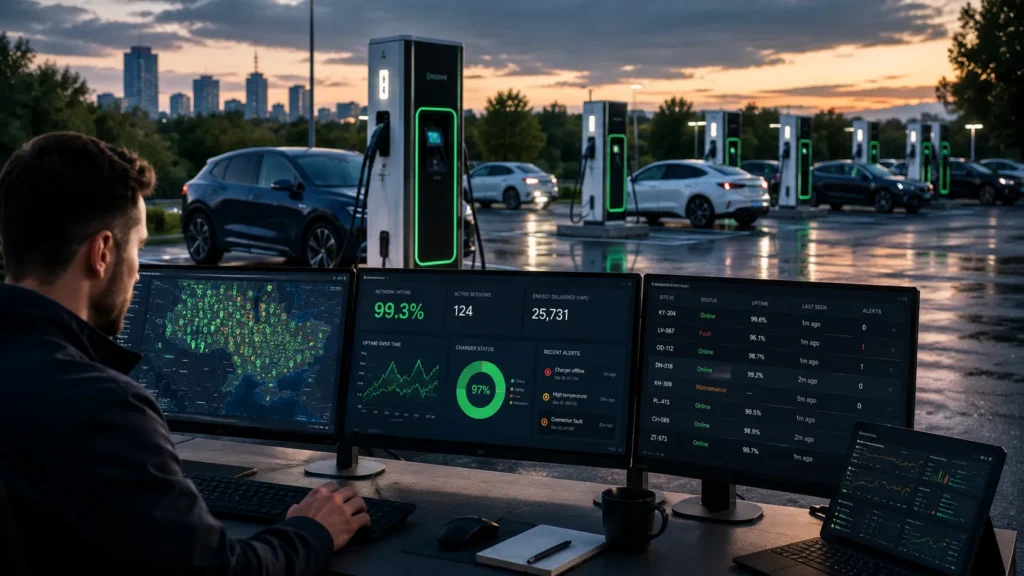
Keeping an EV charging network online is not just about fixing problems quickly. In many cases, the bigger challenge is spotting issues before drivers do and resolving them before they affect more charging sessions.
The good news is that improving uptime does not always mean hiring more people or increasing maintenance budgets. With the right operational approach, charge point operators can reduce downtime, make better use of existing resources, and keep more chargers available without raising day-to-day operating costs. This article looks at the practical steps that make that possible.
We remind you that you can purchase home and commercial charging stations in our store, as well as use public charging stations ECOFACTOR located throughout Ukraine. For convenient access to charging infrastructure, we recommend using our mobile app, available on iOS and Android.
Why High Uptime Does Not Have to Mean Higher OPEX
When people talk about improving charger uptime, the conversation often turns to bigger maintenance teams, more spare parts, or larger operating budgets. It is easy to assume that reaching 99% or higher uptime simply costs more. In practice, that is not always the case.
For many charge point operators, the biggest expense is not repairing a charger. It is the time between a fault occurring and someone noticing it. A charger can remain unavailable for days before a driver reports the issue, even if a technician could fix it within a few hours. During that time, charging sessions are lost, drivers choose another network, and the site generates no revenue from that connector.
The same applies to maintenance. Sending technicians to inspect every charger on a fixed schedule may seem like a safe approach, but unnecessary site visits increase travel costs and take time away from locations that actually need attention. At the same time, waiting until equipment fails creates longer outages and often leads to more expensive repairs.
A more efficient approach is to improve how the network operates rather than simply adding more resources. Modern charging infrastructure already generates a constant stream of operational data. When that information is used effectively, operators can detect faults earlier, prioritize service visits, and resolve problems before they affect large numbers of drivers.
The result is a network that stays available more often without requiring a proportional increase in operating expenses. Instead of reacting to every problem after it becomes visible, operators spend more time preventing downtime in the first place.
What CPOs Should Do to Reach 99%+ Uptime
Reaching consistently high uptime is rarely the result of a single improvement. It comes from a series of operational decisions that work together, from how faults are detected to how maintenance is planned and support requests are handled. The following practices help reduce unnecessary downtime while keeping operating costs under control.
Detect Problems Before Drivers Do
One of the quickest ways to reduce downtime is to shorten the time between a fault appearing and the operator becoming aware of it. Relying on drivers to report broken chargers leaves too much to chance. Some drivers simply move to another station without reporting anything, while others may describe the issue differently from what actually happened.
A charging management platform can identify many problems automatically by continuously communicating with connected chargers. Instead of waiting for complaints, the system can detect changes in charger status, communication failures, connector errors, interrupted charging sessions, or abnormal operating conditions as soon as they occur.
Early detection helps reduce the total duration of charger outages, schedule repairs before more drivers are affected, prioritize faults based on their impact, and minimize revenue loss caused by unavailable chargers. In many cases, improving fault detection has a greater impact on uptime than simply reducing repair time.
Build a Monitoring System That Works Without Constant Supervision
As charging networks grow, manually checking every charger becomes unrealistic. A network with a handful of stations can be monitored through occasional dashboard reviews. A network with hundreds of charge points cannot. That does not mean operators need a control room staffed around the clock. The goal is to build a monitoring system that only demands attention when something actually needs action.
A well-configured charging management platform should monitor key operational data in real time, including charger availability and connection status, charging session activity, power output and energy delivery, temperature and electrical measurements, and communication errors and hardware fault codes.
Instead of expecting operators to watch dashboards throughout the day, the platform should generate alerts when predefined conditions are met. For example, it can notify the operations team if a charger unexpectedly goes offline, repeatedly fails to start charging sessions, or reports abnormal temperatures. This approach changes how teams spend their time. Rather than searching for problems, they can focus on resolving the few issues that actually require attention.
Combine Preventive Maintenance with Real Usage Data
Preventive maintenance remains one of the most effective ways to reduce unexpected failures, but the schedule should not exist in isolation from network data.
Routine inspections are still important. Cables wear over time, connectors become damaged, filters collect dust, and electrical components should be tested regularly. However, charging data helps operators decide where maintenance will have the greatest impact. For example, one DC charger serving a busy highway location may complete dozens of charging sessions every day, while another charger at a smaller site may be used only occasionally. Treating both locations exactly the same does not always make operational or financial sense. The objective is not to maintain every charger more often. It is to maintain the right chargers at the right time.
Use OCPP Data to Speed Up Troubleshooting
Not every charging problem requires a technician on site. Sometimes the issue is related to communication, software, firmware, or authorization rather than the hardware itself.
This is where access to detailed OCPP communication data becomes valuable. Instead of relying only on summary reports or charger status indicators, operators can review message exchanges between the charger and the backend system to understand exactly what happened during a failed charging session. This level of visibility helps answer questions such as whether the charger received the charging request, whether user authentication completed successfully, whether communication stopped during the session, and whether the problem is linked to the charger or the backend platform.
When support teams have this information before creating a service ticket, many problems can be resolved remotely or accurately assigned to the right team. Field technicians arrive with a much clearer understanding of the issue, reducing repeated visits and shortening repair times.
Make Every Technician Visit Count
Every site visit costs money. Travel time, scheduling, labor, and replacement parts all contribute to operating expenses, so avoiding unnecessary dispatches is just as important as responding quickly when hardware failures occur.
Remote diagnostics help determine whether a problem actually requires an on-site repair. Some issues can be resolved by restarting software services, updating firmware, correcting backend settings, or restoring communication without sending anyone to the location.
When a technician does need to visit, preparation makes a noticeable difference. Knowing the reported fault, reviewing recent charger activity, and checking historical error logs allows the technician to bring the correct tools and replacement parts the first time. Improving uptime is not only about responding quickly. It is about making every response more efficient.
Treat Customer Support as Part of Network Uptime
A charger can appear fully operational in the management platform while drivers are still unable to complete charging sessions. Payment problems, mobile app issues, RFID authentication failures, or simple user confusion can all prevent successful charging even when the hardware is working as expected.
For that reason, customer support should be considered part of the network’s operational strategy rather than a separate service. Drivers should always have an easy way to report problems directly from the charging location or through the mobile application. Clear contact information, responsive support channels, and accurate issue tracking help operators identify problems that automated monitoring may not immediately detect.
Support data can reveal patterns that technical monitoring alone cannot. Multiple reports from the same location may indicate a recurring software issue, confusing payment flow, or compatibility problem with certain vehicle models. When technical monitoring and customer feedback work together, operators gain a much more complete picture of network performance. That combination helps reduce both technical downtime and the situations where chargers are technically available but practically unusable for drivers.

Improve Charging Network Reliability With ECOFACTOR
High network uptime depends on more than routine maintenance. Alongside charging stations, ECOFACTOR supports charging infrastructure with energy solutions that include hybrid inverters, battery systems, and solar panels, as well as digital tools available through its iOS and Android app. The charging station map also helps drivers find and access charging locations more efficiently.
ECOFACTOR can support charging networks with:
- Charging infrastructure designed for commercial operation
- Energy solutions that help support station availability
- Tools for easier access to charging network information
- Cables and accessories for installation and ongoing operation
Contact ECOFACTOR to discuss infrastructure solutions for improving charging network performance.
Which Metrics Matter More Than Uptime Alone
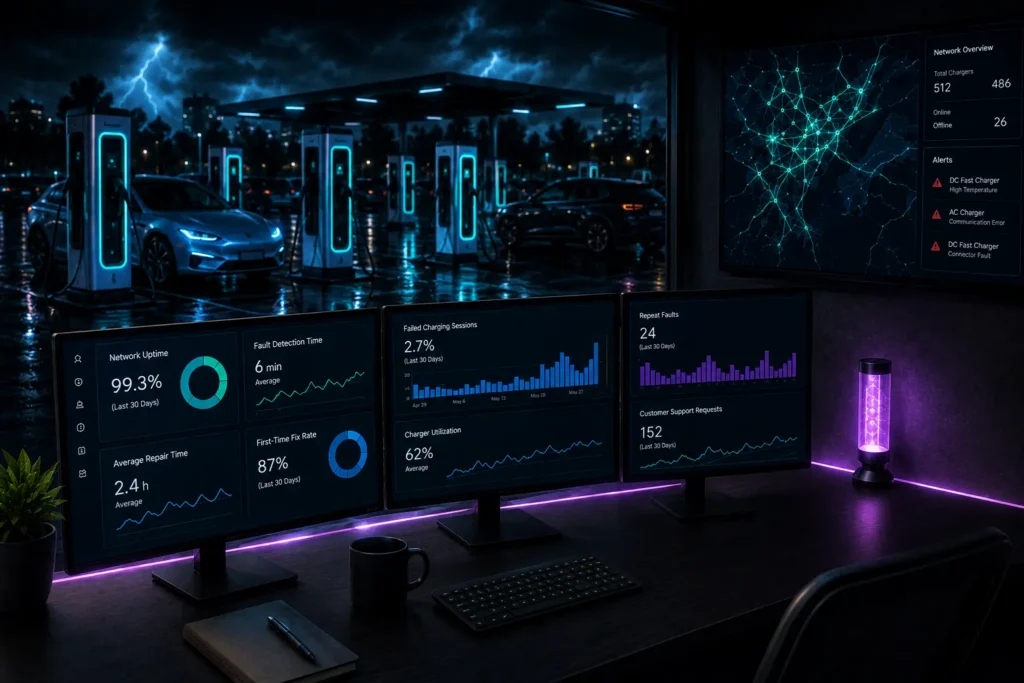
A network can report 99% uptime and still leave drivers frustrated. If faults take too long to detect, repairs require multiple visits, or chargers regularly fail to start sessions, the uptime figure alone does not tell the whole story.
Looking at a broader set of operational metrics makes it easier to identify weak points before they begin affecting customer satisfaction or revenue.
| Metric | Why It Matters |
|---|---|
| Network uptime | Shows the percentage of time chargers remain available for use. |
| Fault detection time | Measures how quickly the system identifies a problem after it occurs. Shorter detection times reduce total downtime. |
| Average repair time | Indicates how long it takes to restore a charger after a fault has been confirmed. |
| First-time fix rate | Shows how often technicians solve a problem during the first visit, helping reduce repeat travel and labor costs. |
| Failed charging sessions | Reveals issues that may not appear in uptime reports, such as payment, authentication, or communication failures. |
| Charger utilization | Helps prioritize maintenance by showing which chargers have the greatest operational impact. |
| Repeat faults | Identifies equipment or locations that require deeper investigation instead of repeated temporary fixes. |
| Customer support requests | Highlights recurring driver issues that technical monitoring alone may not detect. |
When these metrics are reviewed together, patterns become much easier to spot. A charger with frequent failed sessions but few hardware faults may need a software update. A location with repeated connector damage may benefit from a different maintenance schedule or changes to the site layout. Decisions become based on evidence rather than assumptions.
A Practical Checklist for Charge Point Operators
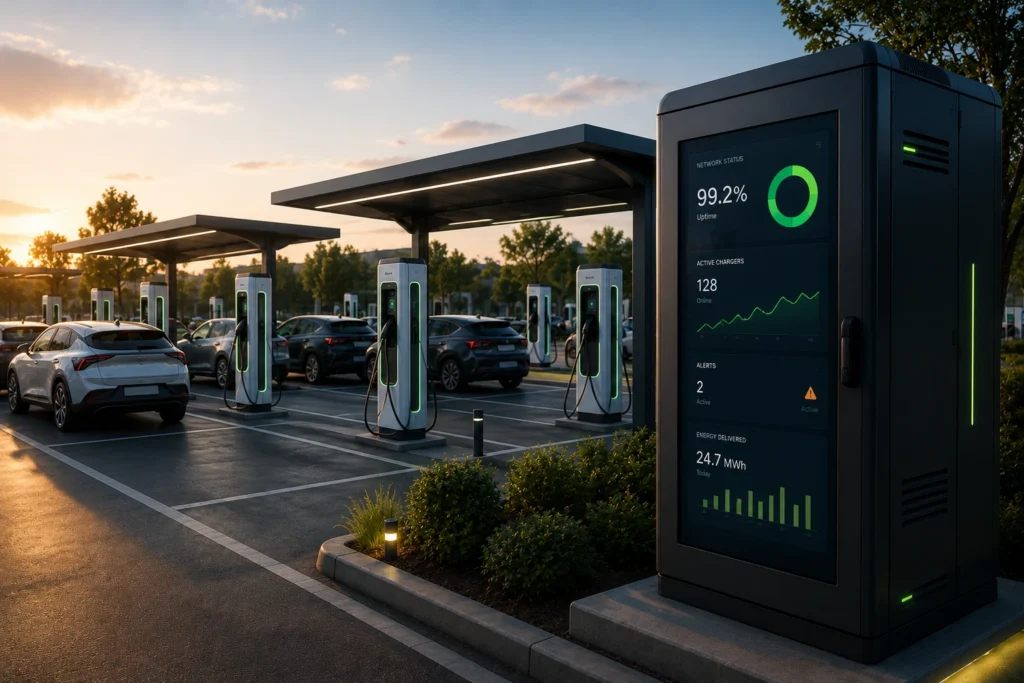
Reaching 99%+ uptime does not usually require a complete overhaul of an existing charging network. In many cases, it comes from improving everyday operations and making better use of the tools already available.
A practical starting point includes enabling real-time monitoring for every charger in the network, configuring automatic alerts for critical faults instead of relying on manual checks, reviewing charger status and fault reports every day, combining preventive maintenance with actual charger usage and fault history, keeping firmware updated and verifying charger performance after every update, giving support teams access to detailed OCPP logs for faster diagnostics, performing remote troubleshooting before dispatching technicians whenever possible, tracking repair performance including first-time fix rates and average repair times, making it easy for drivers to report issues through the charger or mobile app, and reviewing operational metrics regularly to adjust maintenance priorities based on real network performance.
None of these actions is particularly complicated on its own. Together, they create a network that spends less time offline, requires fewer unnecessary service visits, and delivers a more reliable charging experience without continuously increasing operating costs.
Frequently Asked Questions
Is 99% uptime realistic for a public EV charging network?
Yes, but it requires consistent operational processes rather than perfect hardware. Remote monitoring, preventive maintenance, and quick fault response all play an important role in keeping chargers available.
Does improving uptime always increase operating costs?
Not necessarily. Many operators reduce downtime by detecting faults earlier and planning maintenance more efficiently instead of simply adding more technicians or increasing service visits.
Why is remote monitoring so important?
Remote monitoring helps operators spot issues as they happen instead of waiting for drivers to report them. That can shorten outages and make troubleshooting much faster.
How often should EV charging stations be maintained?
There is no single schedule that fits every network. Regular inspections are important, but maintenance should reflect charger usage, fault history, and manufacturer recommendations rather than relying only on fixed dates.
What information can OCPP logs provide?
OCPP logs record communication between the charger and the management platform. They help identify whether a problem is related to the charger itself, the backend, user authentication, or communication between the two.
Which KPI should CPOs track besides uptime?
Uptime is only one indicator. It is equally useful to monitor fault detection time, average repair time, failed charging sessions, first-time fix rates, charger utilization, and recurring faults to get a clearer picture of network performance.
Conclusion
High network uptime is often associated with larger maintenance budgets, but that is only part of the picture. The biggest gains usually come from improving how quickly problems are detected, how efficiently they are diagnosed, and how effectively maintenance resources are used.
For charge point operators in Ukraine, where public charging infrastructure continues to expand each year, building efficient operational processes from the beginning can be just as important as choosing reliable hardware. A growing network becomes much easier to manage when monitoring, preventive maintenance, diagnostics, and customer support work together instead of operating separately.
Reaching 99%+ uptime is not about eliminating every fault. Charging infrastructure is too complex for that. The goal is to reduce the time that faults remain unresolved, prevent avoidable outages, and keep chargers available for drivers as consistently as possible. With the right operational approach, those improvements can often be achieved without increasing day-to-day operating expenses.