

Table of contents:
Quick Summary: In 2026, electric vehicles with the longest range reached 585 km (Mercedes-Benz CLA 250+) and 720 km (Lucid Air Grand Touring). The best balance of price, range, and practicality is offered by the Skoda Elroq, Kia EV5 (245 miles), Tesla Model 3 Premium RWD (580 km according to EV Database), and Renault 5 (250 miles). The Audi A6 e-tron provides over 600 km of range with fast charging capability.
Range remains the most important criterion when choosing an electric vehicle. In 2026, technology has taken a huge leap forward — modern models can travel over 700 kilometers without recharging, and the speed of energy replenishment has become comparable to gasoline cars.
British experts conducted large-scale testing and identified the market leaders in real driving range. Let’s look at the models that showed the best results in independent tests and offer the optimal balance between range, price, and practicality for everyday use.
We remind you that you can purchase home and commercial charging stations in our online store, as well as use public charging stations ECOFACTOR located throughout Ukraine. For convenient access to charging infrastructure, we recommend using our mobile app, available on iOS and Android.
Range Leaders: Top 5 Models of 2026
Battery technologies in 2026 have reached new heights. Premium models with batteries over 80 kWh demonstrate a range that makes electric vehicles fully competitive for intercity travel and long trips.
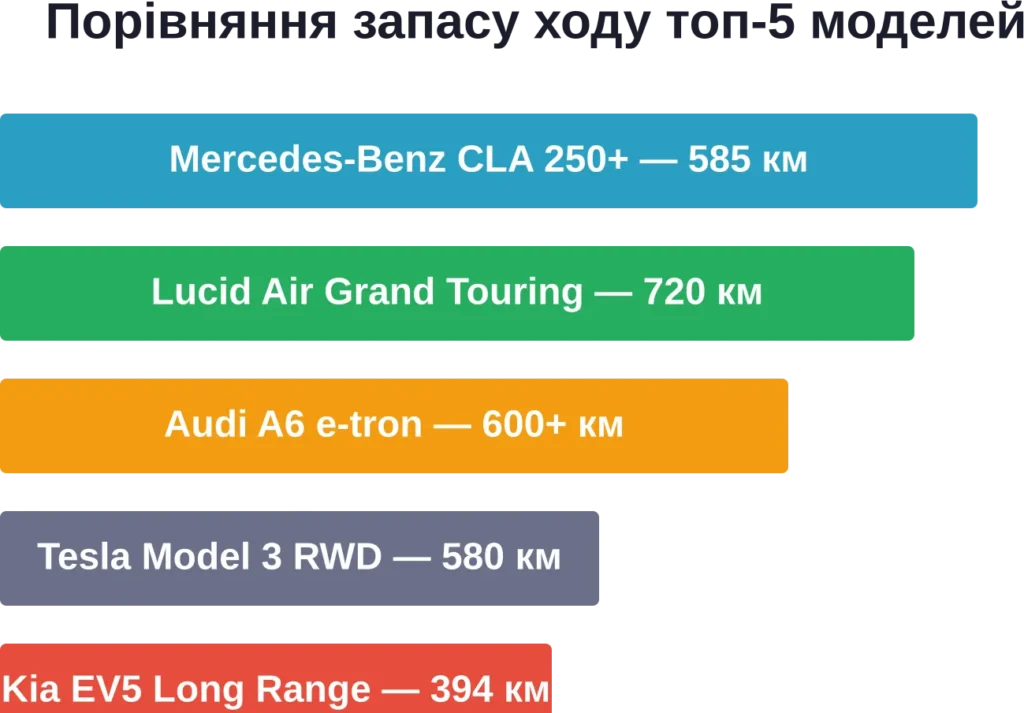
Mercedes-Benz CLA 250+ — 585 km in Real Conditions
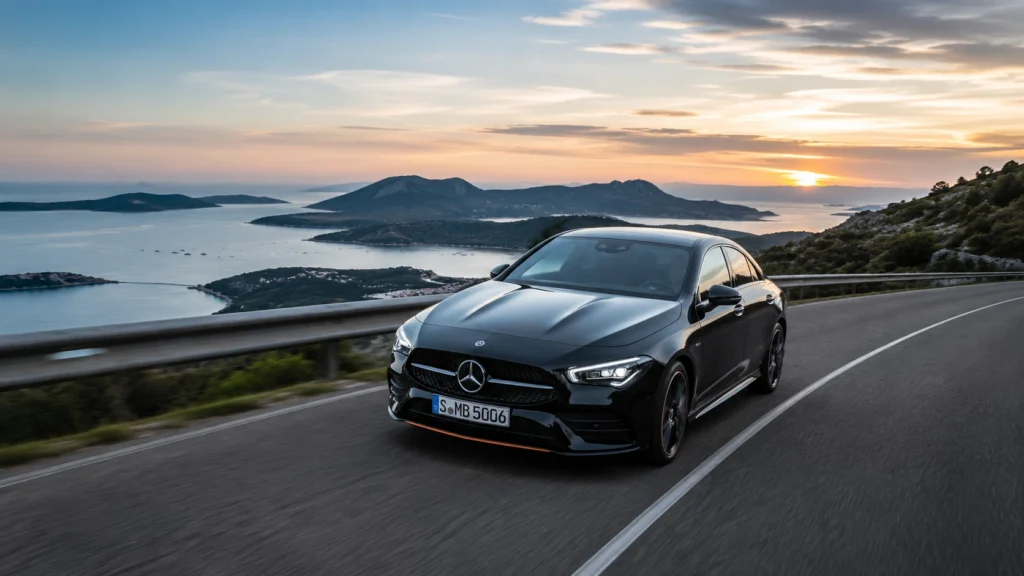
The Mercedes-Benz CLA 250+ provides over 750 km according to WLTP (and about 585-600+ km in real tests), making it one of the leaders in range among production electric vehicles available for order as of March 2026.
The battery is optimized for efficiency rather than charging speed. Mercedes focused on aerodynamics — the drag coefficient is only 0.20-0.21 Cd, which is a good indicator in the automotive industry.
Lucid Air Grand Touring — Up to 720 km
The American Lucid Air Grand Touring offers up to 720 km of range under optimal conditions thanks to a high-density battery. The company uses its own developed power cells that provide more energy with less weight.
This electric vehicle is aimed at the premium segment and competes with the Mercedes EQS. But range is not the only advantage. Lucid offers an 800-volt architecture with charging power up to 300 kW, allowing you to add 300 km of range in 20 minutes.
Audi A6 e-tron — Over 600 km
The Audi A6 e-tron supports fast charging with power up to 270 kW. This makes the model practical for intercity trips where access to fast stations is limited.
The Audi S6 e-tron (top version) offers up to 550 hp (with launch control) and 3.9 s acceleration. The A6 e-tron Performance version has 367 hp. The battery has a capacity of about 100 kWh (nominal), which guarantees a real range of over 600 km even in a mixed cycle with active driving.
Tesla Model 3 Premium RWD — 580 km
The Tesla Model 3 Premium RWD provides 580 km of range according to EV Database. The 79.0 kWh battery delivers high efficiency — one of the best figures in the segment.
Tesla offers fast charging with 250 kW power, allowing you to replenish the charge from 10% to 80% in about 30 minutes. The model is suitable for daily trips up to 400 km without the need for additional charging. With one 15-minute stop at a fast station, the total range increases to 325 miles (523 km).
Kia EV5 Long Range — 245 Miles (394 km)
The Kia EV5 81.4 kWh (MY26) is available to order from September 2025. Real range is 245 miles, efficiency is 318 Wh/mi. The 78.0 kWh (usable) battery provides a long-trip suitability rating of 2.5 out of 5.
The first leg without charging is 178 miles. With one 15-minute charge, the total range reaches 262 miles. Kia offers a 7-year battery warranty, which is average for the segment. The model price starts from £39,345 in the UK.
| Model | Battery (kWh) | Range (km) | Fast Charging | Efficiency |
|---|---|---|---|---|
| Mercedes-Benz CLA 250+ | — | 585 | — | High |
| Lucid Air GT | — | 720 | 300 kW | Very High |
| Audi A6 e-tron | 100.0 | 600+ | 270 kW | High |
| Tesla Model 3 Premium RWD | 60.0 | 580 | 250 kW | 218 Wh/mi |
| Kia EV5 Long Range | 78.0 | 394 | — | 318 Wh/mi |
Best Budget Models with Large Range
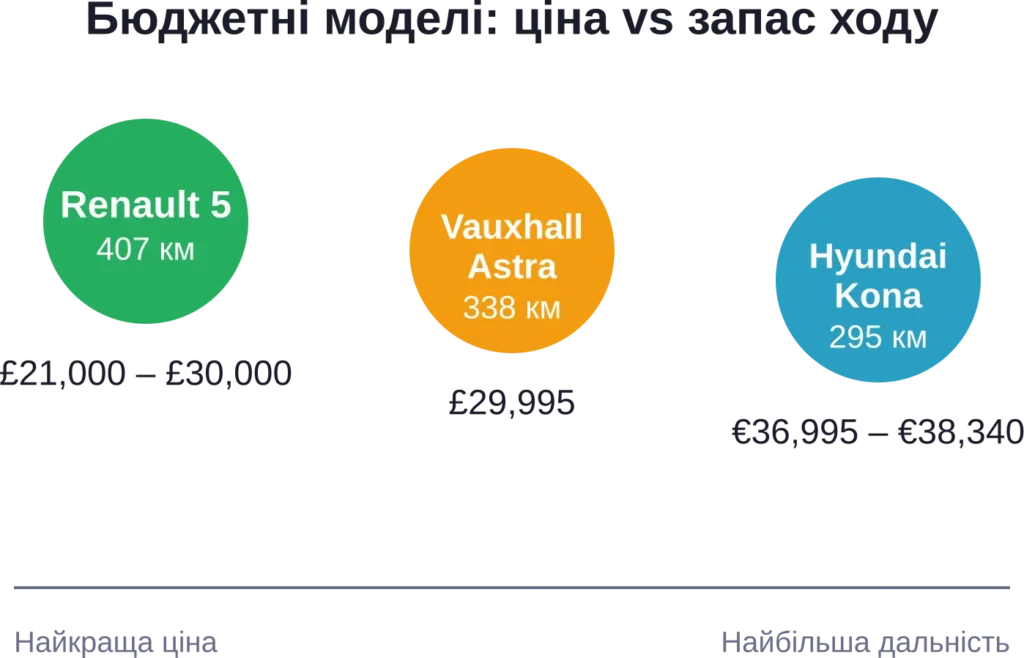
Not everyone is ready to spend over 100 thousand euros on an electric vehicle. In 2026, several affordable models appeared that offer a range of over 250 km for a price up to £30,000.
Renault 5 E-Tech — 253 Miles
The Renault 5 E-Tech with a 52 kWh battery provides about 250 miles of range according to What Car? tests. Peak charging speed is 100 kW, allowing the battery to be replenished from 10% to 80% in approximately 30 minutes.
Some Renault 5 modifications do not exceed £30,000. The initial Evolution version costs £21,000 including the government electric vehicle subsidy in the UK. Standard warranty is 3 years or 60,000 miles, battery warranty is 8 years.
This is the best offer for those looking for a stylish city electric car with sufficient range for weekend trips out of town. The only drawback is the waiting time — demand significantly exceeds supply.
Vauxhall Astra Electric 58 kWh — 210 Miles
The Vauxhall Astra Electric 58 kWh with a usable 55.4 kWh battery provides 210 miles of real range. Efficiency is 264 Wh/mi. Orders opened at the beginning of 2026.
The price starts from £29,995. The first leg without charging is 155 miles, with one 15-minute charge the total range increases to 224 miles. Long-trip suitability rating is 2 out of 5, making the model suitable mainly for regional trips rather than long journeys.
Hyundai Kona Electric 48.6 kWh — 295 km
The Hyundai Kona Electric 48.6 kWh has been available since January 2026 in the Netherlands and Germany. The battery provides 295 km of real range. Efficiency is 165 Wh/km, which is a very good figure for a compact crossover.
The price in the Netherlands is €36,995, in Germany — €38,340. Battery warranty is 8 years, architecture is 400V. The first leg without charging is 213 km, with one stop the total range reaches 291 km. Long-trip suitability is rated 1.5 out of 5 — the model is best suited for city and suburban use.
Factors Affecting Real Range
Official WLTP data often differs from real results. Temperature, driving style, highway speed, and climate control usage can reduce range by 20–50%.
Temperature and Heating
Consumer Reports testing shows that cold and heating can reduce range by 25–50%. Consumer Reports range tests are conducted in summer at temperatures between 70°F and 90°F, providing optimal conditions.
Pre-heating the cabin while connected to the charger helps preserve battery charge. This is especially relevant at –10°C, when range decreases by 20–30%.
Speed and Driving Style
Driving above 110 km/h sharply increases energy consumption due to air resistance. Smooth acceleration, regenerative braking, and maintaining moderate highway speed can increase real range by 15–25%.
Some Tesla models in Consumer Reports tests drove extra miles after the dashboard showed zero remaining range — this is a reserve buffer for emergencies. But it is better not to rely on this reserve and plan charging in advance.
Fast Charging: How to Reduce Waiting Time
Charging power has become a critical characteristic for intercity travel. Models with 270–300 kW support can add 300 km of range in 15–20 minutes. This brings the experience closer to refueling a gasoline car.
The Tesla Model 3 Premium RWD with 250 kW power requires about 30 minutes to charge from 10% to 80%. The Audi A6 e-tron with 270 kW does the same in less than 25 minutes. Lucid Air with 300 kW leads in speed — 20 minutes for 300 km.
It is important to understand that the declared power is only achieved in the optimal charge range (usually 10–50%). After 80%, charging speed drops sharply to protect the battery. That is why most drivers stop at 80% and continue their journey.

Choose Charging Infrastructure for Your Electric Vehicle
A range rating does not show how the car behaves every day — this is already a question of access to charging and how it is organized. ECOFACTOR works directly with this: helps select equipment, set up infrastructure, and solve energy issues for drivers and businesses. Through the mobile app for Android and iOS you can use the network and view the map of charging stations, while the online store allows you to immediately purchase accessories, cables, and mobile chargers without extra searching.
Choose Solutions That Meet Your Needs
Here is what else ECOFACTOR offers:
- Charging Station Configurator to select AC stations or DC stations
- Platform for Operators for managing the charging network
- Energy-Efficient Solutions for load and cost control
- White-Label Solution for launching your own charging network
Contact ECOFACTOR and choose a solution for your real operation.
Skoda Elroq — Best Overall Choice of 2026
British experts named the Skoda Elroq the best electric car of 2026 for its balance of characteristics. The model offers practical space, sufficient range for daily use, and a competitive price.
The Elroq is available with different batteries, but the recommended Long Range version provides about 400 km of real range. This is enough for most usage scenarios without frequent charging stops. Fast charging with about 135 kW power allows the battery to be replenished in 30 minutes.
Skoda offers excellent value for money, a spacious interior and trunk, and an intuitive infotainment system without unnecessary complexity. This makes the Elroq an ideal choice for families transitioning from a gasoline car to an electric one.
Conclusion: How to Choose an Electric Vehicle by Range
Choosing an electric vehicle in 2026 depends on real needs. For daily city trips, 250–350 km of range is sufficient. For regular intercity routes, it is worth considering models with 400–500 km of range and fast charging over 150 kW.
The best price-to-performance ratio is offered by the Renault 5 E-Tech (407 km for £21,000–£30,000), Kia EV5 (394 km for £39,345), and Tesla Model 3 Premium RWD (580 km). In the premium segment, the leaders are the Mercedes-Benz CLA 250+ (585 km), Lucid Air Grand Touring (720 km), and Audi A6 e-tron (over 600 km with the fastest charging).
Remember the impact of temperature, driving style, and speed on real range. Plan routes taking into account the availability of fast charging stations and always leave a 20% charge reserve for unforeseen situations. Check the manufacturers’ official websites for current prices and model availability in your region.